THE RUNNING FIX
COURSE OUTCOME
• CO2- Plot the ship’s position by dead
reckoning, running fix, bow and beam bearing
and lines of position taking into account the
effect of wind and current
1. Plotting a Running Fix
TOPIC/S
LEARNING OUTCOMES
• At the end of the session the students must
be able to:
12.1- apply running fix method in order to
determine the ship’s position;
12.2- apply set and drift to the running fix.
INTRODUCTION
• Under some circumstances such as low
visibility, only one line of position (LOP) can
be obtained at a time. In this event, a line of
position (LOP) obtained at an earlier time may
be advanced to the time of a later LOP. These
two LOP’s should not be parallel to each
other; remember that the optimal angular
spread is 90 degrees. The position obtained is
termed a “running fix because the ship has
“run” a certain distance during the time
interval between the two LOP’s.
• It is more commonly used when only one
object is available for bearings and there is no
means of measuring the range. In this case
there is a planned delay between bearings so
that the change in bearing will provide an
acceptable angle of cut.
RUNNING FIX
• When only one Navigational Aid is available
from which to obtain bearings, use a
technique known as THE RUNNING FIX.
METHODS IN OBTAINING A RUNNING FIX
1. Plot a bearing to a navigational aid (LOP1).
2. Plot a second bearing to a navigational aid
(either the same navigational aid or a
different one) at a later time (LOP2).
3. Advance LOP1 to the time when LOP2 was
taken.
4. The intersection of LOP2 and the advanced
LOP1 constitute the running fix.
ADVANCING A LINE OF POSITION (LOP)
• A ship proceeding on course 020 degrees,
speed 15 knots.
1505H- the plotter plots an LOP to a lighthouse
bearing 310 degrees ( the ship can be
at any point at this 1505H LOP.
1515H- course 020 degrees T
distance run 2.5nm
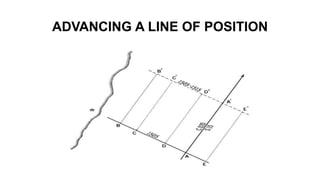
• Some possible points are represented as
points A, B, C, D, and E.
• If the ship was at A at 1505H, it will be at A’ at
1515H. However, if the position at 1505H was
B, the position at 1515H will be B’.
• A similar relationship exists between C and
C’, D and D’, E and E’.
ADVANCING A LINE OF POSITION
• Thus, if any point on the original LOP is
moved a distance equal to the distance run in
the direction of the motion, a line through this
point parallel to the original line of position
represents all possible positions of the ship at
the later time.
• This process is called “advancing” a line of
position.
• Moving a line back to an earlier time is called
retiring a line of position.
WHEN ADVANCING A LINE OF POSITION,
ACCOUNT FOR COURSE CHANGES,
SPEED CHANGES, AND SET AND DRIFT
BETWEEN THE TWO BEARING LINES.
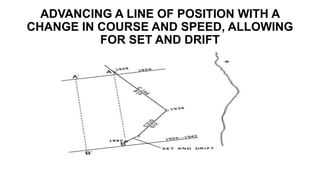
ADVANCING A LINE OF POSITION WITH A
CHANGE IN COURSE AND SPEED, ALLOWING
FOR SET AND DRIFT
1. To advance the 1924H LOP to 1942H, first
apply the best estimate of set and drift to
the 1942H DR position and label the
resulting position point B.
2. Measure the distance between the dead
reckoning position at 1924H (point A) and
point B.
3. Advance the LOP a distance equal to the
distance between points A and B.
NOTE: LOP A’B’ is in the same direction as line
AB
ADVANCING A CIRCLE OF POSITION
• Advance the navigational aids position on the
chart for the course and distance traveled by
the vessel and draw the line of position from
the navigational aids advanced position.
THIS IS THE MOST SATISFACTORY METHOD
FOR ADVANCING A CIRCLE OF POSITION
ADVANCING A LINE OF POSITION (LOP) BY
ITS RELATION TO THE DEAD RECKONING
1. To advance the 1505H LOP to 1527H, first
draw a correction line from the 1505H DR
position to the 1505H LOP.
2. Apply a set and drift correction to the
1527H estimated position (EP).
3. Draw from the 1527H EP a correction line of
the same length and direction as the one
drawn from the 1505H DR to the 1505H LOP
4. Finally, parallel the 1505H bearing to the
end of the correction line.
5. Label an advanced line of position with both
the time of observation and the time to
which the line is adjusted.
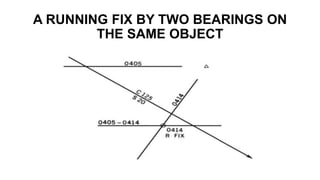
A RUNNING FIX BY TWO BEARINGS ON
THE SAME OBJECT
• Obtaining a running fix without changes of
course or speed between two bearings on the
same navigational aids.
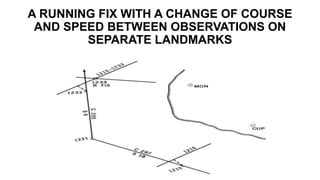
A RUNNING FIX WITH A CHANGE OF COURSE
AND SPEED BETWEEN OBSERVATIONS ON
SEPARATE LANDMARKS
• A running fix with changes in a vessel’s
course and speed between taking two
bearings on two different objects.
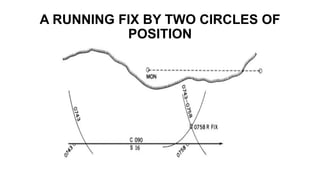
A RUNNING FIX BY TWO CIRCLES OF
POSITION
• A running fix obtained by advancing range
circles of position using the method of
advancing the navigational aids.
SUMMARY
• A running fix is a method of coastal
navigation fixing. It incorporates the use of
estimated position (EP) along with bearings
off of charted objects. Using bearings as well
as an EP makes this more accurate than an
EP alone.
THANK YOU…

S10-Plotting-a-Running-Fix.pptx

  • 1.
  • 2.
    COURSE OUTCOME • CO2-Plot the ship’s position by dead reckoning, running fix, bow and beam bearing and lines of position taking into account the effect of wind and current
  • 3.
    1. Plotting aRunning Fix TOPIC/S
  • 4.
    LEARNING OUTCOMES • Atthe end of the session the students must be able to: 12.1- apply running fix method in order to determine the ship’s position; 12.2- apply set and drift to the running fix.
  • 5.
    INTRODUCTION • Under somecircumstances such as low visibility, only one line of position (LOP) can be obtained at a time. In this event, a line of position (LOP) obtained at an earlier time may be advanced to the time of a later LOP. These two LOP’s should not be parallel to each other; remember that the optimal angular spread is 90 degrees. The position obtained is termed a “running fix because the ship has “run” a certain distance during the time interval between the two LOP’s.
  • 6.
    • It ismore commonly used when only one object is available for bearings and there is no means of measuring the range. In this case there is a planned delay between bearings so that the change in bearing will provide an acceptable angle of cut.
  • 7.
    RUNNING FIX • Whenonly one Navigational Aid is available from which to obtain bearings, use a technique known as THE RUNNING FIX.
  • 8.
    METHODS IN OBTAININGA RUNNING FIX 1. Plot a bearing to a navigational aid (LOP1). 2. Plot a second bearing to a navigational aid (either the same navigational aid or a different one) at a later time (LOP2). 3. Advance LOP1 to the time when LOP2 was taken. 4. The intersection of LOP2 and the advanced LOP1 constitute the running fix.
  • 9.
    ADVANCING A LINEOF POSITION (LOP) • A ship proceeding on course 020 degrees, speed 15 knots. 1505H- the plotter plots an LOP to a lighthouse bearing 310 degrees ( the ship can be at any point at this 1505H LOP. 1515H- course 020 degrees T distance run 2.5nm
  • 10.
    • Some possiblepoints are represented as points A, B, C, D, and E. • If the ship was at A at 1505H, it will be at A’ at 1515H. However, if the position at 1505H was B, the position at 1515H will be B’. • A similar relationship exists between C and C’, D and D’, E and E’.
  • 11.
    ADVANCING A LINEOF POSITION
  • 12.
    • Thus, ifany point on the original LOP is moved a distance equal to the distance run in the direction of the motion, a line through this point parallel to the original line of position represents all possible positions of the ship at the later time. • This process is called “advancing” a line of position. • Moving a line back to an earlier time is called retiring a line of position.
  • 13.
    WHEN ADVANCING ALINE OF POSITION, ACCOUNT FOR COURSE CHANGES, SPEED CHANGES, AND SET AND DRIFT BETWEEN THE TWO BEARING LINES.
  • 14.
    ADVANCING A LINEOF POSITION WITH A CHANGE IN COURSE AND SPEED, ALLOWING FOR SET AND DRIFT
  • 15.
    1. To advancethe 1924H LOP to 1942H, first apply the best estimate of set and drift to the 1942H DR position and label the resulting position point B. 2. Measure the distance between the dead reckoning position at 1924H (point A) and point B.
  • 16.
    3. Advance theLOP a distance equal to the distance between points A and B. NOTE: LOP A’B’ is in the same direction as line AB
  • 17.
    ADVANCING A CIRCLEOF POSITION
  • 18.
    • Advance thenavigational aids position on the chart for the course and distance traveled by the vessel and draw the line of position from the navigational aids advanced position. THIS IS THE MOST SATISFACTORY METHOD FOR ADVANCING A CIRCLE OF POSITION
  • 19.
    ADVANCING A LINEOF POSITION (LOP) BY ITS RELATION TO THE DEAD RECKONING
  • 20.
    1. To advancethe 1505H LOP to 1527H, first draw a correction line from the 1505H DR position to the 1505H LOP. 2. Apply a set and drift correction to the 1527H estimated position (EP). 3. Draw from the 1527H EP a correction line of the same length and direction as the one drawn from the 1505H DR to the 1505H LOP 4. Finally, parallel the 1505H bearing to the end of the correction line.
  • 21.
    5. Label anadvanced line of position with both the time of observation and the time to which the line is adjusted.
  • 22.
    A RUNNING FIXBY TWO BEARINGS ON THE SAME OBJECT
  • 23.
    • Obtaining arunning fix without changes of course or speed between two bearings on the same navigational aids.
  • 24.
    A RUNNING FIXWITH A CHANGE OF COURSE AND SPEED BETWEEN OBSERVATIONS ON SEPARATE LANDMARKS
  • 25.
    • A runningfix with changes in a vessel’s course and speed between taking two bearings on two different objects.
  • 26.
    A RUNNING FIXBY TWO CIRCLES OF POSITION
  • 27.
    • A runningfix obtained by advancing range circles of position using the method of advancing the navigational aids.
  • 28.
    SUMMARY • A runningfix is a method of coastal navigation fixing. It incorporates the use of estimated position (EP) along with bearings off of charted objects. Using bearings as well as an EP makes this more accurate than an EP alone.
  • 29.