Does your rank ordered or scaled 
skewed data have ties?
The question before you at this point is: 
“Are there ties among the rank ordered data I’m 
working with or not?”
The question before you at this point is: 
“Are there ties among the data I’m working with 
or not?”
Your options of course are:
Your options of course are: 
There are TIES 
There are NO TIES
Let’s consider an example:
You have been asked to determine if there is a 
relationship between gender and spelling bee 
competition rankings.
You have been asked to determine if there is a 
relationship between gender and spelling bee 
competition rankings. 
Marathon Runners Gender Spelling Bee Rank 
A 1 6th 
B 2 6th 
C 2 4th 
D 2 2nd 
E 1 7th 
F 1 1st 
G 2 3rd
You have been asked to determine if there is a 
relationship between gender and spelling bee 
competition rankings. 
Marathon Runners Gender Spelling Bee Rank 
A 1 6th 
B 2 6th 
C 2 4th 
D 2 2nd 
E 1 7th 
F 1 1st 
G 2 3rd 
Notice that 
these two 
runners 
have a tied 
ranking
When the rankings are tied you will use a 
statistical method called Kendall’s Tau.
When the rankings are tied you will use a 
statistical method called Kendall’s Tau. 
Spelling Bee Rank 
6th 
6th 
4th
When the rankings are tied you will use a 
statistical method called Kendall’s Tau. 
Spelling Bee Rank 
6th 
6th 
4th 
When the rankings are not tied you will use a 
statistical method called Spearman’s Rho. 
Spelling Bee Rank 
6th 
5th 
4th
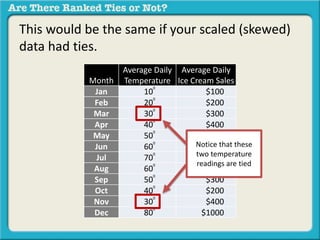
This would be the same if your scaled (skewed) 
data had ties.
This would be the same if your scaled (skewed) 
data had ties. 
Month 
Average Daily 
Temperature 
Average Daily 
Ice Cream Sales 
Jan 100 $100 
Feb 200 $200 
Mar 300 $300 
Apr 400 $400 
May 500 $500 
Jun 600 $300 
Jul 700 $200 
Aug 600 $100 
Sep 500 $300 
Oct 400 $200 
Nov 300 $400 
Dec 800 $1000 
Notice that these 
two temperature 
readings are tied
This would be the same if your scaled (skewed) 
data had ties. 
Month 
Average Daily 
Temperature 
Average Daily 
Ice Cream Sales 
Jan 100 $100 
Feb 200 $200 
Mar 300 $300 
Apr 400 $400 
May 500 $500 
Jun 600 $300 
Jul 700 $200 
Aug 600 $100 
Sep 500 $300 
Oct 400 $200 
Nov 300 $400 
Dec 800 $1000 
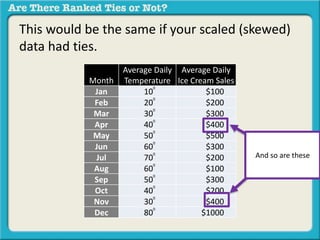
And these are tied 
as well
This would be the same if your scaled (skewed) 
data had ties. 
Month 
Average Daily 
Temperature 
Average Daily 
Ice Cream Sales 
Jan 100 $100 
Feb 200 $200 
Mar 300 $300 
Apr 400 $400 
May 500 $500 
Jun 600 $300 
Jul 700 $200 
Aug 600 $100 
Sep 500 $300 
Oct 400 $200 
Nov 300 $400 
Dec 800 $1000 
And these are tied 
as well
This would be the same if your scaled (skewed) 
data had ties. 
Month 
Average Daily 
Temperature 
Average Daily 
Ice Cream Sales 
Jan 100 $100 
Feb 200 $200 
Mar 300 $300 
Apr 400 $400 
May 500 $500 
Jun 600 $300 
Jul 700 $200 
Aug 600 $100 
Sep 500 $300 
Oct 400 $200 
Nov 300 $400 
Dec 800 $1000 
And so are these
Which option would be most appropriate for the 
data set you are working with: 
There are TIES 
There are NO TIES

Ties or No Ties

  • 1.
    Does your rankordered or scaled skewed data have ties?
  • 2.
    The question beforeyou at this point is: “Are there ties among the rank ordered data I’m working with or not?”
  • 3.
    The question beforeyou at this point is: “Are there ties among the data I’m working with or not?”
  • 4.
    Your options ofcourse are:
  • 5.
    Your options ofcourse are: There are TIES There are NO TIES
  • 6.
  • 7.
    You have beenasked to determine if there is a relationship between gender and spelling bee competition rankings.
  • 8.
    You have beenasked to determine if there is a relationship between gender and spelling bee competition rankings. Marathon Runners Gender Spelling Bee Rank A 1 6th B 2 6th C 2 4th D 2 2nd E 1 7th F 1 1st G 2 3rd
  • 9.
    You have beenasked to determine if there is a relationship between gender and spelling bee competition rankings. Marathon Runners Gender Spelling Bee Rank A 1 6th B 2 6th C 2 4th D 2 2nd E 1 7th F 1 1st G 2 3rd Notice that these two runners have a tied ranking
  • 10.
    When the rankingsare tied you will use a statistical method called Kendall’s Tau.
  • 11.
    When the rankingsare tied you will use a statistical method called Kendall’s Tau. Spelling Bee Rank 6th 6th 4th
  • 12.
    When the rankingsare tied you will use a statistical method called Kendall’s Tau. Spelling Bee Rank 6th 6th 4th When the rankings are not tied you will use a statistical method called Spearman’s Rho. Spelling Bee Rank 6th 5th 4th
  • 13.
    This would bethe same if your scaled (skewed) data had ties.
  • 14.
    This would bethe same if your scaled (skewed) data had ties. Month Average Daily Temperature Average Daily Ice Cream Sales Jan 100 $100 Feb 200 $200 Mar 300 $300 Apr 400 $400 May 500 $500 Jun 600 $300 Jul 700 $200 Aug 600 $100 Sep 500 $300 Oct 400 $200 Nov 300 $400 Dec 800 $1000 Notice that these two temperature readings are tied
  • 15.
    This would bethe same if your scaled (skewed) data had ties. Month Average Daily Temperature Average Daily Ice Cream Sales Jan 100 $100 Feb 200 $200 Mar 300 $300 Apr 400 $400 May 500 $500 Jun 600 $300 Jul 700 $200 Aug 600 $100 Sep 500 $300 Oct 400 $200 Nov 300 $400 Dec 800 $1000 And these are tied as well
  • 16.
    This would bethe same if your scaled (skewed) data had ties. Month Average Daily Temperature Average Daily Ice Cream Sales Jan 100 $100 Feb 200 $200 Mar 300 $300 Apr 400 $400 May 500 $500 Jun 600 $300 Jul 700 $200 Aug 600 $100 Sep 500 $300 Oct 400 $200 Nov 300 $400 Dec 800 $1000 And these are tied as well
  • 17.
    This would bethe same if your scaled (skewed) data had ties. Month Average Daily Temperature Average Daily Ice Cream Sales Jan 100 $100 Feb 200 $200 Mar 300 $300 Apr 400 $400 May 500 $500 Jun 600 $300 Jul 700 $200 Aug 600 $100 Sep 500 $300 Oct 400 $200 Nov 300 $400 Dec 800 $1000 And so are these
  • 18.
    Which option wouldbe most appropriate for the data set you are working with: There are TIES There are NO TIES

Editor's Notes

  • #3 The question before you at this point is - are there ties among the rank ordered data you are working or not? Show example of two data sets. When dealing with ordinal by ordinal variables without any ties, you will use a Spearman's Rho Rank (?) If there are ties you will use a Kendall Tau (show data set) Based on the question or problem you are working with, which option would be most appropriate to choose? -There are ties among the ranks -There are no ties among the ranks
  • #4 The question before you at this point is - are there ties among the rank ordered data you are working or not? Show example of two data sets. When dealing with ordinal by ordinal variables without any ties, you will use a Spearman's Rho Rank (?) If there are ties you will use a Kendall Tau (show data set) Based on the question or problem you are working with, which option would be most appropriate to choose? -There are ties among the ranks -There are no ties among the ranks
  • #5 The question before you at this point is - are there ties among the rank ordered data you are working or not? Show example of two data sets. When dealing with ordinal by ordinal variables without any ties, you will use a Spearman's Rho Rank (?) If there are ties you will use a Kendall Tau (show data set) Based on the question or problem you are working with, which option would be most appropriate to choose? -There are ties among the ranks -There are no ties among the ranks
  • #6 The question before you at this point is - are there ties among the rank ordered data you are working or not? Show example of two data sets. When dealing with ordinal by ordinal variables without any ties, you will use a Spearman's Rho Rank (?) If there are ties you will use a Kendall Tau (show data set) Based on the question or problem you are working with, which option would be most appropriate to choose? -There are ties among the ranks -There are no ties among the ranks
  • #7 The question before you at this point is - are there ties among the rank ordered data you are working or not? Show example of two data sets. When dealing with ordinal by ordinal variables without any ties, you will use a Spearman's Rho Rank (?) If there are ties you will use a Kendall Tau (show data set) Based on the question or problem you are working with, which option would be most appropriate to choose? -There are ties among the ranks -There are no ties among the ranks
  • #8  When dealing with ordinal by ordinal variables without any ties, you will use a Spearman's Rho Rank (?) If there are ties you will use a Kendall Tau (show data set) Based on the question or problem you are working with, which option would be most appropriate to choose? -There are ties among the ranks -There are no ties among the ranks
  • #9  When dealing with ordinal by ordinal variables without any ties, you will use a Spearman's Rho Rank (?) If there are ties you will use a Kendall Tau (show data set) Based on the question or problem you are working with, which option would be most appropriate to choose? -There are ties among the ranks -There are no ties among the ranks
  • #10  When dealing with ordinal by ordinal variables without any ties, you will use a Spearman's Rho Rank (?) If there are ties you will use a Kendall Tau (show data set) Based on the question or problem you are working with, which option would be most appropriate to choose? -There are ties among the ranks -There are no ties among the ranks
  • #11  When dealing with ordinal by ordinal variables without any ties, you will use a Spearman's Rho Rank (?) If there are ties you will use a Kendall Tau (show data set) Based on the question or problem you are working with, which option would be most appropriate to choose? -There are ties among the ranks -There are no ties among the ranks
  • #12  When dealing with ordinal by ordinal variables without any ties, you will use a Spearman's Rho Rank (?) If there are ties you will use a Kendall Tau (show data set) Based on the question or problem you are working with, which option would be most appropriate to choose? -There are ties among the ranks -There are no ties among the ranks
  • #13  When dealing with ordinal by ordinal variables without any ties, you will use a Spearman's Rho Rank (?) If there are ties you will use a Kendall Tau (show data set) Based on the question or problem you are working with, which option would be most appropriate to choose? -There are ties among the ranks -There are no ties among the ranks
  • #14  When dealing with ordinal by ordinal variables without any ties, you will use a Spearman's Rho Rank (?) If there are ties you will use a Kendall Tau (show data set) Based on the question or problem you are working with, which option would be most appropriate to choose? -There are ties among the ranks -There are no ties among the ranks
  • #15  When dealing with ordinal by ordinal variables without any ties, you will use a Spearman's Rho Rank (?) If there are ties you will use a Kendall Tau (show data set) Based on the question or problem you are working with, which option would be most appropriate to choose? -There are ties among the ranks -There are no ties among the ranks
  • #16  When dealing with ordinal by ordinal variables without any ties, you will use a Spearman's Rho Rank (?) If there are ties you will use a Kendall Tau (show data set) Based on the question or problem you are working with, which option would be most appropriate to choose? -There are ties among the ranks -There are no ties among the ranks
  • #17  When dealing with ordinal by ordinal variables without any ties, you will use a Spearman's Rho Rank (?) If there are ties you will use a Kendall Tau (show data set) Based on the question or problem you are working with, which option would be most appropriate to choose? -There are ties among the ranks -There are no ties among the ranks
  • #18  When dealing with ordinal by ordinal variables without any ties, you will use a Spearman's Rho Rank (?) If there are ties you will use a Kendall Tau (show data set) Based on the question or problem you are working with, which option would be most appropriate to choose? -There are ties among the ranks -There are no ties among the ranks