

You will now determine the number of levels there are in 
the problem you are working on.
Your options will be:
Your options will be: 
Two Levels 
Three or More Levels
Levels mean the number of conditions within an 
independent variable.
Why are levels important in statistics? 
As you will see, the number of levels of the independent 
variable will determine the type of statistical analysis 
method we use!
As you will see, the number of levels of the independent 
variable will determine the type of statistical method you 
will use!
You will now see illustrations of what we mean by the 
concept of “levels” or “number of conditions within an 
independent variable”
Consider the following research question:
A researcher wants to analyze if there are 
statistically significant differences among religious 
groups (Catholics, Buddhists, & Muslims) in terms 
of public religious devotion.
First, let’s identify the dependent and independent 
variables.
The dependent variable is:
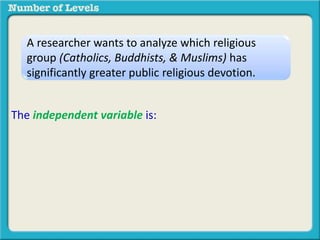
A researcher wants to analyze which religious 
group (Catholics, Buddhists, & Muslims) has 
significantly greater public religious devotion. 
The dependent variable is:
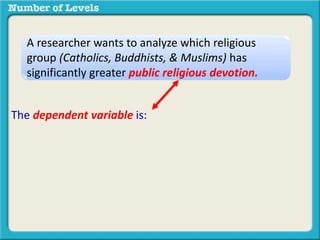
A researcher wants to analyze which religious 
group (Catholics, Buddhists, & Muslims) has 
significantly greater public religious devotion. 
The dependent variable is:
The independent variable is:
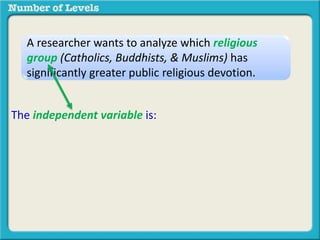
A researcher wants to analyze which religious 
group (Catholics, Buddhists, & Muslims) has 
significantly greater public religious devotion. 
The independent variable is:
A researcher wants to analyze which religious 
group (Catholics, Buddhists, & Muslims) has 
significantly greater public religious devotion. 
The independent variable is:
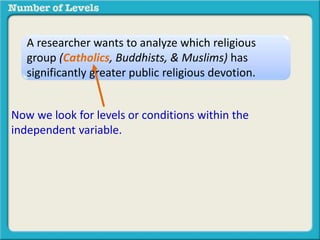
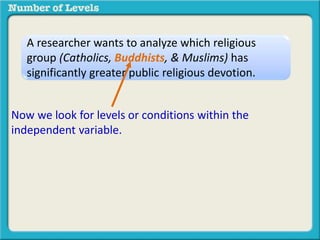
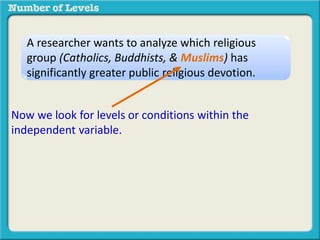
Now we look for levels or conditions within the 
independent variable.
A researcher wants to analyze which religious 
group (Catholics, Buddhists, & Muslims) has 
significantly greater public religious devotion. 
Now we look for levels or conditions within the 
independent variable.
A researcher wants to analyze which religious 
group (Catholics, Buddhists, & Muslims) has 
significantly greater public religious devotion. 
Now we look for levels or conditions within the 
independent variable.
A researcher wants to analyze which religious 
group (Catholics, Buddhists, & Muslims) has 
significantly greater public religious devotion. 
Now we look for levels or conditions within the 
independent variable.
A researcher wants to analyze which religious 
group (Catholics, Buddhists, & Muslims) has 
significantly greater public religious devotion. 
Now we look for levels or conditions within the 
independent variable.
A researcher wants to analyze which religious 
group (Catholics, Buddhists, & Muslims) has 
significantly greater public religious devotion. 
Now we look for levels or conditions within the 
independent variable.
A researcher wants to analyze which religious 
group (Catholics, Buddhists, & Muslims) has 
significantly greater public religious devotion. 
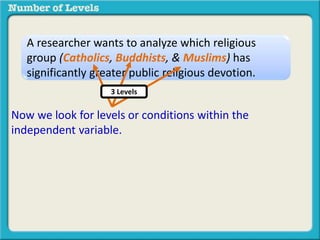
3 Levels 
Now we look for levels or conditions within the 
independent variable.
A researcher wants to analyze which religious 
group (Catholics, Buddhists, & Muslims) has 
significantly greater public religious devotion. 
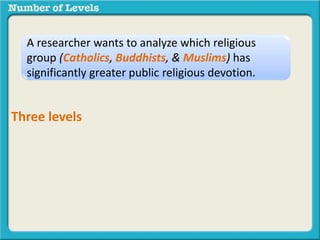
Three levels
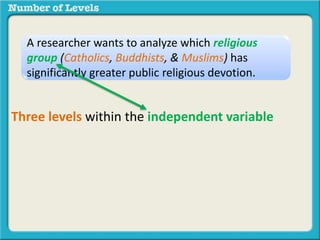
A researcher wants to analyze which religious 
group (Catholics, Buddhists, & Muslims) has 
significantly greater public religious devotion. 
Three levels within the independent variable
So the number of levels would be:
So the number of levels would be: 
Two Levels 
Three or More Levels
Here is another study
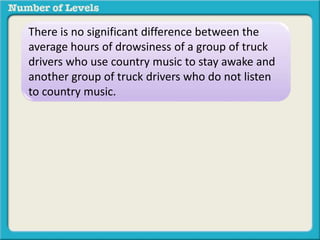
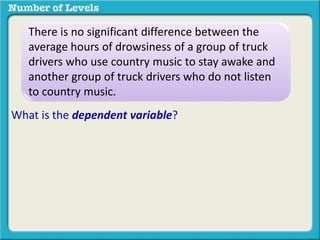
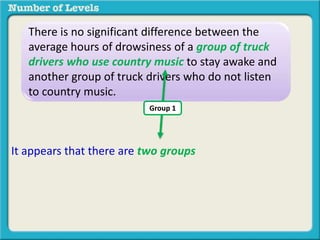
There is no significant difference between the 
average hours of drowsiness of a group of truck 
drivers who use country music to stay awake and 
another group of truck drivers who do not listen 
to country music.
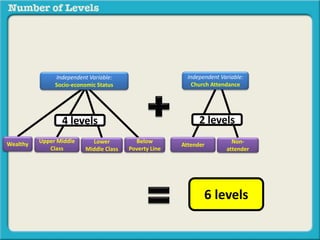
What is the dependent variable?
There is no significant difference between the 
average hours of drowsiness of a group of truck 
drivers who use country music to stay awake and 
another group of truck drivers who do not listen 
to country music. 
What is the dependent variable?
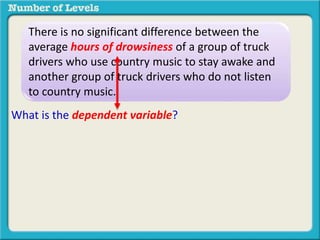
There is no significant difference between the 
average hours of drowsiness of a group of truck 
drivers who use country music to stay awake and 
another group of truck drivers who do not listen 
to country music. 
What is the dependent variable?
What is the independent variable?
There is no significant difference between the 
average hours of drowsiness of a group of truck 
drivers who use country music to stay awake and 
another group of truck drivers who do not listen 
to country music. 
What is the independent variable?
There is no significant difference between the 
average hours of drowsiness of a group of truck 
drivers who use country music to stay awake and 
another group of truck drivers who do not listen 
to country music. 
Actually, the independent variable is not stated.
There is no significant difference between the 
average hours of drowsiness of a group of truck 
drivers who use country music to stay awake and 
another group of truck drivers who do not listen 
to country music. 
But, we can determine the independent variable by 
looking at the groups.
There is no significant difference between the 
average hours of drowsiness of a group of truck 
drivers who use country music to stay awake and 
another group of truck drivers who do not listen 
to country music. 
It appears that there are two groups
There is no significant difference between the 
average hours of drowsiness of a group of truck 
drivers who use country music to stay awake and 
another group of truck drivers who do not listen 
to country music. 
Group 1 
It appears that there are two groups
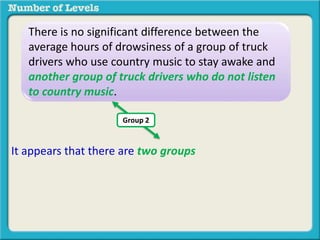
There is no significant difference between the 
average hours of drowsiness of a group of truck 
drivers who use country music to stay awake and 
another group of truck drivers who do not listen 
to country music. 
Group 2 
It appears that there are two groups
So what is the difference between these two groups?
So what is the difference between these two groups? 
- One group listens to country music
So what is the difference between these two groups? 
- One group listens to country music 
- The other group does not listen to country music
So what is the difference between these two groups? 
- One group listens to country music 
- The other group does not listen to country music 
An independent variable simply provides a description of 
these two groups.
So what is the difference between these two groups? 
- One group listens to country music 
- The other group does not listen to country music 
In this case: Country Music Listening
So, let’s go back to the problem
There is no significant difference between the 
average hours of drowsiness of a group of truck 
drivers who use country music to stay awake and 
another group of truck drivers who do not listen 
to country music. 
Now we know that the independent variable is country 
music listening.
There is no significant difference between the 
average hours of drowsiness of a group of truck 
drivers who use country music to stay awake and 
another group of truck drivers who do not listen 
to country music. 
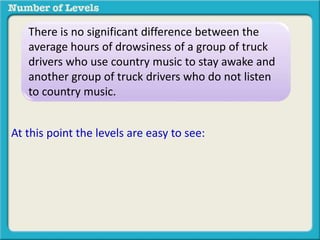
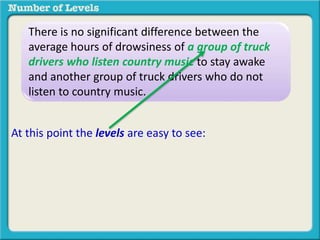
At this point the levels are easy to see:
There is no significant difference between the 
average hours of drowsiness of a group of truck 
drivers who listen country music to stay awake 
and another group of truck drivers who do not 
listen to country music. 
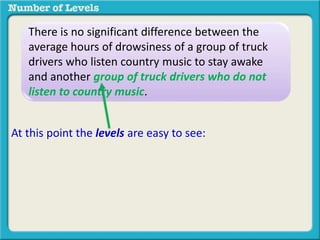
At this point the levels are easy to see:
There is no significant difference between the 
average hours of drowsiness of a group of truck 
drivers who listen country music to stay awake 
and another group of truck drivers who do not 
listen to country music. 
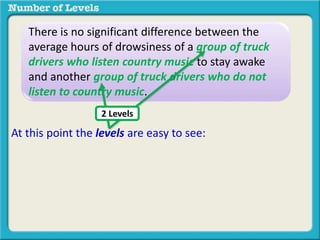
At this point the levels are easy to see:
There is no significant difference between the 
average hours of drowsiness of a group of truck 
drivers who listen country music to stay awake 
and another group of truck drivers who do not 
listen to country music. 
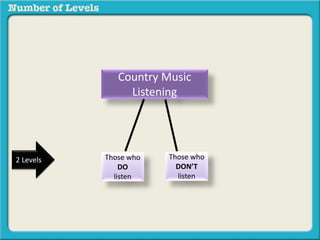
2 Levels 
At this point the levels are easy to see:
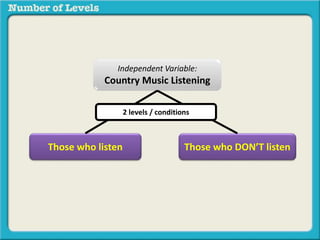
Here is a way to visualize this:
Independent Variable: 
Country Music Listening
Independent Variable: 
Country Music Listening 
2 levels / conditions 
Those who listen Those who DON’T listen
So the number of levels would be:
So the number of levels would be: 
Two Levels 
Three or More Levels
Sometimes there will be two independent variables.
Each independent variable will have it’s own levels.
Let’s see an example:
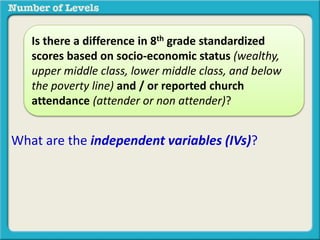
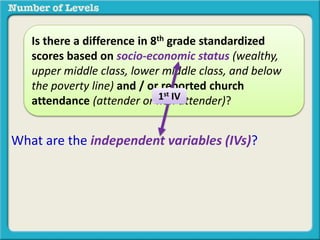
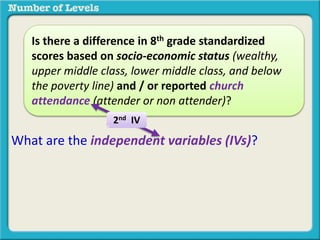
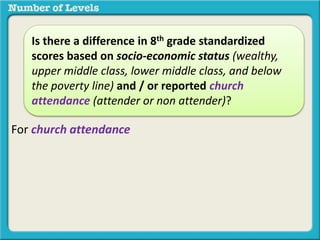
Is there a difference in 8th grade standardized 
scores based on socio-economic status (wealthy, 
upper middle class, lower middle class, and below 
the poverty line) and / or reported church 
attendance (attender or non attender)?
What is the dependent variable?
Is there a difference in 8th grade standardized 
scores based on socio-economic status (wealthy, 
upper middle class, lower middle class, and below 
the poverty line) and / or reported church 
attendance (attender or non attender)? 
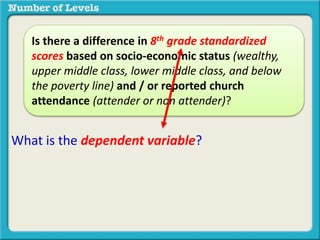
What is the dependent variable?
Is there a difference in 8th grade standardized 
scores based on socio-economic status (wealthy, 
upper middle class, lower middle class, and below 
the poverty line) and / or reported church 
attendance (attender or non attender)? 
What is the dependent variable?
What are the independent variables (IVs)?
Is there a difference in 8th grade standardized 
scores based on socio-economic status (wealthy, 
upper middle class, lower middle class, and below 
the poverty line) and / or reported church 
attendance (attender or non attender)? 
What are the independent variables (IVs)?
Is there a difference in 8th grade standardized 
scores based on socio-economic status (wealthy, 
upper middle class, lower middle class, and below 
the poverty line) and / or reported church 
attendance (attender or n1on attender)? st IV 
What are the independent variables (IVs)?
Is there a difference in 8th grade standardized 
scores based on socio-economic status (wealthy, 
upper middle class, lower middle class, and below 
the poverty line) and / or reported church 
attendance (attender or non attender)? 
2nd IV 
What are the independent variables (IVs)?
What are the Levels?
Is there a difference in 8th grade standardized 
scores based on socio-economic status (wealthy, 
upper middle class, lower middle class, and below 
the poverty line) and / or reported church 
attendance (attender or non attender)? 
What are the Levels?
Is there a difference in 8th grade standardized 
scores based on socio-economic status (wealthy, 
upper middle class, lower middle class, and below 
the poverty line) and / or reported church 
attendance (attender or non attender)? 
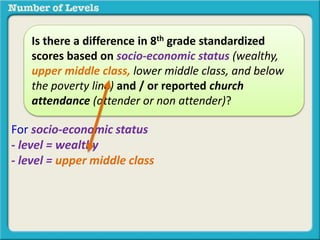
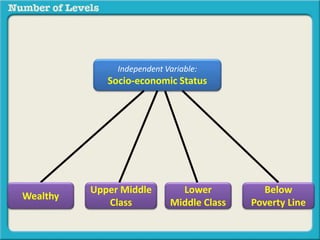
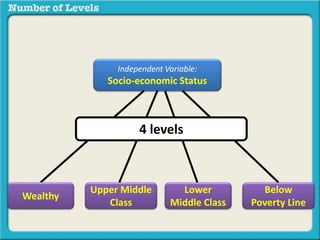
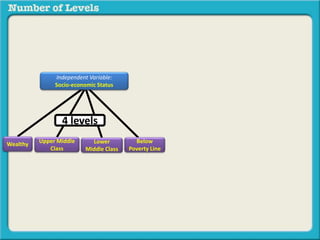
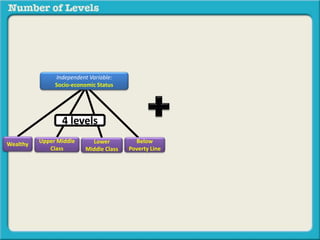
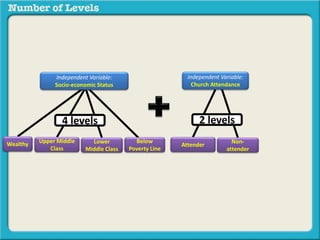
For socio-economic status 
- level 1 = wealthy 
- level 2 = upper middle class 
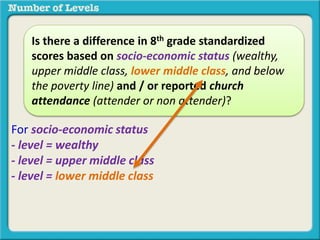
- level 3 = lower middle class 
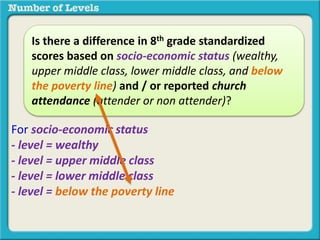
- level 4 = below the poverty line
Is there a difference in 8th grade standardized 
scores based on socio-economic status (wealthy, 
upper middle class, lower middle class, and below 
the poverty line) and / or reported church 
attendance (attender or non attender)? 
For socio-economic status 
- level = wealthy 
- level 2 = upper middle class 
- level 3 = lower middle class 
- level 4 = below the poverty line
Is there a difference in 8th grade standardized 
scores based on socio-economic status (wealthy, 
upper middle class, lower middle class, and below 
the poverty line) and / or reported church 
attendance (attender or non attender)? 
For socio-economic status 
- level = wealthy 
- level = upper middle class 
- level 3 = lower middle class 
- level 4 = below the poverty line
Is there a difference in 8th grade standardized 
scores based on socio-economic status (wealthy, 
upper middle class, lower middle class, and below 
the poverty line) and / or reported church 
attendance (attender or non attender)? 
For socio-economic status 
- level = wealthy 
- level = upper middle class 
- level = lower middle class 
- level 4 = below the poverty line
Is there a difference in 8th grade standardized 
scores based on socio-economic status (wealthy, 
upper middle class, lower middle class, and below 
the poverty line) and / or reported church 
attendance (attender or non attender)? 
For socio-economic status 
- level = wealthy 
- level = upper middle class 
- level = lower middle class 
- level = below the poverty line
Is there a difference in 8th grade standardized 
scores based on socio-economic status (wealthy, 
upper middle class, lower middle class, and below 
the poverty line) and / or reported church 
attendance (attender or non attender)? 
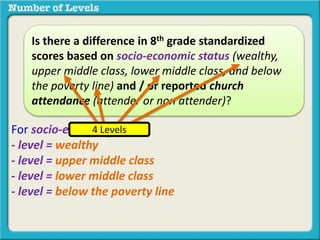
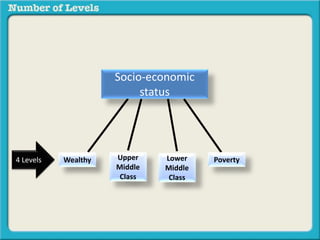
For socio-economic 4 Levels 
status 
- level = wealthy 
- level = upper middle class 
- level = lower middle class 
- level = below the poverty line
Is there a difference in 8th grade standardized 
scores based on socio-economic status (wealthy, 
upper middle class, lower middle class, and below 
the poverty line) and / or reported church 
attendance (attender or non attender)? 
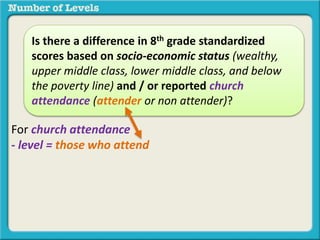
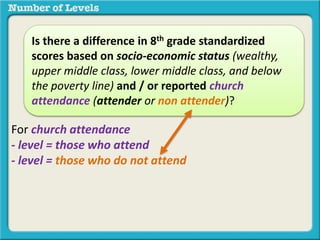
For church attendance 
- level 1 = those who attend 
- level 2 = those who do not attend 
- level 3 = lower middle class 
- level 4 = below the poverty line
Is there a difference in 8th grade standardized 
scores based on socio-economic status (wealthy, 
upper middle class, lower middle class, and below 
the poverty line) and / or reported church 
attendance (attender or non attender)? 
For church attendance 
- level = those who attend 
- level 2 = those who do not attend 
- level 3 = lower middle class 
- level 4 = below the poverty line
Is there a difference in 8th grade standardized 
scores based on socio-economic status (wealthy, 
upper middle class, lower middle class, and below 
the poverty line) and / or reported church 
attendance (attender or non attender)? 
For church attendance 
- level = those who attend 
- level = those who do not attend 
- level 3 = lower middle class 
- level 4 = below the poverty line
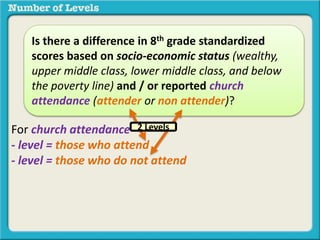
Is there a difference in 8th grade standardized 
scores based on socio-economic status (wealthy, 
upper middle class, lower middle class, and below 
the poverty line) and / or reported church 
attendance (attender or non attender)? 
2 Levels 
For church attendance 
- level = those who attend 
- level = those who do not attend 
- level 3 = lower middle class 
- level 4 = below the poverty line
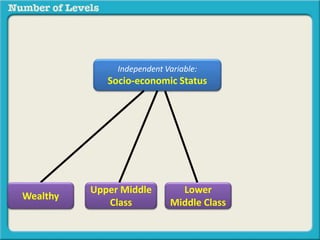
Let’s see this visually:
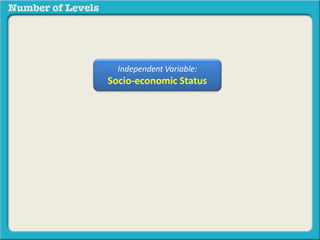
Independent Variable: 
Socio-economic Status
Independent Variable: 
Socio-economic Status 
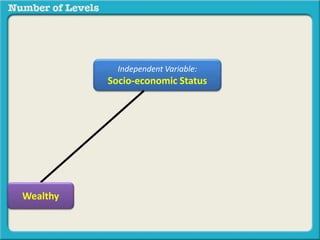
Wealthy
Independent Variable: 
Socio-economic Status 
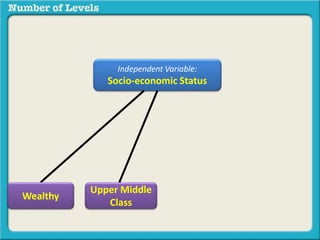
Upper Middle 
Class 
Wealthy
Independent Variable: 
Socio-economic Status 
Upper Middle 
Class 
Wealthy 
Lower 
Middle Class
Independent Variable: 
Socio-economic Status 
Upper Middle 
Class 
Wealthy 
Below 
Poverty Line 
Lower 
Middle Class
Independent Variable: 
Socio-economic Status 
4 levels 
Upper Middle 
Class 
Wealthy 
Below 
Poverty Line 
Lower 
Middle Class
Next Independent Variable:
Independent Variable: 
Church Attendance
Independent Variable: 
Church Attendance 
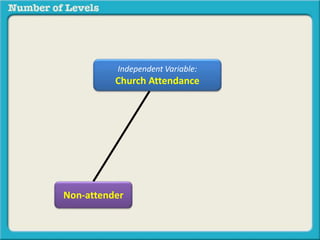
Non-attender
Independent Variable: 
Church Attendance 
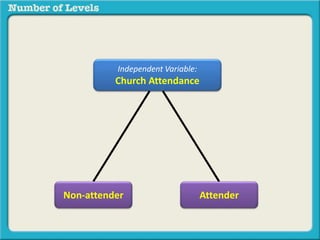
Non-attender Attender
Independent Variable: 
Church Attendance 
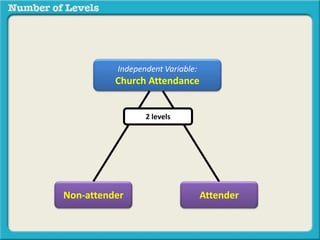
2 levels 
Non-attender Attender
So the number of levels would be:
Independent Variable: 
Socio-economic Status 
4 levels 
Upper Middle 
Wealthy Below 
Class 
Poverty Line 
Lower 
Middle Class
Independent Variable: 
Socio-economic Status 
4 levels 
Upper Middle 
Wealthy Below 
Class 
Poverty Line 
Lower 
Middle Class
Independent Variable: 
Socio-economic Status 
4 levels 
Upper Middle 
Wealthy Below 
Class 
Poverty Line 
Lower 
Middle Class 
Independent Variable: 
Church Attendance 
2 levels 
Attender 
Non-attender
Independent Variable: 
Socio-economic Status 
4 levels 
Upper Middle 
Wealthy Below 
Class 
Poverty Line 
Lower 
Middle Class 
Independent Variable: 
Church Attendance 
2 levels 
Attender 
Non-attender 
6 levels
So the number of levels would be: 
Two Levels 
Three or More Levels
In Summary:
Levels simply mean the number of conditions within an 
independent variable.
Here are a number of visual examples
Independent 
Variable
Socio-economic 
status 
Independent 
Variable
Levels 
Socio-economic 
status
Socio-economic 
Wealthy Upper 
status 
Middle 
Class 
Lower 
Middle 
Class 
4 Levels Poverty
Independent 
Variable
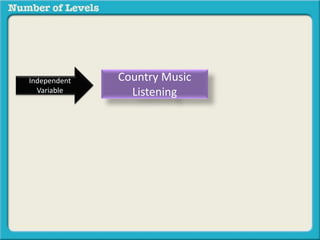
Country Music 
Listening 
Independent 
Variable
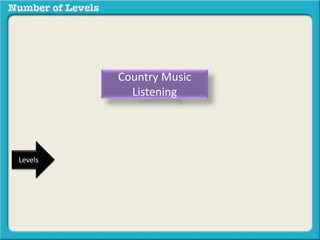
Levels 
Country Music 
Listening
Those who 
DO 
listen 
Those who 
DON’T 
listen 
2 Levels 
Country Music 
Listening
Independent 
Variable
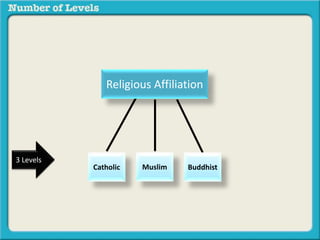
Independent Religious Affiliation 
Variable
Levels 
Religious Affiliation
Catholic Muslim Buddhist 
3 Levels 
Religious Affiliation
Independent 
Variable
Independent 
Variable Gender
Levels 
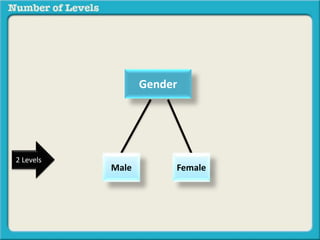
Gender
Male Female 
2 Levels 
Gender
How many levels does the problem you are working on 
have?
How many levels does the problem you are working on 
have? 
Two Levels 
Three or More Levels

How many levels?

  • 1.
    You will nowdetermine the number of levels there are in the problem you are working on.
  • 2.
  • 3.
    Your options willbe: Two Levels Three or More Levels
  • 4.
    Levels mean thenumber of conditions within an independent variable.
  • 5.
    Why are levelsimportant in statistics? As you will see, the number of levels of the independent variable will determine the type of statistical analysis method we use!
  • 6.
    As you willsee, the number of levels of the independent variable will determine the type of statistical method you will use!
  • 7.
    You will nowsee illustrations of what we mean by the concept of “levels” or “number of conditions within an independent variable”
  • 8.
    Consider the followingresearch question:
  • 9.
    A researcher wantsto analyze if there are statistically significant differences among religious groups (Catholics, Buddhists, & Muslims) in terms of public religious devotion.
  • 10.
    First, let’s identifythe dependent and independent variables.
  • 11.
  • 12.
    A researcher wantsto analyze which religious group (Catholics, Buddhists, & Muslims) has significantly greater public religious devotion. The dependent variable is:
  • 13.
    A researcher wantsto analyze which religious group (Catholics, Buddhists, & Muslims) has significantly greater public religious devotion. The dependent variable is:
  • 14.
  • 15.
    A researcher wantsto analyze which religious group (Catholics, Buddhists, & Muslims) has significantly greater public religious devotion. The independent variable is:
  • 16.
    A researcher wantsto analyze which religious group (Catholics, Buddhists, & Muslims) has significantly greater public religious devotion. The independent variable is:
  • 17.
    Now we lookfor levels or conditions within the independent variable.
  • 18.
    A researcher wantsto analyze which religious group (Catholics, Buddhists, & Muslims) has significantly greater public religious devotion. Now we look for levels or conditions within the independent variable.
  • 19.
    A researcher wantsto analyze which religious group (Catholics, Buddhists, & Muslims) has significantly greater public religious devotion. Now we look for levels or conditions within the independent variable.
  • 20.
    A researcher wantsto analyze which religious group (Catholics, Buddhists, & Muslims) has significantly greater public religious devotion. Now we look for levels or conditions within the independent variable.
  • 21.
    A researcher wantsto analyze which religious group (Catholics, Buddhists, & Muslims) has significantly greater public religious devotion. Now we look for levels or conditions within the independent variable.
  • 22.
    A researcher wantsto analyze which religious group (Catholics, Buddhists, & Muslims) has significantly greater public religious devotion. Now we look for levels or conditions within the independent variable.
  • 23.
    A researcher wantsto analyze which religious group (Catholics, Buddhists, & Muslims) has significantly greater public religious devotion. 3 Levels Now we look for levels or conditions within the independent variable.
  • 24.
    A researcher wantsto analyze which religious group (Catholics, Buddhists, & Muslims) has significantly greater public religious devotion. Three levels
  • 25.
    A researcher wantsto analyze which religious group (Catholics, Buddhists, & Muslims) has significantly greater public religious devotion. Three levels within the independent variable
  • 26.
    So the numberof levels would be:
  • 27.
    So the numberof levels would be: Two Levels Three or More Levels
  • 28.
  • 29.
    There is nosignificant difference between the average hours of drowsiness of a group of truck drivers who use country music to stay awake and another group of truck drivers who do not listen to country music.
  • 30.
    What is thedependent variable?
  • 31.
    There is nosignificant difference between the average hours of drowsiness of a group of truck drivers who use country music to stay awake and another group of truck drivers who do not listen to country music. What is the dependent variable?
  • 32.
    There is nosignificant difference between the average hours of drowsiness of a group of truck drivers who use country music to stay awake and another group of truck drivers who do not listen to country music. What is the dependent variable?
  • 33.
    What is theindependent variable?
  • 34.
    There is nosignificant difference between the average hours of drowsiness of a group of truck drivers who use country music to stay awake and another group of truck drivers who do not listen to country music. What is the independent variable?
  • 35.
    There is nosignificant difference between the average hours of drowsiness of a group of truck drivers who use country music to stay awake and another group of truck drivers who do not listen to country music. Actually, the independent variable is not stated.
  • 36.
    There is nosignificant difference between the average hours of drowsiness of a group of truck drivers who use country music to stay awake and another group of truck drivers who do not listen to country music. But, we can determine the independent variable by looking at the groups.
  • 37.
    There is nosignificant difference between the average hours of drowsiness of a group of truck drivers who use country music to stay awake and another group of truck drivers who do not listen to country music. It appears that there are two groups
  • 38.
    There is nosignificant difference between the average hours of drowsiness of a group of truck drivers who use country music to stay awake and another group of truck drivers who do not listen to country music. Group 1 It appears that there are two groups
  • 39.
    There is nosignificant difference between the average hours of drowsiness of a group of truck drivers who use country music to stay awake and another group of truck drivers who do not listen to country music. Group 2 It appears that there are two groups
  • 40.
    So what isthe difference between these two groups?
  • 41.
    So what isthe difference between these two groups? - One group listens to country music
  • 42.
    So what isthe difference between these two groups? - One group listens to country music - The other group does not listen to country music
  • 43.
    So what isthe difference between these two groups? - One group listens to country music - The other group does not listen to country music An independent variable simply provides a description of these two groups.
  • 44.
    So what isthe difference between these two groups? - One group listens to country music - The other group does not listen to country music In this case: Country Music Listening
  • 45.
    So, let’s goback to the problem
  • 46.
    There is nosignificant difference between the average hours of drowsiness of a group of truck drivers who use country music to stay awake and another group of truck drivers who do not listen to country music. Now we know that the independent variable is country music listening.
  • 47.
    There is nosignificant difference between the average hours of drowsiness of a group of truck drivers who use country music to stay awake and another group of truck drivers who do not listen to country music. At this point the levels are easy to see:
  • 48.
    There is nosignificant difference between the average hours of drowsiness of a group of truck drivers who listen country music to stay awake and another group of truck drivers who do not listen to country music. At this point the levels are easy to see:
  • 49.
    There is nosignificant difference between the average hours of drowsiness of a group of truck drivers who listen country music to stay awake and another group of truck drivers who do not listen to country music. At this point the levels are easy to see:
  • 50.
    There is nosignificant difference between the average hours of drowsiness of a group of truck drivers who listen country music to stay awake and another group of truck drivers who do not listen to country music. 2 Levels At this point the levels are easy to see:
  • 51.
    Here is away to visualize this:
  • 52.
  • 53.
    Independent Variable: CountryMusic Listening 2 levels / conditions Those who listen Those who DON’T listen
  • 54.
    So the numberof levels would be:
  • 55.
    So the numberof levels would be: Two Levels Three or More Levels
  • 56.
    Sometimes there willbe two independent variables.
  • 57.
    Each independent variablewill have it’s own levels.
  • 58.
  • 59.
    Is there adifference in 8th grade standardized scores based on socio-economic status (wealthy, upper middle class, lower middle class, and below the poverty line) and / or reported church attendance (attender or non attender)?
  • 60.
    What is thedependent variable?
  • 61.
    Is there adifference in 8th grade standardized scores based on socio-economic status (wealthy, upper middle class, lower middle class, and below the poverty line) and / or reported church attendance (attender or non attender)? What is the dependent variable?
  • 62.
    Is there adifference in 8th grade standardized scores based on socio-economic status (wealthy, upper middle class, lower middle class, and below the poverty line) and / or reported church attendance (attender or non attender)? What is the dependent variable?
  • 63.
    What are theindependent variables (IVs)?
  • 64.
    Is there adifference in 8th grade standardized scores based on socio-economic status (wealthy, upper middle class, lower middle class, and below the poverty line) and / or reported church attendance (attender or non attender)? What are the independent variables (IVs)?
  • 65.
    Is there adifference in 8th grade standardized scores based on socio-economic status (wealthy, upper middle class, lower middle class, and below the poverty line) and / or reported church attendance (attender or n1on attender)? st IV What are the independent variables (IVs)?
  • 66.
    Is there adifference in 8th grade standardized scores based on socio-economic status (wealthy, upper middle class, lower middle class, and below the poverty line) and / or reported church attendance (attender or non attender)? 2nd IV What are the independent variables (IVs)?
  • 67.
    What are theLevels?
  • 68.
    Is there adifference in 8th grade standardized scores based on socio-economic status (wealthy, upper middle class, lower middle class, and below the poverty line) and / or reported church attendance (attender or non attender)? What are the Levels?
  • 69.
    Is there adifference in 8th grade standardized scores based on socio-economic status (wealthy, upper middle class, lower middle class, and below the poverty line) and / or reported church attendance (attender or non attender)? For socio-economic status - level 1 = wealthy - level 2 = upper middle class - level 3 = lower middle class - level 4 = below the poverty line
  • 70.
    Is there adifference in 8th grade standardized scores based on socio-economic status (wealthy, upper middle class, lower middle class, and below the poverty line) and / or reported church attendance (attender or non attender)? For socio-economic status - level = wealthy - level 2 = upper middle class - level 3 = lower middle class - level 4 = below the poverty line
  • 71.
    Is there adifference in 8th grade standardized scores based on socio-economic status (wealthy, upper middle class, lower middle class, and below the poverty line) and / or reported church attendance (attender or non attender)? For socio-economic status - level = wealthy - level = upper middle class - level 3 = lower middle class - level 4 = below the poverty line
  • 72.
    Is there adifference in 8th grade standardized scores based on socio-economic status (wealthy, upper middle class, lower middle class, and below the poverty line) and / or reported church attendance (attender or non attender)? For socio-economic status - level = wealthy - level = upper middle class - level = lower middle class - level 4 = below the poverty line
  • 73.
    Is there adifference in 8th grade standardized scores based on socio-economic status (wealthy, upper middle class, lower middle class, and below the poverty line) and / or reported church attendance (attender or non attender)? For socio-economic status - level = wealthy - level = upper middle class - level = lower middle class - level = below the poverty line
  • 74.
    Is there adifference in 8th grade standardized scores based on socio-economic status (wealthy, upper middle class, lower middle class, and below the poverty line) and / or reported church attendance (attender or non attender)? For socio-economic 4 Levels status - level = wealthy - level = upper middle class - level = lower middle class - level = below the poverty line
  • 75.
    Is there adifference in 8th grade standardized scores based on socio-economic status (wealthy, upper middle class, lower middle class, and below the poverty line) and / or reported church attendance (attender or non attender)? For church attendance - level 1 = those who attend - level 2 = those who do not attend - level 3 = lower middle class - level 4 = below the poverty line
  • 76.
    Is there adifference in 8th grade standardized scores based on socio-economic status (wealthy, upper middle class, lower middle class, and below the poverty line) and / or reported church attendance (attender or non attender)? For church attendance - level = those who attend - level 2 = those who do not attend - level 3 = lower middle class - level 4 = below the poverty line
  • 77.
    Is there adifference in 8th grade standardized scores based on socio-economic status (wealthy, upper middle class, lower middle class, and below the poverty line) and / or reported church attendance (attender or non attender)? For church attendance - level = those who attend - level = those who do not attend - level 3 = lower middle class - level 4 = below the poverty line
  • 78.
    Is there adifference in 8th grade standardized scores based on socio-economic status (wealthy, upper middle class, lower middle class, and below the poverty line) and / or reported church attendance (attender or non attender)? 2 Levels For church attendance - level = those who attend - level = those who do not attend - level 3 = lower middle class - level 4 = below the poverty line
  • 79.
  • 80.
  • 81.
  • 82.
    Independent Variable: Socio-economicStatus Upper Middle Class Wealthy
  • 83.
    Independent Variable: Socio-economicStatus Upper Middle Class Wealthy Lower Middle Class
  • 84.
    Independent Variable: Socio-economicStatus Upper Middle Class Wealthy Below Poverty Line Lower Middle Class
  • 85.
    Independent Variable: Socio-economicStatus 4 levels Upper Middle Class Wealthy Below Poverty Line Lower Middle Class
  • 86.
  • 87.
  • 88.
    Independent Variable: ChurchAttendance Non-attender
  • 89.
    Independent Variable: ChurchAttendance Non-attender Attender
  • 90.
    Independent Variable: ChurchAttendance 2 levels Non-attender Attender
  • 91.
    So the numberof levels would be:
  • 92.
    Independent Variable: Socio-economicStatus 4 levels Upper Middle Wealthy Below Class Poverty Line Lower Middle Class
  • 93.
    Independent Variable: Socio-economicStatus 4 levels Upper Middle Wealthy Below Class Poverty Line Lower Middle Class
  • 94.
    Independent Variable: Socio-economicStatus 4 levels Upper Middle Wealthy Below Class Poverty Line Lower Middle Class Independent Variable: Church Attendance 2 levels Attender Non-attender
  • 95.
    Independent Variable: Socio-economicStatus 4 levels Upper Middle Wealthy Below Class Poverty Line Lower Middle Class Independent Variable: Church Attendance 2 levels Attender Non-attender 6 levels
  • 96.
    So the numberof levels would be: Two Levels Three or More Levels
  • 97.
  • 98.
    Levels simply meanthe number of conditions within an independent variable.
  • 99.
    Here are anumber of visual examples
  • 100.
  • 101.
  • 102.
  • 103.
    Socio-economic Wealthy Upper status Middle Class Lower Middle Class 4 Levels Poverty
  • 104.
  • 105.
    Country Music Listening Independent Variable
  • 106.
  • 107.
    Those who DO listen Those who DON’T listen 2 Levels Country Music Listening
  • 108.
  • 109.
  • 110.
  • 111.
    Catholic Muslim Buddhist 3 Levels Religious Affiliation
  • 112.
  • 113.
  • 114.
  • 115.
    Male Female 2Levels Gender
  • 116.
    How many levelsdoes the problem you are working on have?
  • 117.
    How many levelsdoes the problem you are working on have? Two Levels Three or More Levels

Editor's Notes

  • #23 Fan the levels and put three levels / conditions
  • #24 Fan the levels and put three levels / conditions