Food & Beverage Industry
K S Narayanan
^
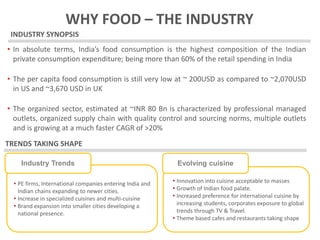
• Innovation into cuisine acceptable to masses
• Growth of Indian food palate.
• Increased preference for international cuisine by
increasing students, corporates exposure to global
trends through TV & Travel.
• Theme based cafes and restaurants taking shape
• PE firms, International companies entering India and
Indian chains expanding to newer cities.
• Increase in specialized cuisines and multi-cuisine
• Brand expansion into smaller cities developing a
national presence.
INDUSTRY SYNOPSIS
TRENDS TAKING SHAPE
• In absolute terms, India’s food consumption is the highest composition of the Indian
private consumption expenditure; being more than 60% of the retail spending in India
• The per capita food consumption is still very low at ~ 200USD as compared to ~2,070USD
in US and ~3,670 USD in UK
• The organized sector, estimated at ~INR 80 Bn is characterized by professional managed
outlets, organized supply chain with quality control and sourcing norms, multiple outlets
and is growing at a much faster CAGR of >20%
WHY FOOD – THE INDUSTRY
Industry Trends Evolving cuisine
^
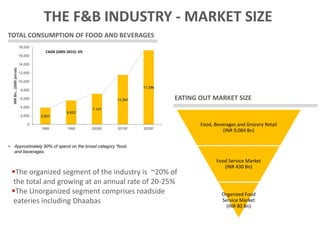
TOTAL CONSUMPTION OF FOOD AND BEVERAGES
EATING OUT MARKET SIZE
Food, Beverages and Grocery Retail
(INR 9,084 Bn)
Food Service Market
(INR 430 Bn)
Organized Food
Service Market
(INR 80 Bn)
3,931
5,622
7,147
11,547
17,296
0
2,000
4,000
6,000
8,000
10,000
12,000
14,000
16,000
18,000
1985 1995 2005E 2015F 2025F
INRBn.,(2000prices)
THE F&B INDUSTRY - MARKET SIZE
• Approximately 90% of spend on the broad category “food,
and beverages.
The organized segment of the industry is ~20% of
the total and growing at an annual rate of 20-25%
The Unorganized segment comprises roadside
eateries including Dhaabas
CAGR (2005-2015)- 5%
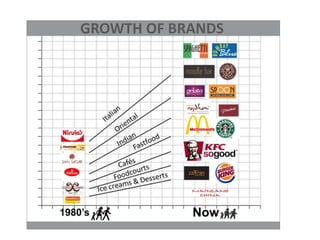
GROWTH OF BRANDS
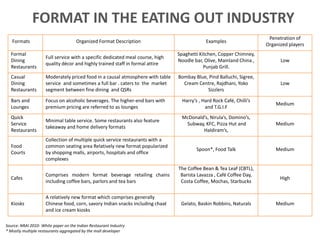
FORMAT IN THE EATING OUT INDUSTRY
Formats Organized Format Description Examples
Penetration of
Organized players
Formal
Dining
Restaurants
Full service with a specific dedicated meal course, high
quality décor and highly trained staff in formal attire
Spaghetti Kitchen, Copper Chimney,
Noodle bar, Olive, Mainland China ,
Punjab Grill.
Low
Casual
Dining
Restaurants
Moderately priced food in a causal atmosphere with table
service and sometimes a full bar . caters to the market
segment between fine dining and QSRs
Bombay Blue, Pind Balluchi, Sigree,
Cream Centre, Rajdhani, Yoko
Sizzlers
Low
Bars and
Lounges
Focus on alcoholic beverages. The higher-end bars with
premium pricing are referred to as lounges
Harry’s , Hard Rock Café, Chilli’s
and T.G.I.F
Medium
Quick
Service
Restaurants
Minimal table service. Some restaurants also feature
takeaway and home delivery formats
McDonald’s, Nirula’s, Domino’s,
Subway, KFC, Pizza Hut and
Haldiram’s,
Medium
Food
Courts
Collection of multiple quick service restaurants with a
common seating area Relatively new format popularized
by shopping malls, airports, hospitals and office
complexes
Spoon*, Food Talk Medium
Cafes
Comprises modern format beverage retailing chains
including coffee bars, parlors and tea bars
The Coffee Bean & Tea Leaf (CBTL),
Barista Lavazza , Café Coffee Day,
Costa Coffee, Mochas, Starbucks
High
Kiosks
A relatively new format which comprises generally
Chinese food, corn, savory Indian snacks including chaat
and ice cream kiosks
Gelato, Baskin Robbins, Naturals Medium
Source: NRAI 2010- White paper on the Indian Restaurant Industry
* Mostly multiple restaurants aggregated by the mall developer
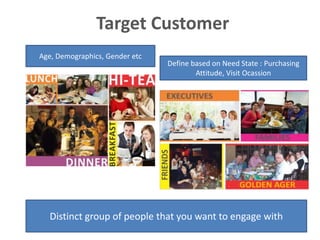
Target Customer
Age, Demographics, Gender etc
Define based on Need State : Purchasing
Attitude, Visit Ocassion
Distinct group of people that you want to engage with
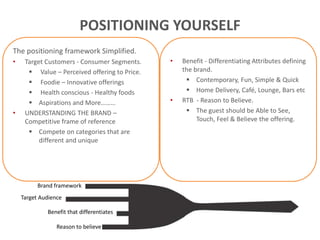
POSITIONING YOURSELF
The positioning framework Simplified.
• Target Customers - Consumer Segments.
 Value – Perceived offering to Price.
 Foodie – Innovative offerings
 Health conscious - Healthy foods
 Aspirations and More………
• UNDERSTANDING THE BRAND –
Competitive frame of reference
 Compete on categories that are
different and unique
Target Audience
Brand framework
Benefit that differentiates
Reason to believe
• Benefit - Differentiating Attributes defining
the brand.
 Contemporary, Fun, Simple & Quick
 Home Delivery, Café, Lounge, Bars etc
• RTB - Reason to Believe.
 The guest should be Able to See,
Touch, Feel & Believe the offering.
IDENTIFYING KEY DIFFERENTIATORS
• LOCATION! LOCATION ! LOCATION !
This comes out to be the major factor defining if it will make or break a restaurant.
• SERVICE : Service plays a very important aspect in defining your brand and its offering. Will
people think of your restaurants as a place with “exceptional customer service?”. Prompt
Response (within 24 hours) . I-pad offered by our brands to ensure quick recovery.
• PRICING : In a market like India pricing plays a key role as consumers have define value based
on their experiences. You can be in the affordable segment, value segment and premium
segment.
• OFFERING/FOOD SELECTION : Differentiating your restaurant on products, cuisines is quite
common which can be sooner or later replicated. Innovation to taste keeping the broader
aspect intact is what comes out as a winner.
• THEME BASED RESTAURANTS : Every business is based on a thought which defines the
place, it could either be cuisine, theme, category. Many brands are based on themes which
follow consumer needs like Buffet BBQ Nation, Global Fusion and Deli’s wherein consumer
can buy products too apart from dine-in.
• HERITAGE : Some brands are built on heritage of having served and survived over decades
building the RTB for consumers to choose that brand .Eg : Copper Chimney.
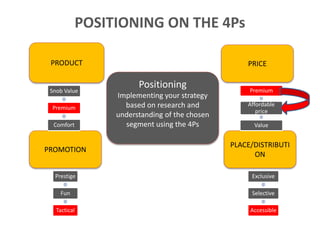
POSITIONING ON THE 4Ps
PRODUCT PRICE
PROMOTION
PLACE/DISTRIBUTI
ON
Snob Value
Premium
Comfort
Premium
Affordable
price
Value
Exclusive
Selective
Accessible
Prestige
Fun
Tactical
Positioning
Implementing your strategy
based on research and
understanding of the chosen
segment using the 4Ps
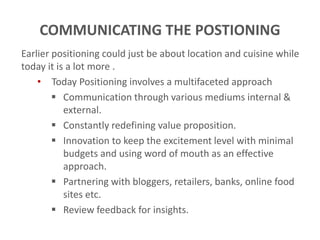
COMMUNICATING THE POSTIONING
Earlier positioning could just be about location and cuisine while
today it is a lot more .
• Today Positioning involves a multifaceted approach
 Communication through various mediums internal &
external.
 Constantly redefining value proposition.
 Innovation to keep the excitement level with minimal
budgets and using word of mouth as an effective
approach.
 Partnering with bloggers, retailers, banks, online food
sites etc.
 Review feedback for insights.
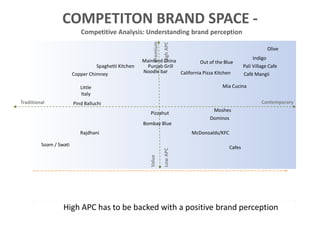
COMPETITON BRAND SPACE -
Competitive Analysis: Understanding brand perception
LowAPC
Premium
HighAPC
Bombay Blue
Moshes
Mia CucinaLittle
Italy
Olive
Indigo
Copper Chimney
Value
Contemporary
California Pizza Kitchen
Traditional
High APC has to be backed with a positive brand perception
Café Mangii
Out of the Blue
Pali Village Cafe
McDonoalds/KFC
Pizzahut
Spaghetti Kitchen Punjab Grill
Dominos
Rajdhani
Pind Balluchi
Mainland China
Noodle bar
Soam / Swati
Cafes
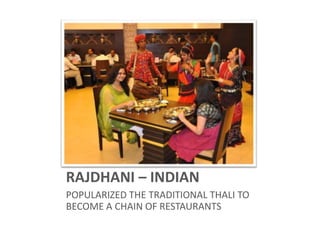
RAJDHANI – INDIAN
POPULARIZED THE TRADITIONAL THALI TO
BECOME A CHAIN OF RESTAURANTS
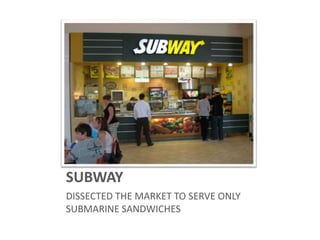
SUBWAY
DISSECTED THE MARKET TO SERVE ONLY
SUBMARINE SANDWICHES
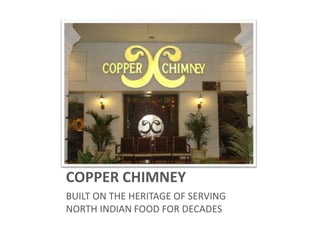
COPPER CHIMNEY
BUILT ON THE HERITAGE OF SERVING
NORTH INDIAN FOOD FOR DECADES
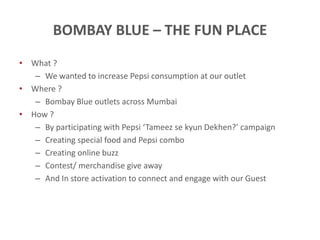
BOMBAY BLUE – THE FUN PLACE
• What ?
– We wanted to increase Pepsi consumption at our outlet
• Where ?
– Bombay Blue outlets across Mumbai
• How ?
– By participating with Pepsi ‘Tameez se kyun Dekhen?’ campaign
– Creating special food and Pepsi combo
– Creating online buzz
– Contest/ merchandise give away
– And In store activation to connect and engage with our Guest
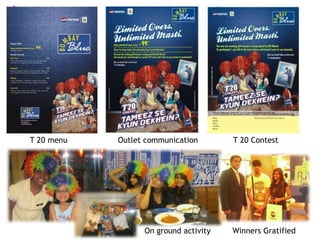
T20 Menu creative
T 20 menu Outlet communication T 20 Contest
On ground activity Winners Gratified
SPAGHETTI KITCHEN –
TRADITIONAL ITALIAN
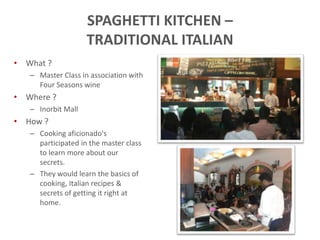
• What ?
– Master Class in association with
Four Seasons wine
• Where ?
– Inorbit Mall
• How ?
– Cooking aficionado's
participated in the master class
to learn more about our
secrets.
– They would learn the basics of
cooking, Italian recipes &
secrets of getting it right at
home.
THE COFFEE BEAN & TEA LEAF
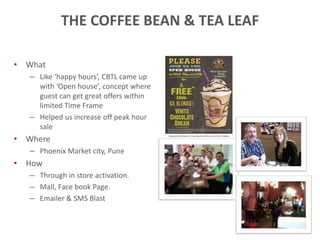
• What
– Like ‘happy hours’, CBTL came up
with ‘Open house’, concept where
guest can get great offers within
limited Time Frame
– Helped us increase off peak hour
sale
• Where
– Phoenix Market city, Pune
• How
– Through in store activation.
– Mall, Face book Page.
– Emailer & SMS Blast
THANK YOU