Terrific
Tides
By
Rumi Johnson
and
Carrie Chen
What are tides?
Tides are the periodic changes in the water level of
Earth’s oceans, gulfs, and bays. The gravity of the
Sun and moon both contribute to increasing and
decreasing the level of these bodies of water. Since
the Sun is 360 times further away from the Earth than
the moon, the moon has a much larger effect when
producing tides than the Sun. Most parts of the world
experience two high tides and two low tides every day,
which is called a semi-diurnal tide. Some places
experience one high tide and one low tide every day,
which is called a diurnal tide. When a tide occurs in
a location, the flip side of that place on Earth also
experiences the same thing.
DID YOU KNOW?
•

The shape of a coastline and the shape of an ocean floor
determines if it has two high/low tides per day or only one.

•

High and low tide times differ by about 50 minutes from the
previous day since the earth rotates faster than the moon.

•

The lowest tidal range (difference between high and low
tide) occurs in the deepest part of the ocean.

•

The highest tidal range in the world is in the Bay of Fundy in
Nova Scotia, Canada at about 15 meters.

•

The gravitational pull of the Moon and Sun DO have an
effect on land, but it’s less noticeable than with water
because land is less flexible than water.
When were tides discovered?
Tides were discovered over 300
years ago by Isaac Newton. He
developed a theory called “The
Equilibrium Theory of Tides”
which suggests that every
object exerts a pull on every
other object.
Types of Tides
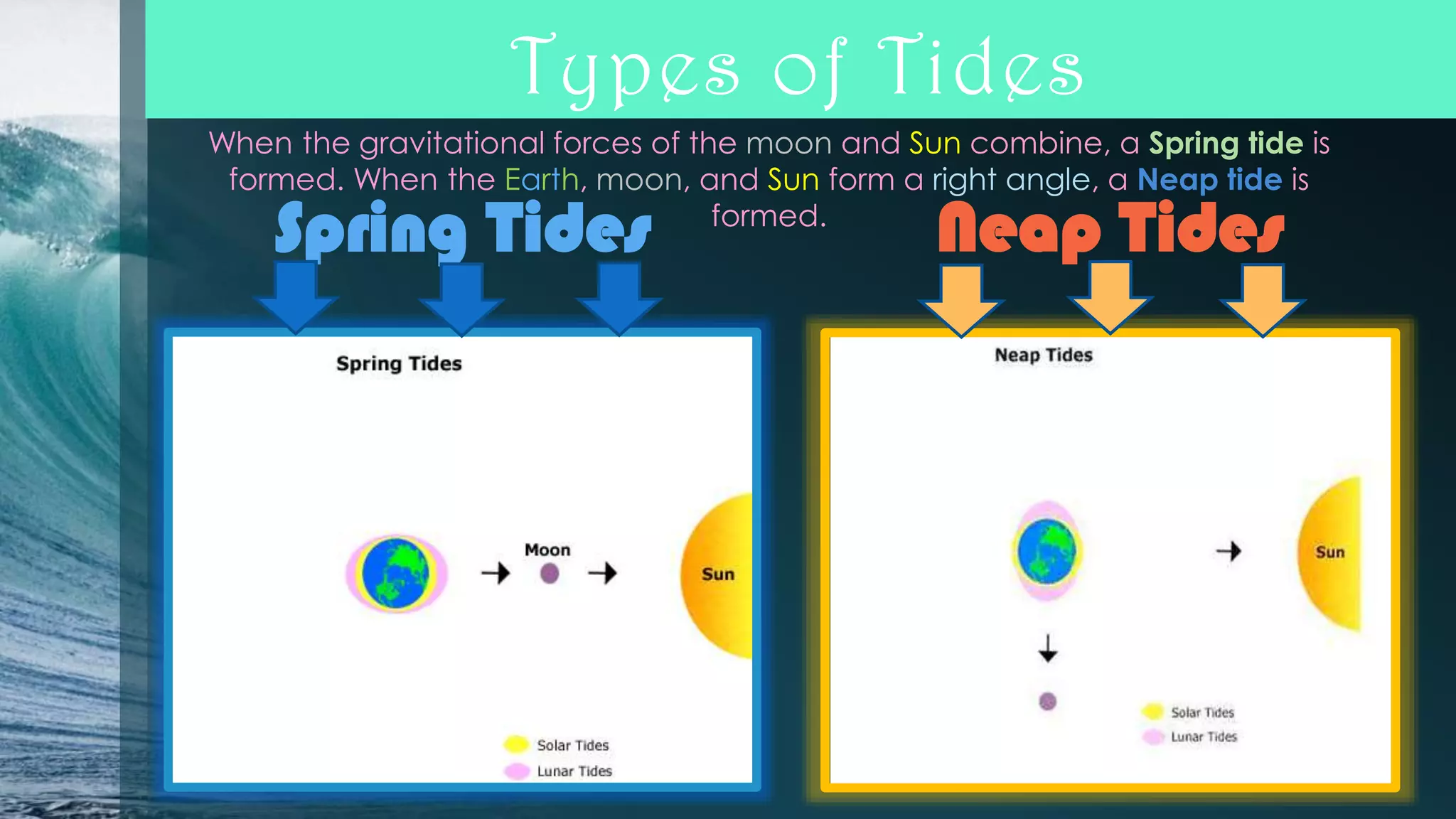
When the gravitational forces of the moon and Sun combine, a Spring tide is
formed. When the Earth, moon, and Sun form a right angle, a Neap tide is
formed.

Spring Tides

Neap Tides
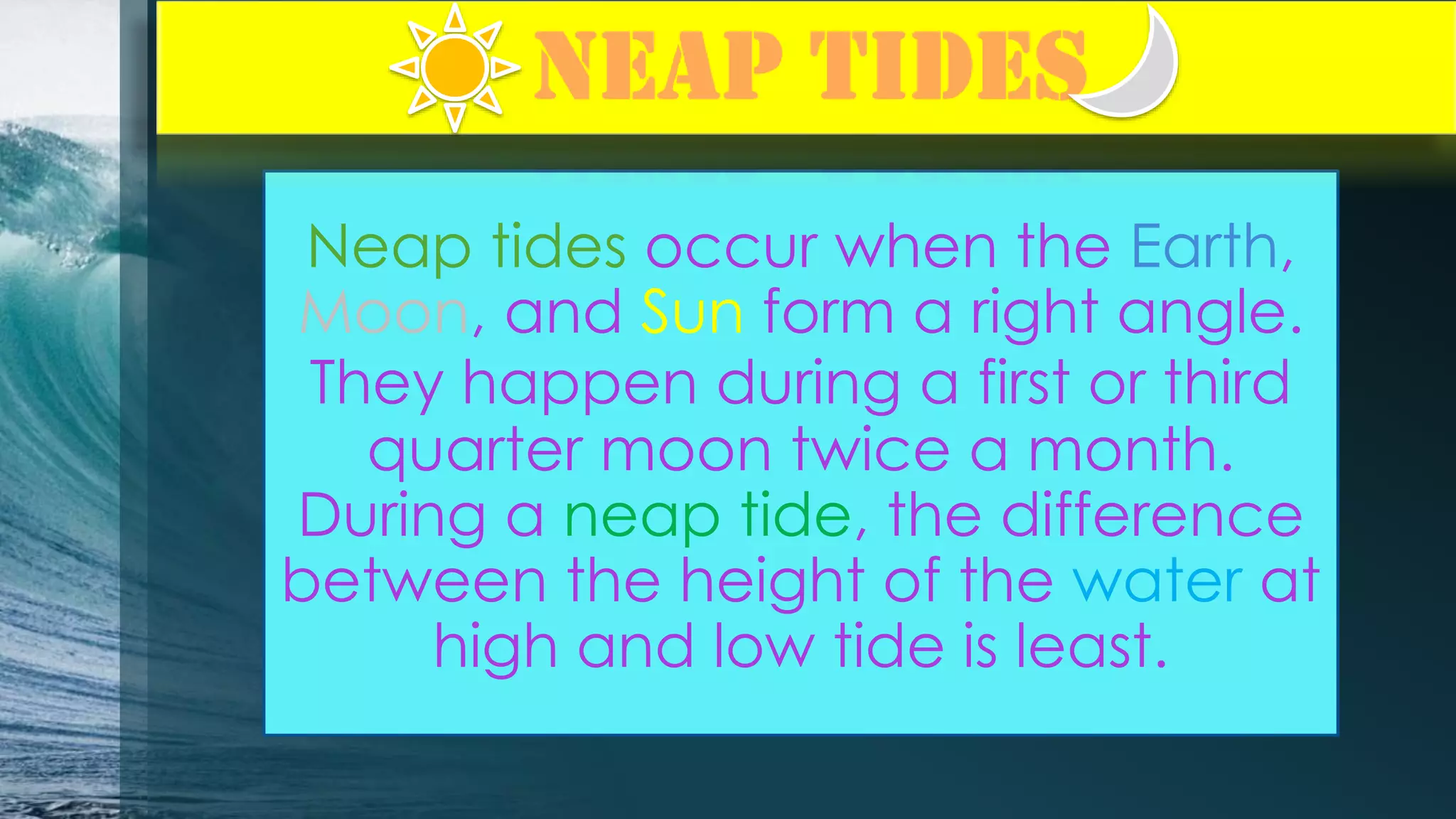
Neap tides occur when the Earth,
Moon, and Sun form a right angle.
They happen during a first or third
quarter moon twice a month.
During a neap tide, the difference
between the height of the water at
high and low tide is least.
Spring tides occur when the Earth,
Moon, and Sun are lined up. The
gravitational pull of both the Sun
and Moon are pulling in the same
direction, so during a Spring tide,
high and low tides are more EXTREME
than normal. Spring tides occur
during full and new moons.
We Hope You Enjoyed Our
Presentation!

Geniushourpowerpoint.pdf

  • 1.
  • 2.
    What are tides? Tidesare the periodic changes in the water level of Earth’s oceans, gulfs, and bays. The gravity of the Sun and moon both contribute to increasing and decreasing the level of these bodies of water. Since the Sun is 360 times further away from the Earth than the moon, the moon has a much larger effect when producing tides than the Sun. Most parts of the world experience two high tides and two low tides every day, which is called a semi-diurnal tide. Some places experience one high tide and one low tide every day, which is called a diurnal tide. When a tide occurs in a location, the flip side of that place on Earth also experiences the same thing.
  • 3.
    DID YOU KNOW? • Theshape of a coastline and the shape of an ocean floor determines if it has two high/low tides per day or only one. • High and low tide times differ by about 50 minutes from the previous day since the earth rotates faster than the moon. • The lowest tidal range (difference between high and low tide) occurs in the deepest part of the ocean. • The highest tidal range in the world is in the Bay of Fundy in Nova Scotia, Canada at about 15 meters. • The gravitational pull of the Moon and Sun DO have an effect on land, but it’s less noticeable than with water because land is less flexible than water.
  • 4.
    When were tidesdiscovered? Tides were discovered over 300 years ago by Isaac Newton. He developed a theory called “The Equilibrium Theory of Tides” which suggests that every object exerts a pull on every other object.
  • 5.
    Types of Tides Whenthe gravitational forces of the moon and Sun combine, a Spring tide is formed. When the Earth, moon, and Sun form a right angle, a Neap tide is formed. Spring Tides Neap Tides
  • 6.
    Neap tides occurwhen the Earth, Moon, and Sun form a right angle. They happen during a first or third quarter moon twice a month. During a neap tide, the difference between the height of the water at high and low tide is least.
  • 7.
    Spring tides occurwhen the Earth, Moon, and Sun are lined up. The gravitational pull of both the Sun and Moon are pulling in the same direction, so during a Spring tide, high and low tides are more EXTREME than normal. Spring tides occur during full and new moons.
  • 8.
    We Hope YouEnjoyed Our Presentation!