Dr. Swarnima Singh, Dept of Geography DDUGU
What Are Tides?
Tides are the daily rise and fall of
Earth’s waters on its coastlines.
As the tide comes in, the level of
water on the beach rises, and as the
tide goes out, the level of water on the
beach goes down.
High tides are when the water
reaches its highest point.
Low tides are when the water
reaches its lowest point.
What
Causes Tides?
The gravitational pull from the Moon,
and the rotation of the Earth on its
axis, cause the ocean and sea water to
bulge, producing the tides.
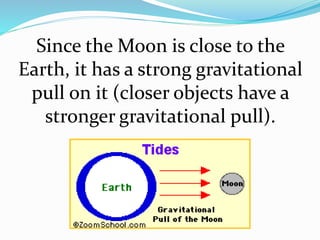
Since the Moon is close to the
Earth, it has a strong gravitational
pull on it (closer objects have a
stronger gravitational pull).
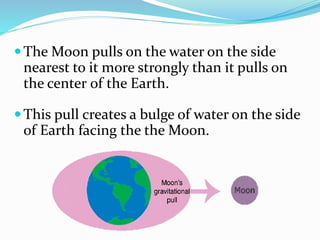
The Moon pulls on the water on the side
nearest to it more strongly than it pulls on
the center of the Earth.
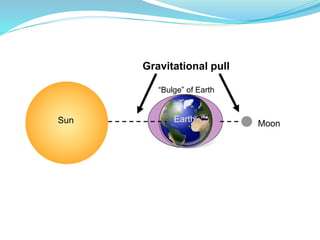
This pull creates a bulge of water on the side
of Earth facing the the Moon.
“Bulge” of Earth
Sun Earth Moon
Gravitational pull
9
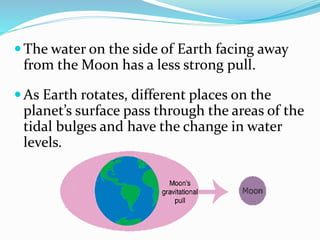
The water on the side of Earth facing away
from the Moon has a less strong pull.
As Earth rotates, different places on the
planet’s surface pass through the areas of the
tidal bulges and have the change in water
levels.
The Earth rotates one full turn in 24
hours, but the bulge of water stays on
the side of the Earth facing the moon.
The bulge stays in place as the Earth
moves under it.
High tide
In places where there are tidal
bulges, high tide is occurring
along the coastlines.
High
Tide
High
Tide
In places between the tidal
bulges, low tide is occurring
along the coastlines.
Low Tide
Low Tide
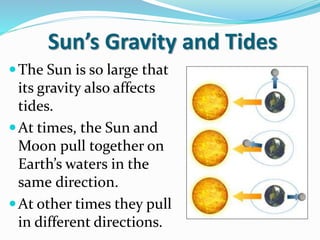
Sun’s Gravity and Tides
The Sun is so large that
its gravity also affects
tides.
At times, the Sun and
Moon pull together on
Earth’s waters in the
same direction.
At other times they pull
in different directions.
Think, Pair, Share:
Why does the Moon’s gravity affect
tides more than the Sun’s gravity?
Even though the Sun is much larger
than the Moon, the Moon is much
closer to the Earth than the Sun.
Changes in the positions of Earth,
the Moon, and Sun affect the
height of tides during a month.
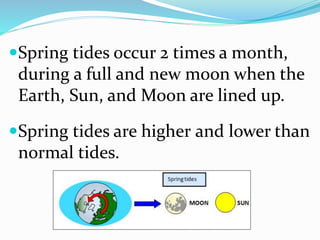
Spring tides occur 2 times a month,
during a full and new moon when the
Earth, Sun, and Moon are lined up.
Spring tides are higher and lower than
normal tides.
Spring Tide
Spring Tide
Low Tide
Low Tide
High Tide
High Tide
New Moon Full Moon
Neap tides occur in between spring tides,
at the first and third quarters of the Moon
when the Sun and Moon pull at right
angles to each other.
Neap tides are not
as high or low as
normal tides.
Neap Tides
Neap Tide
Low Tide
Low Tide
High Tide
High Tide
First Quarter
Moon
Third Quarter
Moon
Spring and Neap Tides
http://ww2.valdosta.edu/~cbarnbau/as
tro_demos/tides/neap_sp.html
“Strong Tides” “Weak Tides”
On Saturday at the beach, the
water is highest at 11:15 a.m. On
Sunday, the water is highest at
11:55 a.m. Why does the tide
come in later?
The moon has moved a little, so the beach
is closest to the moon at a later time.
Tides occur at different times each day
because the Earth rotates more quickly
than the moon revolves around the Earth.
Earth’s
North Pole
Noon on Monday
Noon on Tuesday
Moon orbits this way
Another view…
Tides at a Monthly Glance
Show What You Know…
You arrive at the beach at 9:00
A.M. You lay a towel on the sand,
and then you run 30 steps to
reach the water’s edge. By 3:00
P.M., the water has almost
reached your towel. What do you
think happened?
The tide came in.
You’re on the beach at
midnight. The moon is
right overhead. Is the tide
low or high? Why?
High tide because the
moon is closest as it can be
The diagram below shows the possible
positions of the moon relative to the
Earth and sun during different tidal
ranges. Use the diagram below to
answer the questions that follow.
At which position would the moon be
during a neap tide?
A. 1
B. 2
C. 3
D. 4
At which position would the moon
be during a spring tide?
A. 1
B. 2
C. 3
D. 4
The tidal range would be greater when the
moon is at position 3 than when the moon is at
position 4 because…
A. position 4 forms a 90° angle
with the sun and the Earth.
B. position 3 is very near a neap-
tide position.
C. position 3 is very near a
spring-tide position.
D. position 4 is very near a
spring-tide position.
Tides Summarizer

tides_DrSS.pptx

  • 1.
    Dr. Swarnima Singh,Dept of Geography DDUGU
  • 2.
    What Are Tides? Tidesare the daily rise and fall of Earth’s waters on its coastlines. As the tide comes in, the level of water on the beach rises, and as the tide goes out, the level of water on the beach goes down.
  • 3.
    High tides arewhen the water reaches its highest point.
  • 4.
    Low tides arewhen the water reaches its lowest point.
  • 6.
    What Causes Tides? The gravitationalpull from the Moon, and the rotation of the Earth on its axis, cause the ocean and sea water to bulge, producing the tides.
  • 7.
    Since the Moonis close to the Earth, it has a strong gravitational pull on it (closer objects have a stronger gravitational pull).
  • 8.
    The Moon pullson the water on the side nearest to it more strongly than it pulls on the center of the Earth. This pull creates a bulge of water on the side of Earth facing the the Moon.
  • 9.
    “Bulge” of Earth SunEarth Moon Gravitational pull 9
  • 10.
    The water onthe side of Earth facing away from the Moon has a less strong pull. As Earth rotates, different places on the planet’s surface pass through the areas of the tidal bulges and have the change in water levels.
  • 11.
    The Earth rotatesone full turn in 24 hours, but the bulge of water stays on the side of the Earth facing the moon. The bulge stays in place as the Earth moves under it. High tide
  • 12.
    In places wherethere are tidal bulges, high tide is occurring along the coastlines. High Tide High Tide
  • 13.
    In places betweenthe tidal bulges, low tide is occurring along the coastlines. Low Tide Low Tide
  • 14.
    Sun’s Gravity andTides The Sun is so large that its gravity also affects tides. At times, the Sun and Moon pull together on Earth’s waters in the same direction. At other times they pull in different directions.
  • 15.
    Think, Pair, Share: Whydoes the Moon’s gravity affect tides more than the Sun’s gravity? Even though the Sun is much larger than the Moon, the Moon is much closer to the Earth than the Sun.
  • 16.
    Changes in thepositions of Earth, the Moon, and Sun affect the height of tides during a month.
  • 17.
    Spring tides occur2 times a month, during a full and new moon when the Earth, Sun, and Moon are lined up. Spring tides are higher and lower than normal tides.
  • 18.
  • 19.
    Spring Tide Low Tide LowTide High Tide High Tide New Moon Full Moon
  • 20.
    Neap tides occurin between spring tides, at the first and third quarters of the Moon when the Sun and Moon pull at right angles to each other. Neap tides are not as high or low as normal tides.
  • 21.
  • 22.
    Neap Tide Low Tide LowTide High Tide High Tide First Quarter Moon Third Quarter Moon
  • 24.
    Spring and NeapTides http://ww2.valdosta.edu/~cbarnbau/as tro_demos/tides/neap_sp.html
  • 25.
  • 26.
    On Saturday atthe beach, the water is highest at 11:15 a.m. On Sunday, the water is highest at 11:55 a.m. Why does the tide come in later? The moon has moved a little, so the beach is closest to the moon at a later time.
  • 27.
    Tides occur atdifferent times each day because the Earth rotates more quickly than the moon revolves around the Earth.
  • 28.
    Earth’s North Pole Noon onMonday Noon on Tuesday Moon orbits this way Another view…
  • 29.
    Tides at aMonthly Glance
  • 30.
  • 31.
    You arrive atthe beach at 9:00 A.M. You lay a towel on the sand, and then you run 30 steps to reach the water’s edge. By 3:00 P.M., the water has almost reached your towel. What do you think happened? The tide came in.
  • 32.
    You’re on thebeach at midnight. The moon is right overhead. Is the tide low or high? Why? High tide because the moon is closest as it can be
  • 33.
    The diagram belowshows the possible positions of the moon relative to the Earth and sun during different tidal ranges. Use the diagram below to answer the questions that follow.
  • 34.
    At which positionwould the moon be during a neap tide? A. 1 B. 2 C. 3 D. 4
  • 35.
    At which positionwould the moon be during a spring tide? A. 1 B. 2 C. 3 D. 4
  • 36.
    The tidal rangewould be greater when the moon is at position 3 than when the moon is at position 4 because… A. position 4 forms a 90° angle with the sun and the Earth. B. position 3 is very near a neap- tide position. C. position 3 is very near a spring-tide position. D. position 4 is very near a spring-tide position.
  • 37.