Tidal Energy
Arpan Deyasi
Dept of ECE, RCCIIT, Kolkata, India
Course: EI605D
5/19/2020 1Arpan Deyasi, EI605D
5/19/2020 2Arpan Deyasi, EI605D
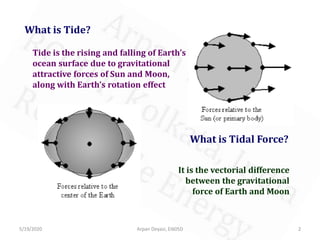
What is Tide?
Tide is the rising and falling of Earth’s
ocean surface due to gravitational
attractive forces of Sun and Moon,
along with Earth’s rotation effect
What is Tidal Force?
It is the vectorial difference
between the gravitational
force of Earth and Moon
5/19/2020 3Arpan Deyasi, EI605D
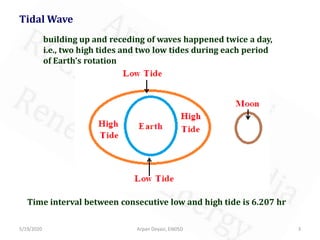
Tidal Wave
building up and receding of waves happened twice a day,
i.e., two high tides and two low tides during each period
of Earth’s rotation
Time interval between consecutive low and high tide is 6.207 hr
5/19/2020 Arpan Deyasi, EI605D 4
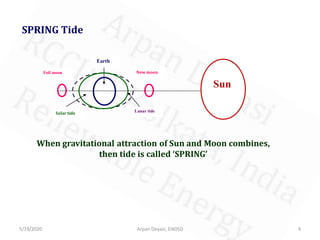
SPRING Tide
Sun
New moonFull moon
Earth
Solar tide Lunar tide
When gravitational attraction of Sun and Moon combines,
then tide is called ‘SPRING’
5/19/2020 Arpan Deyasi, EI605D 5
NEAP Tide
When gravitational attraction of Sun and Moon work
orthogonally, then tide is called ‘NEAP’
Earth
Solar tide
Lunar tide
Sun
5/19/2020 6Arpan Deyasi, EI605D
Tidal Energy Generation
1. In-stream Device: KE of moving water is utilized into
power the turbines
shorter and stronger blades, work as underwater windmills
The set-up can be gradually scaled-up in the form of array
It has lower potential costs
It has higher ecological impacts
5/19/2020 7Arpan Deyasi, EI605D
Tidal Energy Generation
2. Barrages: It’s a type of bigger hydroelectric plant built
at the bay
Uses PE difference between high and low tides
Higher cost of installation
Larger ecological impacts
5/19/2020 8Arpan Deyasi, EI605D
Tidal Energy Generation
3. Lagoon : It’s a type of small barrage built at lower cost
Self-contained structures
Combination of ebb and flood
Cost and potential impact are lower than barrage
5/19/2020 9Arpan Deyasi, EI605D
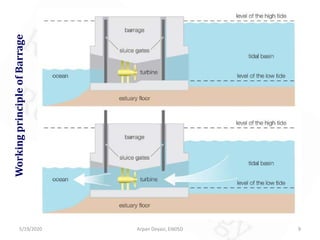
WorkingprincipleofBarrage
5/19/2020 10Arpan Deyasi, EI605D
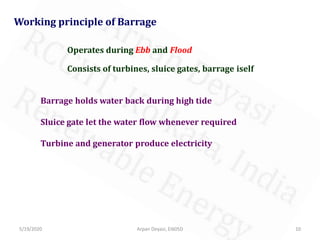
Working principle of Barrage
Consists of turbines, sluice gates, barrage iself
Operates during Ebb and Flood
Barrage holds water back during high tide
Sluice gate let the water flow whenever required
Turbine and generator produce electricity
5/19/2020 Arpan Deyasi, EI605D 11
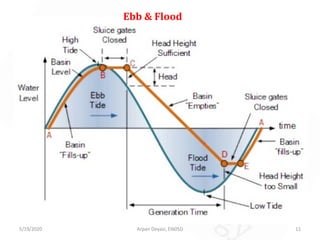
Ebb & Flood
5/19/2020 Arpan Deyasi, EI605D 12
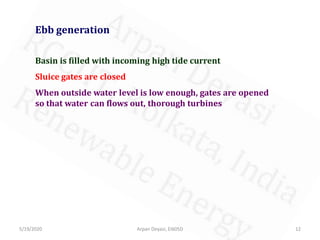
Ebb generation
Basin is filled with incoming high tide current
Sluice gates are closed
When outside water level is low enough, gates are opened
so that water can flows out, thorough turbines
5/19/2020 Arpan Deyasi, EI605D 13
Flood generation
Basin is emptied with low tide
Sluice gates are closed
When water level is outside is high enough, gates are opened to
allow water flow inside, through turbines
5/19/2020 14Arpan Deyasi, EI605D
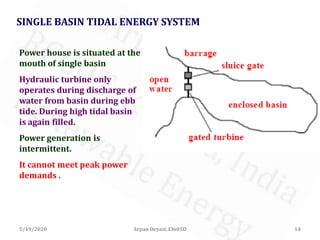
SINGLE BASIN TIDAL ENERGY SYSTEM
Power house is situated at the
mouth of single basin
Hydraulic turbine only
operates during discharge of
water from basin during ebb
tide. During high tidal basin
is again filled.
Power generation is
intermittent.
It cannot meet peak power
demands .
5/19/2020 15Arpan Deyasi, EI605D
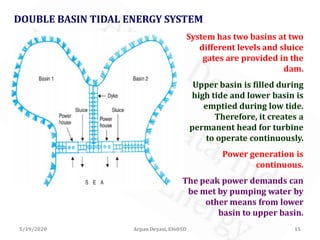
DOUBLE BASIN TIDAL ENERGY SYSTEM
System has two basins at two
different levels and sluice
gates are provided in the
dam.
Upper basin is filled during
high tide and lower basin is
emptied during low tide.
Therefore, it creates a
permanent head for turbine
to operate continuously.
Power generation is
continuous.
The peak power demands can
be met by pumping water by
other means from lower
basin to upper basin.
5/19/2020 16Arpan Deyasi, EI605D
Uses of Tidal Energy
Tidal Electricity generation
Mechanical crushing of grains in grain mills
Tidal barrage can be used to store energy
Advantages of Tidal Energy
Longevity of equipment is relatively large
Inexhaustible source of energy
No greenhouse gas emission
Can be generated at large scale as 75% of earth is covered by water
Rise and fall of tides are predictable owing to their cyclic fashion
Efficiency is higher than coal, solar or wind
After installation, maintenance cost is relatively low
Fuel is not required for operation
5/19/2020 17Arpan Deyasi, EI605D
Disadvantages of Tidal Energy
Electro-magnetic emissions disrupt aquatic eco-system
High construction costs
Less sites available for construction costs, associated with
expensive transmission costs
Unpredictable sea-wave can destruct power generation units
Frozen sea, weak tides, straight shorelines, low tidal waves
cause obstructions
5/19/2020 18Arpan Deyasi, EI605D
5/19/2020 Arpan Deyasi, EI605D 19
References
1. Non conventional Energy, A. V. Desai, New Age International
Publishers Ltd.
2. Renewable energy resources and emerging technologies, D.P.
Kothari, Prentice Hall of India Pvt. Ltd.
3. Er. R K Rajput, Non-Conventional Energy Sources and Utilisation
(Energy Engineering), S. Chand Publishing
4. B.H Khan, Non Conventioanl Energy Resources, Tata McGraw-Hill
Education

Tidal energy

  • 1.
    Tidal Energy Arpan Deyasi Deptof ECE, RCCIIT, Kolkata, India Course: EI605D 5/19/2020 1Arpan Deyasi, EI605D
  • 2.
    5/19/2020 2Arpan Deyasi,EI605D What is Tide? Tide is the rising and falling of Earth’s ocean surface due to gravitational attractive forces of Sun and Moon, along with Earth’s rotation effect What is Tidal Force? It is the vectorial difference between the gravitational force of Earth and Moon
  • 3.
    5/19/2020 3Arpan Deyasi,EI605D Tidal Wave building up and receding of waves happened twice a day, i.e., two high tides and two low tides during each period of Earth’s rotation Time interval between consecutive low and high tide is 6.207 hr
  • 4.
    5/19/2020 Arpan Deyasi,EI605D 4 SPRING Tide Sun New moonFull moon Earth Solar tide Lunar tide When gravitational attraction of Sun and Moon combines, then tide is called ‘SPRING’
  • 5.
    5/19/2020 Arpan Deyasi,EI605D 5 NEAP Tide When gravitational attraction of Sun and Moon work orthogonally, then tide is called ‘NEAP’ Earth Solar tide Lunar tide Sun
  • 6.
    5/19/2020 6Arpan Deyasi,EI605D Tidal Energy Generation 1. In-stream Device: KE of moving water is utilized into power the turbines shorter and stronger blades, work as underwater windmills The set-up can be gradually scaled-up in the form of array It has lower potential costs It has higher ecological impacts
  • 7.
    5/19/2020 7Arpan Deyasi,EI605D Tidal Energy Generation 2. Barrages: It’s a type of bigger hydroelectric plant built at the bay Uses PE difference between high and low tides Higher cost of installation Larger ecological impacts
  • 8.
    5/19/2020 8Arpan Deyasi,EI605D Tidal Energy Generation 3. Lagoon : It’s a type of small barrage built at lower cost Self-contained structures Combination of ebb and flood Cost and potential impact are lower than barrage
  • 9.
    5/19/2020 9Arpan Deyasi,EI605D WorkingprincipleofBarrage
  • 10.
    5/19/2020 10Arpan Deyasi,EI605D Working principle of Barrage Consists of turbines, sluice gates, barrage iself Operates during Ebb and Flood Barrage holds water back during high tide Sluice gate let the water flow whenever required Turbine and generator produce electricity
  • 11.
    5/19/2020 Arpan Deyasi,EI605D 11 Ebb & Flood
  • 12.
    5/19/2020 Arpan Deyasi,EI605D 12 Ebb generation Basin is filled with incoming high tide current Sluice gates are closed When outside water level is low enough, gates are opened so that water can flows out, thorough turbines
  • 13.
    5/19/2020 Arpan Deyasi,EI605D 13 Flood generation Basin is emptied with low tide Sluice gates are closed When water level is outside is high enough, gates are opened to allow water flow inside, through turbines
  • 14.
    5/19/2020 14Arpan Deyasi,EI605D SINGLE BASIN TIDAL ENERGY SYSTEM Power house is situated at the mouth of single basin Hydraulic turbine only operates during discharge of water from basin during ebb tide. During high tidal basin is again filled. Power generation is intermittent. It cannot meet peak power demands .
  • 15.
    5/19/2020 15Arpan Deyasi,EI605D DOUBLE BASIN TIDAL ENERGY SYSTEM System has two basins at two different levels and sluice gates are provided in the dam. Upper basin is filled during high tide and lower basin is emptied during low tide. Therefore, it creates a permanent head for turbine to operate continuously. Power generation is continuous. The peak power demands can be met by pumping water by other means from lower basin to upper basin.
  • 16.
    5/19/2020 16Arpan Deyasi,EI605D Uses of Tidal Energy Tidal Electricity generation Mechanical crushing of grains in grain mills Tidal barrage can be used to store energy
  • 17.
    Advantages of TidalEnergy Longevity of equipment is relatively large Inexhaustible source of energy No greenhouse gas emission Can be generated at large scale as 75% of earth is covered by water Rise and fall of tides are predictable owing to their cyclic fashion Efficiency is higher than coal, solar or wind After installation, maintenance cost is relatively low Fuel is not required for operation 5/19/2020 17Arpan Deyasi, EI605D
  • 18.
    Disadvantages of TidalEnergy Electro-magnetic emissions disrupt aquatic eco-system High construction costs Less sites available for construction costs, associated with expensive transmission costs Unpredictable sea-wave can destruct power generation units Frozen sea, weak tides, straight shorelines, low tidal waves cause obstructions 5/19/2020 18Arpan Deyasi, EI605D
  • 19.
    5/19/2020 Arpan Deyasi,EI605D 19 References 1. Non conventional Energy, A. V. Desai, New Age International Publishers Ltd. 2. Renewable energy resources and emerging technologies, D.P. Kothari, Prentice Hall of India Pvt. Ltd. 3. Er. R K Rajput, Non-Conventional Energy Sources and Utilisation (Energy Engineering), S. Chand Publishing 4. B.H Khan, Non Conventioanl Energy Resources, Tata McGraw-Hill Education