NAVEED UR REHMAN
www.naveedurrehman.com
www.naveedurrehman.com 1
This is only the introduction part of a very
big presentation.
Please download the full version from here:
https://goo.gl/bXRLGd
www.naveedurrehman.com 2
RENEWABLE ENERGY SYSTEMS
Outline
1. Introduction
2. Solar Energy
3. Wind Energy
4. Hydropower
5. Biomass Energy
6. Geothermal Energy
7. Wave and Tidal Energywww.naveedurrehman.com 3
RENEWABLE ENERGY SYSTEMS
Introduction
• Comparison of different forms of energy
• National and global patterns of energy supply
and utilization
• Temperature and other climate impacts
www.naveedurrehman.com 4
RENEWABLE ENERGY SYSTEMS
Solar Energy
• Solar radiations
• Passive and active solar thermal energy system
• Solar thermal applications
• Water and space heating
• Solar ponds, dryers and distillation
• Solar thermal electric systems
• Photovoltaic cells
• Storage system www.naveedurrehman.com 5
RENEWABLE ENERGY SYSTEMS
Wind Energy
• Wind resources and characteristics
• Wind machinery and generating systems
• Wind turbine types:
horizontal axis & vertical axis
• Betz conditions
• Effects of solidity
• Controlling and optimizing wind turbine
performance www.naveedurrehman.com 6
RENEWABLE ENERGY SYSTEMS
Hydropower
• Basic energy conversion principle
• Conversion equipment and engineering
operations
• Hydraulic machine types
• Affinity laws and specific speed related to
rotodynamic machines
www.naveedurrehman.com 7
RENEWABLE ENERGY SYSTEMS
Biomass Energy
• Biomass resources and biofuels production
• Properties relevant to energy production
• Thermal conversion of biomass
• Biochemical conversion: anaerobic digestion,
fermentation to alcohol, physical processing
and briquetting
• Combustion process
• Use of biomass derived fuelswww.naveedurrehman.com 8
RENEWABLE ENERGY SYSTEMS
Geothermal Energy
• Geophysics of the earth’s interior
• Hydrothermal and geo-pressured systems
• Equipment for recovering energy
• Direct heat utilization and electric power
generation
www.naveedurrehman.com 9
RENEWABLE ENERGY SYSTEMS
Wave and Tidal Energy
• Energy from tides, waves and temperature
differences
• Economic prospects
• Environmental and sustainability considerations
• Types of equipment for extracting wave and
tidal energy
www.naveedurrehman.com 10
RENEWABLE ENERGY SYSTEMS
Books
• John Twidell and Tony Weir, “Renewable
Energy Resources”, Routledge, 2014.
• Godfrey Boyle, “Renewable Energy:
Power for a Sustainable Future”, Oxford
University Press, 2004.
www.naveedurrehman.com 11
Introduction
NAVEED UR REHMAN
www.naveedurrehman.com
www.naveedurrehman.com 12
INTRODUCTION
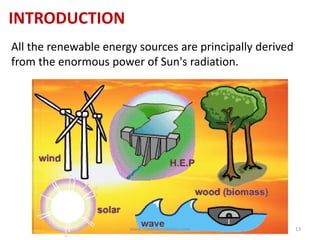
All the renewable energy sources are principally derived
from the enormous power of Sun's radiation.
www.naveedurrehman.com 13
INTRODUCTION
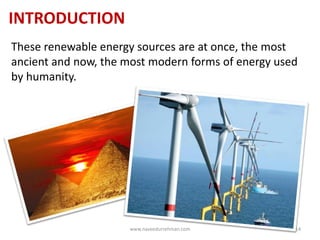
These renewable energy sources are at once, the most
ancient and now, the most modern forms of energy used
by humanity.
www.naveedurrehman.com 14
INTRODUCTION
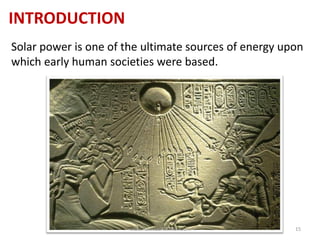
Solar power is one of the ultimate sources of energy upon
which early human societies were based.
www.naveedurrehman.com 15
INTRODUCTION
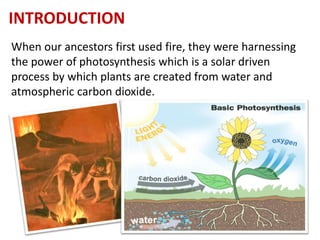
When our ancestors first used fire, they were harnessing
the power of photosynthesis which is a solar driven
process by which plants are created from water and
atmospheric carbon dioxide.
www.naveedurrehman.com 16
INTRODUCTION
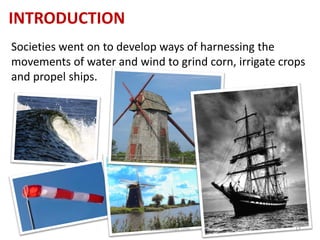
Societies went on to develop ways of harnessing the
movements of water and wind to grind corn, irrigate crops
and propel ships.
www.naveedurrehman.com 17
INTRODUCTION
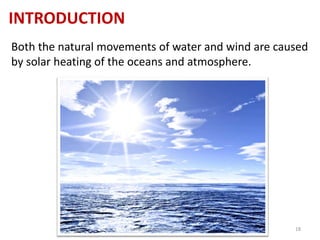
Both the natural movements of water and wind are caused
by solar heating of the oceans and atmosphere.
www.naveedurrehman.com 18
INTRODUCTION
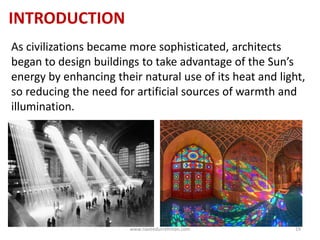
As civilizations became more sophisticated, architects
began to design buildings to take advantage of the Sun’s
energy by enhancing their natural use of its heat and light,
so reducing the need for artificial sources of warmth and
illumination.
www.naveedurrehman.com 19
INTRODUCTION
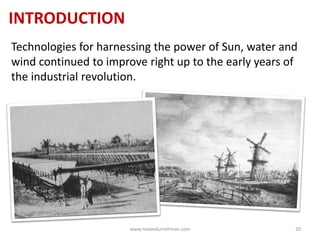
Technologies for harnessing the power of Sun, water and
wind continued to improve right up to the early years of
the industrial revolution.
www.naveedurrehman.com 20
INTRODUCTION
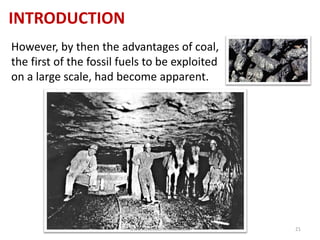
However, by then the advantages of coal,
the first of the fossil fuels to be exploited
on a large scale, had become apparent.
www.naveedurrehman.com 21
INTRODUCTION
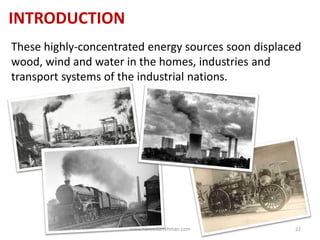
These highly-concentrated energy sources soon displaced
wood, wind and water in the homes, industries and
transport systems of the industrial nations.
www.naveedurrehman.com 22
INTRODUCTION
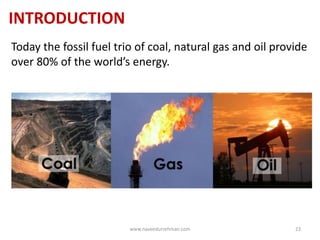
Today the fossil fuel trio of coal, natural gas and oil provide
over 80% of the world’s energy.
www.naveedurrehman.com 23
INTRODUCTION
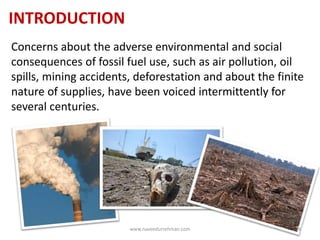
Concerns about the adverse environmental and social
consequences of fossil fuel use, such as air pollution, oil
spills, mining accidents, deforestation and about the finite
nature of supplies, have been voiced intermittently for
several centuries.
www.naveedurrehman.com 24
INTRODUCTION
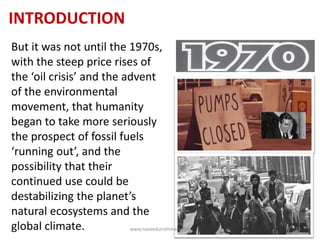
But it was not until the 1970s,
with the steep price rises of
the ‘oil crisis’ and the advent
of the environmental
movement, that humanity
began to take more seriously
the prospect of fossil fuels
‘running out’, and the
possibility that their
continued use could be
destabilizing the planet’s
natural ecosystems and the
global climate. www.naveedurrehman.com 25
INTRODUCTION
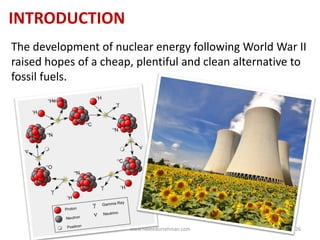
The development of nuclear energy following World War II
raised hopes of a cheap, plentiful and clean alternative to
fossil fuels.
www.naveedurrehman.com 26
INTRODUCTION
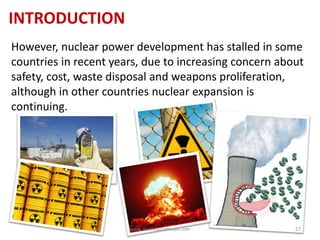
However, nuclear power development has stalled in some
countries in recent years, due to increasing concern about
safety, cost, waste disposal and weapons proliferation,
although in other countries nuclear expansion is
continuing.
www.naveedurrehman.com 27
INTRODUCTION
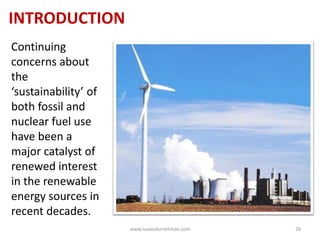
Continuing
concerns about
the
‘sustainability’ of
both fossil and
nuclear fuel use
have been a
major catalyst of
renewed interest
in the renewable
energy sources in
recent decades.
www.naveedurrehman.com 28
INTRODUCTION
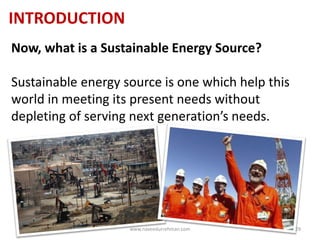
Now, what is a Sustainable Energy Source?
Sustainable energy source is one which help this
world in meeting its present needs without
depleting of serving next generation’s needs.
www.naveedurrehman.com 29
INTRODUCTION
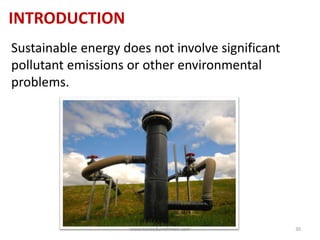
Sustainable energy does not involve significant
pollutant emissions or other environmental
problems.
www.naveedurrehman.com 30
INTRODUCTION
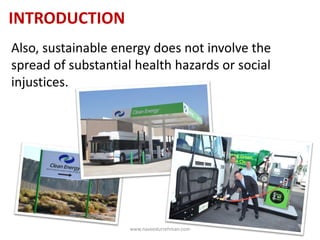
Also, sustainable energy does not involve the
spread of substantial health hazards or social
injustices.
www.naveedurrehman.com 31
INTRODUCTION
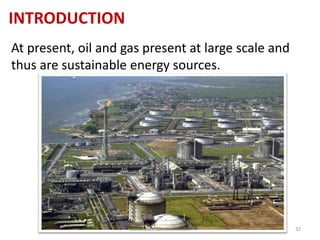
At present, oil and gas present at large scale and
thus are sustainable energy sources.
www.naveedurrehman.com 32
INTRODUCTION
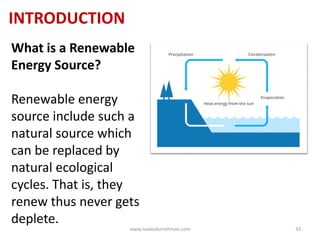
What is a Renewable
Energy Source?
Renewable energy
source include such a
natural source which
can be replaced by
natural ecological
cycles. That is, they
renew thus never gets
deplete.
www.naveedurrehman.com 33
INTRODUCTION
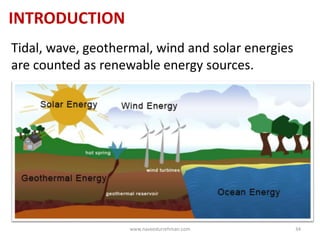
Tidal, wave, geothermal, wind and solar energies
are counted as renewable energy sources.
www.naveedurrehman.com 34
INTRODUCTION
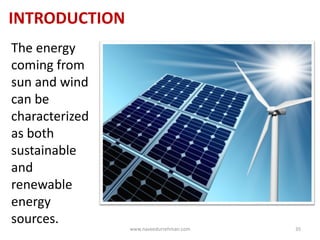
The energy
coming from
sun and wind
can be
characterized
as both
sustainable
and
renewable
energy
sources.
www.naveedurrehman.com 35
This is only the introduction part of a very
big presentation.
Please download the full version from here:
https://goo.gl/bXRLGd
www.naveedurrehman.com 36
www.naveedurrehman.com 37

Renewable Energy Systems

  • 1.
  • 2.
    This is onlythe introduction part of a very big presentation. Please download the full version from here: https://goo.gl/bXRLGd www.naveedurrehman.com 2
  • 3.
    RENEWABLE ENERGY SYSTEMS Outline 1.Introduction 2. Solar Energy 3. Wind Energy 4. Hydropower 5. Biomass Energy 6. Geothermal Energy 7. Wave and Tidal Energywww.naveedurrehman.com 3
  • 4.
    RENEWABLE ENERGY SYSTEMS Introduction •Comparison of different forms of energy • National and global patterns of energy supply and utilization • Temperature and other climate impacts www.naveedurrehman.com 4
  • 5.
    RENEWABLE ENERGY SYSTEMS SolarEnergy • Solar radiations • Passive and active solar thermal energy system • Solar thermal applications • Water and space heating • Solar ponds, dryers and distillation • Solar thermal electric systems • Photovoltaic cells • Storage system www.naveedurrehman.com 5
  • 6.
    RENEWABLE ENERGY SYSTEMS WindEnergy • Wind resources and characteristics • Wind machinery and generating systems • Wind turbine types: horizontal axis & vertical axis • Betz conditions • Effects of solidity • Controlling and optimizing wind turbine performance www.naveedurrehman.com 6
  • 7.
    RENEWABLE ENERGY SYSTEMS Hydropower •Basic energy conversion principle • Conversion equipment and engineering operations • Hydraulic machine types • Affinity laws and specific speed related to rotodynamic machines www.naveedurrehman.com 7
  • 8.
    RENEWABLE ENERGY SYSTEMS BiomassEnergy • Biomass resources and biofuels production • Properties relevant to energy production • Thermal conversion of biomass • Biochemical conversion: anaerobic digestion, fermentation to alcohol, physical processing and briquetting • Combustion process • Use of biomass derived fuelswww.naveedurrehman.com 8
  • 9.
    RENEWABLE ENERGY SYSTEMS GeothermalEnergy • Geophysics of the earth’s interior • Hydrothermal and geo-pressured systems • Equipment for recovering energy • Direct heat utilization and electric power generation www.naveedurrehman.com 9
  • 10.
    RENEWABLE ENERGY SYSTEMS Waveand Tidal Energy • Energy from tides, waves and temperature differences • Economic prospects • Environmental and sustainability considerations • Types of equipment for extracting wave and tidal energy www.naveedurrehman.com 10
  • 11.
    RENEWABLE ENERGY SYSTEMS Books •John Twidell and Tony Weir, “Renewable Energy Resources”, Routledge, 2014. • Godfrey Boyle, “Renewable Energy: Power for a Sustainable Future”, Oxford University Press, 2004. www.naveedurrehman.com 11
  • 12.
  • 13.
    INTRODUCTION All the renewableenergy sources are principally derived from the enormous power of Sun's radiation. www.naveedurrehman.com 13
  • 14.
    INTRODUCTION These renewable energysources are at once, the most ancient and now, the most modern forms of energy used by humanity. www.naveedurrehman.com 14
  • 15.
    INTRODUCTION Solar power isone of the ultimate sources of energy upon which early human societies were based. www.naveedurrehman.com 15
  • 16.
    INTRODUCTION When our ancestorsfirst used fire, they were harnessing the power of photosynthesis which is a solar driven process by which plants are created from water and atmospheric carbon dioxide. www.naveedurrehman.com 16
  • 17.
    INTRODUCTION Societies went onto develop ways of harnessing the movements of water and wind to grind corn, irrigate crops and propel ships. www.naveedurrehman.com 17
  • 18.
    INTRODUCTION Both the naturalmovements of water and wind are caused by solar heating of the oceans and atmosphere. www.naveedurrehman.com 18
  • 19.
    INTRODUCTION As civilizations becamemore sophisticated, architects began to design buildings to take advantage of the Sun’s energy by enhancing their natural use of its heat and light, so reducing the need for artificial sources of warmth and illumination. www.naveedurrehman.com 19
  • 20.
    INTRODUCTION Technologies for harnessingthe power of Sun, water and wind continued to improve right up to the early years of the industrial revolution. www.naveedurrehman.com 20
  • 21.
    INTRODUCTION However, by thenthe advantages of coal, the first of the fossil fuels to be exploited on a large scale, had become apparent. www.naveedurrehman.com 21
  • 22.
    INTRODUCTION These highly-concentrated energysources soon displaced wood, wind and water in the homes, industries and transport systems of the industrial nations. www.naveedurrehman.com 22
  • 23.
    INTRODUCTION Today the fossilfuel trio of coal, natural gas and oil provide over 80% of the world’s energy. www.naveedurrehman.com 23
  • 24.
    INTRODUCTION Concerns about theadverse environmental and social consequences of fossil fuel use, such as air pollution, oil spills, mining accidents, deforestation and about the finite nature of supplies, have been voiced intermittently for several centuries. www.naveedurrehman.com 24
  • 25.
    INTRODUCTION But it wasnot until the 1970s, with the steep price rises of the ‘oil crisis’ and the advent of the environmental movement, that humanity began to take more seriously the prospect of fossil fuels ‘running out’, and the possibility that their continued use could be destabilizing the planet’s natural ecosystems and the global climate. www.naveedurrehman.com 25
  • 26.
    INTRODUCTION The development ofnuclear energy following World War II raised hopes of a cheap, plentiful and clean alternative to fossil fuels. www.naveedurrehman.com 26
  • 27.
    INTRODUCTION However, nuclear powerdevelopment has stalled in some countries in recent years, due to increasing concern about safety, cost, waste disposal and weapons proliferation, although in other countries nuclear expansion is continuing. www.naveedurrehman.com 27
  • 28.
    INTRODUCTION Continuing concerns about the ‘sustainability’ of bothfossil and nuclear fuel use have been a major catalyst of renewed interest in the renewable energy sources in recent decades. www.naveedurrehman.com 28
  • 29.
    INTRODUCTION Now, what isa Sustainable Energy Source? Sustainable energy source is one which help this world in meeting its present needs without depleting of serving next generation’s needs. www.naveedurrehman.com 29
  • 30.
    INTRODUCTION Sustainable energy doesnot involve significant pollutant emissions or other environmental problems. www.naveedurrehman.com 30
  • 31.
    INTRODUCTION Also, sustainable energydoes not involve the spread of substantial health hazards or social injustices. www.naveedurrehman.com 31
  • 32.
    INTRODUCTION At present, oiland gas present at large scale and thus are sustainable energy sources. www.naveedurrehman.com 32
  • 33.
    INTRODUCTION What is aRenewable Energy Source? Renewable energy source include such a natural source which can be replaced by natural ecological cycles. That is, they renew thus never gets deplete. www.naveedurrehman.com 33
  • 34.
    INTRODUCTION Tidal, wave, geothermal,wind and solar energies are counted as renewable energy sources. www.naveedurrehman.com 34
  • 35.
    INTRODUCTION The energy coming from sunand wind can be characterized as both sustainable and renewable energy sources. www.naveedurrehman.com 35
  • 36.
    This is onlythe introduction part of a very big presentation. Please download the full version from here: https://goo.gl/bXRLGd www.naveedurrehman.com 36
  • 37.