Tibial tubercle transposition in treatment of
patellofemoral malalignment:
anteromedialization versus distomedialization.
Clinical and functional outcome comparison.
Dei Giudici L, Enea D, Fravisini M, Canè PP, Gigante A
DISCLOSURE
None of the Authors have conflict of
interest to declare
BACKGROUND
Patello femoral malalignment can be:
 Static:
 Alteration of passive joint stabilizers
 Trochlear dysplasia
 Increased TTTG
 Increased femoral and/or tibial torsion
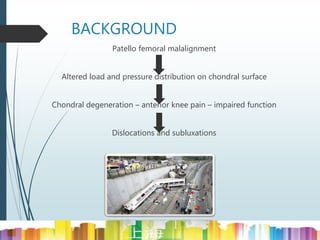
 Valgus / Varus Knee
 Dynamic:
 Umbalanced muscular forces
BACKGROUND
Patello femoral malalignment
Altered load and pressure distribution on chondral surface
Chondral degeneration – anterior knee pain – impaired function
Dislocations and subluxations
BACKGROUND
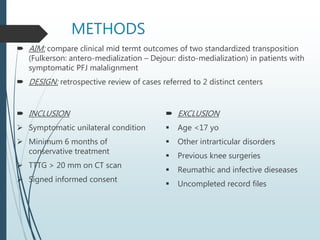
Symptomatic patello femoral malalignment = surgical correction of the cause
- Altered TTTG
- Patella Alta
Tibial tubercle
transposition
Elmslie-Trillat Fulkerson
Hauser
Maquet
?No
gold
standard
METHODS
 AIM: compare clinical mid termt outcomes of two standardized transposition
(Fulkerson: antero-medialization – Dejour: disto-medialization) in patients with
symptomatic PFJ malalignment
 DESIGN: retrospective review of cases referred to 2 distinct centers
 INCLUSION
 Symptomatic unilateral condition
 Minimum 6 months of
conservative treatment
 TTTG > 20 mm on CT scan
 Signed informed consent
 EXCLUSION
 Age <17 yo
 Other intrarticular disorders
 Previous knee surgeries
 Reumathic and infective dieseases
 Uncompleted record files
METHODS
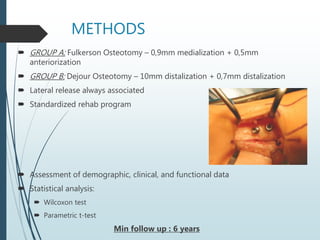
 GROUP A: Fulkerson Osteotomy – 0,9mm medialization + 0,5mm
anteriorization
 GROUP B: Dejour Osteotomy – 10mm distalization + 0,7mm distalization
 Lateral release always associated
 Standardized rehab program
 Assessment of demographic, clinical, and functional data
 Statistical analysis:
 Wilcoxon test
 Parametric t-test
Min follow up : 6 years
RESULTS
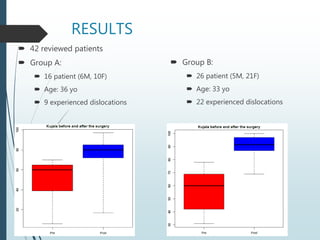
 42 reviewed patients
 Group A:
 16 patient (6M, 10F)
 Age: 36 yo
 9 experienced dislocations
 Group B:
 26 patient (5M, 21F)
 Age: 33 yo
 22 experienced dislocations
RESULTS
0
10
20
30
40
50
60
70
80
90
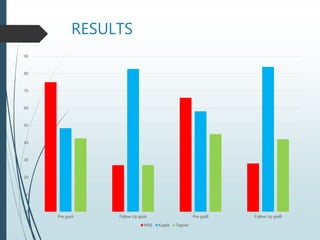
Pre grpA Follow Up grpA Pre grpB Follow Up grpB
NRS Kujala Tegner
RESULTS
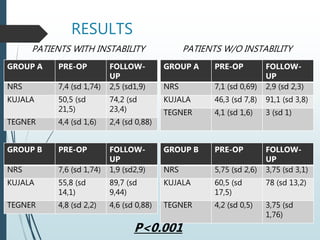
GROUP A PRE-OP FOLLOW-
UP
NRS 7,1 (sd 0,69) 2,9 (sd 2,3)
KUJALA 46,3 (sd 7,8) 91,1 (sd 3,8)
TEGNER 4,1 (sd 1,6) 3 (sd 1)
P<0.001
GROUP A PRE-OP FOLLOW-
UP
NRS 7,4 (sd 1,74) 2,5 (sd1,9)
KUJALA 50,5 (sd
21,5)
74,2 (sd
23,4)
TEGNER 4,4 (sd 1,6) 2,4 (sd 0,88)
GROUP B PRE-OP FOLLOW-
UP
NRS 5,75 (sd 2,6) 3,75 (sd 3,1)
KUJALA 60,5 (sd
17,5)
78 (sd 13,2)
TEGNER 4,2 (sd 0,5) 3,75 (sd
1,76)
GROUP B PRE-OP FOLLOW-
UP
NRS 7,6 (sd 1,74) 1,9 (sd2,9)
KUJALA 55,8 (sd
14,1)
89,7 (sd
9,44)
TEGNER 4,8 (sd 2,2) 4,6 (sd 0,88)
PATIENTS WITH INSTABILITY PATIENTS W/O INSTABILITY
CONCLUSIONS
 Outcome overlapping for anteromedialization and
distomedialization
 Patients with stable PFJ have a limited effect from a distalization
surgerie. It should be associated to other surgical concomitant
procedures
 The lack of significant differences between group A and B, despite
the good outcomes obtained at the final follow up, can be
explained by the unloading of the articular cartilage
 The «perfect transposition» requires an extensive pre-op planning,
and should be tailored on the individual patient
ESSENTIAL BIBLIOGRAPHY
• Luyckx T, Didden K, Vandenneucker H, Labey L, Innocenti B, Bellemans J. Is there a biomechanical
explanation for anterior knee pain in patients with patella alta? Influence of patellar height on
patellofemoral contact force, contact area and contact pressure. J Bone Joint Surg Br. 2009;91:344–50
• Stefanik JJ, Zhu Y, Zumwalt AC, Gross KD, Clancy M, Lynch JA, Frey Law LA, Lewis CE, Roemer FW,
Powers CM, Guermazi A, Felson DT. Association between patella alta and the prevalence and
worsening of structural features of patellofemoral joint osteoarthritis: the multicenter osteoarthritis
study. Arthritis Care Res (Hoboken). 2010;62:1258–65.
• Dejour DH. The patellofemoral joint and its historical roots: the Lyon School of Knee Surgery. Knee
Surg Sports Traumatol Arthrosc. 2013;21(7):1482-1494
• Dei Giudici L, Enea D, Pierdicca L, Cecconi S, Ulisse S, Arima S, Giovagnoni A, Gigante A. Evaluation of
patello-femoral alignment by CT scans: interobserver reliability of several parameters. Radiol Med
2015 DOI: 10,007/s11547-015-0536-y
• Naveed MA, Ackroyd CE, Porteous AJ (2013) Long-term (10–15-year) outcome of arthroscopically
assisted Elmslie-Trillat tibial tubercle osteotomy. Bone Jt J 95-B:478–485
• Dejour D, Nove’-Jovesserand L, Walch G. Patellofemoral disorders-classification and an approach to
operative treatment for instability. Controversies in Orthopedic Sports Medicine 1998;22:235-44.

Tibial tubercle transposition for patellofemoral malalignment

  • 1.
    Tibial tubercle transpositionin treatment of patellofemoral malalignment: anteromedialization versus distomedialization. Clinical and functional outcome comparison. Dei Giudici L, Enea D, Fravisini M, Canè PP, Gigante A
  • 2.
    DISCLOSURE None of theAuthors have conflict of interest to declare
  • 3.
    BACKGROUND Patello femoral malalignmentcan be:  Static:  Alteration of passive joint stabilizers  Trochlear dysplasia  Increased TTTG  Increased femoral and/or tibial torsion  Valgus / Varus Knee  Dynamic:  Umbalanced muscular forces
  • 4.
    BACKGROUND Patello femoral malalignment Alteredload and pressure distribution on chondral surface Chondral degeneration – anterior knee pain – impaired function Dislocations and subluxations
  • 5.
    BACKGROUND Symptomatic patello femoralmalalignment = surgical correction of the cause - Altered TTTG - Patella Alta Tibial tubercle transposition Elmslie-Trillat Fulkerson Hauser Maquet ?No gold standard
  • 6.
    METHODS  AIM: compareclinical mid termt outcomes of two standardized transposition (Fulkerson: antero-medialization – Dejour: disto-medialization) in patients with symptomatic PFJ malalignment  DESIGN: retrospective review of cases referred to 2 distinct centers  INCLUSION  Symptomatic unilateral condition  Minimum 6 months of conservative treatment  TTTG > 20 mm on CT scan  Signed informed consent  EXCLUSION  Age <17 yo  Other intrarticular disorders  Previous knee surgeries  Reumathic and infective dieseases  Uncompleted record files
  • 7.
    METHODS  GROUP A:Fulkerson Osteotomy – 0,9mm medialization + 0,5mm anteriorization  GROUP B: Dejour Osteotomy – 10mm distalization + 0,7mm distalization  Lateral release always associated  Standardized rehab program  Assessment of demographic, clinical, and functional data  Statistical analysis:  Wilcoxon test  Parametric t-test Min follow up : 6 years
  • 8.
    RESULTS  42 reviewedpatients  Group A:  16 patient (6M, 10F)  Age: 36 yo  9 experienced dislocations  Group B:  26 patient (5M, 21F)  Age: 33 yo  22 experienced dislocations
  • 9.
    RESULTS 0 10 20 30 40 50 60 70 80 90 Pre grpA FollowUp grpA Pre grpB Follow Up grpB NRS Kujala Tegner
  • 10.
    RESULTS GROUP A PRE-OPFOLLOW- UP NRS 7,1 (sd 0,69) 2,9 (sd 2,3) KUJALA 46,3 (sd 7,8) 91,1 (sd 3,8) TEGNER 4,1 (sd 1,6) 3 (sd 1) P<0.001 GROUP A PRE-OP FOLLOW- UP NRS 7,4 (sd 1,74) 2,5 (sd1,9) KUJALA 50,5 (sd 21,5) 74,2 (sd 23,4) TEGNER 4,4 (sd 1,6) 2,4 (sd 0,88) GROUP B PRE-OP FOLLOW- UP NRS 5,75 (sd 2,6) 3,75 (sd 3,1) KUJALA 60,5 (sd 17,5) 78 (sd 13,2) TEGNER 4,2 (sd 0,5) 3,75 (sd 1,76) GROUP B PRE-OP FOLLOW- UP NRS 7,6 (sd 1,74) 1,9 (sd2,9) KUJALA 55,8 (sd 14,1) 89,7 (sd 9,44) TEGNER 4,8 (sd 2,2) 4,6 (sd 0,88) PATIENTS WITH INSTABILITY PATIENTS W/O INSTABILITY
  • 11.
    CONCLUSIONS  Outcome overlappingfor anteromedialization and distomedialization  Patients with stable PFJ have a limited effect from a distalization surgerie. It should be associated to other surgical concomitant procedures  The lack of significant differences between group A and B, despite the good outcomes obtained at the final follow up, can be explained by the unloading of the articular cartilage  The «perfect transposition» requires an extensive pre-op planning, and should be tailored on the individual patient
  • 12.
    ESSENTIAL BIBLIOGRAPHY • LuyckxT, Didden K, Vandenneucker H, Labey L, Innocenti B, Bellemans J. Is there a biomechanical explanation for anterior knee pain in patients with patella alta? Influence of patellar height on patellofemoral contact force, contact area and contact pressure. J Bone Joint Surg Br. 2009;91:344–50 • Stefanik JJ, Zhu Y, Zumwalt AC, Gross KD, Clancy M, Lynch JA, Frey Law LA, Lewis CE, Roemer FW, Powers CM, Guermazi A, Felson DT. Association between patella alta and the prevalence and worsening of structural features of patellofemoral joint osteoarthritis: the multicenter osteoarthritis study. Arthritis Care Res (Hoboken). 2010;62:1258–65. • Dejour DH. The patellofemoral joint and its historical roots: the Lyon School of Knee Surgery. Knee Surg Sports Traumatol Arthrosc. 2013;21(7):1482-1494 • Dei Giudici L, Enea D, Pierdicca L, Cecconi S, Ulisse S, Arima S, Giovagnoni A, Gigante A. Evaluation of patello-femoral alignment by CT scans: interobserver reliability of several parameters. Radiol Med 2015 DOI: 10,007/s11547-015-0536-y • Naveed MA, Ackroyd CE, Porteous AJ (2013) Long-term (10–15-year) outcome of arthroscopically assisted Elmslie-Trillat tibial tubercle osteotomy. Bone Jt J 95-B:478–485 • Dejour D, Nove’-Jovesserand L, Walch G. Patellofemoral disorders-classification and an approach to operative treatment for instability. Controversies in Orthopedic Sports Medicine 1998;22:235-44.