MACI VERSUS TECNICHE «ONE STEP»:MACI VERSUS TECNICHE «ONE STEP»:
RISULTATI ARTROSCOPICI E BIOPTICI ARISULTATI ARTROSCOPICI E BIOPTICI A
CONFRONTOCONFRONTO
Luca Dei GiudiciLuca Dei Giudici, S. Cecconi, A. Gigante
Clinica Ortopedica, Università Politecnica delle MarcheClinica Ortopedica, Università Politecnica delle Marche
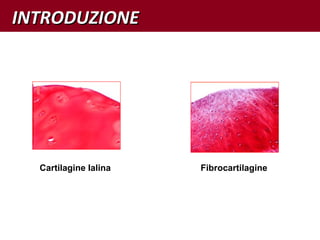
Cartilagine Ialina Fibrocartilagine
INTRODUZIONEINTRODUZIONE
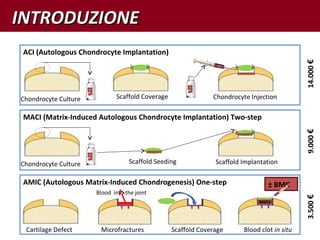
Chondrocyte Culture Scaffold Seeding Scaffold Implantation
MACI (Matrix-Induced Autologous Chondrocyte Implantation) Two-step
Chondrocyte Culture Scaffold Coverage Chondrocyte Injection
ACI (Autologous Chondrocyte Implantation)
Cartilage Defect Microfractures Scaffold Coverage Blood clot in situ
Blood into the joint
AMIC (Autologous Matrix-Induced Chondrogenesis) One-step ± BMC
MSCs
14.000€9.000€3.500€
INTRODUZIONEINTRODUZIONE
• Solo pochi studi in letteratura di sono focalizzati sulla
quantificazione dei risultati istologici dopo impianti ACI
Briggs TW, Mahroof S, David LA, Flannelly J, Pringle J, Bayliss M (2003) Histological evaluation of chondral defects after autologous
chondrocyte implantation of the knee. J Bone Joint Surg Br 85:1077-83
Brun P, Dickinson SC, Zavan B, Cortivo R, Hollander AP, Abatangelo G (2008) Characteristics of repair tissue in second-look and third-look
biopsies from patients treated with engineered cartilage: relationship to symptomatology and time after implantation. Arthritis Res
Ther 10:R132
Henderson I, Lavigne P, Valenzuela H, Oakes B (2007) Autologous chondrocyte implantation: superior biologic properties of hyaline cartilage
repairs. Clin Orthop Relat Res 455:253-61
Roberts S, McCall IW, Darby AJ, Menage J, Evans H, Harrison PE, Richardson JB (2003) Autologous chondrocyte implantation for cartilage
repair: monitoring its success by magnetic resonance imaging and histology. Arthritis Res Ther 5:R60-73
Roberts S, Menage J, Sandell LJ, Evans EH, Richardson JB (2009) Immunohistochemical study of collagen types I and II and procollagen IIA in
human cartilage repair tissue following autologous chondrocyte implantation. Knee 16:398-404
• Un solo studio ha analizzato biopsie di pazienti sottoposti a MACI
Zheng MH, Willers C, Kirilak L, Yates P, Xu J, Wood D, Shimmin A (2007) Matrix-induced autologous chondrocyte implantation (MACI): biological and
histological assessment. Tissue Eng 13:737-46
• Quasi niente si conosce dei risultati di tecniche One-step ± BMC
Giannini S, Buda R, Vannini F, Cavallo M, Grigolo B. One-step bone marrow-derived cell transplantation in talar osteochondral lesions. Clin
Orthop Relat Res 2009; 467:3307-20.
Saw KY, Anz A, Merican S, Tay YG, Ragavanaidu K, Jee CS, McGuire DA. Articular Cartilage Regeneration With Autologous Peripheral
Blood Progenitor Cells and Hyaluronic Acid After Arthroscopic Subchondral Drilling: A Report of 5 Cases With Histology.
Arthroscopy 2011 [Epub ahead of print]
INTRODUZIONEINTRODUZIONE
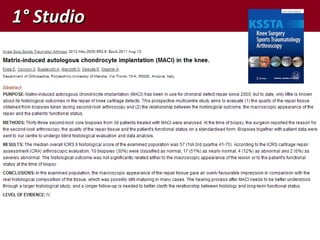
• 1° Studio:
Valutazione clinico-istologica
MACI
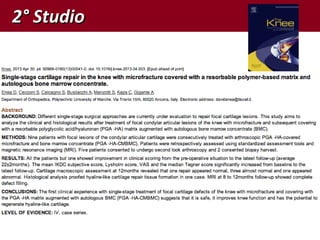
• 2° Studio:
Valutazione clinico-istologica
AMIC
SCOPO DELLO STUDIOSCOPO DELLO STUDIO
1° Studio1° Studio
• Studio Retrospettivo Multicentrico (8 centri)
• 30 pazienti (M:F = 20:10, età media 43±7 anni) con
lesione grado III o IV sec. Outerbridge
• 33 lesioni (Med:Lat = 17:13) trattate per via artroscopica
mediante tecnica MACI
• second-look artroscopico (ICRS-CRA) con prelievo
bioptico (Histology ICRS II)
MATERIALI e METODI (MACI)MATERIALI e METODI (MACI)
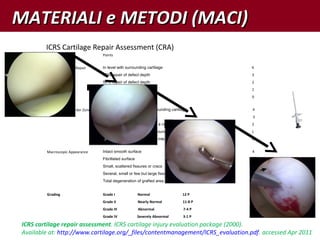
Criteria Points
Degree of Defect Repair In level with surrounding cartilage ….4
75% repair of defect depth 3
50% repair of defect depth 2
25% repair of defect depth 1
0% repair of defectdepth 0
Integration to Border Zone Complete integration with surrounding cartilage …………………………………… ….4
Demarcating border < 1mm 3
3/4 of graft integrated, 1/4 with a notable border >1mm width 2
1/2 of graft integrated with surrounding cartilage, 1/2 with a border > 1mm 1
From no contact to 1/4 of graft integrated with surrounding cartilage 0
Macroscopic Appearance Intact smooth surface 4
Fibrillated surface 3
Small, scattered fissures or cracs 2
Several, small or few but large fissures ..1
Total degeneration of grafted area 0
Grading Grade I Normal 12 P
Grade II Nearly Normal 11-8 P
Grade III Abnormal 7-4 P
Grade IV Severely Abnormal 3-1 P
ICRS Cartilage Repair Assessment (CRA)
ICRS cartilage repair assessment. ICRS cartilage injury evaluation package (2000).
Available at: http://www.cartilage.org/_files/contentmanagement/ICRS_evaluation.pdf. accessed Apr 2011
MATERIALI e METODI (MACI)MATERIALI e METODI (MACI)
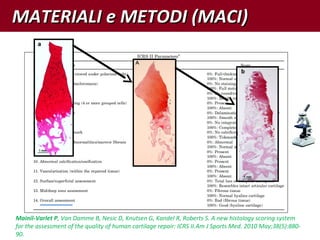
Mainil-Varlet P, Van Damme B, Nesic D, Knutsen G, Kandel R, Roberts S. A new histology scoring system
for the assessment of the quality of human cartilage repair: ICRS II.Am J Sports Med. 2010 May;38(5):880-
90.
MATERIALI e METODI (MACI)MATERIALI e METODI (MACI)
RISULTATI (MACI)RISULTATI (MACI)
• CRA
10 normal
17 near-normal
4 abnormal
2 severly abnormal
• ICRS II
7 Hyaline like
24 Mixture
2 Fibrous
Nessuna
correlazione
Risultati Istologici -
Macroscopici
2° Studio2° Studio
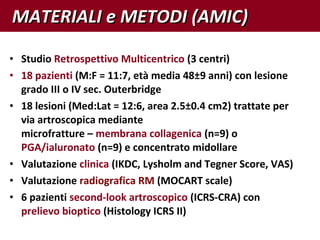
• Studio Retrospettivo Multicentrico (3 centri)
• 18 pazienti (M:F = 11:7, età media 48±9 anni) con lesione
grado III o IV sec. Outerbridge
• 18 lesioni (Med:Lat = 12:6, area 2.5±0.4 cm2) trattate per
via artroscopica mediante
microfratture – membrana collagenica (n=9) o
PGA/ialuronato (n=9) e concentrato midollare
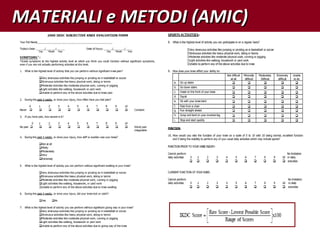
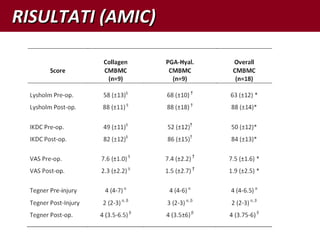
• Valutazione clinica (IKDC, Lysholm and Tegner Score, VAS)
• Valutazione radiografica RM (MOCART scale)
• 6 pazienti second-look artroscopico (ICRS-CRA) con
prelievo bioptico (Histology ICRS II)
MATERIALI e METODI (AMIC)MATERIALI e METODI (AMIC)
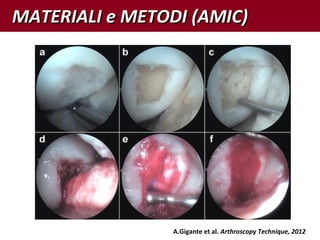
A.Gigante et al. Arthroscopy Technique, 2012
MATERIALI e METODI (AMIC)MATERIALI e METODI (AMIC)
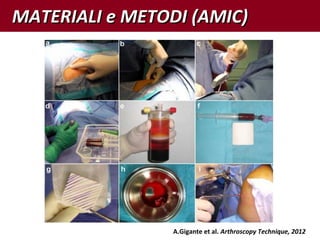
A.Gigante et al. Arthroscopy Technique, 2012
MATERIALI e METODI (AMIC)MATERIALI e METODI (AMIC)
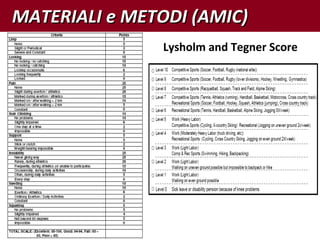
Lysholm and Tegner Score
MATERIALI e METODI (AMIC)MATERIALI e METODI (AMIC)
MATERIALI e METODI (AMIC)MATERIALI e METODI (AMIC)nal of Radiology 57 (2006) 16–23
Table 2
Cartilage repair tissue grading scale (MOCART)
Variables
1. Degree of defect repair and filling of the defect
Complete (on a level with adjacent cartilage)
Hypertrophy (over the level of the adjacent cartilage)
Incomplete (under the level of the adjacent cartilage; underfilling)
>50% of the adjacent cartilage
<50% of the adjacent cartilage
Subchondral bone exposed (complete delamination or dislocation
and/or loose body)
2. Integration to border zone
Complete (complete integration with adjacent cartilage)
Incomplete (incomplete integration with adjacent cartilage)
Demarcating border visible (split-like)
Defect visible
<50% of the length of the repair tissue
>50% of the length of the repair tissue
3. Surface of the repair tissue
Surface intact (lamina splendens intact)
Surface damaged (fibrillations, fissures and ulcerations)
<50% of repair tissue depth
>50% of repair tissue depth or total degeneration
4. Structure of the repair tissue
Homogenous
Inhomogenous or cleft formation
ondral bone plate and marrow. The signal intensity
repair tissue was separately determined in fast spin-
(dual T2-FSE) and fat-suppressed gradient-echo (3D-
S) sequences and a complete repair was graded as
ense if it appeared as intense as the adjacent native
ge.
cording to the first published classification system,
marginal modifications were performed to obtain repro-
e results and clear definitions. Thus, the variable syn-
was modified to the variable effusion. The appearance
usion is defined when the accumulation of fluid in the
ial joint increases more than 1 cm in any section of the
Clinical outcome
r the description of the clinical outcome of the patients,
sed a standardized evaluation system, which was
ned for the description of cartilage repair procedures
ationwide registry (CARRERA: Cartilage Repair Reg-
Austria). This system includes subjective and objective
me scores and provides a computerized analysis tool.
e analysis used in this study, subjective patient evalua-
f validated scores were used, specifically, visual analog
(VAS) and knee injury and osteoarthritis outcome score
S) [15–17]. KOOS is a 42-item self-administered, self-
natory questionnaire that covers five patient-relevant
>50% of repair tissue depth or total degeneration
4. Structure of the repair tissue
Homogenous
Inhomogenous or cleft formation
5. Signal intensity of the repair tissue
Dual T2-FSE
Isointense
Moderately hyperintense
Markedly hyperintense
3D-GE-FS
Isointense
Moderately hypointense
Markedly hypointense
6. Subchondral lamina
Intact
Not intact
7. Subchondral bone
Intact
Non-intact (edema, granulation tissue, cysts, sclerosis)
8. Ahesions
No
Yes
9. Effusion
No
Yes
s r e p r e s e n t a t i v e o f t h e a v e r a g e q u a l i t y o f c a r t i l a g e r e p a i r . a , b T h e T 1 c o r o n a l
p o s t - o p e r a t i v e l y ) o f t h e l e f t k n e e s h o w c o m p l e t e d e f e c t f i l l i n g o f t h e m e d i a l
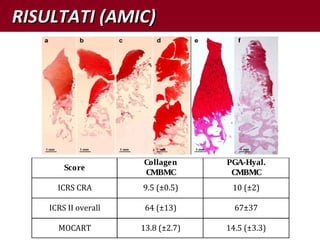
RISULTATI (AMIC)RISULTATI (AMIC)
Score
Collagen
CMBMC
PGA-Hyal.
CMBMC
ICRS CRA 9.5 (±0.5) 10 (±2)
ICRS II overall 64 (±13) 67±37
MOCART 13.8 (±2.7) 14.5 (±3.3)
DISCUSSIONEDISCUSSIONE
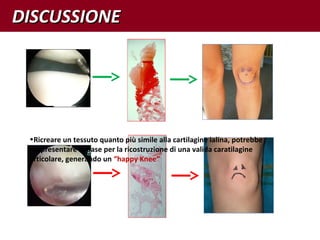
•Ricreare un tessuto quanto più simile alla cartilagine ialina, potrebbe
rappresentare la base per la ricostruzione di una valida caratilagine
articolare, generando un “happy Knee”
CONCLUSIONICONCLUSIONI
• Migliora la funzionalità clinica a medio
termine (follow-up 12 mesi)
• Potenzialità ricreare tessuto hyaline-like
• Necessità di studi clinici prospettici con
ampie casistiche di confronto
Tecnica MACI versus le tecniche one step

Tecnica MACI versus le tecniche one step

  • 1.
    MACI VERSUS TECNICHE«ONE STEP»:MACI VERSUS TECNICHE «ONE STEP»: RISULTATI ARTROSCOPICI E BIOPTICI ARISULTATI ARTROSCOPICI E BIOPTICI A CONFRONTOCONFRONTO Luca Dei GiudiciLuca Dei Giudici, S. Cecconi, A. Gigante Clinica Ortopedica, Università Politecnica delle MarcheClinica Ortopedica, Università Politecnica delle Marche
  • 2.
  • 3.
    Chondrocyte Culture ScaffoldSeeding Scaffold Implantation MACI (Matrix-Induced Autologous Chondrocyte Implantation) Two-step Chondrocyte Culture Scaffold Coverage Chondrocyte Injection ACI (Autologous Chondrocyte Implantation) Cartilage Defect Microfractures Scaffold Coverage Blood clot in situ Blood into the joint AMIC (Autologous Matrix-Induced Chondrogenesis) One-step ± BMC MSCs 14.000€9.000€3.500€ INTRODUZIONEINTRODUZIONE
  • 4.
    • Solo pochistudi in letteratura di sono focalizzati sulla quantificazione dei risultati istologici dopo impianti ACI Briggs TW, Mahroof S, David LA, Flannelly J, Pringle J, Bayliss M (2003) Histological evaluation of chondral defects after autologous chondrocyte implantation of the knee. J Bone Joint Surg Br 85:1077-83 Brun P, Dickinson SC, Zavan B, Cortivo R, Hollander AP, Abatangelo G (2008) Characteristics of repair tissue in second-look and third-look biopsies from patients treated with engineered cartilage: relationship to symptomatology and time after implantation. Arthritis Res Ther 10:R132 Henderson I, Lavigne P, Valenzuela H, Oakes B (2007) Autologous chondrocyte implantation: superior biologic properties of hyaline cartilage repairs. Clin Orthop Relat Res 455:253-61 Roberts S, McCall IW, Darby AJ, Menage J, Evans H, Harrison PE, Richardson JB (2003) Autologous chondrocyte implantation for cartilage repair: monitoring its success by magnetic resonance imaging and histology. Arthritis Res Ther 5:R60-73 Roberts S, Menage J, Sandell LJ, Evans EH, Richardson JB (2009) Immunohistochemical study of collagen types I and II and procollagen IIA in human cartilage repair tissue following autologous chondrocyte implantation. Knee 16:398-404 • Un solo studio ha analizzato biopsie di pazienti sottoposti a MACI Zheng MH, Willers C, Kirilak L, Yates P, Xu J, Wood D, Shimmin A (2007) Matrix-induced autologous chondrocyte implantation (MACI): biological and histological assessment. Tissue Eng 13:737-46 • Quasi niente si conosce dei risultati di tecniche One-step ± BMC Giannini S, Buda R, Vannini F, Cavallo M, Grigolo B. One-step bone marrow-derived cell transplantation in talar osteochondral lesions. Clin Orthop Relat Res 2009; 467:3307-20. Saw KY, Anz A, Merican S, Tay YG, Ragavanaidu K, Jee CS, McGuire DA. Articular Cartilage Regeneration With Autologous Peripheral Blood Progenitor Cells and Hyaluronic Acid After Arthroscopic Subchondral Drilling: A Report of 5 Cases With Histology. Arthroscopy 2011 [Epub ahead of print] INTRODUZIONEINTRODUZIONE
  • 5.
    • 1° Studio: Valutazioneclinico-istologica MACI • 2° Studio: Valutazione clinico-istologica AMIC SCOPO DELLO STUDIOSCOPO DELLO STUDIO
  • 6.
  • 7.
    • Studio RetrospettivoMulticentrico (8 centri) • 30 pazienti (M:F = 20:10, età media 43±7 anni) con lesione grado III o IV sec. Outerbridge • 33 lesioni (Med:Lat = 17:13) trattate per via artroscopica mediante tecnica MACI • second-look artroscopico (ICRS-CRA) con prelievo bioptico (Histology ICRS II) MATERIALI e METODI (MACI)MATERIALI e METODI (MACI)
  • 8.
    Criteria Points Degree ofDefect Repair In level with surrounding cartilage ….4 75% repair of defect depth 3 50% repair of defect depth 2 25% repair of defect depth 1 0% repair of defectdepth 0 Integration to Border Zone Complete integration with surrounding cartilage …………………………………… ….4 Demarcating border < 1mm 3 3/4 of graft integrated, 1/4 with a notable border >1mm width 2 1/2 of graft integrated with surrounding cartilage, 1/2 with a border > 1mm 1 From no contact to 1/4 of graft integrated with surrounding cartilage 0 Macroscopic Appearance Intact smooth surface 4 Fibrillated surface 3 Small, scattered fissures or cracs 2 Several, small or few but large fissures ..1 Total degeneration of grafted area 0 Grading Grade I Normal 12 P Grade II Nearly Normal 11-8 P Grade III Abnormal 7-4 P Grade IV Severely Abnormal 3-1 P ICRS Cartilage Repair Assessment (CRA) ICRS cartilage repair assessment. ICRS cartilage injury evaluation package (2000). Available at: http://www.cartilage.org/_files/contentmanagement/ICRS_evaluation.pdf. accessed Apr 2011 MATERIALI e METODI (MACI)MATERIALI e METODI (MACI)
  • 9.
    Mainil-Varlet P, VanDamme B, Nesic D, Knutsen G, Kandel R, Roberts S. A new histology scoring system for the assessment of the quality of human cartilage repair: ICRS II.Am J Sports Med. 2010 May;38(5):880- 90. MATERIALI e METODI (MACI)MATERIALI e METODI (MACI)
  • 10.
    RISULTATI (MACI)RISULTATI (MACI) •CRA 10 normal 17 near-normal 4 abnormal 2 severly abnormal • ICRS II 7 Hyaline like 24 Mixture 2 Fibrous Nessuna correlazione Risultati Istologici - Macroscopici
  • 11.
  • 12.
    • Studio RetrospettivoMulticentrico (3 centri) • 18 pazienti (M:F = 11:7, età media 48±9 anni) con lesione grado III o IV sec. Outerbridge • 18 lesioni (Med:Lat = 12:6, area 2.5±0.4 cm2) trattate per via artroscopica mediante microfratture – membrana collagenica (n=9) o PGA/ialuronato (n=9) e concentrato midollare • Valutazione clinica (IKDC, Lysholm and Tegner Score, VAS) • Valutazione radiografica RM (MOCART scale) • 6 pazienti second-look artroscopico (ICRS-CRA) con prelievo bioptico (Histology ICRS II) MATERIALI e METODI (AMIC)MATERIALI e METODI (AMIC)
  • 13.
    MATERIALI e METODI(AMIC)MATERIALI e METODI (AMIC) A.Gigante et al. Arthroscopy Technique, 2012
  • 14.
    MATERIALI e METODI(AMIC)MATERIALI e METODI (AMIC) A.Gigante et al. Arthroscopy Technique, 2012
  • 15.
    MATERIALI e METODI(AMIC)MATERIALI e METODI (AMIC) Lysholm and Tegner Score
  • 16.
    MATERIALI e METODI(AMIC)MATERIALI e METODI (AMIC)
  • 17.
    MATERIALI e METODI(AMIC)MATERIALI e METODI (AMIC)nal of Radiology 57 (2006) 16–23 Table 2 Cartilage repair tissue grading scale (MOCART) Variables 1. Degree of defect repair and filling of the defect Complete (on a level with adjacent cartilage) Hypertrophy (over the level of the adjacent cartilage) Incomplete (under the level of the adjacent cartilage; underfilling) >50% of the adjacent cartilage <50% of the adjacent cartilage Subchondral bone exposed (complete delamination or dislocation and/or loose body) 2. Integration to border zone Complete (complete integration with adjacent cartilage) Incomplete (incomplete integration with adjacent cartilage) Demarcating border visible (split-like) Defect visible <50% of the length of the repair tissue >50% of the length of the repair tissue 3. Surface of the repair tissue Surface intact (lamina splendens intact) Surface damaged (fibrillations, fissures and ulcerations) <50% of repair tissue depth >50% of repair tissue depth or total degeneration 4. Structure of the repair tissue Homogenous Inhomogenous or cleft formation ondral bone plate and marrow. The signal intensity repair tissue was separately determined in fast spin- (dual T2-FSE) and fat-suppressed gradient-echo (3D- S) sequences and a complete repair was graded as ense if it appeared as intense as the adjacent native ge. cording to the first published classification system, marginal modifications were performed to obtain repro- e results and clear definitions. Thus, the variable syn- was modified to the variable effusion. The appearance usion is defined when the accumulation of fluid in the ial joint increases more than 1 cm in any section of the Clinical outcome r the description of the clinical outcome of the patients, sed a standardized evaluation system, which was ned for the description of cartilage repair procedures ationwide registry (CARRERA: Cartilage Repair Reg- Austria). This system includes subjective and objective me scores and provides a computerized analysis tool. e analysis used in this study, subjective patient evalua- f validated scores were used, specifically, visual analog (VAS) and knee injury and osteoarthritis outcome score S) [15–17]. KOOS is a 42-item self-administered, self- natory questionnaire that covers five patient-relevant >50% of repair tissue depth or total degeneration 4. Structure of the repair tissue Homogenous Inhomogenous or cleft formation 5. Signal intensity of the repair tissue Dual T2-FSE Isointense Moderately hyperintense Markedly hyperintense 3D-GE-FS Isointense Moderately hypointense Markedly hypointense 6. Subchondral lamina Intact Not intact 7. Subchondral bone Intact Non-intact (edema, granulation tissue, cysts, sclerosis) 8. Ahesions No Yes 9. Effusion No Yes s r e p r e s e n t a t i v e o f t h e a v e r a g e q u a l i t y o f c a r t i l a g e r e p a i r . a , b T h e T 1 c o r o n a l p o s t - o p e r a t i v e l y ) o f t h e l e f t k n e e s h o w c o m p l e t e d e f e c t f i l l i n g o f t h e m e d i a l
  • 18.
  • 19.
    RISULTATI (AMIC)RISULTATI (AMIC) Score Collagen CMBMC PGA-Hyal. CMBMC ICRSCRA 9.5 (±0.5) 10 (±2) ICRS II overall 64 (±13) 67±37 MOCART 13.8 (±2.7) 14.5 (±3.3)
  • 20.
    DISCUSSIONEDISCUSSIONE •Ricreare un tessutoquanto più simile alla cartilagine ialina, potrebbe rappresentare la base per la ricostruzione di una valida caratilagine articolare, generando un “happy Knee”
  • 21.
    CONCLUSIONICONCLUSIONI • Migliora lafunzionalità clinica a medio termine (follow-up 12 mesi) • Potenzialità ricreare tessuto hyaline-like • Necessità di studi clinici prospettici con ampie casistiche di confronto

Editor's Notes

  • #7 Tutto parte dall’assunzione che la cartilagine ialina sia il presupposto per una funzione articolare normale….un happy knee
  • #12 Tutto parte dall’assunzione che la cartilagine ialina sia il presupposto per una funzione articolare normale….un happy knee
  • #21 Tutto parte dall’assunzione che la cartilagine ialina sia il presupposto per una funzione articolare normale….un happy knee