Adhesive	
  Capsuli.s	
  Debate:	
  
Hydrodistension	


Abbas	
  Rashid	
  FRCS	
  (Tr&Orth)	
  
Wrigh;ngton	
  Upper	
  Limb	
  Unit	
  
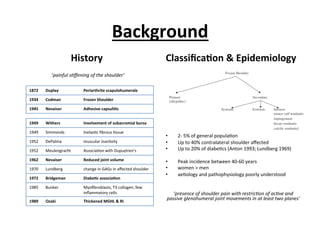
Background	
  
History	
  
	
  ‘painful	
  s*ffening	
  of	
  the	
  shoulder‘	
  
Classifica;on	
  &	
  Epidemiology	


•  2-­‐	
  5%	
  of	
  general	
  popula.on	
  	
  
•  Up	
  to	
  40%	
  contralateral	
  shoulder	
  affected	
  
•  Up	
  to	
  20%	
  of	
  diabe.cs	
  (Anton	
  1993;	
  Lundberg	
  1969)	
  
•  Peak	
  incidence	
  between	
  40-­‐60	
  years	
  
•  women	
  >	
  men	
  
•  ae.ology	
  and	
  pathophysiology	
  poorly	
  understood	


‘presence	
  of	
  shoulder	
  pain	
  with	
  restric*on	
  of	
  ac*ve	
  and	
  
passive	
  glenohumeral	
  joint	
  movements	
  in	
  at	
  least	
  two	
  planes’	
  
1872	
   Duplay	
   Periarthrite	
  scapulohumerale	
  
1934	
   Codman	
   Frozen	
  Shoulder	
  
1945	
   Nevaiser	
  	
   Adhesive	
  capsuli;s	
  
1949	
   Withers	
   Involvement	
  of	
  subacromial	
  bursa	
  	
  
1949	
   Simmonds	
   Inelas.c	
  fibrous	
  .ssue	
  	
  
1952	
   DePalma	
   muscular	
  inac.vity	
  
1952	
   Meulengracht	
   Associa.on	
  with	
  Dupuytren’s	
  
1962	
  	
   Nevaiser	
  	
   Reduced	
  joint	
  volume	
  
1970	
   Lundberg	
   change	
  in	
  GAGs	
  in	
  affected	
  shoulder	
  	
  
1972	
   Bridgeman	
  	
   Diabe;c	
  associa;on	
  
1985	
   Bunker	
   Myofibroblasts,	
  T3	
  collagen,	
  few	
  
inflammatory	
  cells	
  
1989	
   Ozaki	
   Thickened	
  MGHL	
  &	
  RI	
  
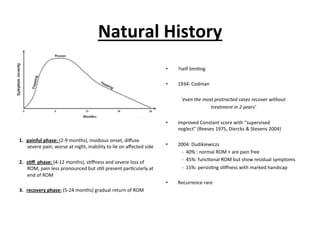
Natural	
  History	


1.  painful	
  phase:	
  (2-­‐9	
  months),	
  insidious	
  onset,	
  diffuse	
  
severe	
  pain,	
  worse	
  at	
  night,	
  inability	
  to	
  lie	
  on	
  affected	
  side	
  
2.  s;ff	
  	
  phase:	
  (4-­‐12	
  months),	
  s.ffness	
  and	
  severe	
  loss	
  of	
  
ROM,	
  pain	
  less	
  pronounced	
  but	
  s.ll	
  present	
  par.cularly	
  at	
  
end	
  of	
  ROM	
  
3.  recovery	
  phase:	
  (5-­‐24	
  months)	
  gradual	
  return	
  of	
  ROM	


•  ?self	
  limi.ng	
  
•  1934:	
  Codman	


‘even	
  the	
  most	
  protracted	
  cases	
  recover	
  without	
  	
  
treatment	
  in	
  2	
  years’	
  
•  improved	
  Constant	
  score	
  with	
  “supervised	
  
neglect”	
  (Reeves	
  1975,	
  Diercks	
  &	
  Stevens	
  2004)	


•  2004:	
  Dudikiewiczs	
  
	
  -­‐	
  	
  40%	
  :	
  normal	
  ROM	
  +	
  are	
  pain	
  free	
  
	
  -­‐	
  	
  45%:	
  func.onal	
  ROM	
  but	
  show	
  residual	
  symptoms	
  
	
  -­‐	
  	
  15%:	
  persis.ng	
  s.ffness	
  with	
  marked	
  handicap	


•  Recurrence	
  rare	
  	
  
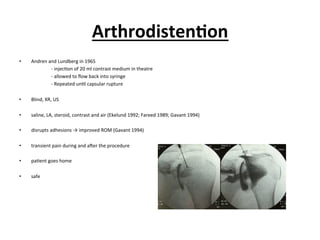
Arthrodisten;on	
  
•  Andren	
  and	
  Lundberg	
  in	
  1965	


  -­‐	
  injec.on	
  of	
  20	
  ml	
  contrast	
  medium	
  in	
  theatre	


  -­‐	
  allowed	
  to	
  flow	
  back	
  into	
  syringe	


  -­‐	
  Repeated	
  un.l	
  capsular	
  rupture	
  	
  
•  Blind,	
  XR,	
  US	
  
•  saline,	
  LA,	
  steroid,	
  contrast	
  and	
  air	
  (Ekelund	
  1992;	
  Fareed	
  1989;	
  Gavant	
  1994)	
  
•  disrupts	
  adhesions	
  →	
  improved	
  ROM	
  (Gavant	
  1994)	
  
•  transient	
  pain	
  during	
  and	
  aier	
  the	
  procedure	


•  pa.ent	
  goes	
  home	
  
•  safe	
  	
  
Cochrane	
  Review	
  2006	
  
•  update	
  of	
  1998	
  review	
  
•  Previously	
  no	
  arthrodistension	
  studies	


par%cipants	
  
•  adults	
  with	
  FS	
  
•  mixed	
  popula.ons	
  studies	
  included	
  if	
  FS	
  par.cipants	
  were	
  presented	
  separately	
  or	
  >	
  90%	
  of	
  par.cipants	
  in	
  the	
  study	
  
interven%ons	
  
•  Arthrodistension	
  vs.	
  placebo	
  or	
  other	
  interven.ons	
  
outcome	
  measures	
  
•  1o	
  outcomes:	
  pain	
  and	
  func.on/disability	
  assessment	
  
•  2o	
  measures:	
  ROM;	
  severity;	
  analgesic	
  use;	
  adverse	
  events;	
  .me	
  to	
  recovery	
  or	
  recurrence.	
  
•  November	
  1999	
  to	
  November	
  2006	
  
•  Combined	
  search	
  terms:	
  ‘adhesive	
  capsuli.s’	
  and	
  ‘arthrodistension’	


  1.	
  The	
  Cochrane	
  Musculoskeletal	
  Review	
  Group	
  Specialised	
  Register	


  2.	
  Cochrane	
  Central	
  Register	
  of	
  Controlled	
  Trials	
  (CENTRAL)	


  3.	
  MEDLINE	
  (OVID)	


  4.	
  EMBASE	
  (embase.com)	


  5.	
  CINAHL	
  (OVID)	


  6.	
  Reference	
  lists	
  in	
  review	
  ar.cles	
  and	
  trials	
  retrieved	


  7.	
  Personal	
  communica.on	
  with	
  experts	
  in	
  the	
  field	
  
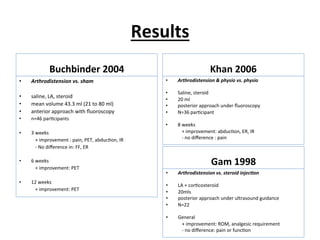
Results	
  	
  
Buchbinder	
  2004	
  
•  Arthrodistension	
  vs.	
  sham	
  
•  saline,	
  LA,	
  steroid	
  	
  
•  mean	
  volume	
  43.3	
  ml	
  (21	
  to	
  80	
  ml)	
  	
  
•  anterior	
  approach	
  with	
  fluoroscopy	
  
•  n=46	
  par.cipants	
  
•  3	
  weeks	
  
	
  +	
  improvement	
  :	
  pain,	
  PET,	
  abduc.on,	
  IR	


  -­‐	
  No	
  difference	
  in:	
  FF,	
  ER	


•  6	
  weeks	
  
	
  +	
  improvement:	
  PET	


•  12	
  weeks	
  
	
  +	
  improvement:	
  PET	
  
Khan	
  2006	
  
•  Arthrodistension	
  &	
  physio	
  vs.	
  physio	
  
•  Saline,	
  steroid	
  	
  
•  20	
  ml	
  	
  
•  posterior	
  approach	
  under	
  fluoroscopy	
  
•  N=36	
  par.cipant	


•  8	
  weeks	
  
	
  +	
  improvement:	
  abduc.on,	
  ER,	
  IR	


  -­‐	
  no	
  difference	
  :	
  pain	


Gam	
  1998	
  	
  
•  Arthrodistension	
  vs.	
  steroid	
  injec%on	
  
•  LA	
  +	
  cor.costeroid	
  	
  
•  20mls	
  	
  
•  posterior	
  approach	
  under	
  ultrasound	
  guidance	
  	
  
•  N=22	
  	
  
•  General	
  
	
  +	
  improvement:	
  ROM,	
  analgesic	
  requirement	


  -­‐	
  no	
  difference:	
  pain	
  or	
  func.on	


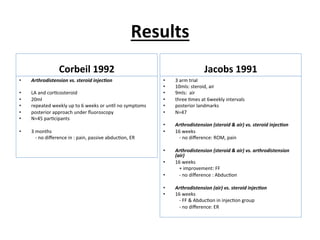
Results	
  
Corbeil	
  1992	
  	
  
•  Arthrodistension	
  vs.	
  steroid	
  injec%on	
  
•  LA	
  and	
  cor.costeroid	
  	
  
•  20ml	
  	
  
•  repeated	
  weekly	
  up	
  to	
  6	
  weeks	
  or	
  un.l	
  no	
  symptoms	
  
•  posterior	
  approach	
  under	
  fluoroscopy	
  
•  N=45	
  par.cipants	
  
•  3	
  months	
  
	
  -­‐	
  no	
  difference	
  in	
  :	
  pain,	
  passive	
  abduc.on,	
  ER	


Jacobs	
  1991	
  	
  
•  3	
  arm	
  trial	
  
•  10mls:	
  steroid,	
  air	
  	
  
•  9mls:	
  	
  air	
  	
  
•  three	
  .mes	
  at	
  6weekly	
  intervals	
  	
  
•  posterior	
  landmarks	
  
•  N=47	
  
•  Arthrodistension	
  (steroid	
  &	
  air)	
  vs.	
  steroid	
  injec%on	
  	
  
•  16	
  weeks	
  
	
  -­‐	
  no	
  difference:	
  ROM,	
  pain	


•  Arthrodistension	
  (steroid	
  &	
  air)	
  vs.	
  arthrodistension	
  
(air)	
  
•  16	
  weeks	


  +	
  improvement:	
  FF	
  
•  	
   -­‐	
  no	
  difference	
  :	
  Abduc.on	
  
•  Arthrodistension	
  (air)	
  vs.	
  steroid	
  injec%on	
  	
  
•  16	
  weeks	
  
	
  -­‐	
  FF	
  &	
  Abduc.on	
  in	
  injec.on	
  group	


  -­‐	
  no	
  difference:	
  ER	


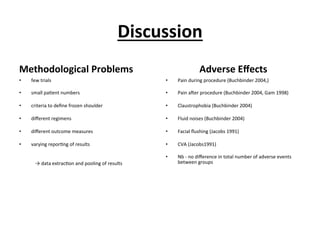
Discussion	
  
Methodological	
  Problems	
  
•  few	
  trials	
  	
  
•  small	
  pa.ent	
  numbers	
  
•  criteria	
  to	
  define	
  frozen	
  shoulder	
  
•  different	
  regimens	
  
•  different	
  outcome	
  measures	
  	
  
•  varying	
  repor.ng	
  of	
  results	


  →	
  data	
  extrac.on	
  and	
  pooling	
  of	
  results	


Adverse	
  Effects	
  
•  Pain	
  during	
  procedure	
  (Buchbinder	
  2004,)	
  
•  Pain	
  aier	
  procedure	
  (Buchbinder	
  2004,	
  Gam	
  1998)	
  
•  Claustrophobia	
  (Buchbinder	
  2004)	
  
•  Fluid	
  noises	
  (Buchbinder	
  2004)	
  
•  Facial	
  flushing	
  (Jacobs	
  1991)	
  
•  CVA	
  (Jacobs1991)	
  
•  Nb	
  -­‐	
  no	
  difference	
  in	
  total	
  number	
  of	
  adverse	
  events	
  
between	
  groups	
  
Recent	
  Evidence	
  
Clement	
  2013	
  
•  efficacy	
  of	
  arthrodistension	
  in	
  diabe.cs	
  
•  prospec.ve	
  cohort	
  study	
  
•  N=51	
  pa.ents	
  (12	
  diabe.cs:39	
  non-­‐diabe.cs)	
  with	
  53	
  
frozen	
  shoulders	
  
•  OSS,	
  VAS,	
  ROM:	
  2	
  days,	
  1	
  month	
  
•  OSS,	
  VAS:	
  mean	
  of	
  14	
  months	
  (range	
  8-­‐26	
  months).	
  	
  
•  1	
  month	
  
	
  +	
  ROM	
  improved	
  (p	
  <	
  0.001)	
  
•  Final	
  f/u	
  
	
  +	
  OSS	
  improved	
  (p	
  <	
  0.001)	


  +	
  VAS	
  improved	
  (p	
  <	
  0.001)	


•  outcome	
  in	
  diabe.c	
  pa.ents	
  the	
  same	
  
!  effec.ve	
  in	
  diabe.c	
  pa.ents	
  
!  gives	
  long-­‐term	
  improvement	
  
!  low	
  number	
  of	
  pa.ents	
  requiring	
  secondary	
  procedure	
  
Bae	
  et	
  al.	
  2014	
  
•  US-­‐guided	
  ant	
  approach	
  vs.	
  XR-­‐guided	
  post	
  approach	
  	
  
•  RCT	
  
•  N=54	
  
•  XR:	
  5ml	
  LA,	
  5ml	
  contrast,	
  1ml	
  steroid,	
  9ml	
  saline	
  	
  
•  US:	
  5ml	
  LA,	
  1ml	
  steroid,	
  14ml	
  saline	
  
•  Physiotherapy	
  
•  f/u:	
  1	
  week,	
  5	
  weeks,	
  9	
  weeks	
  
•  No	
  difference:	
  SPADI,	
  VNS,	
  PROM,	
  and	
  hand	
  power	
  
!  Less	
  radia.on	
  
!  ?cost	
  analysis	
  
!  Both	
  approaches	
  efficate	
  
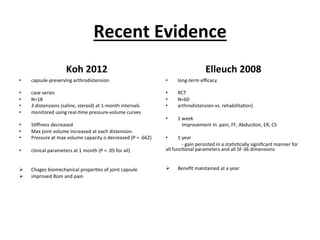
Recent	
  Evidence	
  
Koh	
  2012	
  
•  capsule-­‐preserving	
  arthrodistension	
  
•  case	
  series	
  
•  N=18	
  	
  
•  3	
  distensions	
  (saline,	
  steroid)	
  at	
  1-­‐month	
  intervals	
  
•  monitored	
  using	
  real-­‐.me	
  pressure-­‐volume	
  curves	
  
•  S.ffness	
  decreased	
  	
  
•  Max	
  joint	
  volume	
  increased	
  at	
  each	
  distension.	
  
•  Pressure	
  at	
  max	
  volume	
  capacity	
  o	
  decreased	
  (P	
  =	
  .662)	
  
•  clinical	
  parameters	
  at	
  1	
  month	
  (P	
  <	
  .05	
  for	
  all)	
  
!  Chages	
  biomechanical	
  proper.es	
  of	
  joint	
  capsule	
  
!  improved	
  Rom	
  and	
  pain	
  
Elleuch	
  2008	
  
•  long-­‐term	
  efficacy	
  
•  RCT	
  
•  N=60	
  
•  arthrodistension	
  vs.	
  rehabilita.on)	
  	
  
•  1	
  week	
  
	
  Improvement	
  in:	
  pain,	
  FF,	
  Abduc.on,	
  ER,	
  CS	


•  1	
  year	
  
	
  -­‐	
  gain	
  persisted	
  in	
  a	
  sta.s.cally	
  significant	
  manner	
  for	
  
all	
  func.onal	
  parameters	
  and	
  all	
  SF-­‐36	
  dimensions	


!  Benefit	
  maintained	
  at	
  a	
  year	
  
Conclusion	
  
!  minimal	
  harm	
  
!  may	
  shorten	
  dura.on	
  of	
  symptoms	
  
!  may	
  be	
  of	
  value	
  in	
  pa.ent	
  groups	
  with	
  high	
  incidence	
  of	
  adhesive	
  capsuli.s	
  
!  ?benefits	
  due	
  to	
  steroid,	
  capsular	
  distension	
  or	
  both	
  
!  Cannot	
  draw	
  firm	
  conclusions	
  
!  Further	
  well-­‐designed	
  trials	
  needed	
  
References	
  
•  Buchbinder	
  R,	
  Green	
  S,	
  Forbes	
  A,	
  Hall	
  S,	
  Lawler	
  G.	
  Arthrographic	
  joint	
  distension	
  with	
  saline	
  and	
  steroid	
  improves	
  func.on	
  and	
  reduces	
  pain	
  in	
  pa.ents	
  with	
  painful	
  s.ff	
  shoulder:	
  results	
  of	
  a	
  randomised	
  double-­‐
blind	
  placebo-­‐controlled	
  trial.	
  Annals	
  of	
  Rheuma*c	
  Disease	
  2004;63:302-­‐9.	
  	
  
•  Corbeil	
  V,	
  Dussault	
  R,	
  Leduc	
  B,	
  Fleury	
  J.	
  Adhesive	
  capsuli.s	
  of	
  the	
  shoulder:	
  a	
  compara.ve	
  study	
  of	
  arthrography	
  with	
  intra-­‐ar.cular	
  cor.cotherapy	
  and	
  with	
  or	
  without	
  capsular	
  distension	
  [Capsulite	
  retrac.le	
  de	
  
l'epaule:	
  etude	
  compari.ve	
  de	
  l'arthrographie	
  avec	
  cor.cotherapie	
  intra-­‐ar.culaire	
  avec	
  ou	
  sans	
  distension	
  capsulaire].	
  Canadian	
  Associa*on	
  of	
  Radiologists	
  Journal	
  1992;43:127-­‐30.	
  	
  
•  Gam	
  AN,	
  Schydlowsky	
  P,	
  Rossel	
  I,	
  Remvig	
  L,	
  Jensen	
  EM.	
  Treatment	
  of	
  "frozen	
  shoulder"	
  with	
  distension	
  and	
  glucocor.coid	
  compared	
  with	
  glucocor.coid	
  alone.	
  Scandinavian	
  Journal	
  of	
  Rheumatology	
  
1998;27:425-­‐30.	
  	
  
•  Jacobs	
  L,	
  Barton	
  M,	
  Wallace	
  W,	
  Ferrousis	
  J,	
  Dunn	
  W,	
  Bossingham	
  D.	
  Intra-­‐ar.cular	
  distension	
  and	
  steroids	
  in	
  the	
  management	
  of	
  capsuli.s	
  of	
  the	
  shoulder.	
  BMJ	
  1991;302:1498-­‐501.	
  	
  
•  Khan	
  AA,	
  Mowla	
  A,	
  Shakoor	
  MA,	
  Rahman	
  MR.	
  Arthrographic	
  distension	
  of	
  the	
  shoulder	
  joint	
  in	
  the	
  management	
  of	
  frozen	
  shoulder.	
  Mymensingh	
  Medical	
  Journal	
  2005;14:67-­‐70.	
  	
  
•  Andren	
  L,	
  Lunderber	
  B.	
  Treatment	
  of	
  rigid	
  shoulders	
  by	
  joint	
  distension	
  during	
  arthrography.	
  Acta	
  Orthopaedica	
  Scandanavia	
  1965;36:45-­‐53.	
  	
  
•  Hsu	
  S,	
  Chan	
  K.	
  Arthroscopic	
  distension	
  in	
  the	
  management	
  of	
  frozen	
  shoulder.	
  Interna*onal	
  Orthopaedics	
  1991;15:79-­‐83.	
  	
  
•  Rizk	
  TE,	
  Gavant	
  ML,	
  Pinals	
  RS.	
  Treatment	
  of	
  adhesive	
  capsuli.s	
  (frozen	
  shoulder)	
  with	
  arthrographic	
  capsular	
  distension	
  and	
  rupture.	
  Archives	
  of	
  Physical	
  Medicine	
  and	
  Rehabilita*on	
  1994;75:803-­‐7.	
  	
  
•  Anton	
  HA.	
  Frozen	
  shoulder.	
  Canadian	
  Family	
  Physician	
  1993;39:1773-­‐7.	
  	
  
•  Arroll	
  B,	
  Goodyear-­‐Smith	
  F.	
  Cor.costeroid	
  injec.ons	
  for	
  painful	
  shoulder:	
  a	
  meta-­‐analysis.	
  Bri*sh	
  Journal	
  of	
  General	
  Prac*ce	
  2005;55:224-­‐8.	
  	
  
•  Binder	
  AI,	
  Bulgen	
  DY,	
  Hazleman	
  BL,	
  Roberts	
  S.	
  Frozen	
  shoulder:	
  a	
  long-­‐term	
  prospec.ve	
  study.	
  Annals	
  of	
  Rheuma*c	
  Disease	
  1984;43:361-­‐4.	
  	
  
•  Buchbinder	
  R,	
  Green	
  S,	
  Youd	
  JM.	
  Cor.costeroid	
  injec.ons	
  for	
  shoulder	
  pain.	
  Cochrane	
  Database	
  of	
  Systema*c	
  Reviews	
  2003,	
  Issue	
  2.	
  [Art.	
  No.:	
  CD004016.	
  DOI:	
  10.1002/14651858.CD004016]	
  	
  
•  Buchbinder	
  R,	
  Youd	
  J,	
  Green	
  S,	
  Stein	
  A,	
  Forbes	
  A,	
  Harris	
  Bennell	
  K,	
  et	
  al.	
  Efficacy	
  and	
  cost-­‐effec.veness	
  of	
  physiotherapy	
  following	
  glenohumeral	
  joint	
  distension	
  for	
  adhesive	
  capsuli.s:	
  A	
  randomized	
  trial.	
  Arthri*s	
  
Care	
  Research	
  2007;57(6):1027-­‐37.	
  	
  
•  Care|e	
  S,	
  Moffet	
  H,	
  Tardiff	
  J,	
  Besse|e	
  L,	
  Morin	
  F,	
  Fremont	
  P,	
  et	
  al.	
  Intraar.cular	
  cor.costeroids,	
  supervised	
  physiotherapy,	
  or	
  a	
  combina.on	
  of	
  the	
  two	
  in	
  the	
  treatment	
  of	
  adhesive	
  capsuli.s	
  of	
  the	
  shoulder.	
  
Arthri*s	
  and	
  Rheuma*sm	
  2003;48:829-­‐38.	
  	
  
•  Cates	
  C.	
  Visual	
  Rx.	
  h|p://www.nntonline.net/	
  (accessed	
  27	
  June	
  2007).	
  	
  
•  Codman	
  EA.	
  The	
  Shoulder.	
  Boston:	
  Thomas	
  Toddog,	
  1934.	
  	
  
•  Duplay	
  S.	
  De	
  la	
  peri-­‐arthrite	
  scapulo-­‐humerale	
  et	
  ces	
  raideurs	
  de	
  l'epaule	
  qui	
  en	
  sont	
  la	
  consequence	
  [De	
  la	
  peri-­‐arthrite	
  scapulo-­‐humerale	
  et	
  ces	
  raideurs	
  de	
  l'epaule	
  qui	
  en	
  sont	
  la	
  consequence].	
  Archives	
  General	
  
Medicine	
  1872;20:513.	
  	
  
•  Ekelund	
  A,	
  Rydell	
  N.	
  Combina.on	
  treatment	
  for	
  adhesive	
  capsuli.s	
  of	
  the	
  shoulder.	
  Clinical	
  Orthopaedics	
  and	
  Related	
  Research	
  1992;282:105-­‐9.	
  	
  
•  Fareed	
  DO,	
  Gallivan	
  WR,	
  Jr.	
  Office	
  management	
  of	
  frozen	
  shoulder	
  syndrome:	
  treatment	
  with	
  hydraulic	
  distension	
  under	
  local	
  anesthesia.	
  Clinical	
  Orthopaedics	
  and	
  Related	
  Research	
  1989;242:177-­‐83.	
  	
  
•  Gavant	
  ML,	
  Rizk	
  TE,	
  Gold	
  RE,	
  Flick	
  PA.	
  Disten.on	
  arthrography	
  in	
  the	
  treatment	
  of	
  adhesive	
  capsuli.s	
  of	
  the	
  shoulder.	
  Journal	
  of	
  Vascular	
  Interven*onal	
  Radiology	
  1994;5(2):305-­‐8.	
  	
  
•  Green	
  S,	
  Buchbinder	
  R,	
  Forbes	
  A,	
  Glazier	
  R.	
  Systema.c	
  review	
  of	
  randomised	
  controlled	
  trials	
  of	
  interven.ons	
  for	
  painful	
  shoulder:	
  selec.on	
  criteria,	
  outcome	
  assessment,	
  and	
  efficacy.	
  BMJ	
  1998;16:354-­‐60.	
  	
  
•  Green	
  SE,	
  Buchbinder	
  R,	
  Forbes	
  A,	
  Glazier	
  R.	
  Interven.ons	
  for	
  shoulder	
  pain.	
  Cochrane	
  Database	
  of	
  Systema*c	
  Reviews	
  1999,	
  Issue	
  2.	
  [Art.	
  No.:	
  CD001156.	
  DOI:	
  10.1002/14651858.CD001156]	
  	
  
•  Hazleman	
  BL.	
  The	
  painful	
  s.ff	
  shoulder.	
  Rheumatology	
  and	
  Physical	
  Medicine	
  1972;11(8):413-­‐21.	
  	
  
•  Higgins	
  JPT,	
  Green	
  S,	
  editors.	
  Loca.ng	
  and	
  selec.ng	
  studies.	
  Cochrane	
  Handbook	
  for	
  Systema.c	
  Reviews	
  of	
  Interven.ons	
  4.2.5	
  [updated	
  May	
  2005];	
  Sec.on	
  5.	
  www.cochrane.org/resources/handbook/hbook.htm	
  
(accessed	
  24	
  November	
  2006).	
  	
  
•  Lundberg	
  B.	
  The	
  frozen	
  shoulder.	
  Acta	
  Orthopaedica	
  Scandanavia	
  1969;119:5-­‐59.	
  	
  
•  Moher	
  D,	
  Schulz	
  K,	
  Altman	
  DG	
  for	
  the	
  CONSORT	
  Group.	
  The	
  CONSORT	
  statement:	
  revised	
  recommenda.ons	
  for	
  improving	
  the	
  quality	
  of	
  reports	
  of	
  parallel	
  group	
  randomized	
  trials	
  2001.	
  h|p://www.consort-­‐
statement.org/Statement/revisedstatement.htm	
  (accessed	
  27	
  June	
  2007).	
  	
  
•  Neviaser	
  JS.	
  Adhesive	
  capsuli.s	
  of	
  the	
  shoulder:	
  a	
  study	
  of	
  the	
  pathological	
  findings	
  in	
  periarthri.s	
  of	
  the	
  shoulder.	
  Journal	
  of	
  Bone	
  and	
  Joint	
  Surgery	
  1945;27:211-­‐22.	
  	
  
–  Web	
  of	
  Science®	
  Times	
  Cited:	
  157	
  
•  Neviaser	
  TJ.	
  Adhesive	
  capsuli.s.	
  Orthopedic	
  Clinics	
  of	
  North	
  America	
  1987;18:439-­‐43.	
  	
  
•  Reeves	
  B.	
  The	
  natural	
  history	
  of	
  the	
  frozen	
  shoulder	
  syndrome.	
  Scandinavian	
  Journal	
  of	
  Rheumatology	
  1975;4:193-­‐6.	
  	
  
•  Simmonds	
  F.	
  Shoulder	
  pain	
  with	
  par.cular	
  reference	
  to	
  'frozen'	
  shoulder.	
  Journal	
  of	
  Bone	
  and	
  Joint	
  Surgery	
  1949;318:426-­‐32.	
  	
  
•  Tugwell	
  P,	
  Shea	
  B,	
  Boers	
  M,	
  Simons	
  L,	
  Strand	
  V,	
  Wells	
  G.	
  Evidence-­‐based	
  Rheumatology.	
  BMJ	
  Books,	
  2003.	
  	
  
•  van	
  der	
  Windt	
  DA,	
  Koes	
  BW,	
  de	
  Jong	
  BA,	
  Bouter	
  LM.	
  Shoulder	


Hydrodistension debate abas rashid

  • 1.
      Adhesive  Capsuli.s  Debate:   Hydrodistension       Abbas  Rashid  FRCS  (Tr&Orth)   Wrigh;ngton  Upper  Limb  Unit  
  • 2.
    Background   History    ‘painful  s*ffening  of  the  shoulder‘   Classifica;on  &  Epidemiology               •  2-­‐  5%  of  general  popula.on     •  Up  to  40%  contralateral  shoulder  affected   •  Up  to  20%  of  diabe.cs  (Anton  1993;  Lundberg  1969)   •  Peak  incidence  between  40-­‐60  years   •  women  >  men   •  ae.ology  and  pathophysiology  poorly  understood     ‘presence  of  shoulder  pain  with  restric*on  of  ac*ve  and   passive  glenohumeral  joint  movements  in  at  least  two  planes’   1872   Duplay   Periarthrite  scapulohumerale   1934   Codman   Frozen  Shoulder   1945   Nevaiser     Adhesive  capsuli;s   1949   Withers   Involvement  of  subacromial  bursa     1949   Simmonds   Inelas.c  fibrous  .ssue     1952   DePalma   muscular  inac.vity   1952   Meulengracht   Associa.on  with  Dupuytren’s   1962     Nevaiser     Reduced  joint  volume   1970   Lundberg   change  in  GAGs  in  affected  shoulder     1972   Bridgeman     Diabe;c  associa;on   1985   Bunker   Myofibroblasts,  T3  collagen,  few   inflammatory  cells   1989   Ozaki   Thickened  MGHL  &  RI  
  • 3.
    Natural  History           1.  painful  phase:  (2-­‐9  months),  insidious  onset,  diffuse   severe  pain,  worse  at  night,  inability  to  lie  on  affected  side   2.  s;ff    phase:  (4-­‐12  months),  s.ffness  and  severe  loss  of   ROM,  pain  less  pronounced  but  s.ll  present  par.cularly  at   end  of  ROM   3.  recovery  phase:  (5-­‐24  months)  gradual  return  of  ROM     •  ?self  limi.ng   •  1934:  Codman         ‘even  the  most  protracted  cases  recover  without     treatment  in  2  years’   •  improved  Constant  score  with  “supervised   neglect”  (Reeves  1975,  Diercks  &  Stevens  2004)       •  2004:  Dudikiewiczs    -­‐    40%  :  normal  ROM  +  are  pain  free    -­‐    45%:  func.onal  ROM  but  show  residual  symptoms    -­‐    15%:  persis.ng  s.ffness  with  marked  handicap       •  Recurrence  rare    
  • 4.
    Arthrodisten;on   •  Andren  and  Lundberg  in  1965        -­‐  injec.on  of  20  ml  contrast  medium  in  theatre      -­‐  allowed  to  flow  back  into  syringe      -­‐  Repeated  un.l  capsular  rupture     •  Blind,  XR,  US   •  saline,  LA,  steroid,  contrast  and  air  (Ekelund  1992;  Fareed  1989;  Gavant  1994)   •  disrupts  adhesions  →  improved  ROM  (Gavant  1994)   •  transient  pain  during  and  aier  the  procedure     •  pa.ent  goes  home   •  safe    
  • 5.
    Cochrane  Review  2006   •  update  of  1998  review   •  Previously  no  arthrodistension  studies     par%cipants   •  adults  with  FS   •  mixed  popula.ons  studies  included  if  FS  par.cipants  were  presented  separately  or  >  90%  of  par.cipants  in  the  study   interven%ons   •  Arthrodistension  vs.  placebo  or  other  interven.ons   outcome  measures   •  1o  outcomes:  pain  and  func.on/disability  assessment   •  2o  measures:  ROM;  severity;  analgesic  use;  adverse  events;  .me  to  recovery  or  recurrence.   •  November  1999  to  November  2006   •  Combined  search  terms:  ‘adhesive  capsuli.s’  and  ‘arthrodistension’      1.  The  Cochrane  Musculoskeletal  Review  Group  Specialised  Register        2.  Cochrane  Central  Register  of  Controlled  Trials  (CENTRAL)        3.  MEDLINE  (OVID)        4.  EMBASE  (embase.com)        5.  CINAHL  (OVID)        6.  Reference  lists  in  review  ar.cles  and  trials  retrieved        7.  Personal  communica.on  with  experts  in  the  field  
  • 6.
    Results     Buchbinder  2004   •  Arthrodistension  vs.  sham   •  saline,  LA,  steroid     •  mean  volume  43.3  ml  (21  to  80  ml)     •  anterior  approach  with  fluoroscopy   •  n=46  par.cipants   •  3  weeks    +  improvement  :  pain,  PET,  abduc.on,  IR      -­‐  No  difference  in:  FF,  ER     •  6  weeks    +  improvement:  PET     •  12  weeks    +  improvement:  PET   Khan  2006   •  Arthrodistension  &  physio  vs.  physio   •  Saline,  steroid     •  20  ml     •  posterior  approach  under  fluoroscopy   •  N=36  par.cipant     •  8  weeks    +  improvement:  abduc.on,  ER,  IR      -­‐  no  difference  :  pain       Gam  1998     •  Arthrodistension  vs.  steroid  injec%on   •  LA  +  cor.costeroid     •  20mls     •  posterior  approach  under  ultrasound  guidance     •  N=22     •  General    +  improvement:  ROM,  analgesic  requirement      -­‐  no  difference:  pain  or  func.on      
  • 7.
    Results   Corbeil  1992     •  Arthrodistension  vs.  steroid  injec%on   •  LA  and  cor.costeroid     •  20ml     •  repeated  weekly  up  to  6  weeks  or  un.l  no  symptoms   •  posterior  approach  under  fluoroscopy   •  N=45  par.cipants   •  3  months    -­‐  no  difference  in  :  pain,  passive  abduc.on,  ER       Jacobs  1991     •  3  arm  trial   •  10mls:  steroid,  air     •  9mls:    air     •  three  .mes  at  6weekly  intervals     •  posterior  landmarks   •  N=47   •  Arthrodistension  (steroid  &  air)  vs.  steroid  injec%on     •  16  weeks    -­‐  no  difference:  ROM,  pain     •  Arthrodistension  (steroid  &  air)  vs.  arthrodistension   (air)   •  16  weeks      +  improvement:  FF   •    -­‐  no  difference  :  Abduc.on   •  Arthrodistension  (air)  vs.  steroid  injec%on     •  16  weeks    -­‐  FF  &  Abduc.on  in  injec.on  group      -­‐  no  difference:  ER    
  • 8.
    Discussion   Methodological  Problems   •  few  trials     •  small  pa.ent  numbers   •  criteria  to  define  frozen  shoulder   •  different  regimens   •  different  outcome  measures     •  varying  repor.ng  of  results      →  data  extrac.on  and  pooling  of  results     Adverse  Effects   •  Pain  during  procedure  (Buchbinder  2004,)   •  Pain  aier  procedure  (Buchbinder  2004,  Gam  1998)   •  Claustrophobia  (Buchbinder  2004)   •  Fluid  noises  (Buchbinder  2004)   •  Facial  flushing  (Jacobs  1991)   •  CVA  (Jacobs1991)   •  Nb  -­‐  no  difference  in  total  number  of  adverse  events   between  groups  
  • 9.
    Recent  Evidence   Clement  2013   •  efficacy  of  arthrodistension  in  diabe.cs   •  prospec.ve  cohort  study   •  N=51  pa.ents  (12  diabe.cs:39  non-­‐diabe.cs)  with  53   frozen  shoulders   •  OSS,  VAS,  ROM:  2  days,  1  month   •  OSS,  VAS:  mean  of  14  months  (range  8-­‐26  months).     •  1  month    +  ROM  improved  (p  <  0.001)   •  Final  f/u    +  OSS  improved  (p  <  0.001)      +  VAS  improved  (p  <  0.001)       •  outcome  in  diabe.c  pa.ents  the  same   !  effec.ve  in  diabe.c  pa.ents   !  gives  long-­‐term  improvement   !  low  number  of  pa.ents  requiring  secondary  procedure   Bae  et  al.  2014   •  US-­‐guided  ant  approach  vs.  XR-­‐guided  post  approach     •  RCT   •  N=54   •  XR:  5ml  LA,  5ml  contrast,  1ml  steroid,  9ml  saline     •  US:  5ml  LA,  1ml  steroid,  14ml  saline   •  Physiotherapy   •  f/u:  1  week,  5  weeks,  9  weeks   •  No  difference:  SPADI,  VNS,  PROM,  and  hand  power   !  Less  radia.on   !  ?cost  analysis   !  Both  approaches  efficate  
  • 10.
    Recent  Evidence   Koh  2012   •  capsule-­‐preserving  arthrodistension   •  case  series   •  N=18     •  3  distensions  (saline,  steroid)  at  1-­‐month  intervals   •  monitored  using  real-­‐.me  pressure-­‐volume  curves   •  S.ffness  decreased     •  Max  joint  volume  increased  at  each  distension.   •  Pressure  at  max  volume  capacity  o  decreased  (P  =  .662)   •  clinical  parameters  at  1  month  (P  <  .05  for  all)   !  Chages  biomechanical  proper.es  of  joint  capsule   !  improved  Rom  and  pain   Elleuch  2008   •  long-­‐term  efficacy   •  RCT   •  N=60   •  arthrodistension  vs.  rehabilita.on)     •  1  week    Improvement  in:  pain,  FF,  Abduc.on,  ER,  CS     •  1  year    -­‐  gain  persisted  in  a  sta.s.cally  significant  manner  for   all  func.onal  parameters  and  all  SF-­‐36  dimensions         !  Benefit  maintained  at  a  year  
  • 11.
    Conclusion   !  minimal  harm   !  may  shorten  dura.on  of  symptoms   !  may  be  of  value  in  pa.ent  groups  with  high  incidence  of  adhesive  capsuli.s   !  ?benefits  due  to  steroid,  capsular  distension  or  both   !  Cannot  draw  firm  conclusions   !  Further  well-­‐designed  trials  needed  
  • 12.
    References   •  Buchbinder  R,  Green  S,  Forbes  A,  Hall  S,  Lawler  G.  Arthrographic  joint  distension  with  saline  and  steroid  improves  func.on  and  reduces  pain  in  pa.ents  with  painful  s.ff  shoulder:  results  of  a  randomised  double-­‐ blind  placebo-­‐controlled  trial.  Annals  of  Rheuma*c  Disease  2004;63:302-­‐9.     •  Corbeil  V,  Dussault  R,  Leduc  B,  Fleury  J.  Adhesive  capsuli.s  of  the  shoulder:  a  compara.ve  study  of  arthrography  with  intra-­‐ar.cular  cor.cotherapy  and  with  or  without  capsular  distension  [Capsulite  retrac.le  de   l'epaule:  etude  compari.ve  de  l'arthrographie  avec  cor.cotherapie  intra-­‐ar.culaire  avec  ou  sans  distension  capsulaire].  Canadian  Associa*on  of  Radiologists  Journal  1992;43:127-­‐30.     •  Gam  AN,  Schydlowsky  P,  Rossel  I,  Remvig  L,  Jensen  EM.  Treatment  of  "frozen  shoulder"  with  distension  and  glucocor.coid  compared  with  glucocor.coid  alone.  Scandinavian  Journal  of  Rheumatology   1998;27:425-­‐30.     •  Jacobs  L,  Barton  M,  Wallace  W,  Ferrousis  J,  Dunn  W,  Bossingham  D.  Intra-­‐ar.cular  distension  and  steroids  in  the  management  of  capsuli.s  of  the  shoulder.  BMJ  1991;302:1498-­‐501.     •  Khan  AA,  Mowla  A,  Shakoor  MA,  Rahman  MR.  Arthrographic  distension  of  the  shoulder  joint  in  the  management  of  frozen  shoulder.  Mymensingh  Medical  Journal  2005;14:67-­‐70.     •  Andren  L,  Lunderber  B.  Treatment  of  rigid  shoulders  by  joint  distension  during  arthrography.  Acta  Orthopaedica  Scandanavia  1965;36:45-­‐53.     •  Hsu  S,  Chan  K.  Arthroscopic  distension  in  the  management  of  frozen  shoulder.  Interna*onal  Orthopaedics  1991;15:79-­‐83.     •  Rizk  TE,  Gavant  ML,  Pinals  RS.  Treatment  of  adhesive  capsuli.s  (frozen  shoulder)  with  arthrographic  capsular  distension  and  rupture.  Archives  of  Physical  Medicine  and  Rehabilita*on  1994;75:803-­‐7.     •  Anton  HA.  Frozen  shoulder.  Canadian  Family  Physician  1993;39:1773-­‐7.     •  Arroll  B,  Goodyear-­‐Smith  F.  Cor.costeroid  injec.ons  for  painful  shoulder:  a  meta-­‐analysis.  Bri*sh  Journal  of  General  Prac*ce  2005;55:224-­‐8.     •  Binder  AI,  Bulgen  DY,  Hazleman  BL,  Roberts  S.  Frozen  shoulder:  a  long-­‐term  prospec.ve  study.  Annals  of  Rheuma*c  Disease  1984;43:361-­‐4.     •  Buchbinder  R,  Green  S,  Youd  JM.  Cor.costeroid  injec.ons  for  shoulder  pain.  Cochrane  Database  of  Systema*c  Reviews  2003,  Issue  2.  [Art.  No.:  CD004016.  DOI:  10.1002/14651858.CD004016]     •  Buchbinder  R,  Youd  J,  Green  S,  Stein  A,  Forbes  A,  Harris  Bennell  K,  et  al.  Efficacy  and  cost-­‐effec.veness  of  physiotherapy  following  glenohumeral  joint  distension  for  adhesive  capsuli.s:  A  randomized  trial.  Arthri*s   Care  Research  2007;57(6):1027-­‐37.     •  Care|e  S,  Moffet  H,  Tardiff  J,  Besse|e  L,  Morin  F,  Fremont  P,  et  al.  Intraar.cular  cor.costeroids,  supervised  physiotherapy,  or  a  combina.on  of  the  two  in  the  treatment  of  adhesive  capsuli.s  of  the  shoulder.   Arthri*s  and  Rheuma*sm  2003;48:829-­‐38.     •  Cates  C.  Visual  Rx.  h|p://www.nntonline.net/  (accessed  27  June  2007).     •  Codman  EA.  The  Shoulder.  Boston:  Thomas  Toddog,  1934.     •  Duplay  S.  De  la  peri-­‐arthrite  scapulo-­‐humerale  et  ces  raideurs  de  l'epaule  qui  en  sont  la  consequence  [De  la  peri-­‐arthrite  scapulo-­‐humerale  et  ces  raideurs  de  l'epaule  qui  en  sont  la  consequence].  Archives  General   Medicine  1872;20:513.     •  Ekelund  A,  Rydell  N.  Combina.on  treatment  for  adhesive  capsuli.s  of  the  shoulder.  Clinical  Orthopaedics  and  Related  Research  1992;282:105-­‐9.     •  Fareed  DO,  Gallivan  WR,  Jr.  Office  management  of  frozen  shoulder  syndrome:  treatment  with  hydraulic  distension  under  local  anesthesia.  Clinical  Orthopaedics  and  Related  Research  1989;242:177-­‐83.     •  Gavant  ML,  Rizk  TE,  Gold  RE,  Flick  PA.  Disten.on  arthrography  in  the  treatment  of  adhesive  capsuli.s  of  the  shoulder.  Journal  of  Vascular  Interven*onal  Radiology  1994;5(2):305-­‐8.     •  Green  S,  Buchbinder  R,  Forbes  A,  Glazier  R.  Systema.c  review  of  randomised  controlled  trials  of  interven.ons  for  painful  shoulder:  selec.on  criteria,  outcome  assessment,  and  efficacy.  BMJ  1998;16:354-­‐60.     •  Green  SE,  Buchbinder  R,  Forbes  A,  Glazier  R.  Interven.ons  for  shoulder  pain.  Cochrane  Database  of  Systema*c  Reviews  1999,  Issue  2.  [Art.  No.:  CD001156.  DOI:  10.1002/14651858.CD001156]     •  Hazleman  BL.  The  painful  s.ff  shoulder.  Rheumatology  and  Physical  Medicine  1972;11(8):413-­‐21.     •  Higgins  JPT,  Green  S,  editors.  Loca.ng  and  selec.ng  studies.  Cochrane  Handbook  for  Systema.c  Reviews  of  Interven.ons  4.2.5  [updated  May  2005];  Sec.on  5.  www.cochrane.org/resources/handbook/hbook.htm   (accessed  24  November  2006).     •  Lundberg  B.  The  frozen  shoulder.  Acta  Orthopaedica  Scandanavia  1969;119:5-­‐59.     •  Moher  D,  Schulz  K,  Altman  DG  for  the  CONSORT  Group.  The  CONSORT  statement:  revised  recommenda.ons  for  improving  the  quality  of  reports  of  parallel  group  randomized  trials  2001.  h|p://www.consort-­‐ statement.org/Statement/revisedstatement.htm  (accessed  27  June  2007).     •  Neviaser  JS.  Adhesive  capsuli.s  of  the  shoulder:  a  study  of  the  pathological  findings  in  periarthri.s  of  the  shoulder.  Journal  of  Bone  and  Joint  Surgery  1945;27:211-­‐22.     –  Web  of  Science®  Times  Cited:  157   •  Neviaser  TJ.  Adhesive  capsuli.s.  Orthopedic  Clinics  of  North  America  1987;18:439-­‐43.     •  Reeves  B.  The  natural  history  of  the  frozen  shoulder  syndrome.  Scandinavian  Journal  of  Rheumatology  1975;4:193-­‐6.     •  Simmonds  F.  Shoulder  pain  with  par.cular  reference  to  'frozen'  shoulder.  Journal  of  Bone  and  Joint  Surgery  1949;318:426-­‐32.     •  Tugwell  P,  Shea  B,  Boers  M,  Simons  L,  Strand  V,  Wells  G.  Evidence-­‐based  Rheumatology.  BMJ  Books,  2003.     •  van  der  Windt  DA,  Koes  BW,  de  Jong  BA,  Bouter  LM.  Shoulder