Buddha’s Heroic Journey Divine Birth – Mother’s dream Call to Adventure – The Four Sights Tests and Trials – Mara Boon - Teachings
Early Life of the Buddha Born as Siddhartha Gautama around 563 BCE at Lumbini Grove, northern India Born into a royal family Married princess Yashodhara when he was nineteen Shielded by his family from difficulties of life outside the court  Life focused on pleasure
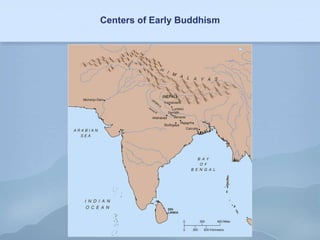
Centers of Early Buddhism
Four Sights Upon managing to temporarily leave the court, Siddhartha saw four things that surprised him: a old man a sick man a corpse a wandering ascetic
Siddhartha sets out Disturbed by the Four Sights, Prince Siddhartha escaped the court and took up ascetic practices After taking ascetic practices to their extreme, he sat under a tree at Bodhgaya with new resolve to understand the nature of suffering Some Buddhist accounts present this as time when demons assailed Siddhartha, trying to defeat him in his efforts at insight
Demon Mara tests Siddhartha Three temptations There’s trouble at home Voluptuous women dance around him Mara summons host of demons
Enlightenment and Teaching * Siddhartha, sitting unperturbed under the Bodhi tree, finally gains insight into the nature of suffering and becomes the Buddha, i.e., the Enlightened One With his new insight, the Buddha set out to instruct others Encountering ascetics at Deer Park near Benares, the Buddha began what would become a forty-five career as a teacher
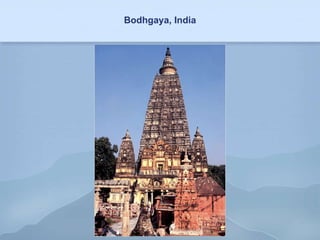
Bodhgaya, India
Fire Sermon Delivered as his second sermon Explains the Four Noble Truths Nirvana, a state of “No-being” beyond all desire Becomes the Buddha, the Enlightened One
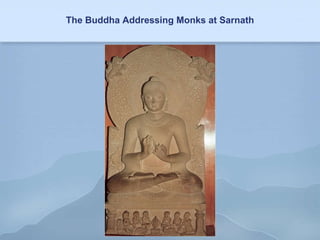
The Buddha Addressing Monks at Sarnath
Boon: A Philosophical System Buddha preaches/teaches Caste system is abandoned in the sangha Arhats (disciples) begin to missionize Monasteries proliferate in India Women are allowed to enter the order Lives for another 45 years, respected for his wisdom and compassion
Teachings Four Noble Truths The Middle Way The Noble Eightfold Path Nirvana  No individual soul (no self to be reborn) No Creator God
Four Noble Truths Fundamental to the Buddha’s teachings is the doctrine of the Four Noble Truths: all life is characterized by suffering  suffering is the result of or misguided desire (attachment) to eliminate misguided desire is to eliminate suffering (detachment) the method for eliminating suffering is the “Eightfold Path ”
Middle Way * The Buddha had known two extremes of religious practice the worldly rituals of Hinduism the extreme privation of asceticism He posited a compromise between these two as the appropriate stance for religious practice
Noble Eightfold Path Right view: correct insight into the nature of suffering Right aim: correct resolve in overcoming suffering Right speech: truthful speech that reflects Buddhist knowledge Right action: ethical behavior and discipline Right living: a livelihood that isn’t in conflict with Buddhist ethical commitments Right effort: disciplining the mind Right mindfulness: remaining focused on appropriate understandings of self and suffering Right concentration: progression through successive stages of insight
NIRVANA Extinction Cessation of consciousness Bliss Release from the cycle of existence Psychological state State of mind NOT  heaven
Samsara, Karma * The Buddha agreed with samsara only in the fact that birth followed death.  Release from suffering was achieved through the Four Noble Truths. The Buddha reinterpreted karma to focus particularly on the states of mind of the individual. Grasping, desires and intentions bind humans to an impermanent world. When these things cease, humans pass over to Nirvana.
KARMA – Buddhist view Primarily psychological Grasping, desires and intentions bind the psychological processes There is a consequence for every thought and deed Impulses from an individual’s life carry over into another life. (yet, there is no self to be reborn)
Skandhas * There is no permanent self rather it is the appearance of self generated by skandhas Senses mind perceptions impulses consciousness As opposed to Hindu thought,  Buddha taught that there was no eternal self that continues through reincarnation. Those who seek permanence suffer for no self exists.
Regarding Metaphysical Questions * The Buddha disregarded broader metaphysical questions, remaining focused instead on the practical concerns of suffering and its alleviation No creator god
Buddhist Scripture Extensive writings exist that pertain to a variety of understandings of the Buddha’s life and teachings Tripitaka, or “three-fold basket,” is an early set of scriptures composed in Pali rules for Buddhist monks collections of what are regarded as the Buddha’s sayings, in addition to stories, poems and songs about the Buddha and what some regard as the Buddha’s former lives Further systematic development of ideas
Buddhist Scripture (cont.) Following the Buddha’s death, some accounts describe the gathering of his followers in a series of councils to decide controversies that had arisen First council shortly after the death of the Buddha, establishing the Tripitika Second and third council a hundred years later to settle questions regarding rules for monks and questions of orthodoxy. Councils continued to be held to decide on points of faith and practice.
Sects develop - Two Major Vehicles * One of the splits that developed among Buddhists was between two major traditions Theravada  Buddhists regarded the Buddha as an exemplary human being who provided a model for ultimate religious transformation through self-application Devotees focus on monastic life Maitreya, the Buddha to come Salvation is through dedicated self-effort rather than intervention of deity.
Two Major Vehicles cont’d * Mahayana  Buddhists regarded the Buddha in more cosmic, god-like terms. Furthermore, human beings were regarded as aided in their spiritual development and well-being by bodhisattvas, beings who - though capable of Nirvana - remained active in the world out of compassion for the suffering of others  Believe in liberated heavenly beings who assist humans– bodhisattvas Salvation is not solely a matter of personal discipline but is assisted by various deities.
Conversion of Asoka – 3 rd  century BCE Northern Indian ruler devoted to conquest Attracted to Buddhist teachings Abandoned warfare and built temples Sent missionaries throughout India, to Asia, Africa, Europe and Sri Lanka, Burma
Buddhism enters China, Korea, Japan and Tibet * By 1 st  century BCE, Mahayana and Theravada sects had entered China From Korea, Buddhism spread to Japan in 6 th  - 8 th  centuries CE 14 th  century: political implications: Mongol chieftain awarded Tibet to the Dalai Lama
Buddhism in China Mahayana Buddhism developed in new directions in imperial China Tian Tai attempted to consolidate seemingly conflicting Buddhist doctrines into a single system that recognized one scripture, the Lotus Sutra, as the pinnacle and clearest exposition of Buddhist thought.  Hua Yen, like Tian Tai, attempted to consolidate all Buddhist teachings; this school, however, placed the Flower Garland Sutra at the pinnacle of Buddhist doctrines. It emphasized the interpenetration of all things.
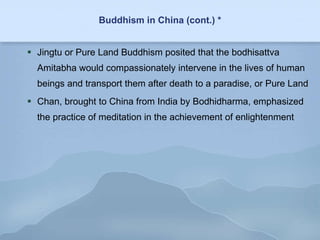
Buddhism in China (cont.) * Jingtu or Pure Land Buddhism posited that the bodhisattva Amitabha would compassionately intervene in the lives of human beings and transport them after death to a paradise, or Pure Land Chan, brought to China from India by Bodhidharma, emphasized the practice of meditation in the achievement of enlightenment
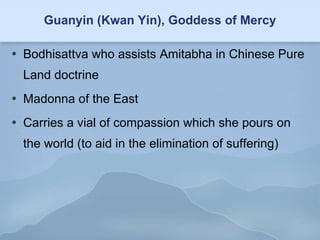
Guanyin (Kwan Yin), Goddess of Mercy Bodhisattva who assists Amitabha in Chinese Pure Land doctrine  Madonna of the East Carries a vial of compassion which she pours on the world (to aid in the elimination of suffering)
Buddhism in Tibet In seventh century CE, Tibetan ruler Srong Tsan Gampo married two Buddhist wives from abroad, bringing Buddhism into Tibet for the first time In the following century, Indian Buddhist teacher Shantarakshita brought Buddhism to Tibet in a more systematic fashion Occult and tantric forms of Buddhism prevailed in Tibet; various schools emerged, including: Nyingmapa, old-school Buddhists who embraced  trantic practices found in Hinduism Gelugpa, protest movement against Nyingmapa’s laxity and sexual abuses.  Advocated celibacy and vegetarianism. Gelugpa lama seen as reincarnated shortly after death.  Elaborate search rituals results in new lama.
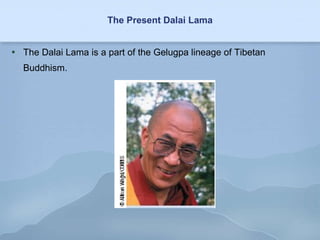
The Present Dalai Lama The Dalai Lama is a part of the Gelugpa lineage of Tibetan Buddhism.
Buddhism in the West In addition to waves of Asian migration to the U.S. beginning in the nineteenth century, non-Asians have also taken an interest in Buddhism - particularly during the 1960s.  Nichiren Shoshu Sokagakkai had been an example of organized forays by Buddhists into America.  Similar to its counterpart in Japan.  Salvation through chanting  Today, a wide range of Buddhist traditions that developed throughout Asia are evidenced in the American landscape
Worldview Absolute – belief in gods was not essential to release from suffering. Theravadins deny deities but Mahayanists believe they are essential.  World – alleviation of suffering meant detachment from the world. The problem for humans was suffering produced by ignorance of the impermanence of the world. The solution was knowledge using the Four Noble Truths. There was no life after death, though something carries over.
Worldview Community ethics includes the symbiotic relationship between monastics and laity; the latter are expected to abstain from theft intoxication inappropriate speech injury to others A strong concern for an end-time of history is not widespread in Buddhist materials, although some Mahayana Buddhists anticipate the appearance of the next Buddha to incarnate: Maitreya
Worldview (cont.) The eight-spoked wheel is a symbol used to suggest the Noble Eightfold Path Some Buddhist laity recite a vow of refuge in three things: the Buddha the Dharma, i.e., Buddhist teachings the Sangha, i.e., the community of Buddhists (or, more specifically, monks and nuns) In some parts of Asia, young laymen take on the role of a Buddhist monk for a finite period of time
Worldview (cont.) Buddhism, in a wide variety of environments, has coexisted with other forms of religious practice; it has even elicited an interest in active dialogue and engagement, as was pursued by the late Catholic monk Thomas Merton
Women and Buddhism Although Mahayana Buddhism has allowed for the ordination of women as nuns, they’ve held a second-class status relative to monks non-Asian women who have converted to Buddhism, such as Tsultrim Allione and Jiyu Kennett Roshi, have introduced innovations in the possible roles for women leaders in Buddhism

Buddism Revised

  • 1.
    Buddha’s Heroic JourneyDivine Birth – Mother’s dream Call to Adventure – The Four Sights Tests and Trials – Mara Boon - Teachings
  • 2.
    Early Life ofthe Buddha Born as Siddhartha Gautama around 563 BCE at Lumbini Grove, northern India Born into a royal family Married princess Yashodhara when he was nineteen Shielded by his family from difficulties of life outside the court Life focused on pleasure
  • 3.
  • 4.
    Four Sights Uponmanaging to temporarily leave the court, Siddhartha saw four things that surprised him: a old man a sick man a corpse a wandering ascetic
  • 5.
    Siddhartha sets outDisturbed by the Four Sights, Prince Siddhartha escaped the court and took up ascetic practices After taking ascetic practices to their extreme, he sat under a tree at Bodhgaya with new resolve to understand the nature of suffering Some Buddhist accounts present this as time when demons assailed Siddhartha, trying to defeat him in his efforts at insight
  • 6.
    Demon Mara testsSiddhartha Three temptations There’s trouble at home Voluptuous women dance around him Mara summons host of demons
  • 7.
    Enlightenment and Teaching* Siddhartha, sitting unperturbed under the Bodhi tree, finally gains insight into the nature of suffering and becomes the Buddha, i.e., the Enlightened One With his new insight, the Buddha set out to instruct others Encountering ascetics at Deer Park near Benares, the Buddha began what would become a forty-five career as a teacher
  • 8.
  • 9.
    Fire Sermon Deliveredas his second sermon Explains the Four Noble Truths Nirvana, a state of “No-being” beyond all desire Becomes the Buddha, the Enlightened One
  • 10.
    The Buddha AddressingMonks at Sarnath
  • 11.
    Boon: A PhilosophicalSystem Buddha preaches/teaches Caste system is abandoned in the sangha Arhats (disciples) begin to missionize Monasteries proliferate in India Women are allowed to enter the order Lives for another 45 years, respected for his wisdom and compassion
  • 12.
    Teachings Four NobleTruths The Middle Way The Noble Eightfold Path Nirvana No individual soul (no self to be reborn) No Creator God
  • 13.
    Four Noble TruthsFundamental to the Buddha’s teachings is the doctrine of the Four Noble Truths: all life is characterized by suffering suffering is the result of or misguided desire (attachment) to eliminate misguided desire is to eliminate suffering (detachment) the method for eliminating suffering is the “Eightfold Path ”
  • 14.
    Middle Way *The Buddha had known two extremes of religious practice the worldly rituals of Hinduism the extreme privation of asceticism He posited a compromise between these two as the appropriate stance for religious practice
  • 15.
    Noble Eightfold PathRight view: correct insight into the nature of suffering Right aim: correct resolve in overcoming suffering Right speech: truthful speech that reflects Buddhist knowledge Right action: ethical behavior and discipline Right living: a livelihood that isn’t in conflict with Buddhist ethical commitments Right effort: disciplining the mind Right mindfulness: remaining focused on appropriate understandings of self and suffering Right concentration: progression through successive stages of insight
  • 16.
    NIRVANA Extinction Cessationof consciousness Bliss Release from the cycle of existence Psychological state State of mind NOT heaven
  • 17.
    Samsara, Karma *The Buddha agreed with samsara only in the fact that birth followed death. Release from suffering was achieved through the Four Noble Truths. The Buddha reinterpreted karma to focus particularly on the states of mind of the individual. Grasping, desires and intentions bind humans to an impermanent world. When these things cease, humans pass over to Nirvana.
  • 18.
    KARMA – Buddhistview Primarily psychological Grasping, desires and intentions bind the psychological processes There is a consequence for every thought and deed Impulses from an individual’s life carry over into another life. (yet, there is no self to be reborn)
  • 19.
    Skandhas * Thereis no permanent self rather it is the appearance of self generated by skandhas Senses mind perceptions impulses consciousness As opposed to Hindu thought, Buddha taught that there was no eternal self that continues through reincarnation. Those who seek permanence suffer for no self exists.
  • 20.
    Regarding Metaphysical Questions* The Buddha disregarded broader metaphysical questions, remaining focused instead on the practical concerns of suffering and its alleviation No creator god
  • 21.
    Buddhist Scripture Extensivewritings exist that pertain to a variety of understandings of the Buddha’s life and teachings Tripitaka, or “three-fold basket,” is an early set of scriptures composed in Pali rules for Buddhist monks collections of what are regarded as the Buddha’s sayings, in addition to stories, poems and songs about the Buddha and what some regard as the Buddha’s former lives Further systematic development of ideas
  • 22.
    Buddhist Scripture (cont.)Following the Buddha’s death, some accounts describe the gathering of his followers in a series of councils to decide controversies that had arisen First council shortly after the death of the Buddha, establishing the Tripitika Second and third council a hundred years later to settle questions regarding rules for monks and questions of orthodoxy. Councils continued to be held to decide on points of faith and practice.
  • 23.
    Sects develop -Two Major Vehicles * One of the splits that developed among Buddhists was between two major traditions Theravada Buddhists regarded the Buddha as an exemplary human being who provided a model for ultimate religious transformation through self-application Devotees focus on monastic life Maitreya, the Buddha to come Salvation is through dedicated self-effort rather than intervention of deity.
  • 24.
    Two Major Vehiclescont’d * Mahayana Buddhists regarded the Buddha in more cosmic, god-like terms. Furthermore, human beings were regarded as aided in their spiritual development and well-being by bodhisattvas, beings who - though capable of Nirvana - remained active in the world out of compassion for the suffering of others Believe in liberated heavenly beings who assist humans– bodhisattvas Salvation is not solely a matter of personal discipline but is assisted by various deities.
  • 25.
    Conversion of Asoka– 3 rd century BCE Northern Indian ruler devoted to conquest Attracted to Buddhist teachings Abandoned warfare and built temples Sent missionaries throughout India, to Asia, Africa, Europe and Sri Lanka, Burma
  • 26.
    Buddhism enters China,Korea, Japan and Tibet * By 1 st century BCE, Mahayana and Theravada sects had entered China From Korea, Buddhism spread to Japan in 6 th - 8 th centuries CE 14 th century: political implications: Mongol chieftain awarded Tibet to the Dalai Lama
  • 27.
    Buddhism in ChinaMahayana Buddhism developed in new directions in imperial China Tian Tai attempted to consolidate seemingly conflicting Buddhist doctrines into a single system that recognized one scripture, the Lotus Sutra, as the pinnacle and clearest exposition of Buddhist thought. Hua Yen, like Tian Tai, attempted to consolidate all Buddhist teachings; this school, however, placed the Flower Garland Sutra at the pinnacle of Buddhist doctrines. It emphasized the interpenetration of all things.
  • 28.
    Buddhism in China(cont.) * Jingtu or Pure Land Buddhism posited that the bodhisattva Amitabha would compassionately intervene in the lives of human beings and transport them after death to a paradise, or Pure Land Chan, brought to China from India by Bodhidharma, emphasized the practice of meditation in the achievement of enlightenment
  • 29.
    Guanyin (Kwan Yin),Goddess of Mercy Bodhisattva who assists Amitabha in Chinese Pure Land doctrine Madonna of the East Carries a vial of compassion which she pours on the world (to aid in the elimination of suffering)
  • 30.
    Buddhism in TibetIn seventh century CE, Tibetan ruler Srong Tsan Gampo married two Buddhist wives from abroad, bringing Buddhism into Tibet for the first time In the following century, Indian Buddhist teacher Shantarakshita brought Buddhism to Tibet in a more systematic fashion Occult and tantric forms of Buddhism prevailed in Tibet; various schools emerged, including: Nyingmapa, old-school Buddhists who embraced trantic practices found in Hinduism Gelugpa, protest movement against Nyingmapa’s laxity and sexual abuses. Advocated celibacy and vegetarianism. Gelugpa lama seen as reincarnated shortly after death. Elaborate search rituals results in new lama.
  • 31.
    The Present DalaiLama The Dalai Lama is a part of the Gelugpa lineage of Tibetan Buddhism.
  • 32.
    Buddhism in theWest In addition to waves of Asian migration to the U.S. beginning in the nineteenth century, non-Asians have also taken an interest in Buddhism - particularly during the 1960s. Nichiren Shoshu Sokagakkai had been an example of organized forays by Buddhists into America. Similar to its counterpart in Japan. Salvation through chanting Today, a wide range of Buddhist traditions that developed throughout Asia are evidenced in the American landscape
  • 33.
    Worldview Absolute –belief in gods was not essential to release from suffering. Theravadins deny deities but Mahayanists believe they are essential. World – alleviation of suffering meant detachment from the world. The problem for humans was suffering produced by ignorance of the impermanence of the world. The solution was knowledge using the Four Noble Truths. There was no life after death, though something carries over.
  • 34.
    Worldview Community ethicsincludes the symbiotic relationship between monastics and laity; the latter are expected to abstain from theft intoxication inappropriate speech injury to others A strong concern for an end-time of history is not widespread in Buddhist materials, although some Mahayana Buddhists anticipate the appearance of the next Buddha to incarnate: Maitreya
  • 35.
    Worldview (cont.) Theeight-spoked wheel is a symbol used to suggest the Noble Eightfold Path Some Buddhist laity recite a vow of refuge in three things: the Buddha the Dharma, i.e., Buddhist teachings the Sangha, i.e., the community of Buddhists (or, more specifically, monks and nuns) In some parts of Asia, young laymen take on the role of a Buddhist monk for a finite period of time
  • 36.
    Worldview (cont.) Buddhism,in a wide variety of environments, has coexisted with other forms of religious practice; it has even elicited an interest in active dialogue and engagement, as was pursued by the late Catholic monk Thomas Merton
  • 37.
    Women and BuddhismAlthough Mahayana Buddhism has allowed for the ordination of women as nuns, they’ve held a second-class status relative to monks non-Asian women who have converted to Buddhism, such as Tsultrim Allione and Jiyu Kennett Roshi, have introduced innovations in the possible roles for women leaders in Buddhism

Editor's Notes

  • #19 Karma: The law that a person’s thoughts and deeds are followed eventually by deserved pleasure or pain. In Hinduism, it is an explanation for caste. In Buddhism, karma I s primarily psychological; in Jainism it is understood in primarily physical terms. Karma in Buddha’s understanding, is psychological instead of physical. Grasping, desires, and intentions bind the psychological processes. Humans become what they intend. In grasping for the impermanent world, the psychological processes become attached. At death, something carries over to influence another psychological aggregation. However, the psychological processes that are detached from this world and its persons have nothing to carry over to another aggregation. The lighted candle is extinguished. When grasping ceases, humans pass beyond suffering into the state of nirvana (the state of being free of egocentrism and the suffering that it causes.