Homogenous photocatalytic
reduction of CO2
2
Overview of Presentation :
1. What is Photocatalyst ?
2. Problems in CO2 reduction !
3. Classification of photocatalyst
4. Homogenous & Heterogeneous Photocatalyst
5. Terminology
6. Semiconductor materials as photocatalyst
7. Types of Molecular Homogenous photocatalyst
(i) Type I and (ii) Type II
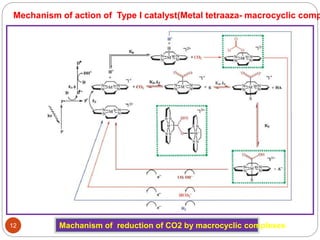
8. Mechanism of action of type I catalyst
9. Mechanism of action of type II catalyst
10. Why not TiO2
11. Binuclear Rhenium and Ruthenium complexes as photocatalyst
12. Ruthenium complexes as photosensitizer and photocatalyst
13. Effect of structures and reaction conditions on photocatalytic
activity
14. Anchoring of photocatalyst to titania and silica
15. Tuning of photocatalyst for desired photoreduced product
16. Problems to be solved in future.
17. My plan of work.
18. References
3
What is photcatalysis ?
“Photocatalysis is a term that combines the basic notion of a
catalyst as a material that enhances the rate of a reaction
approaches equilibrium without being consumed with the notion
that the reaction is accelerated by photons, which of course are
consumed.”
• Photocatalyst is of great interest because the photochemical
reduction of
carbon dioxide has the potential to reduce our CO2 output and
provide
carbonaceous fuels of high energy density.
• Photosynthesis is best example of photoctalysis. Chlorophyll a
and b
work as photocatalyst and convert solar energy to chemical
energy by
water splitting and CO2 reduction.
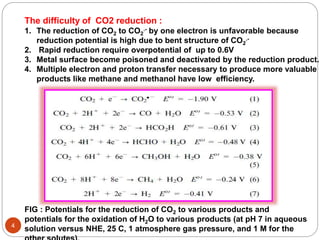
FIG : Potentials for the reduction of CO2 to various products and
potentials for the oxidation of H2O to various products (at pH 7 in aqueous
solution versus NHE, 25 C, 1 atmosphere gas pressure, and 1 M for the4
The difficulty of CO2 reduction :
1. The reduction of CO2 to CO2
.- by one electron is unfavorable because
reduction potential is high due to bent structure of CO2
.-
2. Rapid reduction require overpotential of up to 0.6V
3. Metal surface become poisoned and deactivated by the reduction product.
4. Multiple electron and proton transfer necessary to produce more valuable
products like methane and methanol have low efficiency.
5
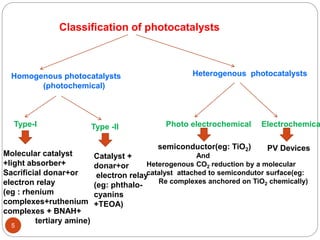
Classification of photocatalysts
Homogenous photocatalysts
(photochemical)
Heterogenous photocatalysts
Photo electrochemical Electrochemica
Molecular catalyst
+light absorber+
Sacrificial donar+or
electron relay
(eg : rhenium
complexes+ruthenium
complexes + BNAH+
tertiary amine)
PV Devicessemiconductor(eg: TiO2)
And
Heterogenous CO2 reduction by a molecular
catalyst attached to semicondutor surface(eg:
Re complexes anchored on TiO2 chemically)
Type-I Type -II
Catalyst +
donar+or
electron relay
(eg: phthalo-
cyanins
+TEOA)
6
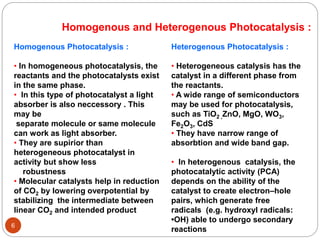
Homogenous and Heterogenous Photocatalysis :
Heterogenous Photocatalysis :
• Heterogeneous catalysis has the
catalyst in a different phase from
the reactants.
• A wide range of semiconductors
may be used for photocatalysis,
such as TiO2 ,ZnO, MgO, WO3,
Fe2O3, CdS
• They have narrow range of
absorbtion and wide band gap.
• In heterogenous catalysis, the
photocatalytic activity (PCA)
depends on the ability of the
catalyst to create electron–hole
pairs, which generate free
radicals (e.g. hydroxyl radicals:
•OH) able to undergo secondary
reactions
Homogenous Photocatalysis :
• In homogeneous photocatalysis, the
reactants and the photocatalysts exist
in the same phase.
• In this type of photocatalyst a light
absorber is also neccessory . This
may be
separate molecule or same molecule
can work as light absorber.
• They are supirior than
heterogeneous photocatalyst in
activity but show less
robustness
• Molecular catalysts help in reduction
of CO2 by lowering overpotential by
stabilizing the intermediate between
linear CO2 and intended product
7
Terminology :
Catalytic selectivity (CS) = [CO2 reduction products] / [other
product and
H2 ]
Quantum Yeild = [CO2 reduction products] / [incident
photons]
Turnover Number (TN) = [CO2 reduction products]
/[catalyst]
Overpotential = Applied potential – Thermodynamic
potential
Turn over frequency (TOF) = Catalytic turn over per unit time
Faradaic effeciency (FE) = [Product]/[electron passed] x number of electron
needed for conversion
8
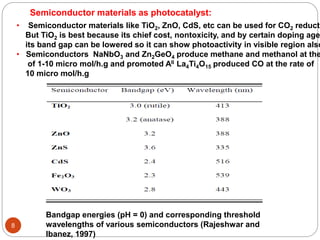
Bandgap energies (pH = 0) and corresponding threshold
wavelengths of various semiconductors (Rajeshwar and
Ibanez, 1997)
Semiconductor materials as photocatalyst:
• Semiconductor materials like TiO2, ZnO, CdS, etc can be used for CO2 reducti
But TiO2 is best because its chief cost, nontoxicity, and by certain doping age
its band gap can be lowered so it can show photoactivity in visible region also
• Semiconductors NaNbO3 and Zn2GeO4 produce methane and methanol at the
of 1-10 micro mol/h.g and promoted AII La4Ti4O15 produced CO at the rate of
10 micro mol/h.g
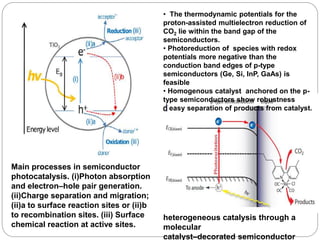
heterogeneous catalysis through a
molecular
catalyst–decorated semiconductor
• The thermodynamic potentials for the
proton-assisted multielectron reduction of
CO2 lie within the band gap of the
semiconductors.
• Photoreduction of species with redox
potentials more negative than the
conduction band edges of p-type
semiconductors (Ge, Si, InP, GaAs) is
feasible
• Homogenous catalyst anchored on the p-
type semiconductors show robustness
easy separation of products from catalyst.
Main processes in semiconductor
photocatalysis. (i)Photon absorption
and electron–hole pair generation.
(ii)Charge separation and migration;
(ii)a to surface reaction sites or (ii)b
to recombination sites. (iii) Surface
chemical reaction at active sites.
(i)Type I photocatalysis :
P + hν = P*
P* + Et3N = P- + Et3N•+
P- + cat = P + cat-
cat- + CO2 = cat + products
Et3N•+ + Et3N = Et3NH+ + Et2NC•HCH3
Et2NC•HCH3 + P (or cat) =
Et2N+CHCH3
+ P- (or cat-
)
10
Tertiary amine known as the “sacrifice
reagent”. Theses provides electrons to
sensitizer for further reaction
TEA, TEOA, and [Co(NH3)5Cl]2+ have been
shown to readily decompose once the
electron transfer has taken place, thus
preventing any further non-productive
back reactions
1-benzyl-1,4-dihydro-
nicotinamide
Types of molecular homogenous photocatalsts :
“A molecular light absorber and
transition metal complex works in
concert, without one there will be
no reaction.”
eg : (a) [Ru(bpy)3]2+
(photosensitizer) and Re
complexes (catalyst)
(b) Metal tetraaza-macrocyclic
complexes
(c) Supramolecular complexes
Type II photocatalysis : “One single compound acts as both the light
absorber and the catalyst.”
eg: (a)Metal porphyrin derivates
investigated for CO2 reduction
(b) Re[(CO)3(bpy)]X based complexes
metalloporphyrin (MP), metallocorrin (MN), metallophthalocyanine
(MPc), and metallocorrole (MC, where R ) C6F5 or 2,6-C6H3Cl2).11
Pcat + hν = Pcat*
Pcat* + Et3N = Pcat- + Et3N•+
Pcat- + CO2 = Pcat + products
Et3N•+ + Et3N = Et3NH+ + Et2NC•HCH3
Et2NC•HCH3 + Pcat = Et2N+ CHCH3 +
Pcat-
12 Machanism of reduction of CO2 by macrocyclic complexes
Mechanism of action of Type I catalyst(Metal tetraaza- macrocyclic comp
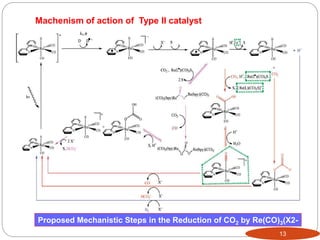
Proposed Mechanistic Steps in the Reduction of CO2 by Re(CO)3(X2-
bpy)X 13
Machenism of action of Type II catalyst
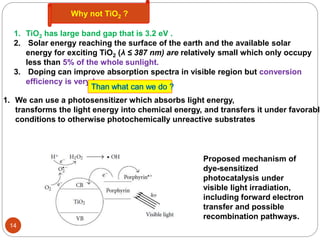
1. TiO2 has large band gap that is 3.2 eV .
2. Solar energy reaching the surface of the earth and the available solar
energy for exciting TiO2 (λ ≤ 387 nm) are relatively small which only occupy
less than 5% of the whole sunlight.
3. Doping can improve absorption spectra in visible region but conversion
efficiency is very low.
14
Why not TiO2 ?
1. We can use a photosensitizer which absorbs light energy,
transforms the light energy into chemical energy, and transfers it under favorable
conditions to otherwise photochemically unreactive substrates
Proposed mechanism of
dye-sensitized
photocatalysis under
visible light irradiation,
including forward electron
transfer and possible
recombination pathways.
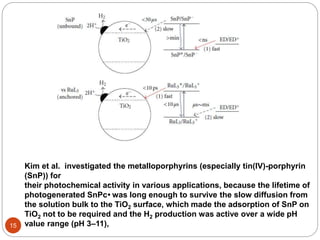
Kim et al. investigated the metalloporphyrins (especially tin(IV)-porphyrin
(SnP)) for
their photochemical activity in various applications, because the lifetime of
photogenerated SnPc• was long enough to survive the slow diffusion from
the solution bulk to the TiO2 surface, which made the adsorption of SnP on
TiO2 not to be required and the H2 production was active over a wide pH
value range (pH 3–11),15
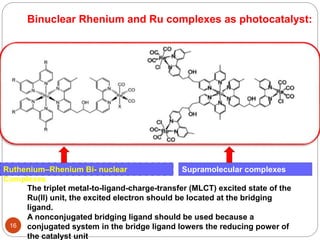
Supramolecular complexes
Re3Ru
16
The triplet metal-to-ligand-charge-transfer (MLCT) excited state of the
Ru(II) unit, the excited electron should be located at the bridging
ligand.
A nonconjugated bridging ligand should be used because a
conjugated system in the bridge ligand lowers the reducing power of
the catalyst unit
Ruthenium–Rhenium Bi- nuclear
Complexes
Binuclear Rhenium and Ru complexes as photocatalyst:
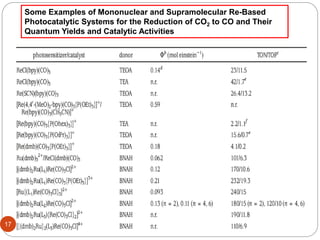
Some Examples of Mononuclear and Supramolecular Re-Based
Photocatalytic Systems for the Reduction of CO2 to CO and Their
Quantum Yields and Catalytic Activities
17
18
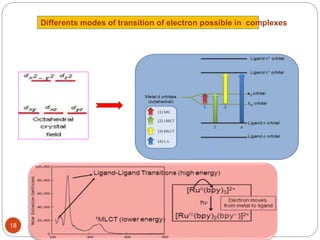
Differents modes of transition of electron possible in complexes
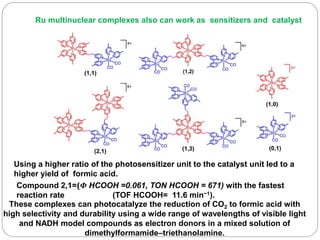
These complexes can photocatalyze the reduction of CO2 to formic acid with
high selectivity and durability using a wide range of wavelengths of visible light
and NADH model compounds as electron donors in a mixed solution of
dimethylformamide–triethanolamine.
Using a higher ratio of the photosensitizer unit to the catalyst unit led to a
higher yield of formic acid.
Compound 2,1=(Φ HCOOH =0.061, TON HCOOH = 671) with the fastest
reaction rate (TOF HCOOH= 11.6 min−1).
Ru multinuclear complexes also can work as sensitizers and catalyst
20
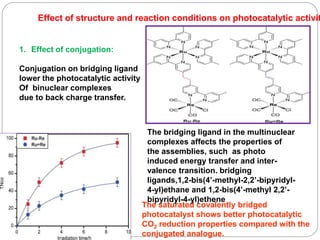
Effect of structure and reaction conditions on photocatalytic activit
1. Effect of conjugation:
Conjugation on bridging ligand
lower the photocatalytic activity
Of binuclear complexes
due to back charge transfer.
The bridging ligand in the multinuclear
complexes affects the properties of
the assemblies, such as photo
induced energy transfer and inter-
valence transition. bridging
ligands,1,2-bis(4’-methyl-2,2’-bipyridyl-
4-yl)ethane and 1,2-bis(4’-methyl 2,2’-
bipyridyl-4-yl)ethene
The saturated covalently bridged
photocatalyst shows better photocatalytic
CO2 reduction properties compared with the
conjugated analogue.
21
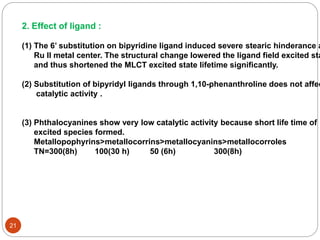
2. Effect of ligand :
(1) The 6’ substitution on bipyridine ligand induced severe stearic hinderance a
Ru II metal center. The structural change lowered the ligand field excited sta
and thus shortened the MLCT excited state lifetime significantly.
(2) Substitution of bipyridyl ligands through 1,10-phenanthroline does not affec
catalytic activity .
(3) Phthalocyanines show very low catalytic activity because short life time of
excited species formed.
Metallopophyrins>metallocorrins>metallocyanins>metallocorroles
TN=300(8h) 100(30 h) 50 (6h) 300(8h)
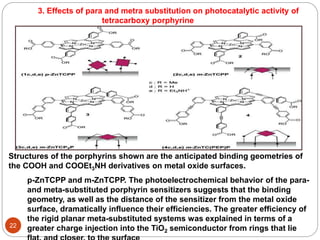
p-ZnTCPP and m-ZnTCPP. The photoelectrochemical behavior of the para-
and meta-substituted porphyrin sensitizers suggests that the binding
geometry, as well as the distance of the sensitizer from the metal oxide
surface, dramatically influence their efficiencies. The greater efficiency of
the rigid planar meta-substituted systems was explained in terms of a
greater charge injection into the TiO2 semiconductor from rings that lie
Structures of the porphyrins shown are the anticipated binding geometries of
the COOH and COOEt3NH derivatives on metal oxide surfaces.
22
3. Effects of para and metra substitution on photocatalytic activity of
tetracarboxy porphyrine
23
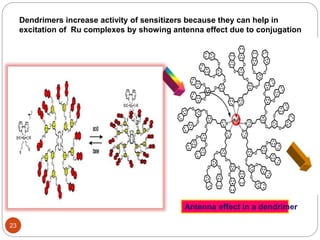
Antenna effect in a dendrimer
Dendrimers increase activity of sensitizers because they can help in
excitation of Ru complexes by showing antenna effect due to conjugation
24
Comparison of UV-Vis spectra of Ru(bpy)3
2+ in high purity water and
acetonitrile (AN). The volume ratio between the amount of acetonitrile to
dissolve Ru(bpy)3
2+ powder and the water to prepare the solution was 1:100.
The spectra were recorded after the solutions reached equilibrium.
[Ru(bpy)3
2+ ] = 1.108 x 10⁻⁵ M.
Effect of solvent on absorbance of Ru complex4.
Photocatalytic activity get increased in non-aqueous solvent in comparison to a
media because CO2 have more solubility(7-8 time ) in Organic solvent
eg: Acetonitrile, DMF, DMSO etc.
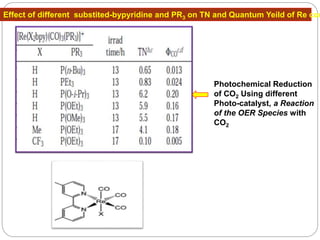
Photochemical Reduction
of CO2 Using different
Photo-catalyst, a Reaction
of the OER Species with
CO2
Effect of different substited-bypyridine and PR3 on TN and Quantum Yeild of Re com
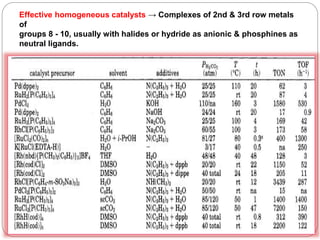
Effective homogeneous catalysts → Complexes of 2nd & 3rd row metals
of
groups 8 - 10, usually with halides or hydride as anionic & phosphines as
neutral ligands.
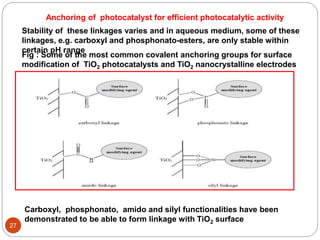
Carboxyl, phosphonato, amido and silyl functionalities have been
demonstrated to be able to form linkage with TiO2 surface
Fig : Some of the most common covalent anchoring groups for surface
modification of TiO2 photocatalysts and TiO2 nanocrystalline electrodes
Stability of these linkages varies and in aqueous medium, some of these
linkages, e.g. carboxyl and phosphonato-esters, are only stable within
certain pH range
27
Anchoring of photocatalyst for efficient photocatalytic activity
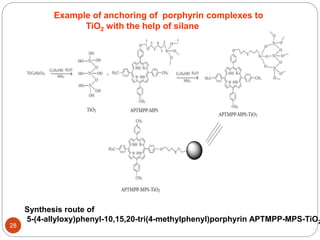
Synthesis route of
5-(4-allyloxy)phenyl-10,15,20-tri(4-methylphenyl)porphyrin APTMPP-MPS-TiO2
28
Example of anchoring of porphyrin complexes to
TiO2 with the help of silane
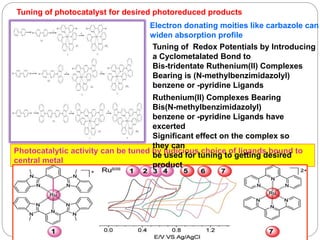
Electron donating moities like carbazole can
widen absorption profile
Tuning of Redox Potentials by Introducing
a Cyclometalated Bond to
Bis-tridentate Ruthenium(II) Complexes
Bearing is (N-methylbenzimidazolyl)
benzene or -pyridine Ligands
Tuning of photocatalyst for desired photoreduced products
Ruthenium(II) Complexes Bearing
Bis(N-methylbenzimidazolyl)
benzene or -pyridine Ligands have
excerted
Significant effect on the complex so
they can
be used for tuning to getting desired
product
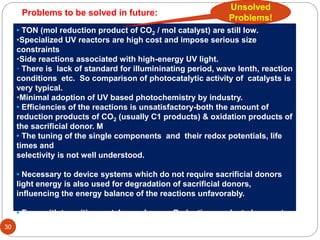
• TON (mol reduction product of CO2 / mol catalyst) are still low.
•Specialized UV reactors are high cost and impose serious size
constraints
•Side reactions associated with high-energy UV light.
• There is lack of standard for illumininating period, wave lenth, reaction
conditions etc. So comparison of photocatalytic activity of catalysts is
very typical.
•Minimal adoption of UV based photochemistry by industry.
• Efficiencies of the reactions is unsatisfactory-both the amount of
reduction products of CO2 (usually C1 products) & oxidation products of
the sacrificial donor. M
• The tuning of the single components and their redox potentials, life
times and
selectivity is not well understood.
• Necessary to device systems which do not require sacrificial donors
light energy is also used for degradation of sacrificial donors,
influencing the energy balance of the reactions unfavorably.
• Even with transition metal complexes – Reduction products have not
been of great economic value (usually only C1 products).
30
Unsolved
Problems!
Problems to be solved in future:
31
My Plan of Work :
1. Synthesis of ruthenium polypyridyl compounds (sensitizer) and
rhenium complexes to which differents groups like –COOH are
attached.
2. Synthesis of tetra carboxy phthalocyanine and other phthalocyanine
derivatives and their anchoring to different surfaces like on
nanotitania, mesoporous silica and other. The main benefit of
anchoring on titania is it contains “titanol TiOH moiety on its
surface so –COOH, -SO3OH substituted complexes can be easily
attached to surface. Another benefit is due to heterogenization
efficiency and lifetime of complex get increased.
3. Synthesis of mixed ligand complexes (bipyridine, phenanthroline,
imidazole,
and their functionalized structures) so that better tuning can be
achieved for desired product.
4. Synthesis of dendrimers type structures (antenna effect) for better
performance of catalyst.
5. Synthesis of complexes of nickel, cobalt ,zinc (porphyrine, correne
1. Bhupendra Kumar, Jonathan M. Smieja, Alissa F. Sasayama, and Clifford P. Kubiak, Chem. Commun.,
2012, 48, 272–274.
2. Jacob Schneider, Hongfei Jia, James T. Muckermana and Etsuko Fujita , Chem. Soc. Rev., 2012, 41,
2036–2051.
3. C. P. Kelly, C. J. Cramer and D. G. Truhler, J. Phys. Chem. B, 2007, 111, 408–422.
4 . Jonathan Rochford, Dorothy Chu, Anders Hagfeldt, and Elena Galoppini, J. Am. Chem. Soc., 2007, 129
(15), 4655-4665.
5. Campbell, W. M.; Burrell, A. K.; Officer, D. L.; Jolley, K. W. Coord. Chem. ReV. 2004, 248, 1363.
6. Luo, L.; Lo, C.-F.; Lin, C.-Y.; Chang, I.-J.; Wei-Guang Diau, E. J. Phys. Chem. B 2006, 110, 410.
7. Gholamkhass B, et al. (2005) Architecture of supramolecular metal complexes for photocatalytic CO2
reduction:
ruthenium-rhenium bi- and tetranuclear complexes.Inorg Chem 44:2326–2336.
8. Olah, G. A.; Prakash, G. K. S.; Goeppert, A. J. Am. Chem. Soc. 2011, 133, 12881−12898.
9. Benson, E. E.; Kubiak, C. P.; Sathrum, A. J.; Smieja, J. M. Chem. Soc. Rev. 2009, 38, 89−99.
10. Hong-Yan Li a, Ling-Xiao Cheng b, Jing Xiong a, Ling-Chen Kang a, Qiu-Lei Xu a, Yu-Cheng Zhu a,
Yun-Mei Tao a,
You-Xuan Zheng a,⇑, Jing-Lin Zuo a, Xiao-Zeng You Inorganica Chimica Acta , 2011 , 370 , 398–404
11. M.H. Keefe, K.D. Benkstein, J.T. Hupp, Coord. Chem. Rev. 2000 , 205, 201.
12.Y.H. Xu, Y. Gao, T. Li, Y. Du, J. Li, E.K. Wang, Adv. Funct. Mater. 2007 , 17, 1003.
13. N. Nensala, T. Nyokong, J. Mol. Catal. A 164 (2000) 69
14. Sharma, V. B.; Jain, S. L.; Sain, B. Tetrahedron Lett. 2003, 44, 383‐386
Sakkibara, Y.; Bera, R. N.; Mizutani, T.; Ishida, K.; Tokumoto, M.; Tani, T. J. Phys. Chem. B. 2001, 105,
1547‐1553.
15. J. Hodak, C. Quinteros, M.I. Litter, E.S. Roman, J. Chem. Soc., Faraday Trans. 1996, 92, 5081.
16. P. Kar, S. Verma, A. Das, and H. N. Ghosh, J. of Phy Chem, C, vol. 113, no. 18, pp. 7970–7977, 2009.
17. Annie K.M. Fung, Brenda K.W. Chiu, Michael H.W. Lam, Water Research , 2003 , 37, 1939–1947
18. V. Iliev, A. Mihaylova, L. Bilyarska, Journal of Molecular Catalysis A: Chemical 2002, 184 , 121–130.
19. Zhan Lu and Tehshik P. Yoon, Angew. Chem. Int. Ed. 2012, 51, 1 – 5
20.Sebastian Wesselbaum, Thorsten vom Stein, Jrgen Klankermayer, and Walter Leitner, Angew. Chem.
Int. Ed. 2012, 51, 7499 –7502
References
33
Thanks
I am the wisest man alive, for I know one
thing, and that is
I know nothing.
“Socrates”

Pawan Homogeneous catalyst for CO2 reduction

  • 1.
  • 2.
    2 Overview of Presentation: 1. What is Photocatalyst ? 2. Problems in CO2 reduction ! 3. Classification of photocatalyst 4. Homogenous & Heterogeneous Photocatalyst 5. Terminology 6. Semiconductor materials as photocatalyst 7. Types of Molecular Homogenous photocatalyst (i) Type I and (ii) Type II 8. Mechanism of action of type I catalyst 9. Mechanism of action of type II catalyst 10. Why not TiO2 11. Binuclear Rhenium and Ruthenium complexes as photocatalyst 12. Ruthenium complexes as photosensitizer and photocatalyst 13. Effect of structures and reaction conditions on photocatalytic activity 14. Anchoring of photocatalyst to titania and silica 15. Tuning of photocatalyst for desired photoreduced product 16. Problems to be solved in future. 17. My plan of work. 18. References
  • 3.
    3 What is photcatalysis? “Photocatalysis is a term that combines the basic notion of a catalyst as a material that enhances the rate of a reaction approaches equilibrium without being consumed with the notion that the reaction is accelerated by photons, which of course are consumed.” • Photocatalyst is of great interest because the photochemical reduction of carbon dioxide has the potential to reduce our CO2 output and provide carbonaceous fuels of high energy density. • Photosynthesis is best example of photoctalysis. Chlorophyll a and b work as photocatalyst and convert solar energy to chemical energy by water splitting and CO2 reduction.
  • 4.
    FIG : Potentialsfor the reduction of CO2 to various products and potentials for the oxidation of H2O to various products (at pH 7 in aqueous solution versus NHE, 25 C, 1 atmosphere gas pressure, and 1 M for the4 The difficulty of CO2 reduction : 1. The reduction of CO2 to CO2 .- by one electron is unfavorable because reduction potential is high due to bent structure of CO2 .- 2. Rapid reduction require overpotential of up to 0.6V 3. Metal surface become poisoned and deactivated by the reduction product. 4. Multiple electron and proton transfer necessary to produce more valuable products like methane and methanol have low efficiency.
  • 5.
    5 Classification of photocatalysts Homogenousphotocatalysts (photochemical) Heterogenous photocatalysts Photo electrochemical Electrochemica Molecular catalyst +light absorber+ Sacrificial donar+or electron relay (eg : rhenium complexes+ruthenium complexes + BNAH+ tertiary amine) PV Devicessemiconductor(eg: TiO2) And Heterogenous CO2 reduction by a molecular catalyst attached to semicondutor surface(eg: Re complexes anchored on TiO2 chemically) Type-I Type -II Catalyst + donar+or electron relay (eg: phthalo- cyanins +TEOA)
  • 6.
    6 Homogenous and HeterogenousPhotocatalysis : Heterogenous Photocatalysis : • Heterogeneous catalysis has the catalyst in a different phase from the reactants. • A wide range of semiconductors may be used for photocatalysis, such as TiO2 ,ZnO, MgO, WO3, Fe2O3, CdS • They have narrow range of absorbtion and wide band gap. • In heterogenous catalysis, the photocatalytic activity (PCA) depends on the ability of the catalyst to create electron–hole pairs, which generate free radicals (e.g. hydroxyl radicals: •OH) able to undergo secondary reactions Homogenous Photocatalysis : • In homogeneous photocatalysis, the reactants and the photocatalysts exist in the same phase. • In this type of photocatalyst a light absorber is also neccessory . This may be separate molecule or same molecule can work as light absorber. • They are supirior than heterogeneous photocatalyst in activity but show less robustness • Molecular catalysts help in reduction of CO2 by lowering overpotential by stabilizing the intermediate between linear CO2 and intended product
  • 7.
    7 Terminology : Catalytic selectivity(CS) = [CO2 reduction products] / [other product and H2 ] Quantum Yeild = [CO2 reduction products] / [incident photons] Turnover Number (TN) = [CO2 reduction products] /[catalyst] Overpotential = Applied potential – Thermodynamic potential Turn over frequency (TOF) = Catalytic turn over per unit time Faradaic effeciency (FE) = [Product]/[electron passed] x number of electron needed for conversion
  • 8.
    8 Bandgap energies (pH= 0) and corresponding threshold wavelengths of various semiconductors (Rajeshwar and Ibanez, 1997) Semiconductor materials as photocatalyst: • Semiconductor materials like TiO2, ZnO, CdS, etc can be used for CO2 reducti But TiO2 is best because its chief cost, nontoxicity, and by certain doping age its band gap can be lowered so it can show photoactivity in visible region also • Semiconductors NaNbO3 and Zn2GeO4 produce methane and methanol at the of 1-10 micro mol/h.g and promoted AII La4Ti4O15 produced CO at the rate of 10 micro mol/h.g
  • 9.
    heterogeneous catalysis througha molecular catalyst–decorated semiconductor • The thermodynamic potentials for the proton-assisted multielectron reduction of CO2 lie within the band gap of the semiconductors. • Photoreduction of species with redox potentials more negative than the conduction band edges of p-type semiconductors (Ge, Si, InP, GaAs) is feasible • Homogenous catalyst anchored on the p- type semiconductors show robustness easy separation of products from catalyst. Main processes in semiconductor photocatalysis. (i)Photon absorption and electron–hole pair generation. (ii)Charge separation and migration; (ii)a to surface reaction sites or (ii)b to recombination sites. (iii) Surface chemical reaction at active sites.
  • 10.
    (i)Type I photocatalysis: P + hν = P* P* + Et3N = P- + Et3N•+ P- + cat = P + cat- cat- + CO2 = cat + products Et3N•+ + Et3N = Et3NH+ + Et2NC•HCH3 Et2NC•HCH3 + P (or cat) = Et2N+CHCH3 + P- (or cat- ) 10 Tertiary amine known as the “sacrifice reagent”. Theses provides electrons to sensitizer for further reaction TEA, TEOA, and [Co(NH3)5Cl]2+ have been shown to readily decompose once the electron transfer has taken place, thus preventing any further non-productive back reactions 1-benzyl-1,4-dihydro- nicotinamide Types of molecular homogenous photocatalsts : “A molecular light absorber and transition metal complex works in concert, without one there will be no reaction.” eg : (a) [Ru(bpy)3]2+ (photosensitizer) and Re complexes (catalyst) (b) Metal tetraaza-macrocyclic complexes (c) Supramolecular complexes
  • 11.
    Type II photocatalysis: “One single compound acts as both the light absorber and the catalyst.” eg: (a)Metal porphyrin derivates investigated for CO2 reduction (b) Re[(CO)3(bpy)]X based complexes metalloporphyrin (MP), metallocorrin (MN), metallophthalocyanine (MPc), and metallocorrole (MC, where R ) C6F5 or 2,6-C6H3Cl2).11 Pcat + hν = Pcat* Pcat* + Et3N = Pcat- + Et3N•+ Pcat- + CO2 = Pcat + products Et3N•+ + Et3N = Et3NH+ + Et2NC•HCH3 Et2NC•HCH3 + Pcat = Et2N+ CHCH3 + Pcat-
  • 12.
    12 Machanism ofreduction of CO2 by macrocyclic complexes Mechanism of action of Type I catalyst(Metal tetraaza- macrocyclic comp
  • 13.
    Proposed Mechanistic Stepsin the Reduction of CO2 by Re(CO)3(X2- bpy)X 13 Machenism of action of Type II catalyst
  • 14.
    1. TiO2 haslarge band gap that is 3.2 eV . 2. Solar energy reaching the surface of the earth and the available solar energy for exciting TiO2 (λ ≤ 387 nm) are relatively small which only occupy less than 5% of the whole sunlight. 3. Doping can improve absorption spectra in visible region but conversion efficiency is very low. 14 Why not TiO2 ? 1. We can use a photosensitizer which absorbs light energy, transforms the light energy into chemical energy, and transfers it under favorable conditions to otherwise photochemically unreactive substrates Proposed mechanism of dye-sensitized photocatalysis under visible light irradiation, including forward electron transfer and possible recombination pathways.
  • 15.
    Kim et al.investigated the metalloporphyrins (especially tin(IV)-porphyrin (SnP)) for their photochemical activity in various applications, because the lifetime of photogenerated SnPc• was long enough to survive the slow diffusion from the solution bulk to the TiO2 surface, which made the adsorption of SnP on TiO2 not to be required and the H2 production was active over a wide pH value range (pH 3–11),15
  • 16.
    Supramolecular complexes Re3Ru 16 The tripletmetal-to-ligand-charge-transfer (MLCT) excited state of the Ru(II) unit, the excited electron should be located at the bridging ligand. A nonconjugated bridging ligand should be used because a conjugated system in the bridge ligand lowers the reducing power of the catalyst unit Ruthenium–Rhenium Bi- nuclear Complexes Binuclear Rhenium and Ru complexes as photocatalyst:
  • 17.
    Some Examples ofMononuclear and Supramolecular Re-Based Photocatalytic Systems for the Reduction of CO2 to CO and Their Quantum Yields and Catalytic Activities 17
  • 18.
    18 Differents modes oftransition of electron possible in complexes
  • 19.
    These complexes canphotocatalyze the reduction of CO2 to formic acid with high selectivity and durability using a wide range of wavelengths of visible light and NADH model compounds as electron donors in a mixed solution of dimethylformamide–triethanolamine. Using a higher ratio of the photosensitizer unit to the catalyst unit led to a higher yield of formic acid. Compound 2,1=(Φ HCOOH =0.061, TON HCOOH = 671) with the fastest reaction rate (TOF HCOOH= 11.6 min−1). Ru multinuclear complexes also can work as sensitizers and catalyst
  • 20.
    20 Effect of structureand reaction conditions on photocatalytic activit 1. Effect of conjugation: Conjugation on bridging ligand lower the photocatalytic activity Of binuclear complexes due to back charge transfer. The bridging ligand in the multinuclear complexes affects the properties of the assemblies, such as photo induced energy transfer and inter- valence transition. bridging ligands,1,2-bis(4’-methyl-2,2’-bipyridyl- 4-yl)ethane and 1,2-bis(4’-methyl 2,2’- bipyridyl-4-yl)ethene The saturated covalently bridged photocatalyst shows better photocatalytic CO2 reduction properties compared with the conjugated analogue.
  • 21.
    21 2. Effect ofligand : (1) The 6’ substitution on bipyridine ligand induced severe stearic hinderance a Ru II metal center. The structural change lowered the ligand field excited sta and thus shortened the MLCT excited state lifetime significantly. (2) Substitution of bipyridyl ligands through 1,10-phenanthroline does not affec catalytic activity . (3) Phthalocyanines show very low catalytic activity because short life time of excited species formed. Metallopophyrins>metallocorrins>metallocyanins>metallocorroles TN=300(8h) 100(30 h) 50 (6h) 300(8h)
  • 22.
    p-ZnTCPP and m-ZnTCPP.The photoelectrochemical behavior of the para- and meta-substituted porphyrin sensitizers suggests that the binding geometry, as well as the distance of the sensitizer from the metal oxide surface, dramatically influence their efficiencies. The greater efficiency of the rigid planar meta-substituted systems was explained in terms of a greater charge injection into the TiO2 semiconductor from rings that lie Structures of the porphyrins shown are the anticipated binding geometries of the COOH and COOEt3NH derivatives on metal oxide surfaces. 22 3. Effects of para and metra substitution on photocatalytic activity of tetracarboxy porphyrine
  • 23.
    23 Antenna effect ina dendrimer Dendrimers increase activity of sensitizers because they can help in excitation of Ru complexes by showing antenna effect due to conjugation
  • 24.
    24 Comparison of UV-Visspectra of Ru(bpy)3 2+ in high purity water and acetonitrile (AN). The volume ratio between the amount of acetonitrile to dissolve Ru(bpy)3 2+ powder and the water to prepare the solution was 1:100. The spectra were recorded after the solutions reached equilibrium. [Ru(bpy)3 2+ ] = 1.108 x 10⁻⁵ M. Effect of solvent on absorbance of Ru complex4. Photocatalytic activity get increased in non-aqueous solvent in comparison to a media because CO2 have more solubility(7-8 time ) in Organic solvent eg: Acetonitrile, DMF, DMSO etc.
  • 25.
    Photochemical Reduction of CO2Using different Photo-catalyst, a Reaction of the OER Species with CO2 Effect of different substited-bypyridine and PR3 on TN and Quantum Yeild of Re com
  • 26.
    Effective homogeneous catalysts→ Complexes of 2nd & 3rd row metals of groups 8 - 10, usually with halides or hydride as anionic & phosphines as neutral ligands.
  • 27.
    Carboxyl, phosphonato, amidoand silyl functionalities have been demonstrated to be able to form linkage with TiO2 surface Fig : Some of the most common covalent anchoring groups for surface modification of TiO2 photocatalysts and TiO2 nanocrystalline electrodes Stability of these linkages varies and in aqueous medium, some of these linkages, e.g. carboxyl and phosphonato-esters, are only stable within certain pH range 27 Anchoring of photocatalyst for efficient photocatalytic activity
  • 28.
    Synthesis route of 5-(4-allyloxy)phenyl-10,15,20-tri(4-methylphenyl)porphyrinAPTMPP-MPS-TiO2 28 Example of anchoring of porphyrin complexes to TiO2 with the help of silane
  • 29.
    Electron donating moitieslike carbazole can widen absorption profile Tuning of Redox Potentials by Introducing a Cyclometalated Bond to Bis-tridentate Ruthenium(II) Complexes Bearing is (N-methylbenzimidazolyl) benzene or -pyridine Ligands Tuning of photocatalyst for desired photoreduced products Ruthenium(II) Complexes Bearing Bis(N-methylbenzimidazolyl) benzene or -pyridine Ligands have excerted Significant effect on the complex so they can be used for tuning to getting desired product
  • 30.
    • TON (molreduction product of CO2 / mol catalyst) are still low. •Specialized UV reactors are high cost and impose serious size constraints •Side reactions associated with high-energy UV light. • There is lack of standard for illumininating period, wave lenth, reaction conditions etc. So comparison of photocatalytic activity of catalysts is very typical. •Minimal adoption of UV based photochemistry by industry. • Efficiencies of the reactions is unsatisfactory-both the amount of reduction products of CO2 (usually C1 products) & oxidation products of the sacrificial donor. M • The tuning of the single components and their redox potentials, life times and selectivity is not well understood. • Necessary to device systems which do not require sacrificial donors light energy is also used for degradation of sacrificial donors, influencing the energy balance of the reactions unfavorably. • Even with transition metal complexes – Reduction products have not been of great economic value (usually only C1 products). 30 Unsolved Problems! Problems to be solved in future:
  • 31.
    31 My Plan ofWork : 1. Synthesis of ruthenium polypyridyl compounds (sensitizer) and rhenium complexes to which differents groups like –COOH are attached. 2. Synthesis of tetra carboxy phthalocyanine and other phthalocyanine derivatives and their anchoring to different surfaces like on nanotitania, mesoporous silica and other. The main benefit of anchoring on titania is it contains “titanol TiOH moiety on its surface so –COOH, -SO3OH substituted complexes can be easily attached to surface. Another benefit is due to heterogenization efficiency and lifetime of complex get increased. 3. Synthesis of mixed ligand complexes (bipyridine, phenanthroline, imidazole, and their functionalized structures) so that better tuning can be achieved for desired product. 4. Synthesis of dendrimers type structures (antenna effect) for better performance of catalyst. 5. Synthesis of complexes of nickel, cobalt ,zinc (porphyrine, correne
  • 32.
    1. Bhupendra Kumar,Jonathan M. Smieja, Alissa F. Sasayama, and Clifford P. Kubiak, Chem. Commun., 2012, 48, 272–274. 2. Jacob Schneider, Hongfei Jia, James T. Muckermana and Etsuko Fujita , Chem. Soc. Rev., 2012, 41, 2036–2051. 3. C. P. Kelly, C. J. Cramer and D. G. Truhler, J. Phys. Chem. B, 2007, 111, 408–422. 4 . Jonathan Rochford, Dorothy Chu, Anders Hagfeldt, and Elena Galoppini, J. Am. Chem. Soc., 2007, 129 (15), 4655-4665. 5. Campbell, W. M.; Burrell, A. K.; Officer, D. L.; Jolley, K. W. Coord. Chem. ReV. 2004, 248, 1363. 6. Luo, L.; Lo, C.-F.; Lin, C.-Y.; Chang, I.-J.; Wei-Guang Diau, E. J. Phys. Chem. B 2006, 110, 410. 7. Gholamkhass B, et al. (2005) Architecture of supramolecular metal complexes for photocatalytic CO2 reduction: ruthenium-rhenium bi- and tetranuclear complexes.Inorg Chem 44:2326–2336. 8. Olah, G. A.; Prakash, G. K. S.; Goeppert, A. J. Am. Chem. Soc. 2011, 133, 12881−12898. 9. Benson, E. E.; Kubiak, C. P.; Sathrum, A. J.; Smieja, J. M. Chem. Soc. Rev. 2009, 38, 89−99. 10. Hong-Yan Li a, Ling-Xiao Cheng b, Jing Xiong a, Ling-Chen Kang a, Qiu-Lei Xu a, Yu-Cheng Zhu a, Yun-Mei Tao a, You-Xuan Zheng a,⇑, Jing-Lin Zuo a, Xiao-Zeng You Inorganica Chimica Acta , 2011 , 370 , 398–404 11. M.H. Keefe, K.D. Benkstein, J.T. Hupp, Coord. Chem. Rev. 2000 , 205, 201. 12.Y.H. Xu, Y. Gao, T. Li, Y. Du, J. Li, E.K. Wang, Adv. Funct. Mater. 2007 , 17, 1003. 13. N. Nensala, T. Nyokong, J. Mol. Catal. A 164 (2000) 69 14. Sharma, V. B.; Jain, S. L.; Sain, B. Tetrahedron Lett. 2003, 44, 383‐386 Sakkibara, Y.; Bera, R. N.; Mizutani, T.; Ishida, K.; Tokumoto, M.; Tani, T. J. Phys. Chem. B. 2001, 105, 1547‐1553. 15. J. Hodak, C. Quinteros, M.I. Litter, E.S. Roman, J. Chem. Soc., Faraday Trans. 1996, 92, 5081. 16. P. Kar, S. Verma, A. Das, and H. N. Ghosh, J. of Phy Chem, C, vol. 113, no. 18, pp. 7970–7977, 2009. 17. Annie K.M. Fung, Brenda K.W. Chiu, Michael H.W. Lam, Water Research , 2003 , 37, 1939–1947 18. V. Iliev, A. Mihaylova, L. Bilyarska, Journal of Molecular Catalysis A: Chemical 2002, 184 , 121–130. 19. Zhan Lu and Tehshik P. Yoon, Angew. Chem. Int. Ed. 2012, 51, 1 – 5 20.Sebastian Wesselbaum, Thorsten vom Stein, Jrgen Klankermayer, and Walter Leitner, Angew. Chem. Int. Ed. 2012, 51, 7499 –7502 References
  • 33.
    33 Thanks I am thewisest man alive, for I know one thing, and that is I know nothing. “Socrates”