‫ممم‬
‫مممم‬
‫مممممم‬
‫مممممم‬
Nano Indentation Effects
on Ti6Al4VELI During
Excimer Laser Irradiation
Hebatalrahman,A*
Dr.eng. Consultant in materials
sciences & materials applications,
Egypt*
hebatalrahman11@yahoo.comhebatalrahman11@
ABSTRACT
• In this work, the effects of laser as method of surface treatment in nanoscale
on the properties of alloys were evaluated. In order to study the effect of UV
laser irradiation on Ti6Al4VELI, it was irradiated by 308nm Excimer laser at
different number of pulses in the range from 2000 pulses to50000pulses. The
nano-indentation measurements were performed on the surface of both
untreated Ti6Al4VELI and on laser irradiated samples in order to determine
their hardness, stiffness and elastic properties such as reduced modulus, the
effect of irradiation process on the microstructure of Ti6Al4VELI was
evaluated by qualitative analysis. This work discuss the effect of laser
processing parameters on the microstructure and compare the results
obtained by various researchers. Therefore, an overview of the difficulties
involved in the laser processing of titanium is provided with a discussion of
future prospects. The research emphasis that laser irradiation is a promising
technique for surface hardening of materials in nano scale rather than
conventional methods
• Key words laser, irradiation, nano-indentation, microstructure, Ti6Al4VELI
INTRODUCTION
• The benefits of titanium to the world are endless. This metal has
completely changed opportunities in medical, chemical processing ,
energy, drilling, aerospace, marine, weaponry, and consumer
industries for ever[1],[2]. Titanium is available in several different
grades. Pure titanium is not as strong as the different titanium
alloys[3].
• The alloy offers the best all-round performance for a variety of weight
reduction applications in aerospace, automotive and marine
equipment. The high strength, low weight ratio and outstanding
corrosion resistance inherent to titanium and its alloys has led to a
wide and diversified range of successful applications which demand
high levels of reliable performance in surgery and medicine as well
as in aerospace, automotive, chemical plant, power generation, oil
and gas extraction, sports, and other major industries. In the majority
of these and other engineering applications, titanium replaces
heavier, less serviceable or less cost-effective materials. Designs
made using the properties provided by titanium often result in
reliable, economic and more durable systems and components[4],
[5].
Experimental Work
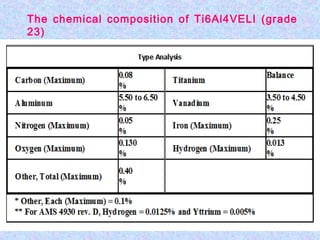
The chemical composition of Ti6Al4VELI (grade
23)
Laser Surface Irradiation
• Samples used in this investigation were
in the standard size for every test
according to ASTM.
• All the experiments were performed at
room temperature in air at atmospheric
pressure;
• the presence of air has no measurable
influence on the process of irradiation by
UV laser
• The irradiation is done on one side of the
sample and covers all the surface area of
the sample.
• optimize condition for laser irradiation of
the samples by Excimer laser at 308nm
The laser irradiation conditions of the
samples
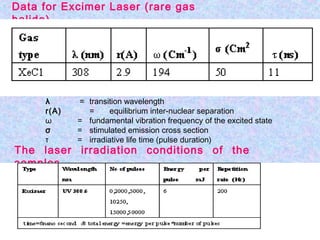
Data for Excimer Laser (rare gas
halide)
λ = transition wavelength
r(A) = equilibrium inter-nuclear separation
ω = fundamental vibration frequency of the excited state
σ = stimulated emission cross section
τ = irradiative life time (pulse duration)
Indentation Data Analysis
• The rapidly expanding field of
depth‑sensing nano-indenta­tion
provides a quantitative method for
mapping the mechanical properties,
• hardness and elastic modu­lus, of the
surface/near‑surface region.
• Quantification is possible through the
use of diamond indenters with well ­
defined tip geometry,
• combined with established models for
determining the mechanical properties
from the measured data.
• employs greater applied load so that the
residual indent can be measured
Indentation Data Analysis
calculations & measurements
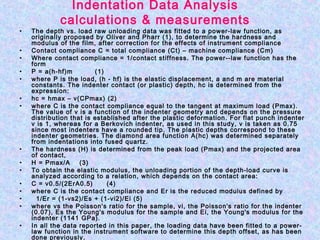
• The depth vs. load raw unloading data was fitted to a power‑law function, as
originally proposed by Oliver and Pharr (1), to determine the hardness and
modulus of the film, after correction for the effects of instrument compliance
• Contact compliance C = total compliance (Ct) – machine compliance (Cm)
• Where contact compliance = 1/contact stiffness. The power-­law function has the
form
• P = a(h-hf)m (1)
• where P is the load, (h ‑ hf) is the elastic displacement, a and m are material
constants. The indenter contact (or plastic) depth, hc is determined from the
expression:
• hc = hmax – v(CPmax) (2)
• where C is the contact compliance equal to the tangent at maximum load (Pmax).
The value of v is a function of the indenter geometry and depends on the pressure
distribution that is established after the plastic deformation. For flat punch indenter
v is 1, whereas for a Berkovich indenter, as used in this study, v is taken as 0.75
since most indenters have a rounded tip. The plastic depths correspond to these
indenter geometries. The diamond area function A(hc) was determined separately
from indentations into fused quartz.
• The hardness (H) is determined from the peak load (Pmax) and the projected area
of contact,
• H = Pmax/A (3)
• To obtain the elastic modulus, the unloading portion of the depth‑load curve is
analyzed according to a relation, which depends on the contact area:
• C = v0.5/(2ErA0.5) (4)
• where C is the contact compliance and Er is the reduced modulus defined by
• 1/Er = (1-vs2)/Es + (1-vi2)/Ei (5)
• where vs the Poisson's ratio for the sample, vi, the Poisson's ratio for the indenter
(0.07), Es the Young's modulus for the sample and Ei, the Young's modulus for the
indenter (1141 GPa).
• In all the data reported in this paper, the loading data have been fitted to a power­
law function in the instrument software to determine this depth offset, as has been
done previously.
Qualitative analysis
Metallographic Examinations
The specimens were prepared by:-
• grinding on different grades of silicon carbide "SiC“
• coarse grinding followed by fine grinding at 180,240,320,400,600, and
800
• polishing was conducted with Alumina powder (3µm) size.
• The details of the microstructure were revealed after etching by
standard etching solution of the alloy selected.
• All specimens had to be etched and polished several times to obtain
best results and to produce a uniform level of sample examination.
• The surfaces of the samples before and after laser irradiation were
examined using an Olympus optical microscope Model BHM at selected
magnification[20].
RESULTS &
DISCUSSIONS
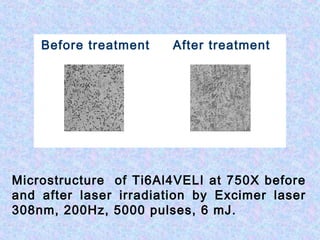
Before treatment After treatment
Microstructure of Ti6Al4VELI at 750X before
and after laser irradiation by Excimer laser
308nm, 200Hz, 5000 pulses, 6 mJ.
• This microstructural morphology, consisting of these sets of
parallel plates which have formed with a crystallographic
relationship to the phase from which they formed, is called a
Widmanstatten structure[21]. The laser irradiation of the alloy
is similar action to cooling rapidly , the relatively higher thermal
conductivity of titanium alloy Ti6Al4VELI which is about
0.219W/cmK, β may decompose by a martensite reaction,
similar to that for pure Ti, and form a Widmanstatten pattern.
Different types of martensite may form depending upon the
alloy chemistry and the quenching temperature[29],[30].
• Since in a given β grain there are six sets of nonparallel growth
planes, then a structure of a plates is formed consisting of six
nonparallel sets. The Widmanstatten microstructure developed
So laser treated Ti-6Al-4V has an excellent combination of
strength and toughness along with excellent performance there
is no change in shape and appearance, it has found extended
application of laser irradiation techniques mentioned in this
work because of useful mechanical properties produced by
surface treatments.
Conclusions
• Using ultra violet Excimer laser 308nm at different number of pulses which is
high power cold beam does not have any thermal effect this prevent alloy
reaction with the atmosphere
• Laser photon energy is absorbed on the surface of the Ti6AL4V ELI alloys and
causes change in the microstructure leads to change in the mechanical
properties
• The Hardness, reduced modulus and stiffness are changed with the amount of
laser energy absorbed and with number of pulses
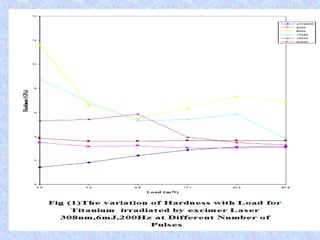
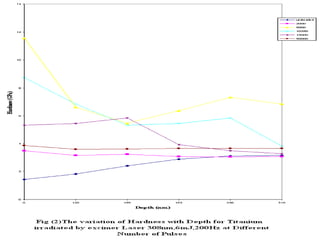
• The maximum value of hardness was 11.8 GPa at unloaded conditions. at
10250 pulses the hardness at the unloaded conditions 8.8GPa , the untreated
sample record 1.4 GPa at the same conditions.
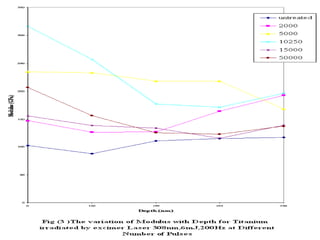
• The variation of modulus with depth as a function of number of pulses. the
maximum value of modulus was 330 GPa recorded at 10250 pulses while at
5000 pulses the modulus value was 270 GPa . the untreated sample record
100 GPa.
• The hardness increased gradually with number of pulses and reach maximum
value 12GPa at 5000 pulses. The rate of hardness decrease from 5000 to
15000 pulses was very narrow.
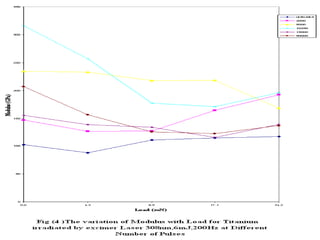
• The modulus decreases gradually to reach the value of base metal with load
increase, the modulus improvement at other pulses in the range from 150 GPa
to 200 GPa.
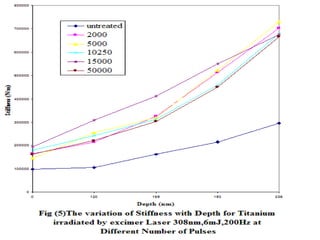
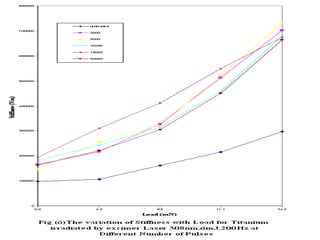
• The variation of stiffness occurs with depth and load respectively as a
function of number of pulses. The rate of stiffness increased with both load
and depth. The maximum value of stiffness was 750000 N/m at 5000pulses.
The rate of increases almost the same from 0 to 236nm, the stiffness values
increased at all conditions of laser irradiation in the range from 650000 N/m to
750000 N/m
• The Widmanstatten microstructure is developed so laser irradiation of
Ti6AL4V ELI in the room temperature is similar to quenching process of the
same alloy due to high thermal conductivity of titanium .
• Laser treated Ti-6Al-4V has an excellent combination of strength and
toughness along with excellent corrosion resistance. Typical uses include
aerospace applications, pressure vessels, aircraft turbine and compressor
blades and disks. Surgical implants, and building elements.
Ti nano

Ti nano

  • 1.
  • 2.
    Nano Indentation Effects onTi6Al4VELI During Excimer Laser Irradiation Hebatalrahman,A* Dr.eng. Consultant in materials sciences & materials applications, Egypt* hebatalrahman11@yahoo.comhebatalrahman11@
  • 3.
    ABSTRACT • In thiswork, the effects of laser as method of surface treatment in nanoscale on the properties of alloys were evaluated. In order to study the effect of UV laser irradiation on Ti6Al4VELI, it was irradiated by 308nm Excimer laser at different number of pulses in the range from 2000 pulses to50000pulses. The nano-indentation measurements were performed on the surface of both untreated Ti6Al4VELI and on laser irradiated samples in order to determine their hardness, stiffness and elastic properties such as reduced modulus, the effect of irradiation process on the microstructure of Ti6Al4VELI was evaluated by qualitative analysis. This work discuss the effect of laser processing parameters on the microstructure and compare the results obtained by various researchers. Therefore, an overview of the difficulties involved in the laser processing of titanium is provided with a discussion of future prospects. The research emphasis that laser irradiation is a promising technique for surface hardening of materials in nano scale rather than conventional methods • Key words laser, irradiation, nano-indentation, microstructure, Ti6Al4VELI
  • 4.
    INTRODUCTION • The benefitsof titanium to the world are endless. This metal has completely changed opportunities in medical, chemical processing , energy, drilling, aerospace, marine, weaponry, and consumer industries for ever[1],[2]. Titanium is available in several different grades. Pure titanium is not as strong as the different titanium alloys[3]. • The alloy offers the best all-round performance for a variety of weight reduction applications in aerospace, automotive and marine equipment. The high strength, low weight ratio and outstanding corrosion resistance inherent to titanium and its alloys has led to a wide and diversified range of successful applications which demand high levels of reliable performance in surgery and medicine as well as in aerospace, automotive, chemical plant, power generation, oil and gas extraction, sports, and other major industries. In the majority of these and other engineering applications, titanium replaces heavier, less serviceable or less cost-effective materials. Designs made using the properties provided by titanium often result in reliable, economic and more durable systems and components[4], [5].
  • 5.
  • 6.
    The chemical compositionof Ti6Al4VELI (grade 23)
  • 7.
    Laser Surface Irradiation •Samples used in this investigation were in the standard size for every test according to ASTM. • All the experiments were performed at room temperature in air at atmospheric pressure; • the presence of air has no measurable influence on the process of irradiation by UV laser • The irradiation is done on one side of the sample and covers all the surface area of the sample. • optimize condition for laser irradiation of the samples by Excimer laser at 308nm
  • 8.
    The laser irradiationconditions of the samples Data for Excimer Laser (rare gas halide) λ = transition wavelength r(A) = equilibrium inter-nuclear separation ω = fundamental vibration frequency of the excited state σ = stimulated emission cross section τ = irradiative life time (pulse duration)
  • 9.
    Indentation Data Analysis •The rapidly expanding field of depth‑sensing nano-indenta­tion provides a quantitative method for mapping the mechanical properties, • hardness and elastic modu­lus, of the surface/near‑surface region. • Quantification is possible through the use of diamond indenters with well ­ defined tip geometry, • combined with established models for determining the mechanical properties from the measured data. • employs greater applied load so that the residual indent can be measured
  • 10.
    Indentation Data Analysis calculations& measurements • The depth vs. load raw unloading data was fitted to a power‑law function, as originally proposed by Oliver and Pharr (1), to determine the hardness and modulus of the film, after correction for the effects of instrument compliance • Contact compliance C = total compliance (Ct) – machine compliance (Cm) • Where contact compliance = 1/contact stiffness. The power-­law function has the form • P = a(h-hf)m (1) • where P is the load, (h ‑ hf) is the elastic displacement, a and m are material constants. The indenter contact (or plastic) depth, hc is determined from the expression: • hc = hmax – v(CPmax) (2) • where C is the contact compliance equal to the tangent at maximum load (Pmax). The value of v is a function of the indenter geometry and depends on the pressure distribution that is established after the plastic deformation. For flat punch indenter v is 1, whereas for a Berkovich indenter, as used in this study, v is taken as 0.75 since most indenters have a rounded tip. The plastic depths correspond to these indenter geometries. The diamond area function A(hc) was determined separately from indentations into fused quartz. • The hardness (H) is determined from the peak load (Pmax) and the projected area of contact, • H = Pmax/A (3) • To obtain the elastic modulus, the unloading portion of the depth‑load curve is analyzed according to a relation, which depends on the contact area: • C = v0.5/(2ErA0.5) (4) • where C is the contact compliance and Er is the reduced modulus defined by • 1/Er = (1-vs2)/Es + (1-vi2)/Ei (5) • where vs the Poisson's ratio for the sample, vi, the Poisson's ratio for the indenter (0.07), Es the Young's modulus for the sample and Ei, the Young's modulus for the indenter (1141 GPa). • In all the data reported in this paper, the loading data have been fitted to a power­ law function in the instrument software to determine this depth offset, as has been done previously.
  • 11.
    Qualitative analysis Metallographic Examinations Thespecimens were prepared by:- • grinding on different grades of silicon carbide "SiC“ • coarse grinding followed by fine grinding at 180,240,320,400,600, and 800 • polishing was conducted with Alumina powder (3µm) size. • The details of the microstructure were revealed after etching by standard etching solution of the alloy selected. • All specimens had to be etched and polished several times to obtain best results and to produce a uniform level of sample examination. • The surfaces of the samples before and after laser irradiation were examined using an Olympus optical microscope Model BHM at selected magnification[20].
  • 12.
  • 19.
    Before treatment Aftertreatment Microstructure of Ti6Al4VELI at 750X before and after laser irradiation by Excimer laser 308nm, 200Hz, 5000 pulses, 6 mJ.
  • 20.
    • This microstructuralmorphology, consisting of these sets of parallel plates which have formed with a crystallographic relationship to the phase from which they formed, is called a Widmanstatten structure[21]. The laser irradiation of the alloy is similar action to cooling rapidly , the relatively higher thermal conductivity of titanium alloy Ti6Al4VELI which is about 0.219W/cmK, β may decompose by a martensite reaction, similar to that for pure Ti, and form a Widmanstatten pattern. Different types of martensite may form depending upon the alloy chemistry and the quenching temperature[29],[30]. • Since in a given β grain there are six sets of nonparallel growth planes, then a structure of a plates is formed consisting of six nonparallel sets. The Widmanstatten microstructure developed So laser treated Ti-6Al-4V has an excellent combination of strength and toughness along with excellent performance there is no change in shape and appearance, it has found extended application of laser irradiation techniques mentioned in this work because of useful mechanical properties produced by surface treatments.
  • 21.
  • 22.
    • Using ultraviolet Excimer laser 308nm at different number of pulses which is high power cold beam does not have any thermal effect this prevent alloy reaction with the atmosphere • Laser photon energy is absorbed on the surface of the Ti6AL4V ELI alloys and causes change in the microstructure leads to change in the mechanical properties • The Hardness, reduced modulus and stiffness are changed with the amount of laser energy absorbed and with number of pulses • The maximum value of hardness was 11.8 GPa at unloaded conditions. at 10250 pulses the hardness at the unloaded conditions 8.8GPa , the untreated sample record 1.4 GPa at the same conditions. • The variation of modulus with depth as a function of number of pulses. the maximum value of modulus was 330 GPa recorded at 10250 pulses while at 5000 pulses the modulus value was 270 GPa . the untreated sample record 100 GPa. • The hardness increased gradually with number of pulses and reach maximum value 12GPa at 5000 pulses. The rate of hardness decrease from 5000 to 15000 pulses was very narrow. • The modulus decreases gradually to reach the value of base metal with load increase, the modulus improvement at other pulses in the range from 150 GPa to 200 GPa. • The variation of stiffness occurs with depth and load respectively as a function of number of pulses. The rate of stiffness increased with both load and depth. The maximum value of stiffness was 750000 N/m at 5000pulses. The rate of increases almost the same from 0 to 236nm, the stiffness values increased at all conditions of laser irradiation in the range from 650000 N/m to 750000 N/m • The Widmanstatten microstructure is developed so laser irradiation of Ti6AL4V ELI in the room temperature is similar to quenching process of the same alloy due to high thermal conductivity of titanium . • Laser treated Ti-6Al-4V has an excellent combination of strength and toughness along with excellent corrosion resistance. Typical uses include aerospace applications, pressure vessels, aircraft turbine and compressor blades and disks. Surgical implants, and building elements.