GOVERNMENT
ENGINEERING
COLLEGE
Subject: CHEMICAL ENGINEERING
THERMODYNAMIC (2140502)
Topic: Throttling and Joule-Thompson
Coefficient and its Applications
1 Bhadja Anand C. 160190105006
2 Davra Dharmik G. 160190105016
3 Moradiya Milan L. 160190105043
4 Pandav Mukund G. 160190105049
5 Papaniya Hitesh L. 160190105051
Submitted By:
Throttling & The Joule-
Thomson Experiment
 Throttling process involves the passage of a higher
pressure fluid through a narrow constriction.
 The effect is the reduction in pressure and increase in
volume
• This process is adiabatic as no heat flows from and to
the system, but it is not reversible.
• It is not an isentropic process
• The entropy of the fluid actually increases
 Such a process occurs in a flow through a porous plug, a
partially closed valve and a very narrow orifice.
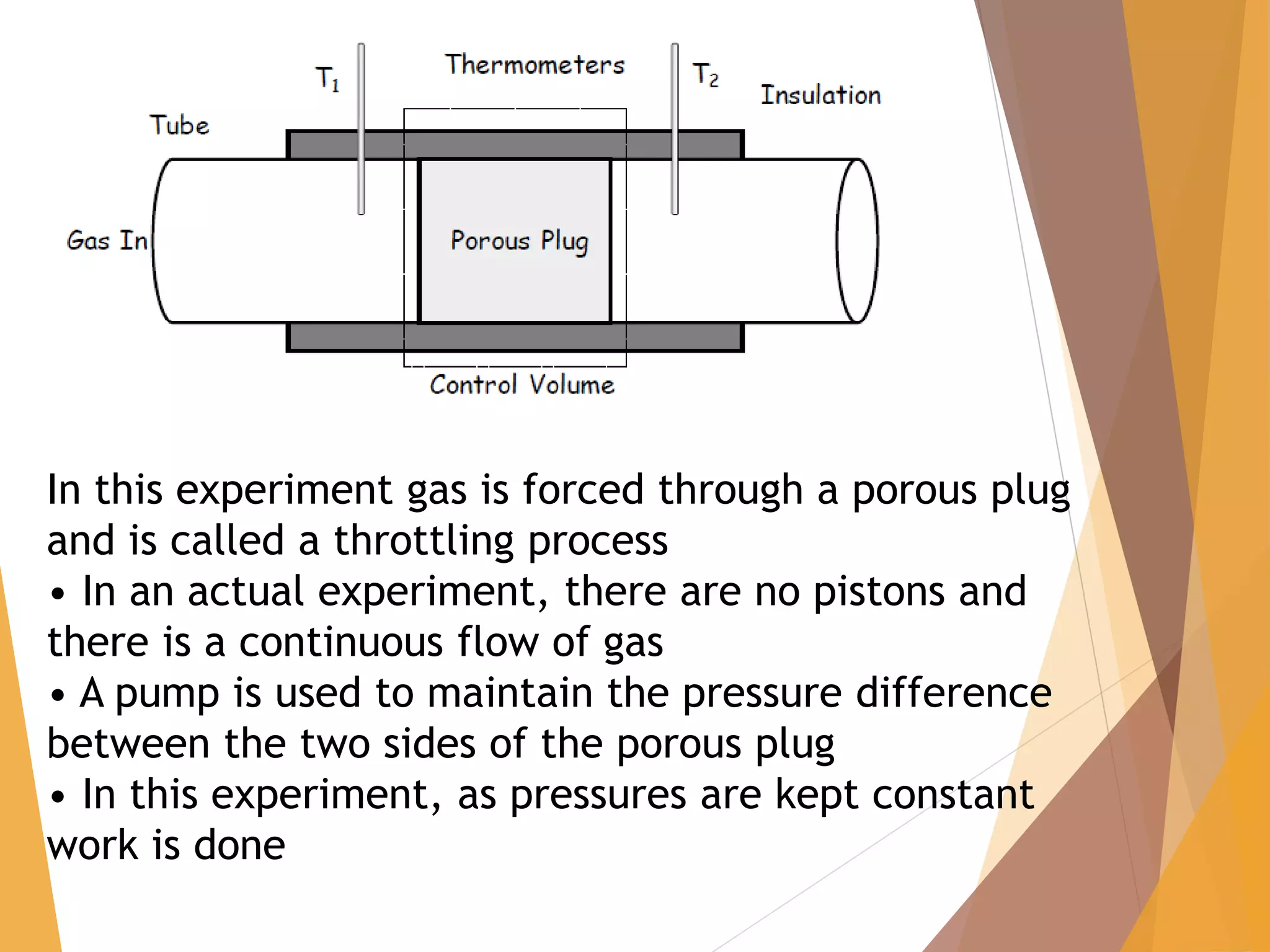
In this experiment gas is forced through a porous plug
and is called a throttling process
• In an actual experiment, there are no pistons and
there is a continuous flow of gas
• A pump is used to maintain the pressure difference
between the two sides of the porous plug
• In this experiment, as pressures are kept constant
work is done
 The pump maintains the pressures 𝑃𝑖 and 𝑃𝑓
 In the experiment 𝑃𝑖, 𝑇𝑖 and 𝑇𝑖 are set and 𝑇𝑓 is measured
 Consider a series of experiments in which 𝑃𝑖 and 𝑇𝑖 are constant
(𝐻𝑖 constant) and the pumping speed is changed to change 𝑃𝑓
and hence 𝑇𝑓
 Since the final enthalpy does not change, we get points of
constant enthalpy
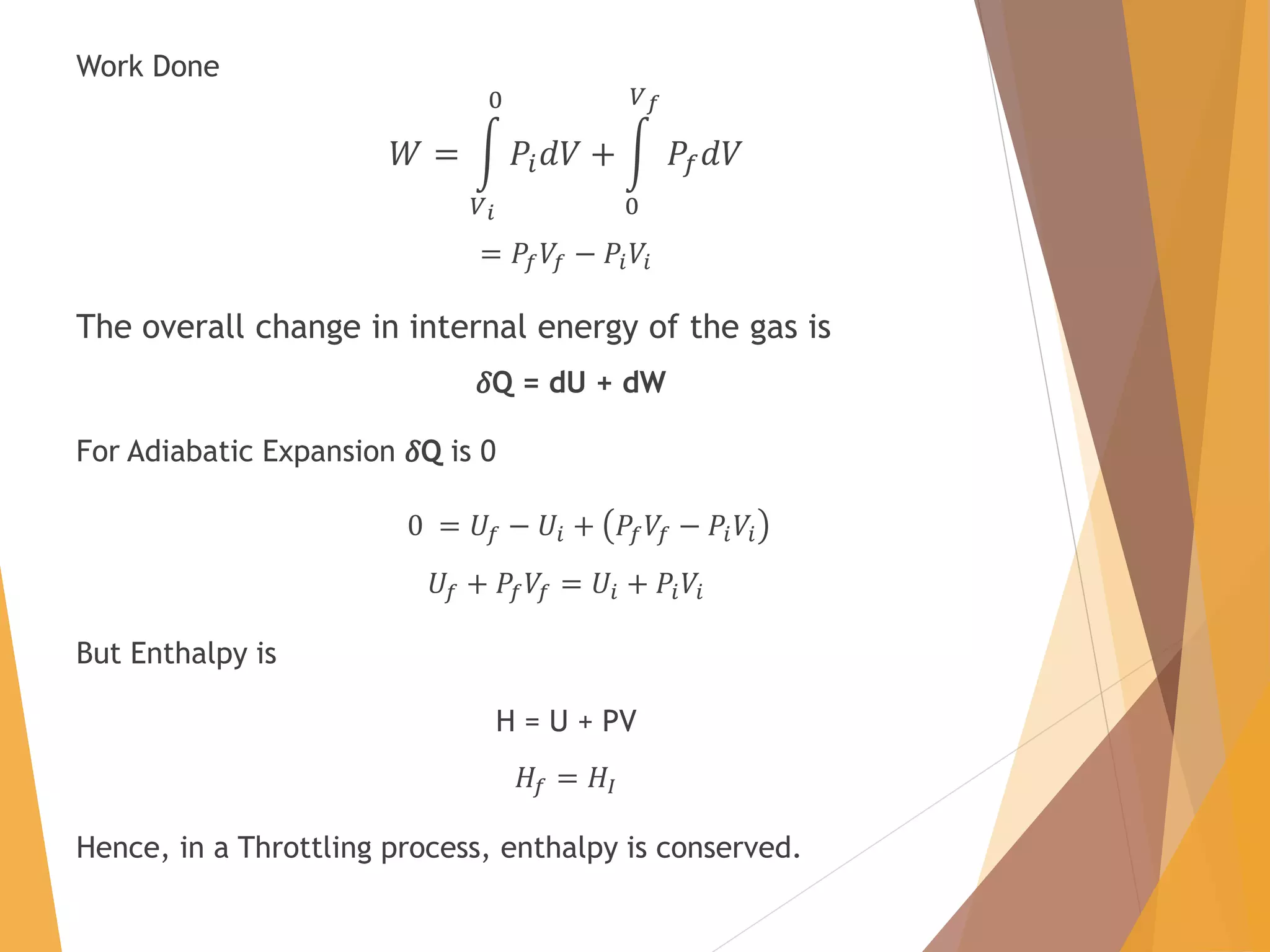
Work Done
𝑊 =
𝑉 𝑖
0
𝑃𝑖 𝑑𝑉 +
0
𝑉 𝑓
𝑃𝑓 𝑑𝑉
= 𝑃𝑓 𝑉𝑓 − 𝑃𝑖 𝑉𝑖
The overall change in internal energy of the gas is
ߜQ = dU + dW
For Adiabatic Expansion ߜQ is 0
0 = 𝑈𝑓 − 𝑈𝑖 + 𝑃𝑓 𝑉𝑓 − 𝑃𝑖 𝑉𝑖
𝑈𝑓 + 𝑃𝑓 𝑉𝑓 = 𝑈𝑖 + 𝑃𝑖 𝑉𝑖
But Enthalpy is
H = U + PV
𝐻𝑓 = 𝐻𝐼
Hence, in a Throttling process, enthalpy is conserved.
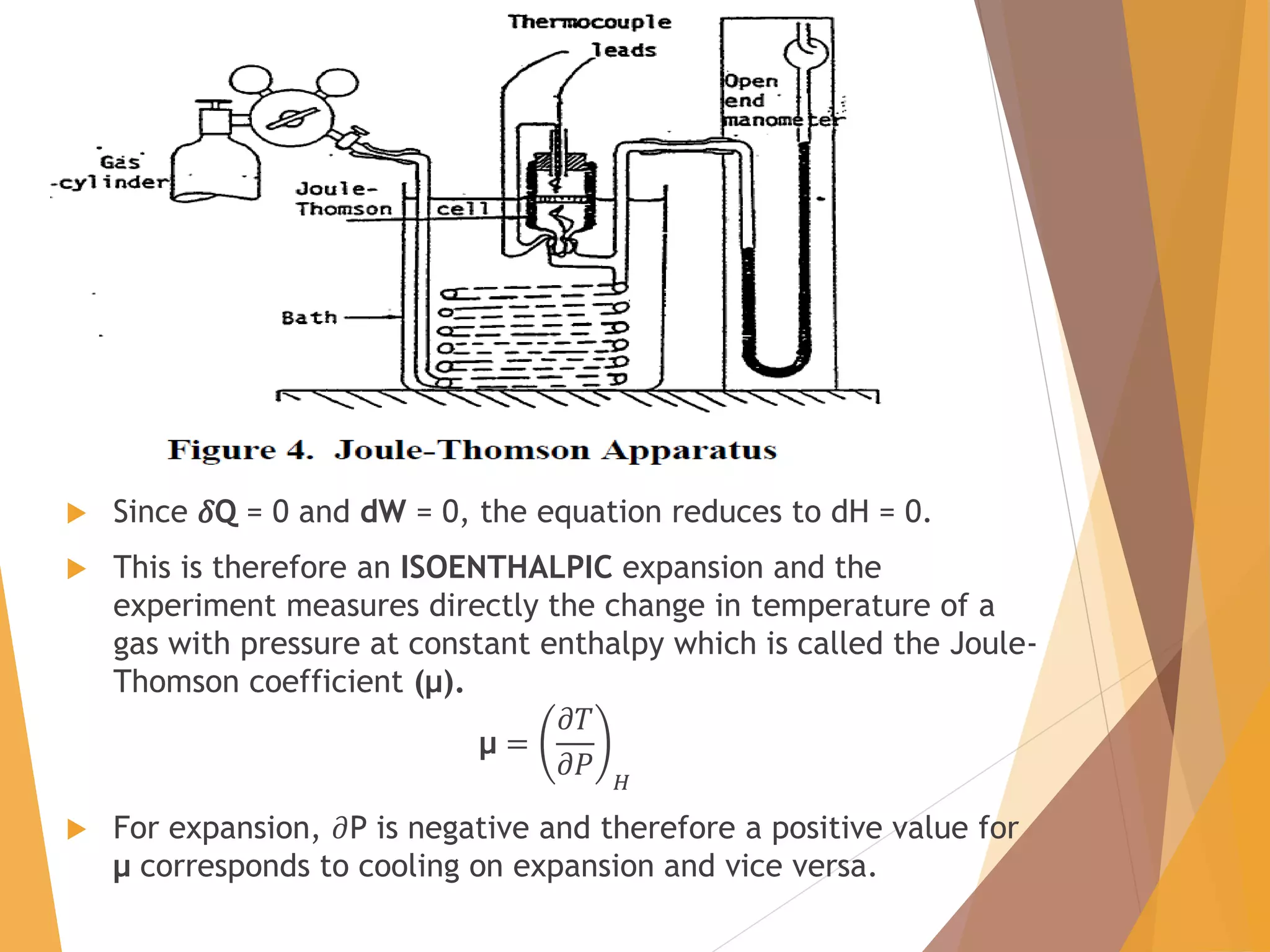
 Since ߜQ = 0 and dW = 0, the equation reduces to dH = 0.
 This is therefore an ISOENTHALPIC expansion and the
experiment measures directly the change in temperature of a
gas with pressure at constant enthalpy which is called the Joule-
Thomson coefficient (μ).
μ =
𝜕𝑇
𝜕𝑃 𝐻
 For expansion, 𝜕P is negative and therefore a positive value for
μ corresponds to cooling on expansion and vice versa.
 The gas which is initially at a
state represented by the point
P as shown in fig., is
undergoing Joule-Thompson
Expansion.
 It will experience the rise in
temperature till the point Q is
reached, and thereafter the
temperature decreases with
further decreases in pressure.
 The slope is the isenthalpy is
equal to the Joule-Thompson
coefficient as per the
relation.
 It is positive only in the region
where pressure is less than
that of Q and is Zero at point
Q, where the isenthalpy
exhibits a maximum.
A smooth curve is placed through the
points yielding an isenthalpic curve
μ
μ < 0 temperature increases
μ = 0 temperature remains constant
μ > 0 temperature decreases
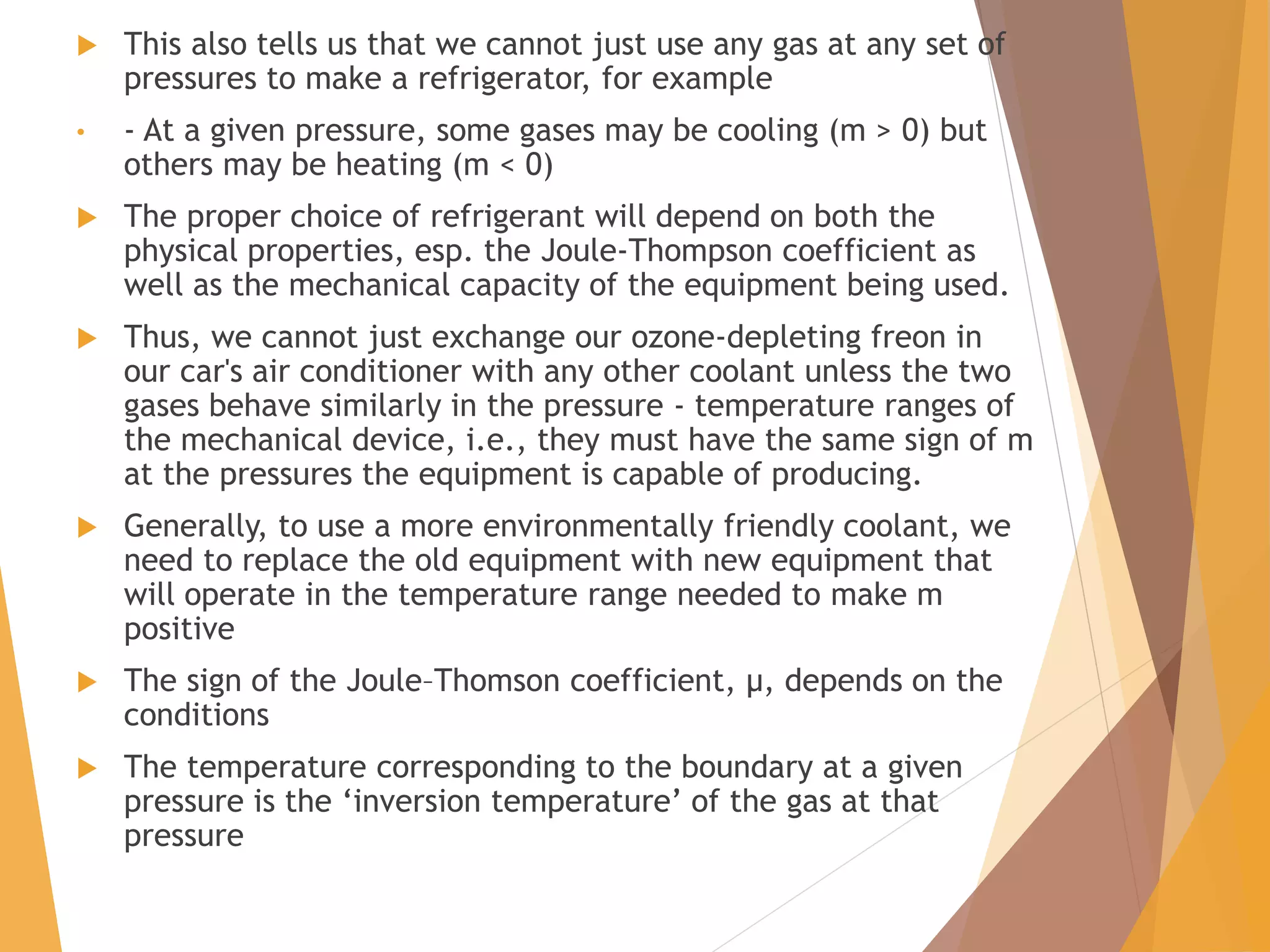
 This also tells us that we cannot just use any gas at any set of
pressures to make a refrigerator, for example
• - At a given pressure, some gases may be cooling (m > 0) but
others may be heating (m < 0)
 The proper choice of refrigerant will depend on both the
physical properties, esp. the Joule-Thompson coefficient as
well as the mechanical capacity of the equipment being used.
 Thus, we cannot just exchange our ozone-depleting freon in
our car's air conditioner with any other coolant unless the two
gases behave similarly in the pressure - temperature ranges of
the mechanical device, i.e., they must have the same sign of m
at the pressures the equipment is capable of producing.
 Generally, to use a more environmentally friendly coolant, we
need to replace the old equipment with new equipment that
will operate in the temperature range needed to make m
positive
 The sign of the Joule–Thomson coefficient, μ, depends on the
conditions
 The temperature corresponding to the boundary at a given
pressure is the ‘inversion temperature’ of the gas at that
pressure
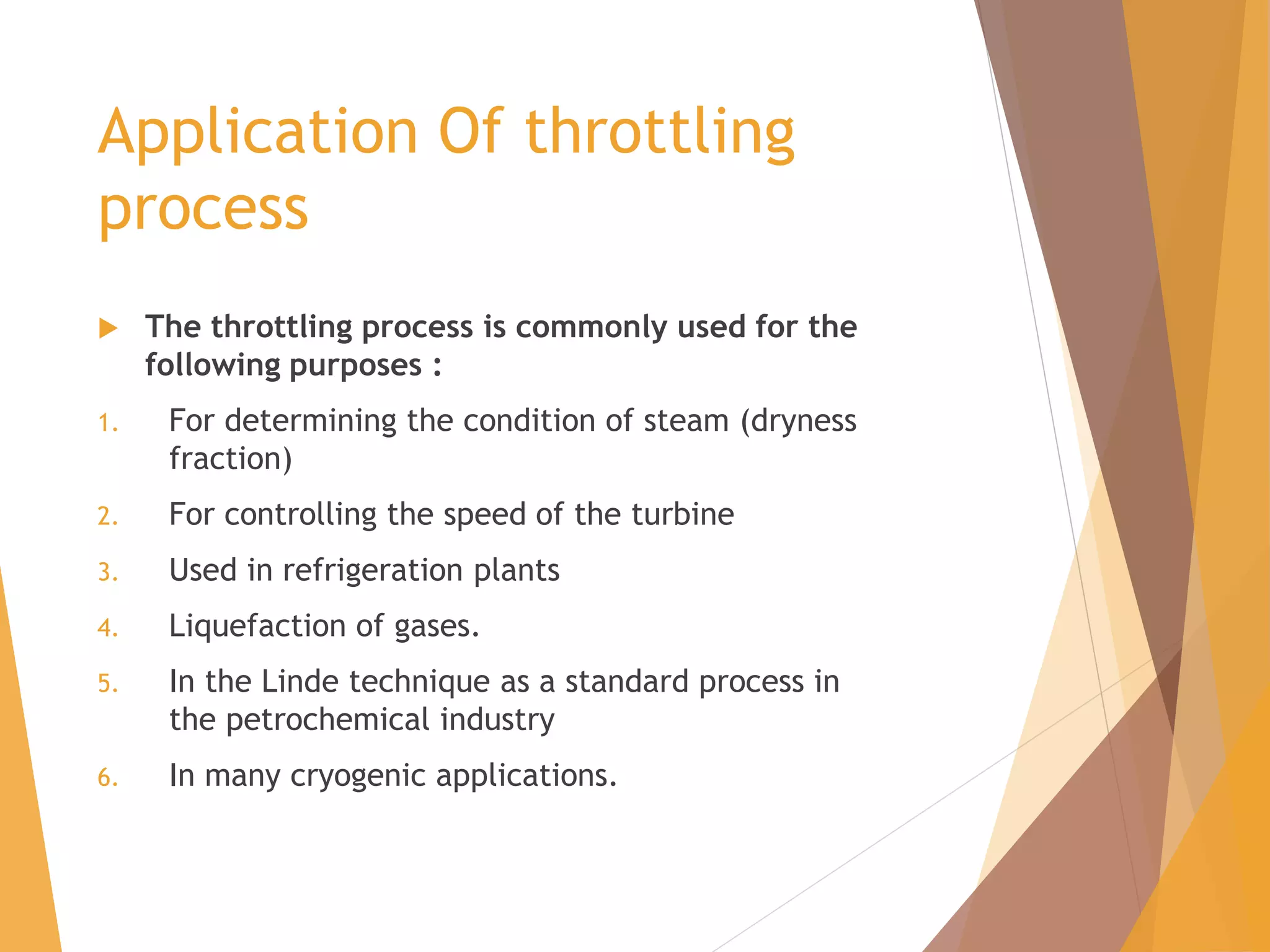
Application Of throttling
process
 The throttling process is commonly used for the
following purposes :
1. For determining the condition of steam (dryness
fraction)
2. For controlling the speed of the turbine
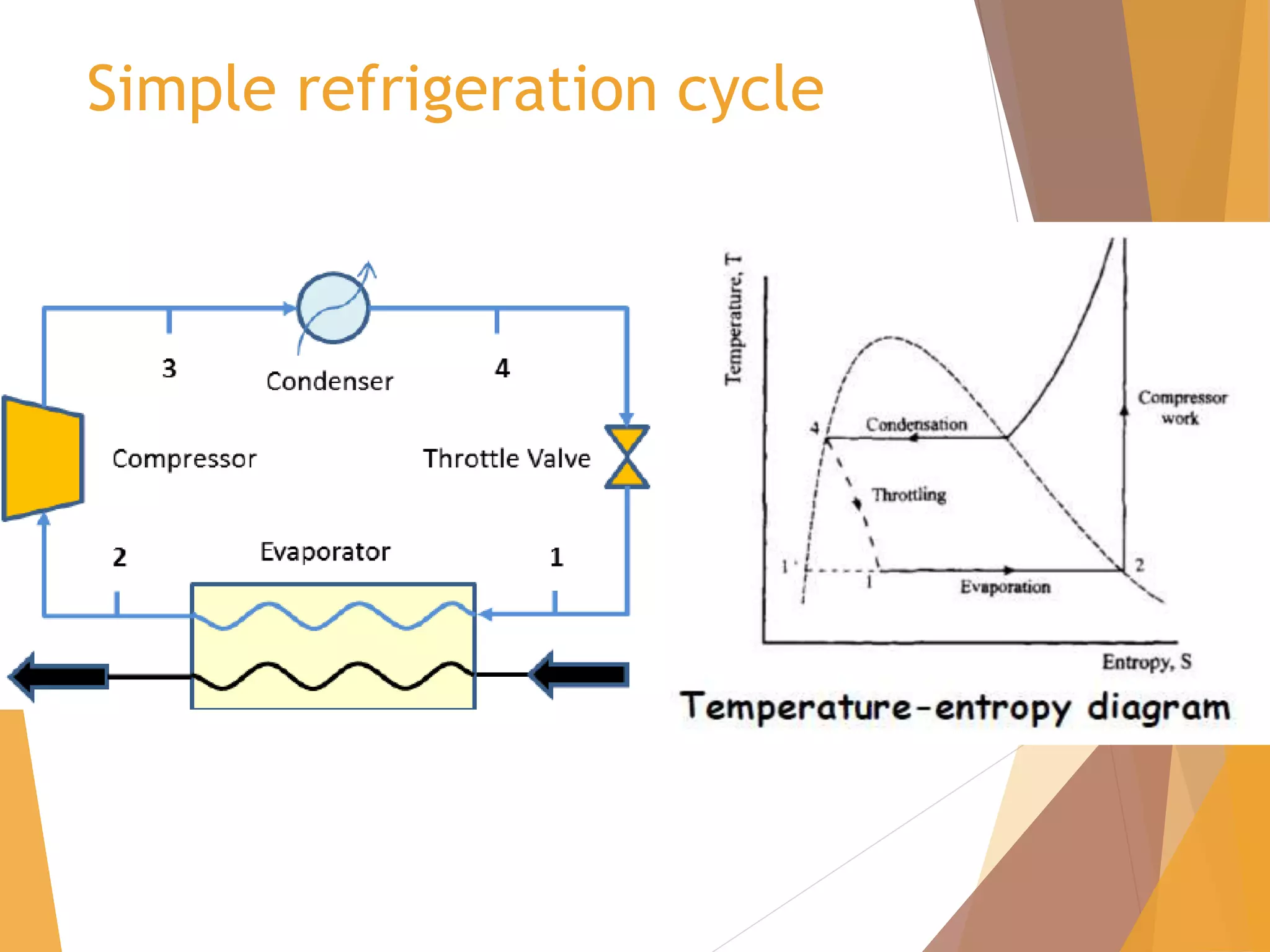
3. Used in refrigeration plants
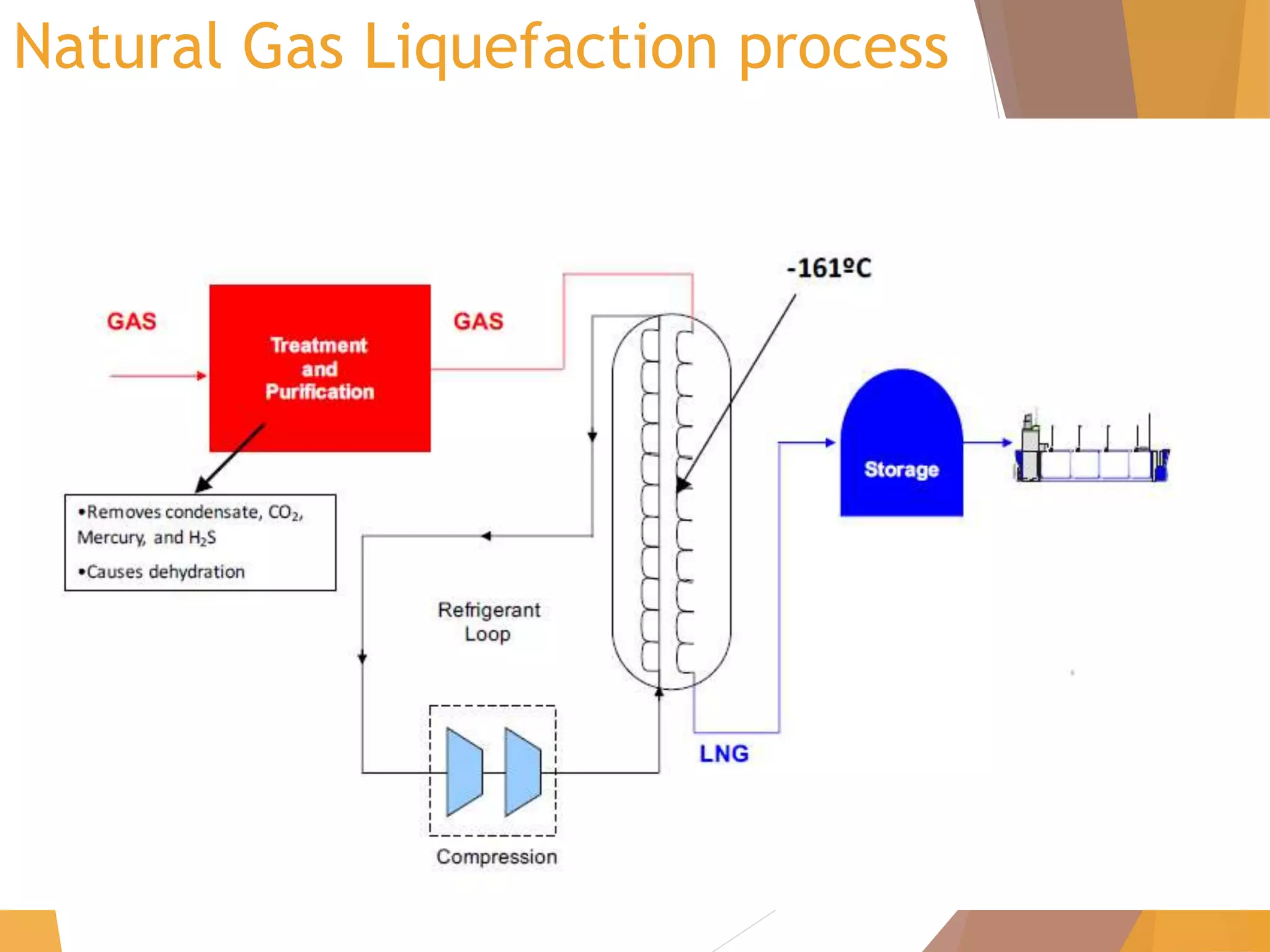
4. Liquefaction of gases.
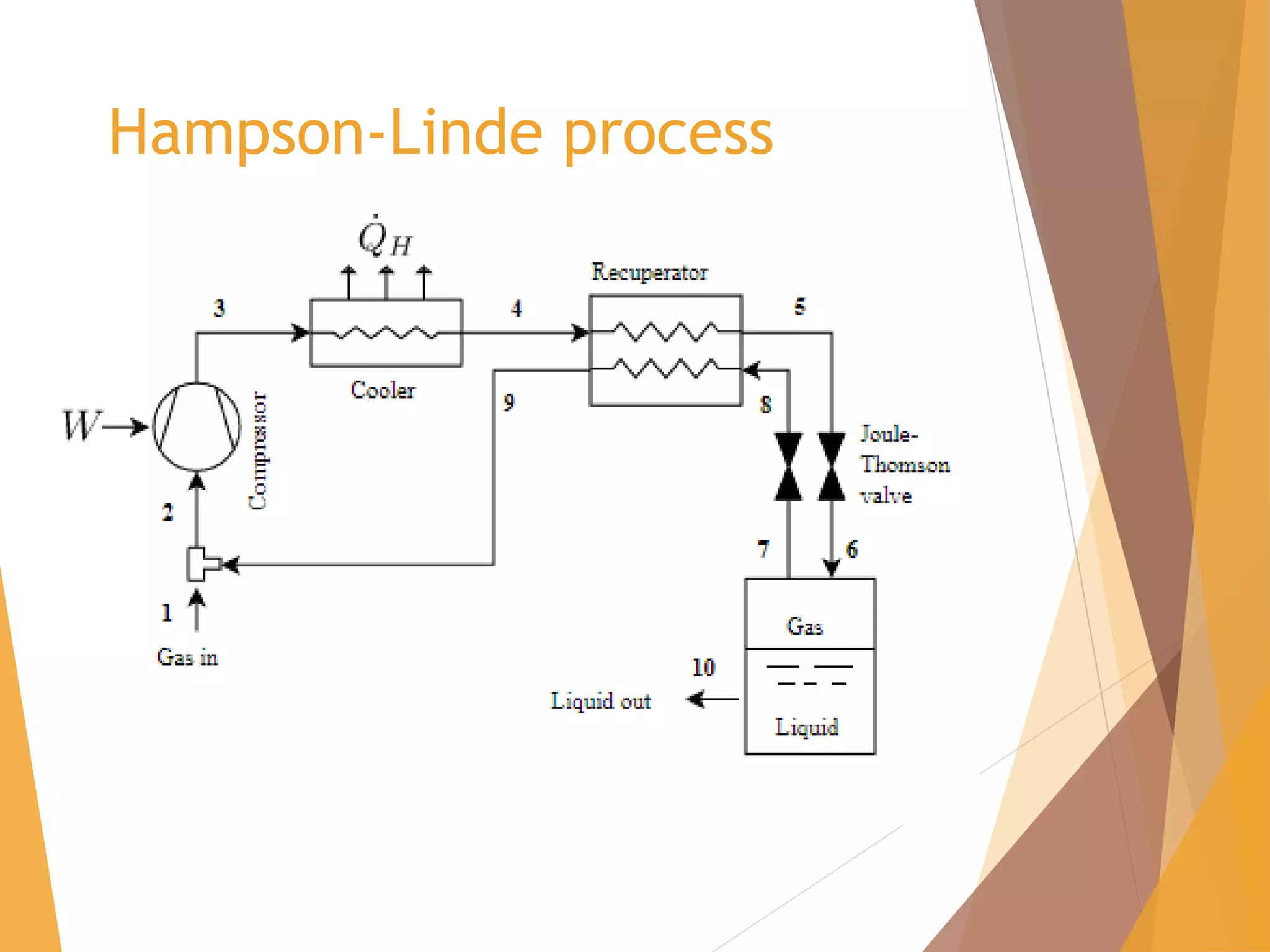
5. In the Linde technique as a standard process in
the petrochemical industry
6. In many cryogenic applications.
Liquefaction
Simple refrigeration cycle
Natural Gas Liquefaction process
Hampson-Linde process
Controlling the speed of turbine by
throttling
References
1. Beattie, J. A. and Bridgeman, O. C., J. Amer. Chem.
Soc., 49, 1665 (1927).
2. Taylor, H. S. and Glasstone, S. (eds.), "A Treatise on
Physical Chemistry", vol. II, 187 ff. van Nostrand,
Princeton, N.J. (1951).
3. Atkins, P.W. "Physical Chemistry", 5th ed., (Freeman,
1994), pp 104-108.
4. “A Textbook of Chemical Engineering
Thermodynamics.” K.V. Narayanan PHI Learning, 6th
ed., pp 127,150, 214.
5. J.H. Noggle, "Physical Chemistry", 3rd ed., Harper
Collins, 1996 pp 104ff.
6. R.G. Mortimer "Physical Chemistry",
Benjamin/Cummings, Redwood City, Calif., 1993, pp
70-73.

Throttling process and its application

  • 1.
    GOVERNMENT ENGINEERING COLLEGE Subject: CHEMICAL ENGINEERING THERMODYNAMIC(2140502) Topic: Throttling and Joule-Thompson Coefficient and its Applications
  • 2.
    1 Bhadja AnandC. 160190105006 2 Davra Dharmik G. 160190105016 3 Moradiya Milan L. 160190105043 4 Pandav Mukund G. 160190105049 5 Papaniya Hitesh L. 160190105051 Submitted By:
  • 3.
    Throttling & TheJoule- Thomson Experiment  Throttling process involves the passage of a higher pressure fluid through a narrow constriction.  The effect is the reduction in pressure and increase in volume • This process is adiabatic as no heat flows from and to the system, but it is not reversible. • It is not an isentropic process • The entropy of the fluid actually increases  Such a process occurs in a flow through a porous plug, a partially closed valve and a very narrow orifice.
  • 4.
    In this experimentgas is forced through a porous plug and is called a throttling process • In an actual experiment, there are no pistons and there is a continuous flow of gas • A pump is used to maintain the pressure difference between the two sides of the porous plug • In this experiment, as pressures are kept constant work is done
  • 5.
     The pumpmaintains the pressures 𝑃𝑖 and 𝑃𝑓  In the experiment 𝑃𝑖, 𝑇𝑖 and 𝑇𝑖 are set and 𝑇𝑓 is measured  Consider a series of experiments in which 𝑃𝑖 and 𝑇𝑖 are constant (𝐻𝑖 constant) and the pumping speed is changed to change 𝑃𝑓 and hence 𝑇𝑓  Since the final enthalpy does not change, we get points of constant enthalpy
  • 6.
    Work Done 𝑊 = 𝑉𝑖 0 𝑃𝑖 𝑑𝑉 + 0 𝑉 𝑓 𝑃𝑓 𝑑𝑉 = 𝑃𝑓 𝑉𝑓 − 𝑃𝑖 𝑉𝑖 The overall change in internal energy of the gas is ߜQ = dU + dW For Adiabatic Expansion ߜQ is 0 0 = 𝑈𝑓 − 𝑈𝑖 + 𝑃𝑓 𝑉𝑓 − 𝑃𝑖 𝑉𝑖 𝑈𝑓 + 𝑃𝑓 𝑉𝑓 = 𝑈𝑖 + 𝑃𝑖 𝑉𝑖 But Enthalpy is H = U + PV 𝐻𝑓 = 𝐻𝐼 Hence, in a Throttling process, enthalpy is conserved.
  • 7.
     Since ߜQ= 0 and dW = 0, the equation reduces to dH = 0.  This is therefore an ISOENTHALPIC expansion and the experiment measures directly the change in temperature of a gas with pressure at constant enthalpy which is called the Joule- Thomson coefficient (μ). μ = 𝜕𝑇 𝜕𝑃 𝐻  For expansion, 𝜕P is negative and therefore a positive value for μ corresponds to cooling on expansion and vice versa.
  • 8.
     The gaswhich is initially at a state represented by the point P as shown in fig., is undergoing Joule-Thompson Expansion.  It will experience the rise in temperature till the point Q is reached, and thereafter the temperature decreases with further decreases in pressure.  The slope is the isenthalpy is equal to the Joule-Thompson coefficient as per the relation.  It is positive only in the region where pressure is less than that of Q and is Zero at point Q, where the isenthalpy exhibits a maximum. A smooth curve is placed through the points yielding an isenthalpic curve
  • 9.
    μ μ < 0temperature increases μ = 0 temperature remains constant μ > 0 temperature decreases
  • 11.
     This alsotells us that we cannot just use any gas at any set of pressures to make a refrigerator, for example • - At a given pressure, some gases may be cooling (m > 0) but others may be heating (m < 0)  The proper choice of refrigerant will depend on both the physical properties, esp. the Joule-Thompson coefficient as well as the mechanical capacity of the equipment being used.  Thus, we cannot just exchange our ozone-depleting freon in our car's air conditioner with any other coolant unless the two gases behave similarly in the pressure - temperature ranges of the mechanical device, i.e., they must have the same sign of m at the pressures the equipment is capable of producing.  Generally, to use a more environmentally friendly coolant, we need to replace the old equipment with new equipment that will operate in the temperature range needed to make m positive  The sign of the Joule–Thomson coefficient, μ, depends on the conditions  The temperature corresponding to the boundary at a given pressure is the ‘inversion temperature’ of the gas at that pressure
  • 12.
    Application Of throttling process The throttling process is commonly used for the following purposes : 1. For determining the condition of steam (dryness fraction) 2. For controlling the speed of the turbine 3. Used in refrigeration plants 4. Liquefaction of gases. 5. In the Linde technique as a standard process in the petrochemical industry 6. In many cryogenic applications.
  • 13.
  • 14.
  • 15.
  • 16.
  • 17.
    Controlling the speedof turbine by throttling
  • 19.
    References 1. Beattie, J.A. and Bridgeman, O. C., J. Amer. Chem. Soc., 49, 1665 (1927). 2. Taylor, H. S. and Glasstone, S. (eds.), "A Treatise on Physical Chemistry", vol. II, 187 ff. van Nostrand, Princeton, N.J. (1951). 3. Atkins, P.W. "Physical Chemistry", 5th ed., (Freeman, 1994), pp 104-108. 4. “A Textbook of Chemical Engineering Thermodynamics.” K.V. Narayanan PHI Learning, 6th ed., pp 127,150, 214. 5. J.H. Noggle, "Physical Chemistry", 3rd ed., Harper Collins, 1996 pp 104ff. 6. R.G. Mortimer "Physical Chemistry", Benjamin/Cummings, Redwood City, Calif., 1993, pp 70-73.