Joule-Thomson Coefficients
Physical Chemistry, David W Ball, pg. 42
Nashiour Rohman
Sultan Qaboos University / Morigaon College
Despite the fact that we have been dealing with
numerous equations, they are all ultimately founded on the
fundamental rule of thermodynamics and the equations of
states. The definition of total energy and various
modifications of that definition serve as the foundation for
these concepts. Additionally, we have seen various instances
where the specification of specific conditions, such as
adiabatic, free expansion, isobaric, and isochoric, can
simplify the equations of thermodynamics.
Conditions are any limitations placed on a process that
make thermodynamics' mathematical calculations simpler.
Exist any additional meaningful restrictions?
The Joule-Thomson experiment, shown in Figure 2.10,
describes another helpful constraint based on the first law of
thermodynamics. On one side of a porous barrier, an
adiabatic system is built up and a gas is introduced into it.
This gas has an initial volume V1, a set pressure p1, and
some temperature T1.
The final volume on this side of the porous barrier is zero
because a piston forces all of the gas through it. As the gas
diffuses to the opposite side of the barrier, where it will have
a temperature T2, a fixed pressure p2, and a volume V2, a
second piston moves out. At first, there is no volume on the
right side of the barrier. It is known that p1 p2 because the
gas is being driven past a barrier. It should be understood
that the gas loses pressure as it is driven from one side to the
other, despite the fact that the pressures on either side are
fixed.
Work on the gas is being done on the left side, which
benefits the overall change in energy. The gas does function
on the right side, negatively impacting the overall shift in
energy. After the first piston is fully pushed in, the system's
net work is as follows:
We shall express U as the internal energy of the gas on side
2 minus the internal energy of the gas on side 1, as the
system is adiabatic and q = 0, therefore Unet wnet.
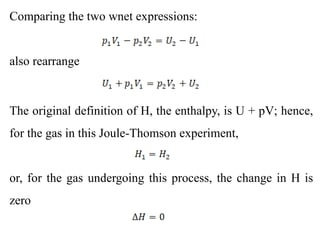
Comparing the two wnet expressions:
also rearrange
The original definition of H, the enthalpy, is U + pV; hence,
for the gas in this Joule-Thomson experiment,
or, for the gas undergoing this process, the change in H is
zero
It is known as an isenthalpic process because the enthalpy of
the gas does not change. Which effects might this isentropic
process have? The change in temperature is not zero, despite
the fact that the change in enthalpy is. What is the
temperature change that occurs along with the pressure drop
in this isentropic process? What, then, is (T/p)H? This
derivative can be measured experimentally with a device like
the one shown in Figure 2.10.
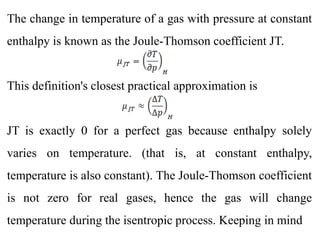
The change in temperature of a gas with pressure at constant
enthalpy is known as the Joule-Thomson coefficient JT.
This definition's closest practical approximation is
JT is exactly 0 for a perfect gas because enthalpy solely
varies on temperature. (that is, at constant enthalpy,
temperature is also constant). The Joule-Thomson coefficient
is not zero for real gases, hence the gas will change
temperature during the isentropic process. Keeping in mind
that the cyclic rule of partial derivatives
This can be rewritten as
and realising that JT is on the left side and that the heat
capacity at constant pressure is the fraction's denominator,
we obtain
Since (H/p)T is 0 for an ideal gas, this equation proves that
JT is zero for ideal gases. But not for actual gases.
Furthermore, using equation 2.35, we can determine (H/p)T
for a real gas, which is a quantity (the change in enthalpy as
pressure changes but at constant temperature) that is
challenging or impossible to measure by direct experiment.
This is possible if we measure JT for real gases and also
know their heat capacities.
Joule-Thomson Coefficients.pptx

Joule-Thomson Coefficients.pptx

  • 1.
    Joule-Thomson Coefficients Physical Chemistry,David W Ball, pg. 42 Nashiour Rohman Sultan Qaboos University / Morigaon College
  • 2.
    Despite the factthat we have been dealing with numerous equations, they are all ultimately founded on the fundamental rule of thermodynamics and the equations of states. The definition of total energy and various modifications of that definition serve as the foundation for these concepts. Additionally, we have seen various instances where the specification of specific conditions, such as adiabatic, free expansion, isobaric, and isochoric, can simplify the equations of thermodynamics.
  • 3.
    Conditions are anylimitations placed on a process that make thermodynamics' mathematical calculations simpler. Exist any additional meaningful restrictions? The Joule-Thomson experiment, shown in Figure 2.10, describes another helpful constraint based on the first law of thermodynamics. On one side of a porous barrier, an adiabatic system is built up and a gas is introduced into it. This gas has an initial volume V1, a set pressure p1, and some temperature T1.
  • 4.
    The final volumeon this side of the porous barrier is zero because a piston forces all of the gas through it. As the gas diffuses to the opposite side of the barrier, where it will have a temperature T2, a fixed pressure p2, and a volume V2, a second piston moves out. At first, there is no volume on the right side of the barrier. It is known that p1 p2 because the gas is being driven past a barrier. It should be understood that the gas loses pressure as it is driven from one side to the other, despite the fact that the pressures on either side are fixed.
  • 5.
    Work on thegas is being done on the left side, which benefits the overall change in energy. The gas does function on the right side, negatively impacting the overall shift in energy. After the first piston is fully pushed in, the system's net work is as follows: We shall express U as the internal energy of the gas on side 2 minus the internal energy of the gas on side 1, as the system is adiabatic and q = 0, therefore Unet wnet.
  • 6.
    Comparing the twownet expressions: also rearrange The original definition of H, the enthalpy, is U + pV; hence, for the gas in this Joule-Thomson experiment, or, for the gas undergoing this process, the change in H is zero
  • 7.
    It is knownas an isenthalpic process because the enthalpy of the gas does not change. Which effects might this isentropic process have? The change in temperature is not zero, despite the fact that the change in enthalpy is. What is the temperature change that occurs along with the pressure drop in this isentropic process? What, then, is (T/p)H? This derivative can be measured experimentally with a device like the one shown in Figure 2.10.
  • 8.
    The change intemperature of a gas with pressure at constant enthalpy is known as the Joule-Thomson coefficient JT. This definition's closest practical approximation is JT is exactly 0 for a perfect gas because enthalpy solely varies on temperature. (that is, at constant enthalpy, temperature is also constant). The Joule-Thomson coefficient is not zero for real gases, hence the gas will change temperature during the isentropic process. Keeping in mind
  • 9.
    that the cyclicrule of partial derivatives This can be rewritten as and realising that JT is on the left side and that the heat capacity at constant pressure is the fraction's denominator, we obtain
  • 10.
    Since (H/p)T is0 for an ideal gas, this equation proves that JT is zero for ideal gases. But not for actual gases. Furthermore, using equation 2.35, we can determine (H/p)T for a real gas, which is a quantity (the change in enthalpy as pressure changes but at constant temperature) that is challenging or impossible to measure by direct experiment. This is possible if we measure JT for real gases and also know their heat capacities.