THROMBOSIS
THROMBOSIS
DR. P.A. GADGIL
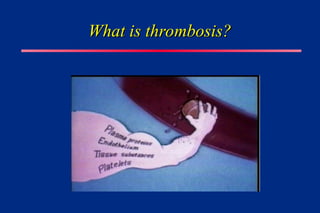
What is thrombosis?
What is thrombosis?
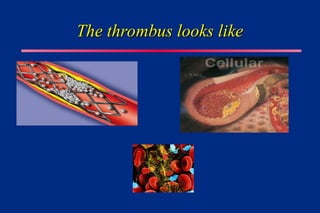
The thrombus looks like
Normal Hemostasis
Normal Hemostasis
Sequence of events following vascular injury
1. Arteriolar vasoconstriction (transient effect)
Reflex neurogenic mechanism
Local secretion of endothelin
2. Primary hemostasis – PLATELET
- Damage to the endothelium exposes platelets to the subendothelial
extracellular matrix (ECM).
- Platelets adhere to the ECM and become activated (Activation)
a. Shape Change
b. Release granules
c. Recruit other platelets to site (Aggregation)
- Form a HEMOSTATIC plug
Normal Hemostasis
Normal Hemostasis
3. Secondary Hemostasis - COAGULATION
a. Tissue factor, a membrane-bound procoagulant factor synthesized by
endothelium is exposed at the site of injury. It acts in conjunction with the
material secreted by platelets to activate the coagulation cascade.
b. Phospholipid complex expression
c. Thrombin activation
a. Formation of thrombin induces more platelet recruitment and granule
release
d. Fibrin Polymerization – resulting in local fibrin admixed with platelets –
form plug to prevent further hemorrhage.
4. Antithrombotic Counter-Regulation
a. Release of components to limit the size of hemostatic plug
Role of Endothelium
Role of Endothelium
• Both Antithromotic properties & Prothrombotic
Properties.
• Antithrombotic (Anticoagulant) Properties of Endothelial Cells
– Antiplatelet
– 1. Barrier to subendothelial collagen - prevent
platelets and plasma factors from exposure
– 2. Prostacyclin - PGI2 , and Nitric Oxide - inhibit
platelet adhesion and aggregation
– 3. Express adenosine diphosphatase to degrade ADP
(ADP promotes platelet aggregation)
Antithrombotic (Anticoagulant) Properties of Endothelial
Cells cont……..
Cells cont……..
• Anticoagulant properties
• 1. Membrane associated, heparin-like molecules
• 2. Thrombomodulin - specific thrombin receptor
• -Binds to thrombin making it an anticoagulant which can activate
protein C - activeProtein C - inhibits clotting by cleaving factors Va
and VIIIa Requires protein S - synthesized by endothelial cells
• 3. Synthesizes tissue factor pathway inhibitor – complexes and
inhibits Factors VIIa and Xa
• 4. Plasminogen activators which promote fibrinolytic activity to
clear fibrin deposits from endothelium
Prothrombotic (Procoagulant) Properties of
Endothelial cells
• Endothelial cells may be activated by infectious agents,
hemodynamic factors, plasma mediators and cytokines or
injured indirectly.
• 1. Synthesize, store, and release von Willebrand factor (vWF) - essential
cofactor for platelet binding to collagen and other surfaces. Stored in
Weibel-Palade bodies.
• 2. Endothelial cells are also induced by cytokines (eg: TNF, or IL-1) or
bacterial endotoxin – to secrete tissue factor (Factor VII) which activates
the extrinsic clotting pathway.
• 3. Endothelial cells bind IXa and Xa and increase their catalytic activities
• 4. Secrete plasminogen activator inhibitors - to depress fibrinolysis
Role of Platelets
Role of Platelets
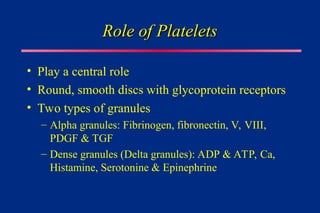
• Play a central role
• Round, smooth discs with glycoprotein receptors
• Two types of granules
– Alpha granules: Fibrinogen, fibronectin, V, VIII,
PDGF & TGF
– Dense granules (Delta granules): ADP & ATP, Ca,
Histamine, Serotonine & Epinephrine
Role of Platelets
Role of Platelets
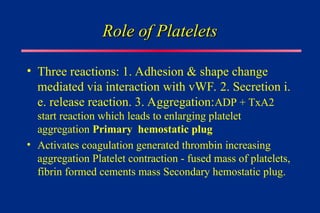
• Three reactions: 1. Adhesion & shape change
mediated via interaction with vWF. 2. Secretion i.
e. release reaction. 3. Aggregation:ADP + TxA2
start reaction which leads to enlarging platelet
aggregation Primary hemostatic plug
• Activates coagulation generated thrombin increasing
aggregation Platelet contraction - fused mass of platelets,
fibrin formed cements mass Secondary hemostatic plug.
Coagulation cascade
Coagulation cascade
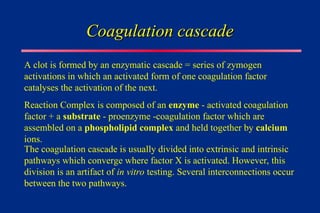
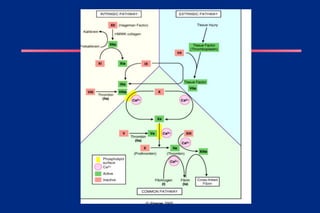
A clot is formed by an enzymatic cascade = series of zymogen
activations in which an activated form of one coagulation factor
catalyses the activation of the next.
Reaction Complex is composed of an enzyme - activated coagulation
factor + a substrate - proenzyme -coagulation factor which are
assembled on a phospholipid complex and held together by calcium
ions.
The coagulation cascade is usually divided into extrinsic and intrinsic
pathways which converge where factor X is activated. However, this
division is an artifact of in vitro testing. Several interconnections occur
between the two pathways.
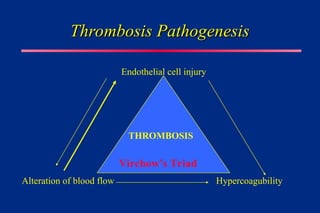
Thrombosis Pathogenesis
Alteration of blood flow Hypercoagubility
Virchow’s Triad
Endothelial cell injury
THROMBOSIS
Endothelial cell injury
• Dominant feature. Lead to thrombosis by itself.
• Exposes subendothelial ECM – Platelet adhesion
--- Release of tissue factors ----- Depletion of
prostacyclin ------ Primary & secondary
hemostatic plug formation
Causes of endothelial injury causing
thrombosis
thrombosis
• Endocardial injury in M.I.
• Ulceration of Atheromatous plaque
• Trauma to vascular endothelium
• Inflammatory vascular injury as in case of vasculitis
• Bacterial endotoxins
• Dysfunction of endothelium as in hemodynamic stress of
hypertension or turbulent flow over scarred valves
• Homocystinuria, Products of cigarette smoke,
hypercholestremia, radiation injury
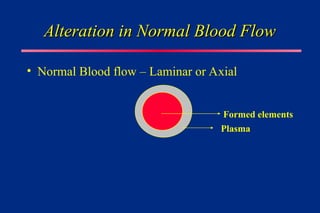
Alteration in Normal Blood Flow
• Normal Blood flow – Laminar or Axial
Formed elements
Plasma
Alteration in Normal Blood Flow
• Disrupt normal laminar flow:
– Allows platelets to contact endothelium
– Prevents dilution of activated clotting factors by fresh-flowing
blood
– Allows the build up of thrombi (slows the inflow of
anticoagulants)
– Promotes endothelial cell activation
Causes where disrupted blood flow
leads to thrombosis
leads to thrombosis
• Ulcerated atherosclerotic plaque leads to turbulence ----
thrombosis
• Aneurysms cause local stasis ----- thrombosis
• M.I. --- Noncontractile myocardium ---- stasis ---
thrombosis
• Mitral stenosis --- stasis or turbulence – thrombosis
• Hyperviscosity syndromes like Polycythemia --- small
vesels stasis --- thrombosis
• Sickle cell disease --- small vessel stasis --- thrombosis
Hypercoaguability
• Definition: any alteration of the coagulation pathways
that predisposes to thombosis
• Primary or Secondary
– Defect in Coagulation factors
– Defect in Inhibitory factors
Hypercoaguability
• Primary (Genetic)
• Mutation in factor V gene
(Factor V Leiden)
• Prothrombin gene
• Methyltetrahydrofoalte
gene
• Antithrombin III defi.
• Protein C defi.
• Protein S defi.
• Secondary (Acquired)
• Immobilisation
• M.I. & A.Fibrillation
• Cancer
• Heparin induced
throbocytopenia
• Anti phospholipid Ab
• Oral contraceptives
TERMINOLOGY AND MORPHOLOGY
(Related to Thrombosis)
THROMBOSIS: Formation, development or presence of a
solid mass within the blood vessels or heart. Adherent to the
vascular endothelium and must be differentiated from a
simple (post mortem) blood clot.
THROMBUS: An aggregation of blood factors, primarily
platelets and fibrin with entrapment of cellular elements,
frequently causes vascular obstruction at the point of its
formation or embolism
TERMINOLOGY AND MORPHOLOGY
(Related to Thrombosis)
THROMBI: Pleural of thrombus ie: several aggregations
within the blood vascular system.Thrombi may develop
anywhere in cardiovascular system: Cardiac chambers,
Valves, Arteries (usually endothelial injury), Veins (often a
result of stasis), Capillaries
Arterial thrombi are attached and grow away from the heart.
Venous thrombi are attached and grow in the direction of
blood flow (to heart).
Arterial and venous thrombi differ!
ARTERIAL Thrombi
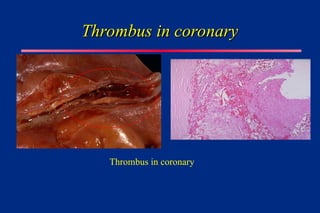
• Generally due to endothelial injury, initial thrombus is
composed of aggregated platelets and RBC's and is soft,
friable and red.
• As arterial thrombi grow, flow patterns adjacent to the
thrombi cause fibrin to be deposited and the platelet mass
that persists is transformed into a fibrin mass. Fibrin
strands polymerize between the separating and
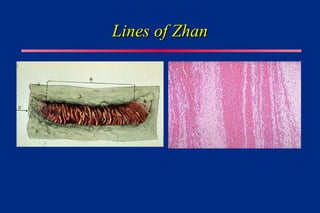
degenerating platelets. The alternating lines of yellow
platelets and fibrin separating RBC's forms the lines of
Zahn.
Lines of Zhan
Lines of Zhan
Thrombus in coronary
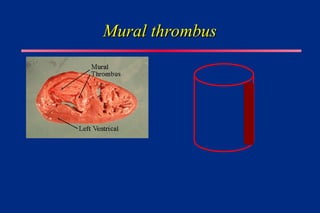
Mural thrombus
Mural thrombus
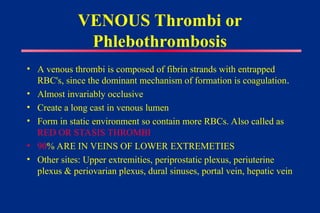
VENOUS Thrombi or
Phlebothrombosis
• A venous thrombi is composed of fibrin strands with entrapped
RBC's, since the dominant mechanism of formation is coagulation.
• Almost invariably occlusive
• Create a long cast in venous lumen
• Form in static environment so contain more RBCs. Also called as
RED OR STASIS THROMBI
• 90% ARE IN VEINS OF LOWER EXTREMETIES
• Other sites: Upper extremities, periprostatic plexus, periuterine
plexus & periovarian plexus, dural sinuses, portal vein, hepatic vein
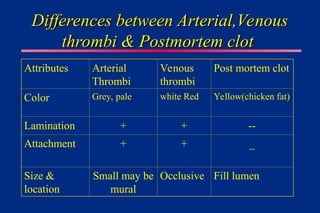
Differences between Arterial,Venous
thrombi & Postmortem clot
Attributes Arterial
Thrombi
Venous
thrombi
Post mortem clot
Color Grey, pale white Red Yellow(chicken fat)
Lamination + + --
Attachment + + _
Size &
location
Small may be
mural
Occlusive Fill lumen
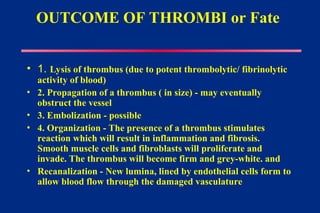
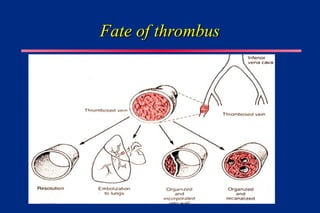
OUTCOME OF THROMBI or Fate
• 1. Lysis of thrombus (due to potent thrombolytic/ fibrinolytic
activity of blood)
• 2. Propagation of a thrombus ( in size) - may eventually
obstruct the vessel
• 3. Embolization - possible
• 4. Organization - The presence of a thrombus stimulates
reaction which will result in inflammation and fibrosis.
Smooth muscle cells and fibroblasts will proliferate and
invade. The thrombus will become firm and grey-white. and
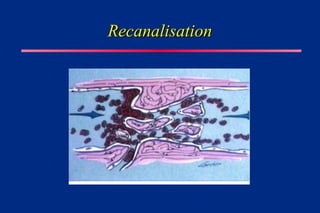
• Recanalization - New lumina, lined by endothelial cells form to
allow blood flow through the damaged vasculature
Fate of thrombus
Fate of thrombus
Recanalisation
Recanalisation
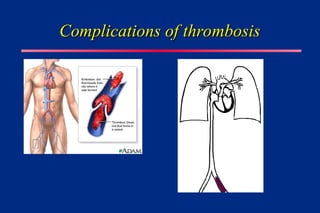
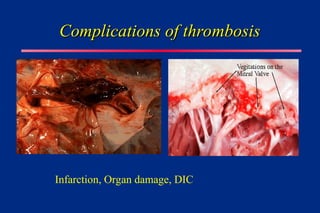
Complications of thrombosis
Infarction, Organ damage, DIC
Infarction
Infarction
• DEFINITION: Area of ischemic necrosis caused by
occlusion of either the arterial supply or the venous
drainage in a particular tissue.
• Examples of infarction we see commonly: M.I.,
Pulmonary Infarction, Bowel infarction, Gangrene
Infarction Pathogenesis
• 99% are due to thrombotic or embolic events &
almost are due to occlusion of arteries.
• Other: 1. Local vasospasm 2. Expansion of
atheroma 3. Extrinsic compression by tumor 4.
Twisting of vessels (Testicular torsion or
volvulus) 5. Compression of vessels by edema 6.
Traumatic rupture 7. Strangulation in hernia 8.
Cardiogenic shock
Infarction Pathogenesis
• Venous thrombosis rarely cause infarction
• Likely in organs with single venous flow like
Testis & Ovary
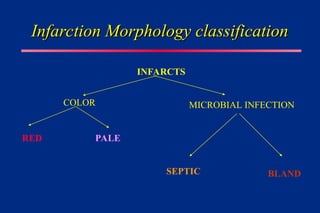
Infarction Morphology classification
RED
INFARCTS
COLOR MICROBIAL INFECTION
PALE
SEPTIC BLAND
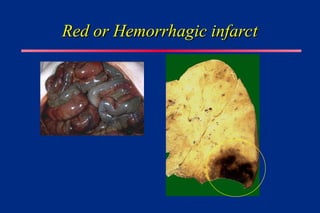
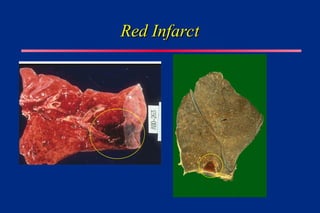
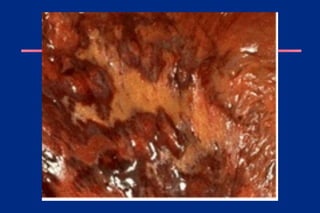
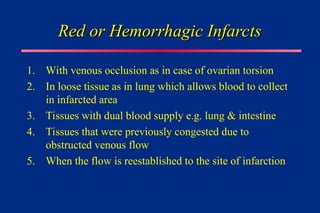
Red or Hemorrhagic Infarcts
1. With venous occlusion as in case of ovarian torsion
2. In loose tissue as in lung which allows blood to collect
in infarcted area
3. Tissues with dual blood supply e.g. lung & intestine
4. Tissues that were previously congested due to
obstructed venous flow
5. When the flow is reestablished to the site of infarction
Red or Hemorrhagic infarct
Red Infarct
Red Infarct
White or Anemic Infarcts
1. Arterial occlusion
2. Solid organs
3. Organs with end arterial blood supply
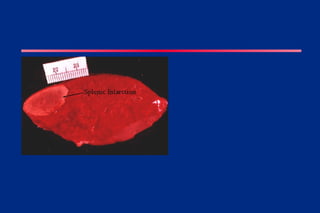
4. Heart, Spleen & kidneys
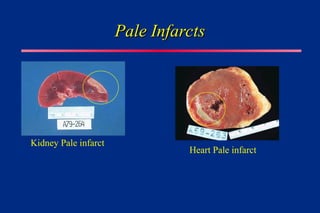
Pale Infarcts
Pale Infarcts
Kidney Pale infarct
Heart Pale infarct
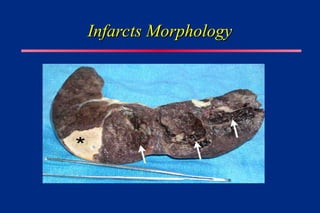
Infarcts Morphology
Infarcts Morphology
• Typically WEDGE shaped with occluded vessel at the
apex & the periphery of the organ forming base.
• Lateral margins irregular
• If the base is formed by serosal surface FIBRINOUS
EXUDATE can be seen.
• All infarcts are poorly defined & hemmorrhagic to begin
with.
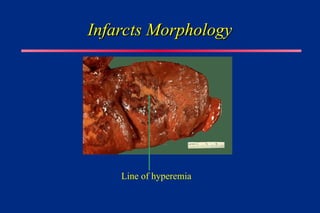
• With the time margins show a narrow rim of hyperemia
due to inflammation at the edge.
Infarcts Morphology
Infarcts Morphology
Line of hyperemia
Infarcts Morphology
Infarcts Morphology
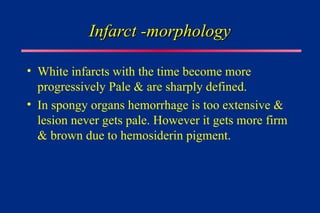
Infarct -morphology
Infarct -morphology
• White infarcts with the time become more
progressively Pale & are sharply defined.
• In spongy organs hemorrhage is too extensive &
lesion never gets pale. However it gets more firm
& brown due to hemosiderin pigment.
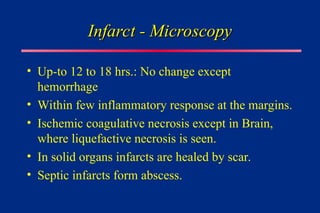
Infarct - Microscopy
• Up-to 12 to 18 hrs.: No change except
hemorrhage
• Within few inflammatory response at the margins.
• Ischemic coagulative necrosis except in Brain,
where liquefactive necrosis is seen.
• In solid organs infarcts are healed by scar.
• Septic infarcts form abscess.
Major determinants of infarct
development
development
• Dependent upon
• 1. Degree/severity of injury to vascular supply
• 2. Size of artery affected
• 3. Degree of vascular occlusion
• 4. Collateral blood supply available
• 5. Vulnerability of cells to ischemia
• 6. O2 carrying capacity of RBC's at time of infarct
Complications of Infarction
• Embolism
• Death
• Serosal fibrinous inflammation
• Dysfunction of the organ
• Abscess formation
• Gangrenous change
Hemodynamics including thrombosis lecture

Hemodynamics including thrombosis lecture

  • 1.
  • 2.
  • 3.
    The thrombus lookslike The thrombus looks like
  • 4.
    Normal Hemostasis Normal Hemostasis Sequenceof events following vascular injury 1. Arteriolar vasoconstriction (transient effect) Reflex neurogenic mechanism Local secretion of endothelin 2. Primary hemostasis – PLATELET - Damage to the endothelium exposes platelets to the subendothelial extracellular matrix (ECM). - Platelets adhere to the ECM and become activated (Activation) a. Shape Change b. Release granules c. Recruit other platelets to site (Aggregation) - Form a HEMOSTATIC plug
  • 5.
    Normal Hemostasis Normal Hemostasis 3.Secondary Hemostasis - COAGULATION a. Tissue factor, a membrane-bound procoagulant factor synthesized by endothelium is exposed at the site of injury. It acts in conjunction with the material secreted by platelets to activate the coagulation cascade. b. Phospholipid complex expression c. Thrombin activation a. Formation of thrombin induces more platelet recruitment and granule release d. Fibrin Polymerization – resulting in local fibrin admixed with platelets – form plug to prevent further hemorrhage. 4. Antithrombotic Counter-Regulation a. Release of components to limit the size of hemostatic plug
  • 6.
    Role of Endothelium Roleof Endothelium • Both Antithromotic properties & Prothrombotic Properties. • Antithrombotic (Anticoagulant) Properties of Endothelial Cells – Antiplatelet – 1. Barrier to subendothelial collagen - prevent platelets and plasma factors from exposure – 2. Prostacyclin - PGI2 , and Nitric Oxide - inhibit platelet adhesion and aggregation – 3. Express adenosine diphosphatase to degrade ADP (ADP promotes platelet aggregation)
  • 7.
    Antithrombotic (Anticoagulant) Propertiesof Endothelial Antithrombotic (Anticoagulant) Properties of Endothelial Cells cont…….. Cells cont…….. • Anticoagulant properties • 1. Membrane associated, heparin-like molecules • 2. Thrombomodulin - specific thrombin receptor • -Binds to thrombin making it an anticoagulant which can activate protein C - activeProtein C - inhibits clotting by cleaving factors Va and VIIIa Requires protein S - synthesized by endothelial cells • 3. Synthesizes tissue factor pathway inhibitor – complexes and inhibits Factors VIIa and Xa • 4. Plasminogen activators which promote fibrinolytic activity to clear fibrin deposits from endothelium
  • 8.
    Prothrombotic (Procoagulant) Propertiesof Endothelial cells • Endothelial cells may be activated by infectious agents, hemodynamic factors, plasma mediators and cytokines or injured indirectly. • 1. Synthesize, store, and release von Willebrand factor (vWF) - essential cofactor for platelet binding to collagen and other surfaces. Stored in Weibel-Palade bodies. • 2. Endothelial cells are also induced by cytokines (eg: TNF, or IL-1) or bacterial endotoxin – to secrete tissue factor (Factor VII) which activates the extrinsic clotting pathway. • 3. Endothelial cells bind IXa and Xa and increase their catalytic activities • 4. Secrete plasminogen activator inhibitors - to depress fibrinolysis
  • 9.
    Role of Platelets Roleof Platelets • Play a central role • Round, smooth discs with glycoprotein receptors • Two types of granules – Alpha granules: Fibrinogen, fibronectin, V, VIII, PDGF & TGF – Dense granules (Delta granules): ADP & ATP, Ca, Histamine, Serotonine & Epinephrine
  • 10.
    Role of Platelets Roleof Platelets • Three reactions: 1. Adhesion & shape change mediated via interaction with vWF. 2. Secretion i. e. release reaction. 3. Aggregation:ADP + TxA2 start reaction which leads to enlarging platelet aggregation Primary hemostatic plug • Activates coagulation generated thrombin increasing aggregation Platelet contraction - fused mass of platelets, fibrin formed cements mass Secondary hemostatic plug.
  • 11.
    Coagulation cascade Coagulation cascade Aclot is formed by an enzymatic cascade = series of zymogen activations in which an activated form of one coagulation factor catalyses the activation of the next. Reaction Complex is composed of an enzyme - activated coagulation factor + a substrate - proenzyme -coagulation factor which are assembled on a phospholipid complex and held together by calcium ions. The coagulation cascade is usually divided into extrinsic and intrinsic pathways which converge where factor X is activated. However, this division is an artifact of in vitro testing. Several interconnections occur between the two pathways.
  • 13.
    Thrombosis Pathogenesis Thrombosis Pathogenesis Alterationof blood flow Hypercoagubility Virchow’s Triad Endothelial cell injury THROMBOSIS
  • 14.
    Endothelial cell injury Endothelialcell injury • Dominant feature. Lead to thrombosis by itself. • Exposes subendothelial ECM – Platelet adhesion --- Release of tissue factors ----- Depletion of prostacyclin ------ Primary & secondary hemostatic plug formation
  • 15.
    Causes of endothelialinjury causing Causes of endothelial injury causing thrombosis thrombosis • Endocardial injury in M.I. • Ulceration of Atheromatous plaque • Trauma to vascular endothelium • Inflammatory vascular injury as in case of vasculitis • Bacterial endotoxins • Dysfunction of endothelium as in hemodynamic stress of hypertension or turbulent flow over scarred valves • Homocystinuria, Products of cigarette smoke, hypercholestremia, radiation injury
  • 16.
    Alteration in NormalBlood Flow Alteration in Normal Blood Flow • Normal Blood flow – Laminar or Axial Formed elements Plasma
  • 17.
    Alteration in NormalBlood Flow Alteration in Normal Blood Flow • Disrupt normal laminar flow: – Allows platelets to contact endothelium – Prevents dilution of activated clotting factors by fresh-flowing blood – Allows the build up of thrombi (slows the inflow of anticoagulants) – Promotes endothelial cell activation
  • 18.
    Causes where disruptedblood flow Causes where disrupted blood flow leads to thrombosis leads to thrombosis • Ulcerated atherosclerotic plaque leads to turbulence ---- thrombosis • Aneurysms cause local stasis ----- thrombosis • M.I. --- Noncontractile myocardium ---- stasis --- thrombosis • Mitral stenosis --- stasis or turbulence – thrombosis • Hyperviscosity syndromes like Polycythemia --- small vesels stasis --- thrombosis • Sickle cell disease --- small vessel stasis --- thrombosis
  • 19.
    Hypercoaguability • Definition: anyalteration of the coagulation pathways that predisposes to thombosis • Primary or Secondary – Defect in Coagulation factors – Defect in Inhibitory factors
  • 20.
    Hypercoaguability • Primary (Genetic) •Mutation in factor V gene (Factor V Leiden) • Prothrombin gene • Methyltetrahydrofoalte gene • Antithrombin III defi. • Protein C defi. • Protein S defi. • Secondary (Acquired) • Immobilisation • M.I. & A.Fibrillation • Cancer • Heparin induced throbocytopenia • Anti phospholipid Ab • Oral contraceptives
  • 21.
    TERMINOLOGY AND MORPHOLOGY (Relatedto Thrombosis) THROMBOSIS: Formation, development or presence of a solid mass within the blood vessels or heart. Adherent to the vascular endothelium and must be differentiated from a simple (post mortem) blood clot. THROMBUS: An aggregation of blood factors, primarily platelets and fibrin with entrapment of cellular elements, frequently causes vascular obstruction at the point of its formation or embolism
  • 22.
    TERMINOLOGY AND MORPHOLOGY (Relatedto Thrombosis) THROMBI: Pleural of thrombus ie: several aggregations within the blood vascular system.Thrombi may develop anywhere in cardiovascular system: Cardiac chambers, Valves, Arteries (usually endothelial injury), Veins (often a result of stasis), Capillaries Arterial thrombi are attached and grow away from the heart. Venous thrombi are attached and grow in the direction of blood flow (to heart). Arterial and venous thrombi differ!
  • 23.
    ARTERIAL Thrombi • Generallydue to endothelial injury, initial thrombus is composed of aggregated platelets and RBC's and is soft, friable and red. • As arterial thrombi grow, flow patterns adjacent to the thrombi cause fibrin to be deposited and the platelet mass that persists is transformed into a fibrin mass. Fibrin strands polymerize between the separating and degenerating platelets. The alternating lines of yellow platelets and fibrin separating RBC's forms the lines of Zahn.
  • 24.
  • 25.
    Thrombus in coronary Thrombusin coronary Thrombus in coronary
  • 26.
  • 27.
    VENOUS Thrombi or Phlebothrombosis •A venous thrombi is composed of fibrin strands with entrapped RBC's, since the dominant mechanism of formation is coagulation. • Almost invariably occlusive • Create a long cast in venous lumen • Form in static environment so contain more RBCs. Also called as RED OR STASIS THROMBI • 90% ARE IN VEINS OF LOWER EXTREMETIES • Other sites: Upper extremities, periprostatic plexus, periuterine plexus & periovarian plexus, dural sinuses, portal vein, hepatic vein
  • 28.
    Differences between Arterial,Venous Differencesbetween Arterial,Venous thrombi & Postmortem clot thrombi & Postmortem clot Attributes Arterial Thrombi Venous thrombi Post mortem clot Color Grey, pale white Red Yellow(chicken fat) Lamination + + -- Attachment + + _ Size & location Small may be mural Occlusive Fill lumen
  • 29.
    OUTCOME OF THROMBIor Fate • 1. Lysis of thrombus (due to potent thrombolytic/ fibrinolytic activity of blood) • 2. Propagation of a thrombus ( in size) - may eventually obstruct the vessel • 3. Embolization - possible • 4. Organization - The presence of a thrombus stimulates reaction which will result in inflammation and fibrosis. Smooth muscle cells and fibroblasts will proliferate and invade. The thrombus will become firm and grey-white. and • Recanalization - New lumina, lined by endothelial cells form to allow blood flow through the damaged vasculature
  • 30.
  • 31.
  • 32.
  • 33.
    Complications of thrombosis Complicationsof thrombosis Infarction, Organ damage, DIC
  • 34.
    Infarction Infarction • DEFINITION: Areaof ischemic necrosis caused by occlusion of either the arterial supply or the venous drainage in a particular tissue. • Examples of infarction we see commonly: M.I., Pulmonary Infarction, Bowel infarction, Gangrene
  • 35.
    Infarction Pathogenesis Infarction Pathogenesis •99% are due to thrombotic or embolic events & almost are due to occlusion of arteries. • Other: 1. Local vasospasm 2. Expansion of atheroma 3. Extrinsic compression by tumor 4. Twisting of vessels (Testicular torsion or volvulus) 5. Compression of vessels by edema 6. Traumatic rupture 7. Strangulation in hernia 8. Cardiogenic shock
  • 36.
    Infarction Pathogenesis Infarction Pathogenesis •Venous thrombosis rarely cause infarction • Likely in organs with single venous flow like Testis & Ovary
  • 37.
    Infarction Morphology classification InfarctionMorphology classification RED INFARCTS COLOR MICROBIAL INFECTION PALE SEPTIC BLAND
  • 38.
    Red or HemorrhagicInfarcts Red or Hemorrhagic Infarcts 1. With venous occlusion as in case of ovarian torsion 2. In loose tissue as in lung which allows blood to collect in infarcted area 3. Tissues with dual blood supply e.g. lung & intestine 4. Tissues that were previously congested due to obstructed venous flow 5. When the flow is reestablished to the site of infarction
  • 39.
    Red or Hemorrhagicinfarct Red or Hemorrhagic infarct
  • 40.
  • 41.
    White or AnemicInfarcts White or Anemic Infarcts 1. Arterial occlusion 2. Solid organs 3. Organs with end arterial blood supply 4. Heart, Spleen & kidneys
  • 42.
    Pale Infarcts Pale Infarcts KidneyPale infarct Heart Pale infarct
  • 43.
    Infarcts Morphology Infarcts Morphology •Typically WEDGE shaped with occluded vessel at the apex & the periphery of the organ forming base. • Lateral margins irregular • If the base is formed by serosal surface FIBRINOUS EXUDATE can be seen. • All infarcts are poorly defined & hemmorrhagic to begin with. • With the time margins show a narrow rim of hyperemia due to inflammation at the edge.
  • 44.
  • 46.
  • 47.
    Infarct -morphology Infarct -morphology •White infarcts with the time become more progressively Pale & are sharply defined. • In spongy organs hemorrhage is too extensive & lesion never gets pale. However it gets more firm & brown due to hemosiderin pigment.
  • 48.
    Infarct - Microscopy Infarct- Microscopy • Up-to 12 to 18 hrs.: No change except hemorrhage • Within few inflammatory response at the margins. • Ischemic coagulative necrosis except in Brain, where liquefactive necrosis is seen. • In solid organs infarcts are healed by scar. • Septic infarcts form abscess.
  • 49.
    Major determinants ofinfarct Major determinants of infarct development development • Dependent upon • 1. Degree/severity of injury to vascular supply • 2. Size of artery affected • 3. Degree of vascular occlusion • 4. Collateral blood supply available • 5. Vulnerability of cells to ischemia • 6. O2 carrying capacity of RBC's at time of infarct
  • 50.
    Complications of Infarction Complicationsof Infarction • Embolism • Death • Serosal fibrinous inflammation • Dysfunction of the organ • Abscess formation • Gangrenous change