Heap properties


The heap property of a tree is a condition that must be true for the tree to be considered a heap.

Min-heap property: for min-heaps, requires

       A[parent(i)]   A[i]

       So, the root of any sub-tree holds the least value in that sub-tree.

Max-heap property: for max-heaps, requires

       A[parent(i)]   A[i]

       The root of any sub-tree holds the greatest value in the sub-tree.

Example

Looks like a max heap, but max-heap property is violated at indices 11 and 12. Why?

because those nodes’ parents have smaller values than their children.
Assume we are given a tree represented by a linear array A, and such that i length[A], and the
trees rooted at Left(i) and Right(i) are heaps. Then, to create a heap rooted at A[i], use
procedure Max-Heapify(A,i):

Max-Heapify(A,i)

1.     l  Left(i)

2.     r  Right(i)

3.     if l   heap-size[A] and A[l] > A[i]

4.     then largest  l

5.     else largest  i

6.     if r   heap-size[A] and A[r] > A[largest]

7.     then largest  r

8.     if largest    i

9.     then swap( A[i], A[largest])

       Max-Heapify(A, largest)
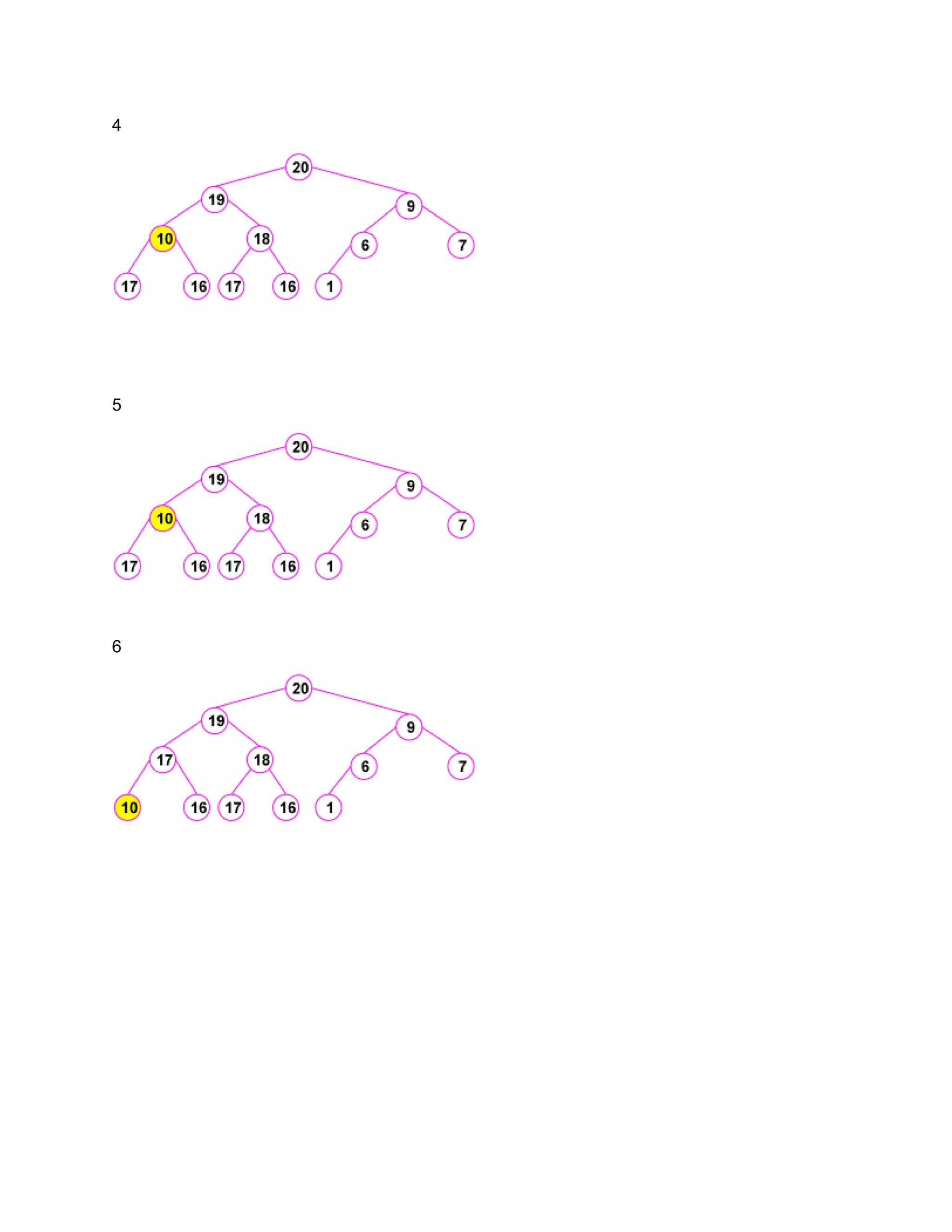
If either child of A[i] is greater than A[i], the greatest child is exchanged with A[i]. So, A[i] moves
down in the heap.

        The move of A[i] may have caused a violation of the max-heap property at it’s new
location.

       So, we must recursively call Max-Heapify(A,i) at the location i where the node “lands”.


1


2


3
4


5


6
Run time of Max-Heapify().

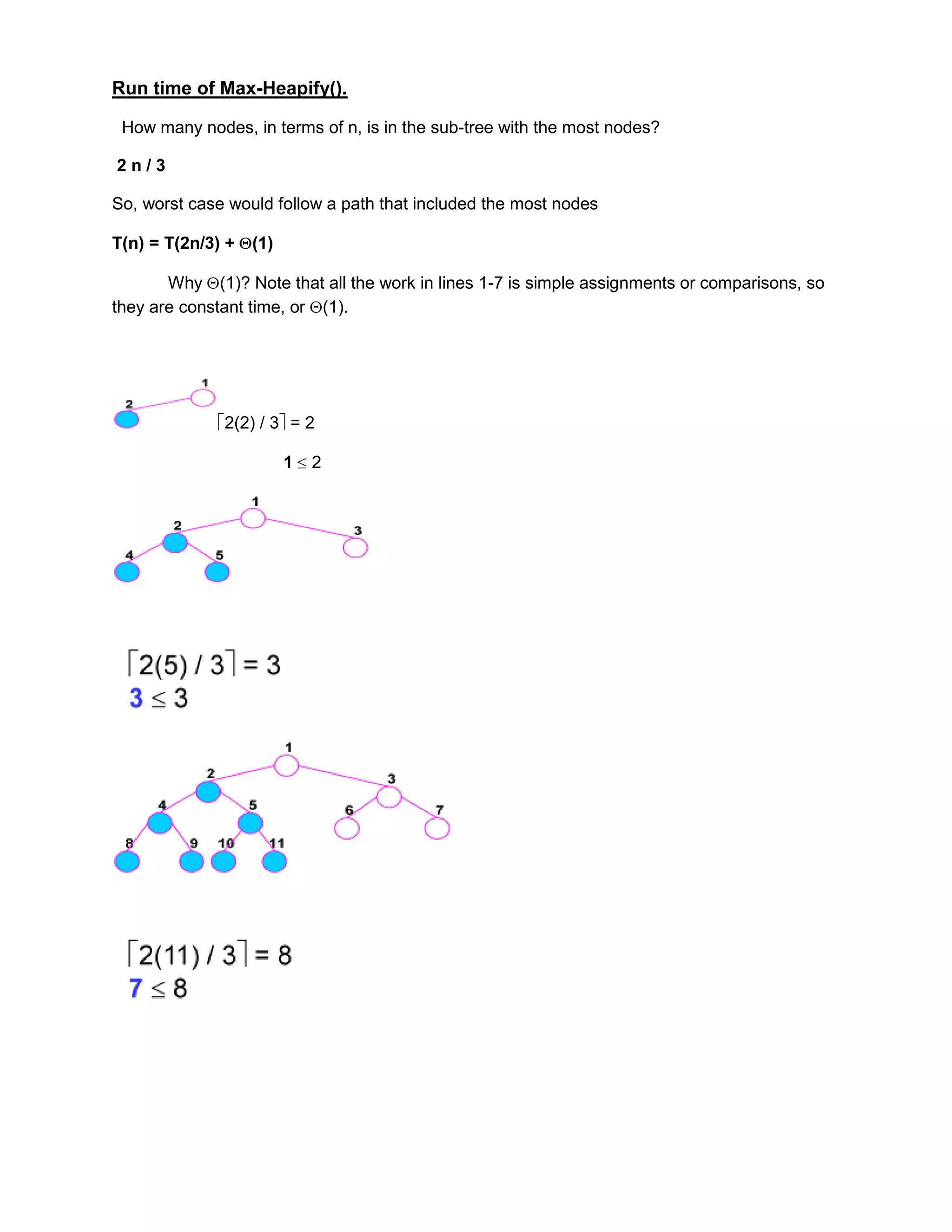
 How many nodes, in terms of n, is in the sub-tree with the most nodes?

2n/3

So, worst case would follow a path that included the most nodes

T(n) = T(2n/3) +   (1)

       Why (1)? Note that all the work in lines 1-7 is simple assignments or comparisons, so
they are constant time, or (1).


              2(2) / 3 = 2

                         1   2
So, what must we do to build a heap?

We call Max-Heapify(A,i) for every i starting at last node and going to the root.

Why Bottom-up?

Because Max-Heapify() moves the larger node upward into the root. If we start at the top and go
to larger node indices, the highest a node can move is to the root of that sub-tree. But what if
there is a violation between the sub-tree’s root and its parent? So, we must start from the
bottom and go towards the root to fix the problems caused by moving larger nodes into the root
of sub-trees.

Heap property

  • 1.
    Heap properties The heapproperty of a tree is a condition that must be true for the tree to be considered a heap. Min-heap property: for min-heaps, requires A[parent(i)] A[i] So, the root of any sub-tree holds the least value in that sub-tree. Max-heap property: for max-heaps, requires A[parent(i)] A[i] The root of any sub-tree holds the greatest value in the sub-tree. Example Looks like a max heap, but max-heap property is violated at indices 11 and 12. Why? because those nodes’ parents have smaller values than their children.
  • 2.
    Assume we aregiven a tree represented by a linear array A, and such that i length[A], and the trees rooted at Left(i) and Right(i) are heaps. Then, to create a heap rooted at A[i], use procedure Max-Heapify(A,i): Max-Heapify(A,i) 1. l  Left(i) 2. r  Right(i) 3. if l heap-size[A] and A[l] > A[i] 4. then largest  l 5. else largest  i 6. if r heap-size[A] and A[r] > A[largest] 7. then largest  r 8. if largest i 9. then swap( A[i], A[largest]) Max-Heapify(A, largest)
  • 3.
    If either childof A[i] is greater than A[i], the greatest child is exchanged with A[i]. So, A[i] moves down in the heap. The move of A[i] may have caused a violation of the max-heap property at it’s new location. So, we must recursively call Max-Heapify(A,i) at the location i where the node “lands”. 1 2 3
  • 4.
  • 5.
    Run time ofMax-Heapify(). How many nodes, in terms of n, is in the sub-tree with the most nodes? 2n/3 So, worst case would follow a path that included the most nodes T(n) = T(2n/3) + (1) Why (1)? Note that all the work in lines 1-7 is simple assignments or comparisons, so they are constant time, or (1). 2(2) / 3 = 2 1 2
  • 6.
    So, what mustwe do to build a heap? We call Max-Heapify(A,i) for every i starting at last node and going to the root. Why Bottom-up? Because Max-Heapify() moves the larger node upward into the root. If we start at the top and go to larger node indices, the highest a node can move is to the root of that sub-tree. But what if there is a violation between the sub-tree’s root and its parent? So, we must start from the bottom and go towards the root to fix the problems caused by moving larger nodes into the root of sub-trees.