Heapsort
http://www.cis.upenn.edu/~matuszek/cit594-2008/
Based off slides by: David Matuszek
2
Previous sorting algorithms
 Insertion Sort
 O(n2) time
 Merge Sort
 O(n) space
3
Heap data structure
 Binary tree
 Balanced
 Left-justified or Complete
 (Max) Heap property: no node has a value greater
than the value in its parent
4
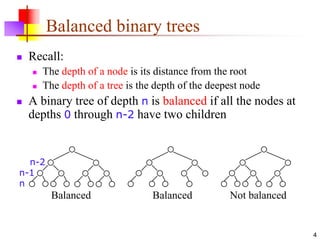
Balanced binary trees
 Recall:
 The depth of a node is its distance from the root
 The depth of a tree is the depth of the deepest node
 A binary tree of depth n is balanced if all the nodes at
depths 0 through n-2 have two children
Balanced Balanced Not balanced
n-2
n-1
n
5
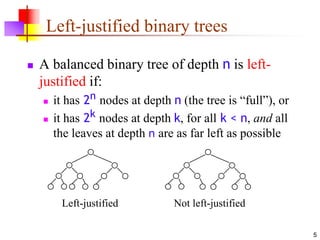
Left-justified binary trees
 A balanced binary tree of depth n is left-
justified if:
 it has 2n nodes at depth n (the tree is “full”), or
 it has 2k nodes at depth k, for all k < n, and all
the leaves at depth n are as far left as possible
Left-justified Not left-justified
6
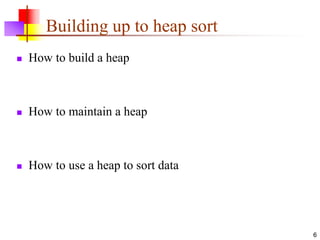
Building up to heap sort
 How to build a heap
 How to maintain a heap
 How to use a heap to sort data
7
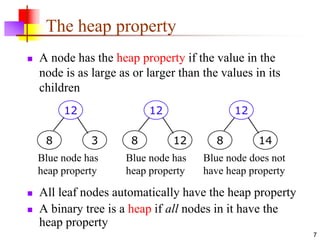
The heap property
 A node has the heap property if the value in the
node is as large as or larger than the values in its
children
 All leaf nodes automatically have the heap property
 A binary tree is a heap if all nodes in it have the
heap property
12
8 3
Blue node has
heap property
12
8 12
Blue node has
heap property
12
8 14
Blue node does not
have heap property
8
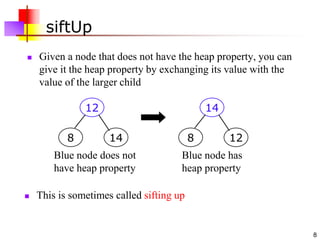
siftUp
 Given a node that does not have the heap property, you can
give it the heap property by exchanging its value with the
value of the larger child
 This is sometimes called sifting up
14
8 12
Blue node has
heap property
12
8 14
Blue node does not
have heap property
9
Constructing a heap I
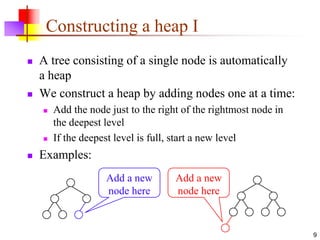
 A tree consisting of a single node is automatically
a heap
 We construct a heap by adding nodes one at a time:
 Add the node just to the right of the rightmost node in
the deepest level
 If the deepest level is full, start a new level
 Examples:
Add a new
node here
Add a new
node here
10
Constructing a heap II
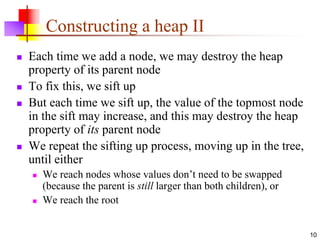
 Each time we add a node, we may destroy the heap
property of its parent node
 To fix this, we sift up
 But each time we sift up, the value of the topmost node
in the sift may increase, and this may destroy the heap
property of its parent node
 We repeat the sifting up process, moving up in the tree,
until either
 We reach nodes whose values don’t need to be swapped
(because the parent is still larger than both children), or
 We reach the root
11
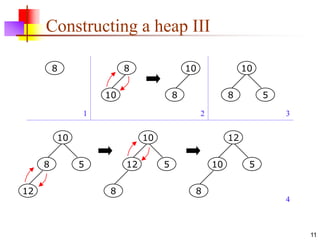
Constructing a heap III
8 8
10
10
8
10
8 5
10
8 5
12
10
12 5
8
12
10 5
8
1 2 3
4
12
Other children are not affected
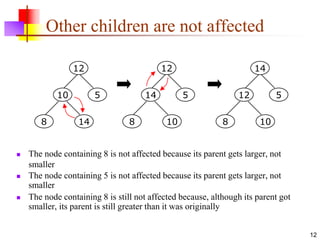
 The node containing 8 is not affected because its parent gets larger, not
smaller
 The node containing 5 is not affected because its parent gets larger, not
smaller
 The node containing 8 is still not affected because, although its parent got
smaller, its parent is still greater than it was originally
12
10 5
8 14
12
14 5
8 10
14
12 5
8 10
13
A sample heap
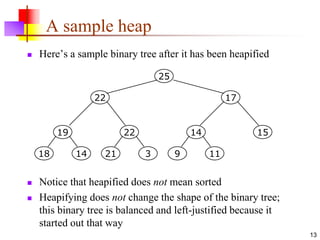
 Here’s a sample binary tree after it has been heapified
 Notice that heapified does not mean sorted
 Heapifying does not change the shape of the binary tree;
this binary tree is balanced and left-justified because it
started out that way
19
14
18
22
3
21
14
11
9
15
25
17
22
14
Removing the root (animated)
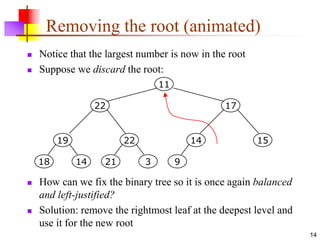
 Notice that the largest number is now in the root
 Suppose we discard the root:
 How can we fix the binary tree so it is once again balanced
and left-justified?
 Solution: remove the rightmost leaf at the deepest level and
use it for the new root
19
14
18
22
3
21
14
11
9
15
17
22
11
15
The reHeap method I
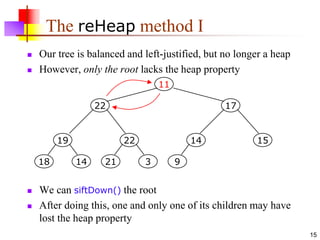
 Our tree is balanced and left-justified, but no longer a heap
 However, only the root lacks the heap property
 We can siftDown() the root
 After doing this, one and only one of its children may have
lost the heap property
19
14
18
22
3
21
14
9
15
17
22
11
16
The reHeap method II
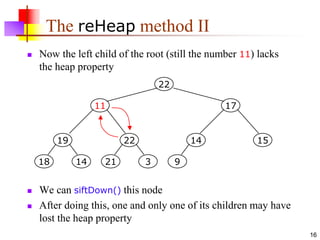
 Now the left child of the root (still the number 11) lacks
the heap property
 We can siftDown() this node
 After doing this, one and only one of its children may have
lost the heap property
19
14
18
22
3
21
14
9
15
17
11
22
17
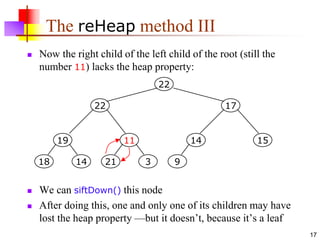
The reHeap method III
 Now the right child of the left child of the root (still the
number 11) lacks the heap property:
 We can siftDown() this node
 After doing this, one and only one of its children may have
lost the heap property —but it doesn’t, because it’s a leaf
19
14
18
11
3
21
14
9
15
17
22
22
18
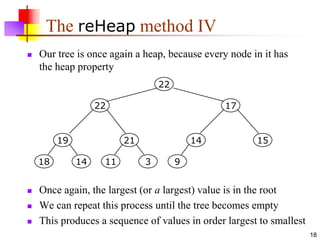
The reHeap method IV
 Our tree is once again a heap, because every node in it has
the heap property
 Once again, the largest (or a largest) value is in the root
 We can repeat this process until the tree becomes empty
 This produces a sequence of values in order largest to smallest
19
14
18
21
3
11
14
9
15
17
22
22
19
Sorting
 What do heaps have to do with sorting an array?
 Here’s the neat part:
 Because the binary tree is balanced and left justified, it can be
represented as an array
 Danger Will Robinson: This representation works well only with
balanced, left-justified binary trees
 All our operations on binary trees can be represented as
operations on arrays
 To sort:
heapify the array;
while the array isn’t empty {
remove and replace the root;
reheap the new root node;
}
20
Key properties
 Determining location of root and “last node” take
constant time
 Remove n elements, re-heap each time
21
Analysis
 To reheap the root node, we have to follow one path
from the root to a leaf node (and we might stop before
we reach a leaf)
 The binary tree is perfectly balanced
 Therefore, this path is O(log n) long
 And we only do O(1) operations at each node
 Therefore, reheaping takes O(log n) times
 Since we reheap inside a while loop that we do n times,
the total time for the while loop is n*O(log n), or
O(n log n)
22
Analysis
 Construct the heap O(n log n)
 Remove and re-heap O(log n)
 Do this n times O(n log n)
 Total time O(n log n) + O(n log n)
23
The End
 Continue to priority queues?
24
Priority Queue
 Queue – only access element in front
 Queue elements sorted by order of importance
 Implement as a heap where nodes store priority values
25
Extract Max
 Remove root
 Swap with last node
 Re-heapify
26
Increase Key
 Change node value
 Re-heapify

CSE680-06HeapSort.ppt

  • 1.
  • 2.
    2 Previous sorting algorithms Insertion Sort  O(n2) time  Merge Sort  O(n) space
  • 3.
    3 Heap data structure Binary tree  Balanced  Left-justified or Complete  (Max) Heap property: no node has a value greater than the value in its parent
  • 4.
    4 Balanced binary trees Recall:  The depth of a node is its distance from the root  The depth of a tree is the depth of the deepest node  A binary tree of depth n is balanced if all the nodes at depths 0 through n-2 have two children Balanced Balanced Not balanced n-2 n-1 n
  • 5.
    5 Left-justified binary trees A balanced binary tree of depth n is left- justified if:  it has 2n nodes at depth n (the tree is “full”), or  it has 2k nodes at depth k, for all k < n, and all the leaves at depth n are as far left as possible Left-justified Not left-justified
  • 6.
    6 Building up toheap sort  How to build a heap  How to maintain a heap  How to use a heap to sort data
  • 7.
    7 The heap property A node has the heap property if the value in the node is as large as or larger than the values in its children  All leaf nodes automatically have the heap property  A binary tree is a heap if all nodes in it have the heap property 12 8 3 Blue node has heap property 12 8 12 Blue node has heap property 12 8 14 Blue node does not have heap property
  • 8.
    8 siftUp  Given anode that does not have the heap property, you can give it the heap property by exchanging its value with the value of the larger child  This is sometimes called sifting up 14 8 12 Blue node has heap property 12 8 14 Blue node does not have heap property
  • 9.
    9 Constructing a heapI  A tree consisting of a single node is automatically a heap  We construct a heap by adding nodes one at a time:  Add the node just to the right of the rightmost node in the deepest level  If the deepest level is full, start a new level  Examples: Add a new node here Add a new node here
  • 10.
    10 Constructing a heapII  Each time we add a node, we may destroy the heap property of its parent node  To fix this, we sift up  But each time we sift up, the value of the topmost node in the sift may increase, and this may destroy the heap property of its parent node  We repeat the sifting up process, moving up in the tree, until either  We reach nodes whose values don’t need to be swapped (because the parent is still larger than both children), or  We reach the root
  • 11.
    11 Constructing a heapIII 8 8 10 10 8 10 8 5 10 8 5 12 10 12 5 8 12 10 5 8 1 2 3 4
  • 12.
    12 Other children arenot affected  The node containing 8 is not affected because its parent gets larger, not smaller  The node containing 5 is not affected because its parent gets larger, not smaller  The node containing 8 is still not affected because, although its parent got smaller, its parent is still greater than it was originally 12 10 5 8 14 12 14 5 8 10 14 12 5 8 10
  • 13.
    13 A sample heap Here’s a sample binary tree after it has been heapified  Notice that heapified does not mean sorted  Heapifying does not change the shape of the binary tree; this binary tree is balanced and left-justified because it started out that way 19 14 18 22 3 21 14 11 9 15 25 17 22
  • 14.
    14 Removing the root(animated)  Notice that the largest number is now in the root  Suppose we discard the root:  How can we fix the binary tree so it is once again balanced and left-justified?  Solution: remove the rightmost leaf at the deepest level and use it for the new root 19 14 18 22 3 21 14 11 9 15 17 22 11
  • 15.
    15 The reHeap methodI  Our tree is balanced and left-justified, but no longer a heap  However, only the root lacks the heap property  We can siftDown() the root  After doing this, one and only one of its children may have lost the heap property 19 14 18 22 3 21 14 9 15 17 22 11
  • 16.
    16 The reHeap methodII  Now the left child of the root (still the number 11) lacks the heap property  We can siftDown() this node  After doing this, one and only one of its children may have lost the heap property 19 14 18 22 3 21 14 9 15 17 11 22
  • 17.
    17 The reHeap methodIII  Now the right child of the left child of the root (still the number 11) lacks the heap property:  We can siftDown() this node  After doing this, one and only one of its children may have lost the heap property —but it doesn’t, because it’s a leaf 19 14 18 11 3 21 14 9 15 17 22 22
  • 18.
    18 The reHeap methodIV  Our tree is once again a heap, because every node in it has the heap property  Once again, the largest (or a largest) value is in the root  We can repeat this process until the tree becomes empty  This produces a sequence of values in order largest to smallest 19 14 18 21 3 11 14 9 15 17 22 22
  • 19.
    19 Sorting  What doheaps have to do with sorting an array?  Here’s the neat part:  Because the binary tree is balanced and left justified, it can be represented as an array  Danger Will Robinson: This representation works well only with balanced, left-justified binary trees  All our operations on binary trees can be represented as operations on arrays  To sort: heapify the array; while the array isn’t empty { remove and replace the root; reheap the new root node; }
  • 20.
    20 Key properties  Determininglocation of root and “last node” take constant time  Remove n elements, re-heap each time
  • 21.
    21 Analysis  To reheapthe root node, we have to follow one path from the root to a leaf node (and we might stop before we reach a leaf)  The binary tree is perfectly balanced  Therefore, this path is O(log n) long  And we only do O(1) operations at each node  Therefore, reheaping takes O(log n) times  Since we reheap inside a while loop that we do n times, the total time for the while loop is n*O(log n), or O(n log n)
  • 22.
    22 Analysis  Construct theheap O(n log n)  Remove and re-heap O(log n)  Do this n times O(n log n)  Total time O(n log n) + O(n log n)
  • 23.
    23 The End  Continueto priority queues?
  • 24.
    24 Priority Queue  Queue– only access element in front  Queue elements sorted by order of importance  Implement as a heap where nodes store priority values
  • 25.
    25 Extract Max  Removeroot  Swap with last node  Re-heapify
  • 26.
    26 Increase Key  Changenode value  Re-heapify