3. Tercer condicional / Third Conditional


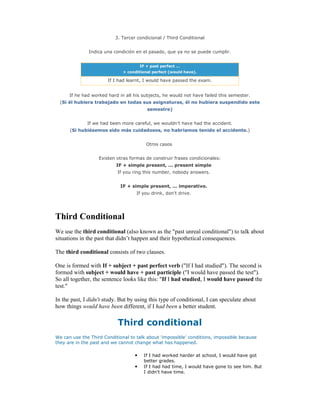
              Indica una condición en el pasado, que ya no se puede cumplir.


                                       IF + past perfect ...
                              + conditional perfect (would have).

                       If I had learnt, I would have passed the exam.


      If he had worked hard in all his subjects, he would not have failed this semester.
  (Si él hubiera trabajado en todas sus asignaturas, él no hubiera suspendido este
                                          semestre)


              If we had been more careful, we wouldn't have had the accident.
      (Si hubiésemos sido más cuidadosos, no habríamos tenido el accidente.)


                                          Otros casos


                   Existen otras formas de construir frases condicionales:
                           IF + simple present, ... present simple
                           If you ring this number, nobody answers.


                             IF + simple present, ... imperativo.
                                    If you drink, don't drive.


Third Conditional
We use the third conditional (also known as the "past unreal conditional") to talk about
situations in the past that didn’t happen and their hypothetical consequences.

The third conditional consists of two clauses.

One is formed with If + subject + past perfect verb ("If I had studied"). The second is
formed with subject + would have + past participle ("I would have passed the test").
So all together, the sentence looks like this: "If I had studied, I would have passed the
test."

In the past, I didn't study. But by using this type of conditional, I can speculate about
how things would have been different, if I had been a better student.

                           Third conditional
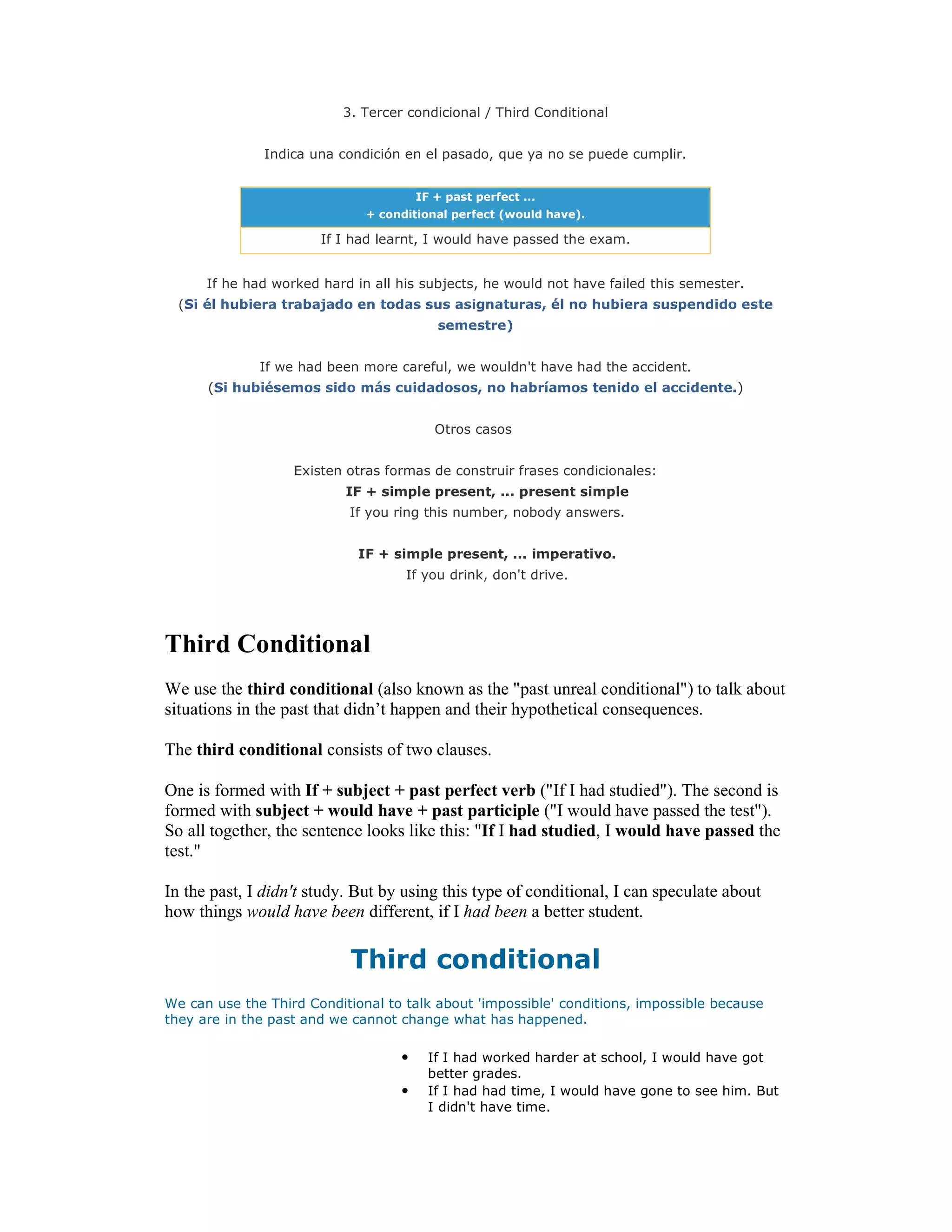
We can use the Third Conditional to talk about 'impossible' conditions, impossible because
they are in the past and we cannot change what has happened.

                                   •     If I had worked harder at school, I would have got
                                         better grades.
                                   •     If I had had time, I would have gone to see him. But
                                         I didn't have time.
•   If we had bought that house, we would have had to
                                        rebuild the kitchen.
                                    •   If we had caught the earlier train, we would have got
                                        there on time but we were late.

Notice that the main clause can contain 'would', 'could' or 'might.

                                    •   If I had seen him at the meeting, I would have asked
                                        him. (But he wasn't there so I didn't.)
                                    •   If I had seen him at the meeting, I could have asked
                                        him. ( But he wasn't there so it wasn't possible.)
                                    •   If I had seen him at the meeting, I might have asked
                                        him. (But I'm not sure. Perhaps if the opportunity
                                        had arisen.)
                                    •   If I had paid more attention in class, I would have
                                        understood the lesson.

Also notice that sometimes the 'if clause' is implied rather than spoken.

                                    •   I'd have done it. ("if you had asked me but you
                                        didn't.")
                                    •   I wouldn't have said that. ("if I'd been there.")
                                    •   He wouldn't have let him get away with that. ("if he
                                        had tried that with me.")

Te invitamos a que entres a esta página y desarrolles los siguiente ejercicios

http://www.englishgrammarsecrets.com/thirdconditional/exercise1.swf


Desarolla el siguiente ejercicio


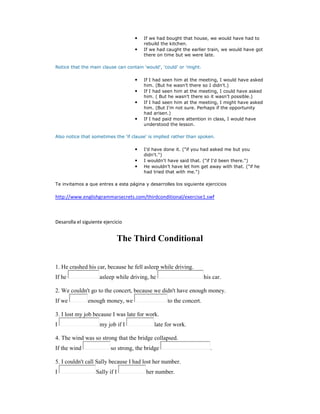
                                The Third Conditional


1. He crashed his car, because he fell asleep while driving.
If he                asleep while driving, he                         his car.

2. We couldn't go to the concert, because we didn't have enough money.
If we          enough money, we                    to the concert.

3. I lost my job because I was late for work.
I                    my job if I             late for work.

4. The wind was so strong that the bridge collapsed.
If the wind               so strong, the bridge                          .

5. I couldn't call Sally because I had lost her number.
I                  Sally if I            her number.
Third Conditional


                                                                          Introduction


The third conditional (also called conditional type 3) is a structure used for talking
about unreal situations in the past. This page will explain how the third conditional is
formed, and when to use it.


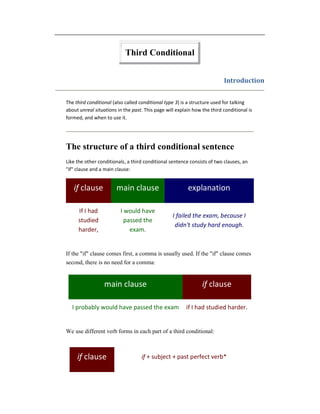
The structure of a third conditional sentence
Like the other conditionals, a third conditional sentence consists of two clauses, an
"if" clause and a main clause:


   if clause           main clause                       explanation

     If I had            I would have
                                                  I failed the exam, because I
     studied               passed the
                                                   didn't study hard enough.
     harder,                 exam.


If the "if" clause comes first, a comma is usually used. If the "if" clause comes
second, there is no need for a comma:


                  main clause                                   if clause

  I probably would have passed the exam                 if I had studied harder.


We use different verb forms in each part of a third conditional:


     if clause                     if + subject + past perfect verb*
main                subject + would (OR could, OR might) have +
      clause                             past participle


*The past perfect is formed with the auxiliary verb "had", and the past
participle (or third form) of the verb.

Note also that third conditional forms can be contracted:


                                 If I had studied harder, I probably would
        Full form                          have passed the exam.


      Contracted                 If I'd studied harder, I probably would've
        form                                  passed the exam.


Using the third conditional
The third conditional is used to talk about things which DID NOT HAPPEN in the past.
If your native language does not have a similar construction, you may find this a little
strange, but it can be very useful. It is often used to express criticism or regret:


             Example                                  Explanation

      If you had driven more                 Criticism: You had an accident
     carefully, you would not                   because you didn't drive
       have had an accident.                         carefully enough.


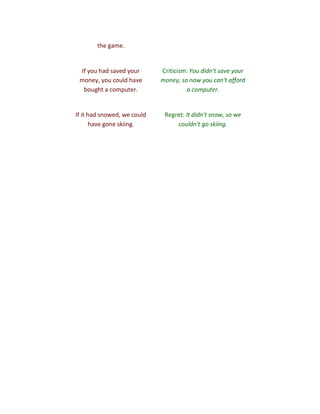
     If we had played a little               Regret: We didn't play well, so
    better, we could have won                      we lost the game.
the game.


 If you had saved your       Criticism: You didn't save your
 money, you could have       money, so now you can't afford
  bought a computer.                  a computer.


If it had snowed, we could    Regret: It didn't snow, so we
       have gone skiing.          couldn't go skiing.

Third conditional word

  • 1.
    3. Tercer condicional/ Third Conditional Indica una condición en el pasado, que ya no se puede cumplir. IF + past perfect ... + conditional perfect (would have). If I had learnt, I would have passed the exam. If he had worked hard in all his subjects, he would not have failed this semester. (Si él hubiera trabajado en todas sus asignaturas, él no hubiera suspendido este semestre) If we had been more careful, we wouldn't have had the accident. (Si hubiésemos sido más cuidadosos, no habríamos tenido el accidente.) Otros casos Existen otras formas de construir frases condicionales: IF + simple present, ... present simple If you ring this number, nobody answers. IF + simple present, ... imperativo. If you drink, don't drive. Third Conditional We use the third conditional (also known as the "past unreal conditional") to talk about situations in the past that didn’t happen and their hypothetical consequences. The third conditional consists of two clauses. One is formed with If + subject + past perfect verb ("If I had studied"). The second is formed with subject + would have + past participle ("I would have passed the test"). So all together, the sentence looks like this: "If I had studied, I would have passed the test." In the past, I didn't study. But by using this type of conditional, I can speculate about how things would have been different, if I had been a better student. Third conditional We can use the Third Conditional to talk about 'impossible' conditions, impossible because they are in the past and we cannot change what has happened. • If I had worked harder at school, I would have got better grades. • If I had had time, I would have gone to see him. But I didn't have time.
  • 2.
    If we had bought that house, we would have had to rebuild the kitchen. • If we had caught the earlier train, we would have got there on time but we were late. Notice that the main clause can contain 'would', 'could' or 'might. • If I had seen him at the meeting, I would have asked him. (But he wasn't there so I didn't.) • If I had seen him at the meeting, I could have asked him. ( But he wasn't there so it wasn't possible.) • If I had seen him at the meeting, I might have asked him. (But I'm not sure. Perhaps if the opportunity had arisen.) • If I had paid more attention in class, I would have understood the lesson. Also notice that sometimes the 'if clause' is implied rather than spoken. • I'd have done it. ("if you had asked me but you didn't.") • I wouldn't have said that. ("if I'd been there.") • He wouldn't have let him get away with that. ("if he had tried that with me.") Te invitamos a que entres a esta página y desarrolles los siguiente ejercicios http://www.englishgrammarsecrets.com/thirdconditional/exercise1.swf Desarolla el siguiente ejercicio The Third Conditional 1. He crashed his car, because he fell asleep while driving. If he asleep while driving, he his car. 2. We couldn't go to the concert, because we didn't have enough money. If we enough money, we to the concert. 3. I lost my job because I was late for work. I my job if I late for work. 4. The wind was so strong that the bridge collapsed. If the wind so strong, the bridge . 5. I couldn't call Sally because I had lost her number. I Sally if I her number.
  • 3.
    Third Conditional Introduction The third conditional (also called conditional type 3) is a structure used for talking about unreal situations in the past. This page will explain how the third conditional is formed, and when to use it. The structure of a third conditional sentence Like the other conditionals, a third conditional sentence consists of two clauses, an "if" clause and a main clause: if clause main clause explanation If I had I would have I failed the exam, because I studied passed the didn't study hard enough. harder, exam. If the "if" clause comes first, a comma is usually used. If the "if" clause comes second, there is no need for a comma: main clause if clause I probably would have passed the exam if I had studied harder. We use different verb forms in each part of a third conditional: if clause if + subject + past perfect verb*
  • 4.
    main subject + would (OR could, OR might) have + clause past participle *The past perfect is formed with the auxiliary verb "had", and the past participle (or third form) of the verb. Note also that third conditional forms can be contracted: If I had studied harder, I probably would Full form have passed the exam. Contracted If I'd studied harder, I probably would've form passed the exam. Using the third conditional The third conditional is used to talk about things which DID NOT HAPPEN in the past. If your native language does not have a similar construction, you may find this a little strange, but it can be very useful. It is often used to express criticism or regret: Example Explanation If you had driven more Criticism: You had an accident carefully, you would not because you didn't drive have had an accident. carefully enough. If we had played a little Regret: We didn't play well, so better, we could have won we lost the game.
  • 5.
    the game. Ifyou had saved your Criticism: You didn't save your money, you could have money, so now you can't afford bought a computer. a computer. If it had snowed, we could Regret: It didn't snow, so we have gone skiing. couldn't go skiing.