New	
  Thinking	
  

 “What	
  are	
  the	
  ideas	
  about	
  
 knowledge,	
  mind,	
  and	
  learning	
  that	
  
 inform	
  your	
  current	
  thinking	
  about	
  
 how	
  you	
  teach	
  and	
  how	
  schools	
  
 should	
  be	
  organised?”	
  
                                             Ref:	
  Jane	
  Gilbert	
  (2005)	
  	
  
                        Catching	
  the	
  Knowledge	
  Wave	
  -­‐	
  NZCER
How	
  we	
  understand	
  knowledge	
  
                           •  Knowledge	
  is	
  “stuff”	
  
                           •  It	
  can	
  be	
  stored	
  -­‐	
  in	
  minds,	
  books	
  or	
  other	
  
                              kinds	
  of	
  databases	
  
                           •  Knowledge	
  is	
  true,	
  correct,	
  “the	
  facts”	
  
                           •  It	
  is	
  something	
  stable	
  that	
  accumulates	
  slowly	
  
                              over	
  Ome;	
  new	
  knowledge	
  builds	
  on	
  older	
  
                              knowledge	
  
                           •  It	
  is	
  built	
  up	
  by	
  people,	
  and	
  people	
  can	
  “have”	
  
                              it,	
  however,	
  it	
  exists	
  objecOvely,	
  independently	
  
                              of	
  people	
  
                           •  There	
  are	
  different	
  branches	
  of	
  knowledge	
  
                              called	
  disciplines	
  or	
  subjects	
  
Ref: Jane Gilbert (2005)
Catching the Knowledge     •  Each	
  discipline	
  has	
  its	
  own	
  way	
  of	
  doing	
  things	
  
Wave - NZCER
How	
  we	
  understand	
  minds	
  
                           •  Minds	
  are	
  like	
  containers	
  (filing	
  
                              cabinets	
  or	
  databases),	
  they	
  store	
  
                              knowledge	
  
                           •  Minds	
  also	
  process	
  knowledge;	
  they	
  
                              take	
  it	
  in,	
  organise	
  it	
  and	
  represent	
  it	
  
                           •  Minds	
  are	
  the	
  places	
  where	
  thinking	
  
                              and	
  learning	
  happen	
  
                           •  Some	
  minds	
  have	
  more	
  capacity	
  than	
  
                              other	
  minds	
  for	
  storing	
  and	
  
                              processing	
  knowledge	
  
                           •  The	
  mind	
  is	
  located	
  in	
  the	
  brain,	
  but	
  
Ref: Jane Gilbert (2005)
                              its	
  acOviOes	
  are	
  disOnct	
  from	
  the	
  
Catching the Knowledge
Wave - NZCER
                              brain’s	
  other	
  funcOons	
  
How	
  we	
  understand	
  learning	
  
                           •  Learning	
  is	
  the	
  process	
  by	
  which	
  
                              knowledge	
  gets	
  stored	
  in	
  minds	
  
                           •  Learning	
  is	
  an	
  individual	
  acOvity:	
  it	
  
                              takes	
  place	
  in	
  individual	
  minds	
  
                           •  Learning	
  is	
  an	
  acOvity	
  that	
  happens	
  in	
  
                              more	
  or	
  less	
  the	
  same	
  way	
  in	
  all	
  
                              individuals	
  
                           •  Learners	
  of	
  the	
  same	
  age	
  (or	
  stage	
  of	
  
                              development)	
  will	
  be	
  ready	
  for	
  the	
  
                              same	
  kinds	
  of	
  knowledge	
  at	
  the	
  same	
  
                              Ome	
  
                           •  Learning	
  is	
  easier	
  if	
  the	
  knowledge	
  to	
  
Ref: Jane Gilbert (2005)
Catching the Knowledge
                              be	
  learned	
  is	
  broken	
  down	
  into	
  parts	
  
Wave - NZCER                  and	
  introduced	
  as	
  a	
  series	
  of	
  steps.	
  
What	
  about	
  you?	
  
•  How	
  would	
  you	
  summarise	
  your	
  thinking	
  
   about…	
  
    –  Knowledge	
  
    –  Minds	
  
    –  Learning	
  
•  How	
  would	
  you	
  describe	
  this	
  to	
  a	
  colleague?	
  
•  How	
  is	
  what	
  you	
  believe	
  evidenced	
  in	
  your	
  
   teaching	
  context?	
  
Learning	
  theories


How	
  do	
  any	
  of	
  the	
  following	
  
theories	
  of	
  learning	
  inform	
  the	
  
decisions	
  you	
  make	
  about	
  your	
  
teaching?	
  
Behaviourism	
  

Concept:	
  	
  
Learning	
  is	
  a	
  change	
  in	
  behaviour…mind	
  is	
  a	
  black	
  box	
  
Key	
  Figures:	
  	
  
Pavlov,	
  Thorndike,	
  Watson,	
  Skinner	
  
Epistomology/Pedagogy	
  
    -­‐ 	
  Knowledge	
  is	
  objecOve,	
  but	
  secondary	
  to	
  behavioural	
  consideraOons	
  
     -­‐ 	
  Teaching	
  is	
  sOmulus/response-­‐based	
  (condiOoning)	
  
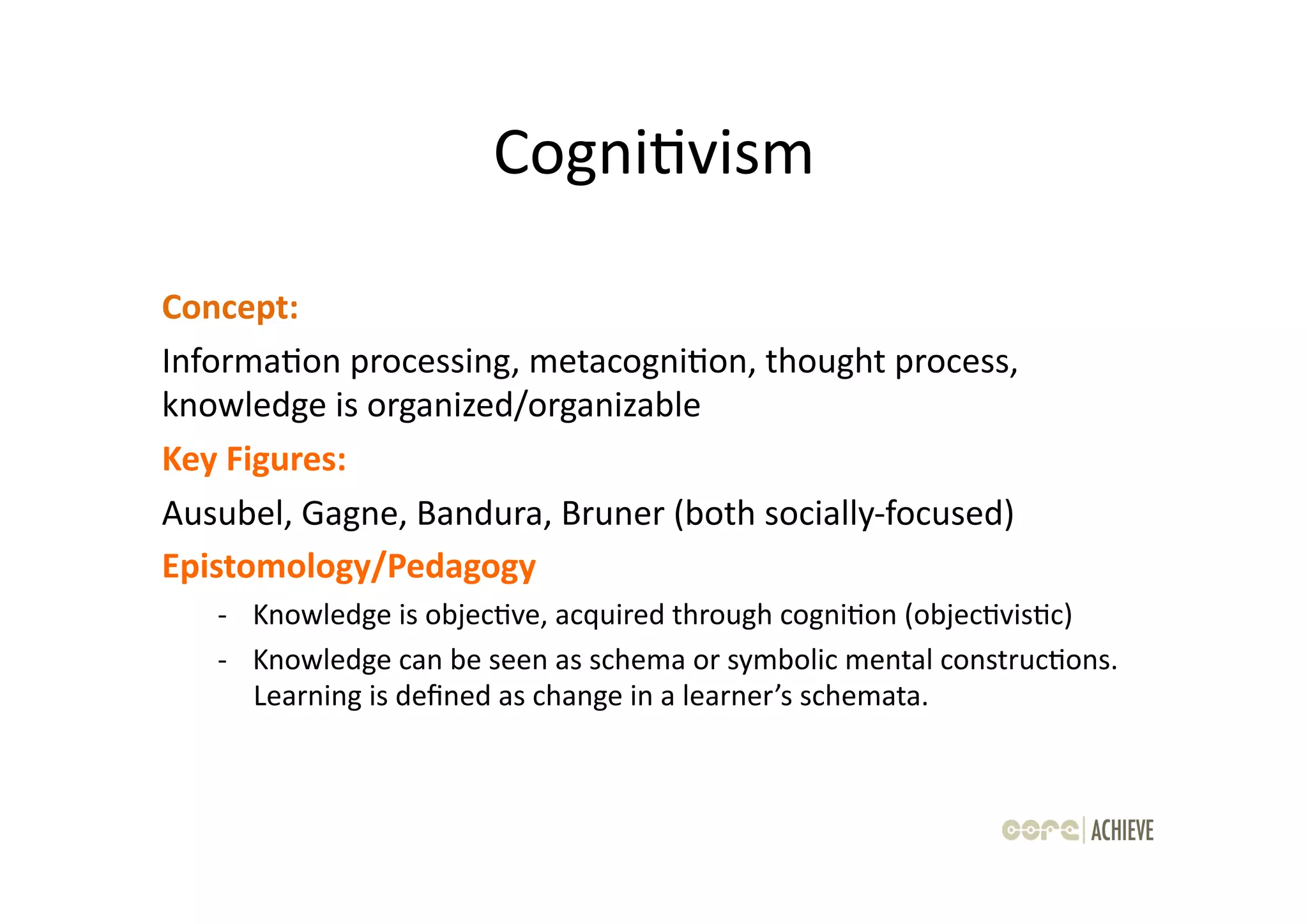
CogniOvism	
  

Concept:	
  	
  
InformaOon	
  processing,	
  metacogniOon,	
  thought	
  process,	
  
knowledge	
  is	
  organized/organizable	
  	
  
Key	
  Figures:	
  	
  
Ausubel,	
  Gagne,	
  Bandura,	
  Bruner	
  (both	
  socially-­‐focused)	
  
Epistomology/Pedagogy	
  
    -­‐  Knowledge	
  is	
  objecOve,	
  acquired	
  through	
  cogniOon	
  (objecOvisOc)	
  
    -­‐  Knowledge	
  can	
  be	
  seen	
  as	
  schema	
  or	
  symbolic	
  mental	
  construcOons.	
  
         Learning	
  is	
  defined	
  as	
  change	
  in	
  a	
  learner’s	
  schemata.	
  
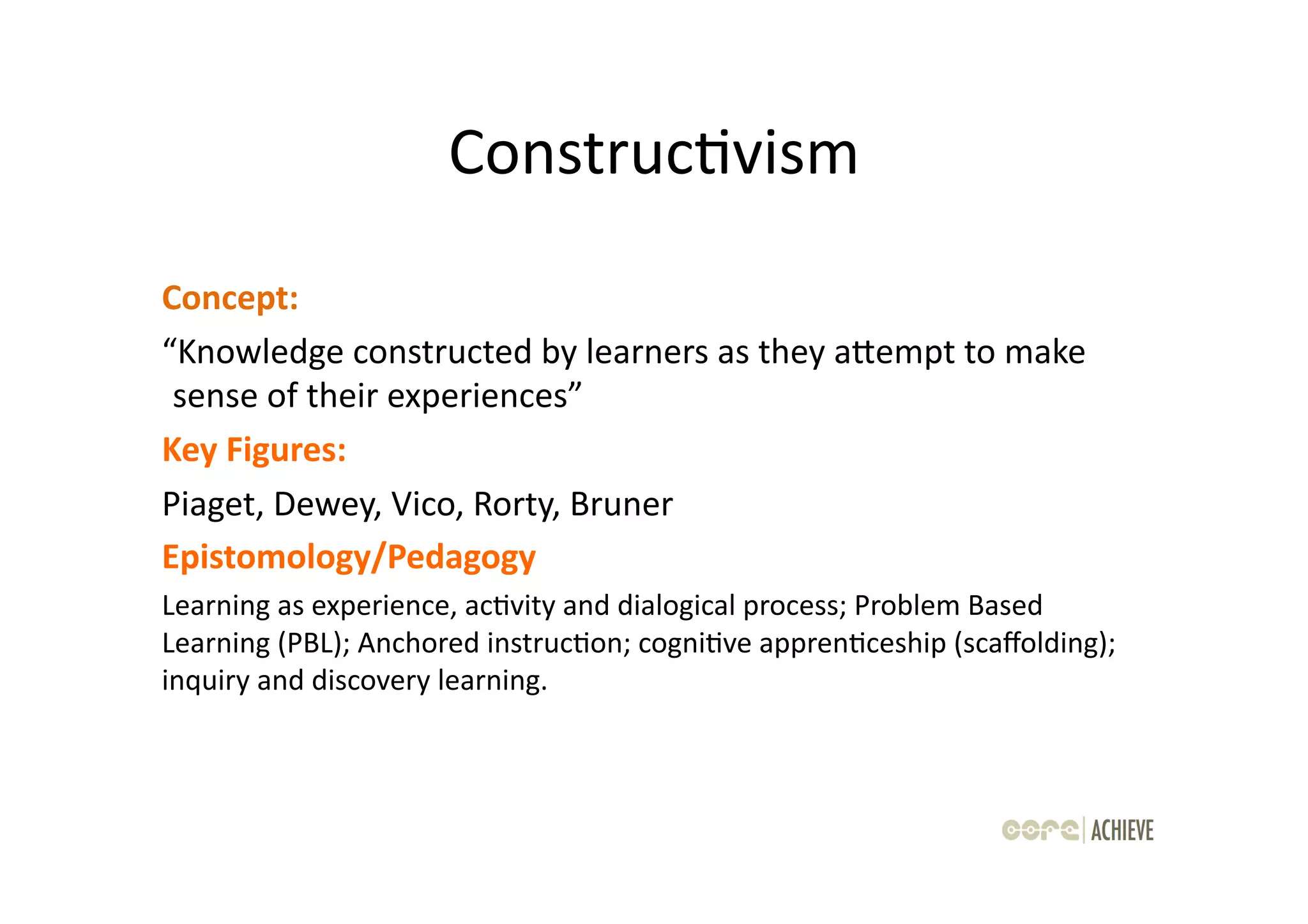
ConstrucOvism	
  
Concept:	
  	
  
“Knowledge	
  constructed	
  by	
  learners	
  as	
  they	
  aaempt	
  to	
  make	
  
 sense	
  of	
  their	
  experiences”	
  	
  
Key	
  Figures:	
  	
  
Piaget,	
  Dewey,	
  Vico,	
  Rorty,	
  Bruner	
  
Epistomology/Pedagogy	
  
Learning	
  as	
  experience,	
  acOvity	
  and	
  dialogical	
  process;	
  Problem	
  Based	
  
Learning	
  (PBL);	
  Anchored	
  instrucOon;	
  cogniOve	
  apprenOceship	
  (scaffolding);	
  
inquiry	
  and	
  discovery	
  learning.	
  
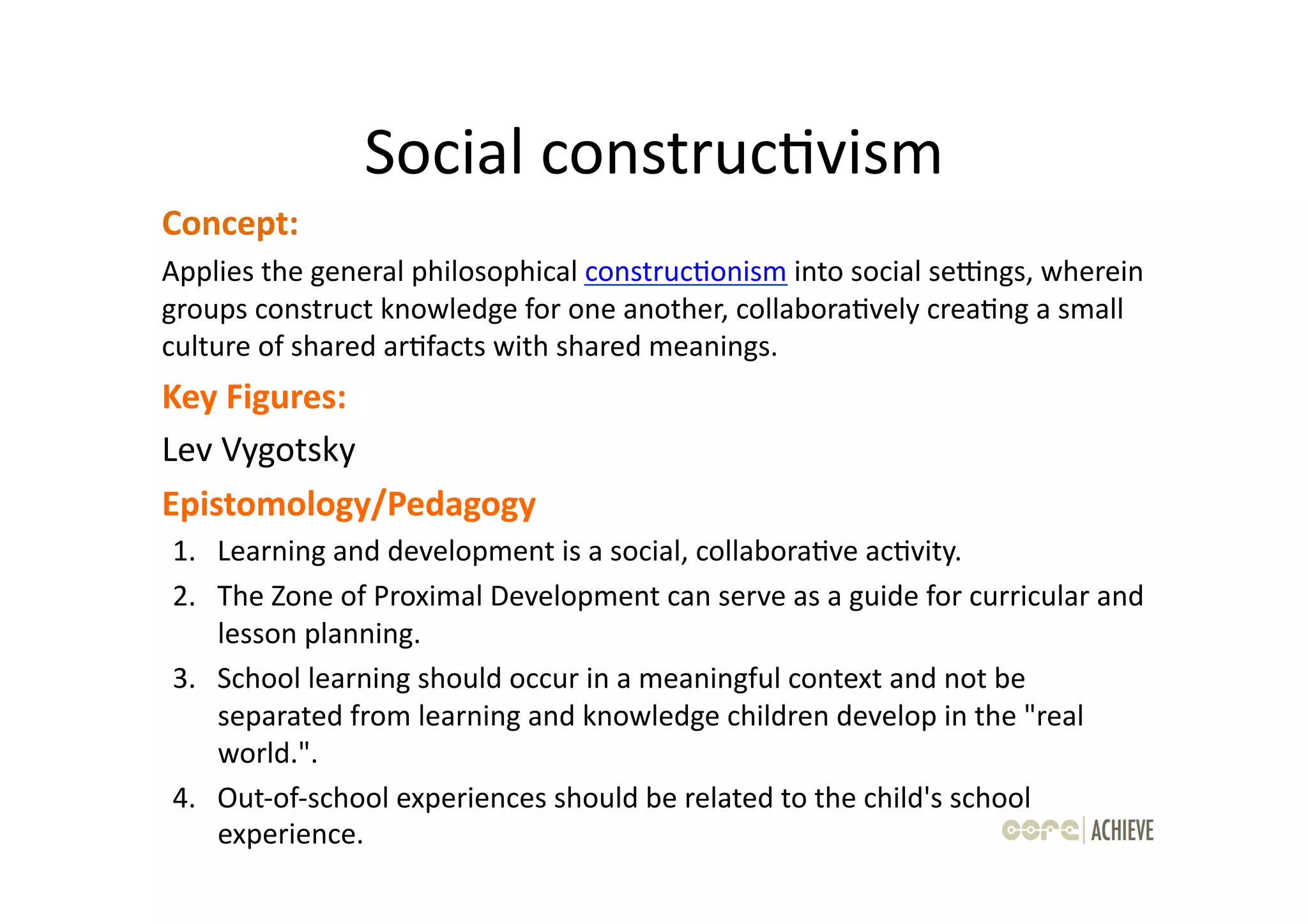
Social	
  construcOvism	
  
Concept:	
  	
  
Applies	
  the	
  general	
  philosophical	
  construcOonism	
  into	
  social	
  sedngs,	
  wherein	
  
groups	
  construct	
  knowledge	
  for	
  one	
  another,	
  collaboraOvely	
  creaOng	
  a	
  small	
  
culture	
  of	
  shared	
  arOfacts	
  with	
  shared	
  meanings.	
  
Key	
  Figures:	
  	
  
Lev	
  Vygotsky	
  
Epistomology/Pedagogy	
  
 1.  Learning	
  and	
  development	
  is	
  a	
  social,	
  collaboraOve	
  acOvity.	
  	
  
 2.  The	
  Zone	
  of	
  Proximal	
  Development	
  can	
  serve	
  as	
  a	
  guide	
  for	
  curricular	
  and	
  
     lesson	
  planning.	
  	
  
 3.  School	
  learning	
  should	
  occur	
  in	
  a	
  meaningful	
  context	
  and	
  not	
  be	
  
     separated	
  from	
  learning	
  and	
  knowledge	
  children	
  develop	
  in	
  the	
  "real	
  
     world.".	
  	
  
 4.  Out-­‐of-­‐school	
  experiences	
  should	
  be	
  related	
  to	
  the	
  child's	
  school	
  
     experience.	
  
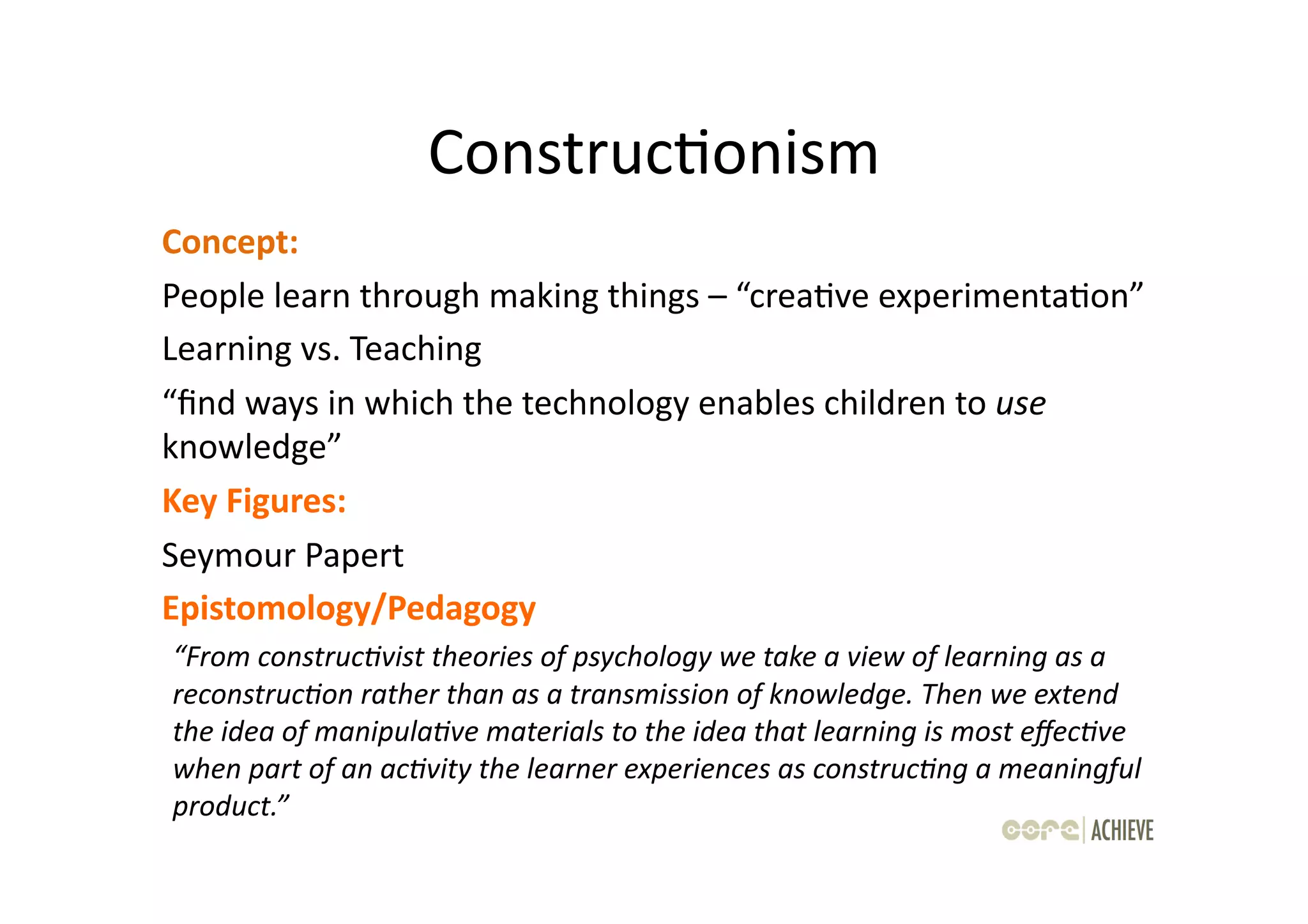
ConstrucOonism	
  
Concept:	
  	
  
People	
  learn	
  through	
  making	
  things	
  –	
  “creaOve	
  experimentaOon”	
  
Learning	
  vs.	
  Teaching	
  
“find	
  ways	
  in	
  which	
  the	
  technology	
  enables	
  children	
  to	
  use	
  
knowledge”	
  	
  
Key	
  Figures:	
  	
  
Seymour	
  Papert	
  
Epistomology/Pedagogy	
  
“From	
  construc-vist	
  theories	
  of	
  psychology	
  we	
  take	
  a	
  view	
  of	
  learning	
  as	
  a	
  
reconstruc-on	
  rather	
  than	
  as	
  a	
  transmission	
  of	
  knowledge.	
  Then	
  we	
  extend	
  
the	
  idea	
  of	
  manipula-ve	
  materials	
  to	
  the	
  idea	
  that	
  learning	
  is	
  most	
  effec-ve	
  
when	
  part	
  of	
  an	
  ac-vity	
  the	
  learner	
  experiences	
  as	
  construc-ng	
  a	
  meaningful	
  
product.”	
  
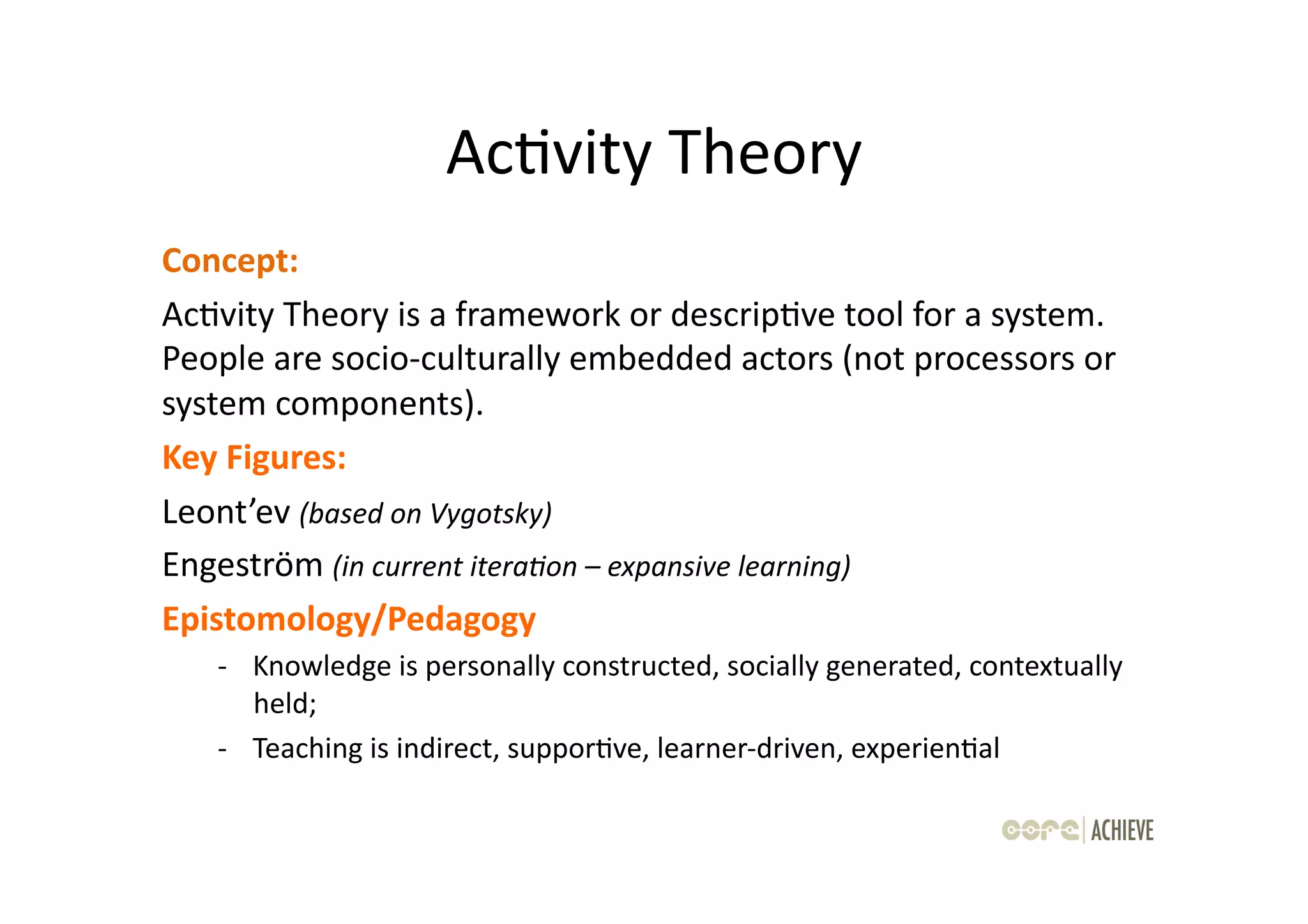
AcOvity	
  Theory	
  
Concept:	
  	
  
AcOvity	
  Theory	
  is	
  a	
  framework	
  or	
  descripOve	
  tool	
  for	
  a	
  system.	
  
People	
  are	
  socio-­‐culturally	
  embedded	
  actors	
  (not	
  processors	
  or	
  
system	
  components).	
  	
  
Key	
  Figures:	
  	
  
Leont’ev	
  (based	
  on	
  Vygotsky)	
  
Engeström	
  (in	
  current	
  itera-on	
  –	
  expansive	
  learning)	
  
Epistomology/Pedagogy	
  
     -­‐ 	
  Knowledge	
  is	
  personally	
  constructed,	
  socially	
  generated,	
  contextually	
  
             held;	
  
     -­‐ 	
  Teaching	
  is	
  indirect,	
  supporOve,	
  learner-­‐driven,	
  experienOal	
  
References
                                	
  
•  hap://www.nzcer.org.nz/nzcerpress/catching-­‐knowledge-­‐
   wave-­‐knowledge-­‐society-­‐and-­‐future-­‐educaOon	
  

•  hap://www.learning-­‐theories.com	
  

•  hap://www.lifecircles-­‐inc.com/Learningtheories/
   learningmap.html	
  

•  hap://www.emtech.net/learning_theories.htm	
  

Thinking about learning

  • 2.
    New  Thinking   “What  are  the  ideas  about   knowledge,  mind,  and  learning  that   inform  your  current  thinking  about   how  you  teach  and  how  schools   should  be  organised?”   Ref:  Jane  Gilbert  (2005)     Catching  the  Knowledge  Wave  -­‐  NZCER
  • 3.
    How  we  understand  knowledge   •  Knowledge  is  “stuff”   •  It  can  be  stored  -­‐  in  minds,  books  or  other   kinds  of  databases   •  Knowledge  is  true,  correct,  “the  facts”   •  It  is  something  stable  that  accumulates  slowly   over  Ome;  new  knowledge  builds  on  older   knowledge   •  It  is  built  up  by  people,  and  people  can  “have”   it,  however,  it  exists  objecOvely,  independently   of  people   •  There  are  different  branches  of  knowledge   called  disciplines  or  subjects   Ref: Jane Gilbert (2005) Catching the Knowledge •  Each  discipline  has  its  own  way  of  doing  things   Wave - NZCER
  • 4.
    How  we  understand  minds   •  Minds  are  like  containers  (filing   cabinets  or  databases),  they  store   knowledge   •  Minds  also  process  knowledge;  they   take  it  in,  organise  it  and  represent  it   •  Minds  are  the  places  where  thinking   and  learning  happen   •  Some  minds  have  more  capacity  than   other  minds  for  storing  and   processing  knowledge   •  The  mind  is  located  in  the  brain,  but   Ref: Jane Gilbert (2005) its  acOviOes  are  disOnct  from  the   Catching the Knowledge Wave - NZCER brain’s  other  funcOons  
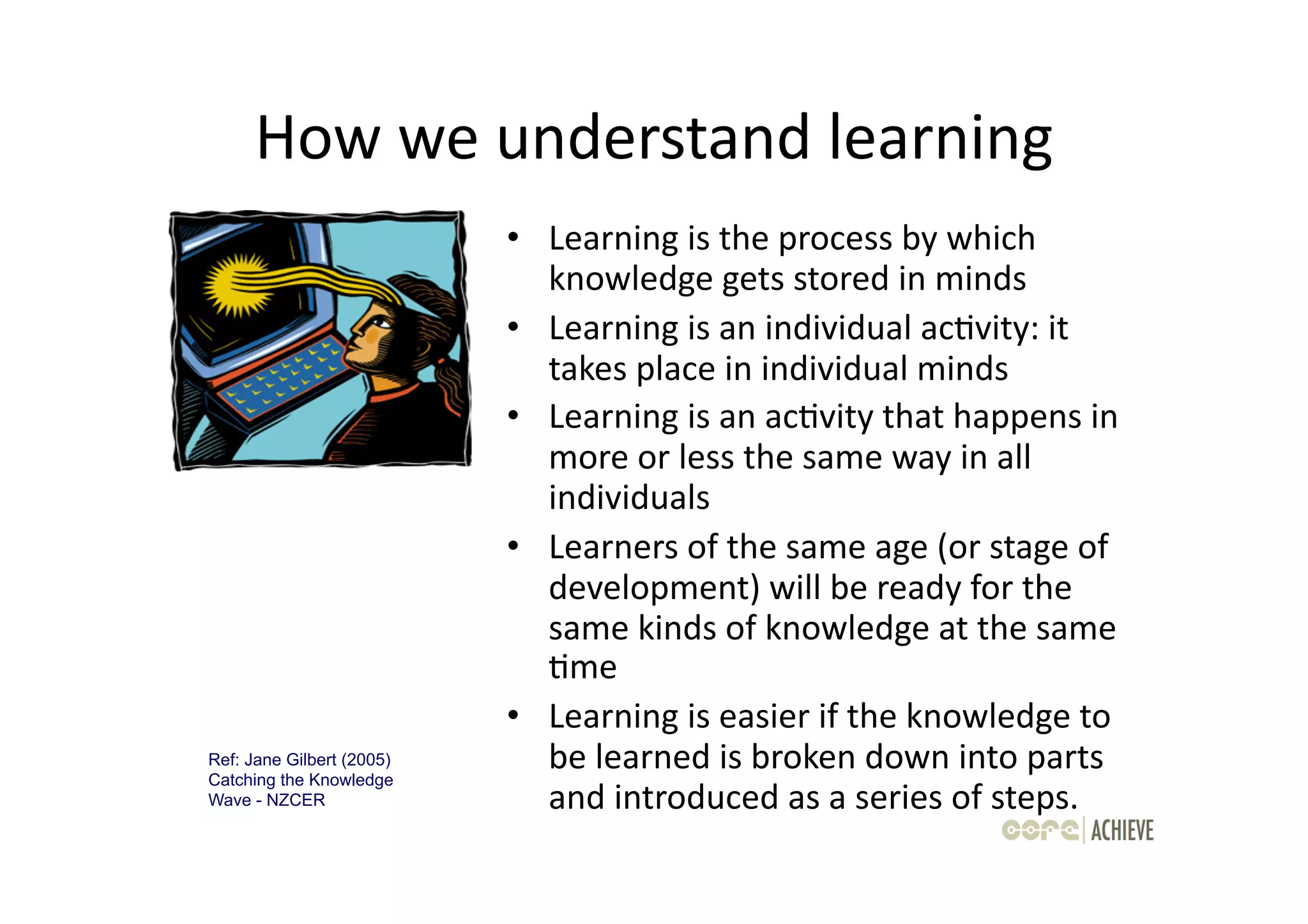
  • 5.
    How  we  understand  learning   •  Learning  is  the  process  by  which   knowledge  gets  stored  in  minds   •  Learning  is  an  individual  acOvity:  it   takes  place  in  individual  minds   •  Learning  is  an  acOvity  that  happens  in   more  or  less  the  same  way  in  all   individuals   •  Learners  of  the  same  age  (or  stage  of   development)  will  be  ready  for  the   same  kinds  of  knowledge  at  the  same   Ome   •  Learning  is  easier  if  the  knowledge  to   Ref: Jane Gilbert (2005) Catching the Knowledge be  learned  is  broken  down  into  parts   Wave - NZCER and  introduced  as  a  series  of  steps.  
  • 6.
    What  about  you?   •  How  would  you  summarise  your  thinking   about…   –  Knowledge   –  Minds   –  Learning   •  How  would  you  describe  this  to  a  colleague?   •  How  is  what  you  believe  evidenced  in  your   teaching  context?  
  • 7.
    Learning  theories   How  do  any  of  the  following   theories  of  learning  inform  the   decisions  you  make  about  your   teaching?  
  • 8.
    Behaviourism   Concept:     Learning  is  a  change  in  behaviour…mind  is  a  black  box   Key  Figures:     Pavlov,  Thorndike,  Watson,  Skinner   Epistomology/Pedagogy   -­‐  Knowledge  is  objecOve,  but  secondary  to  behavioural  consideraOons   -­‐  Teaching  is  sOmulus/response-­‐based  (condiOoning)  
  • 9.
    CogniOvism   Concept:     InformaOon  processing,  metacogniOon,  thought  process,   knowledge  is  organized/organizable     Key  Figures:     Ausubel,  Gagne,  Bandura,  Bruner  (both  socially-­‐focused)   Epistomology/Pedagogy   -­‐  Knowledge  is  objecOve,  acquired  through  cogniOon  (objecOvisOc)   -­‐  Knowledge  can  be  seen  as  schema  or  symbolic  mental  construcOons.   Learning  is  defined  as  change  in  a  learner’s  schemata.  
  • 10.
    ConstrucOvism   Concept:     “Knowledge  constructed  by  learners  as  they  aaempt  to  make   sense  of  their  experiences”     Key  Figures:     Piaget,  Dewey,  Vico,  Rorty,  Bruner   Epistomology/Pedagogy   Learning  as  experience,  acOvity  and  dialogical  process;  Problem  Based   Learning  (PBL);  Anchored  instrucOon;  cogniOve  apprenOceship  (scaffolding);   inquiry  and  discovery  learning.  
  • 11.
    Social  construcOvism   Concept:     Applies  the  general  philosophical  construcOonism  into  social  sedngs,  wherein   groups  construct  knowledge  for  one  another,  collaboraOvely  creaOng  a  small   culture  of  shared  arOfacts  with  shared  meanings.   Key  Figures:     Lev  Vygotsky   Epistomology/Pedagogy   1.  Learning  and  development  is  a  social,  collaboraOve  acOvity.     2.  The  Zone  of  Proximal  Development  can  serve  as  a  guide  for  curricular  and   lesson  planning.     3.  School  learning  should  occur  in  a  meaningful  context  and  not  be   separated  from  learning  and  knowledge  children  develop  in  the  "real   world.".     4.  Out-­‐of-­‐school  experiences  should  be  related  to  the  child's  school   experience.  
  • 12.
    ConstrucOonism   Concept:     People  learn  through  making  things  –  “creaOve  experimentaOon”   Learning  vs.  Teaching   “find  ways  in  which  the  technology  enables  children  to  use   knowledge”     Key  Figures:     Seymour  Papert   Epistomology/Pedagogy   “From  construc-vist  theories  of  psychology  we  take  a  view  of  learning  as  a   reconstruc-on  rather  than  as  a  transmission  of  knowledge.  Then  we  extend   the  idea  of  manipula-ve  materials  to  the  idea  that  learning  is  most  effec-ve   when  part  of  an  ac-vity  the  learner  experiences  as  construc-ng  a  meaningful   product.”  
  • 13.
    AcOvity  Theory   Concept:     AcOvity  Theory  is  a  framework  or  descripOve  tool  for  a  system.   People  are  socio-­‐culturally  embedded  actors  (not  processors  or   system  components).     Key  Figures:     Leont’ev  (based  on  Vygotsky)   Engeström  (in  current  itera-on  –  expansive  learning)   Epistomology/Pedagogy   -­‐  Knowledge  is  personally  constructed,  socially  generated,  contextually   held;   -­‐  Teaching  is  indirect,  supporOve,  learner-­‐driven,  experienOal  
  • 14.
    References   •  hap://www.nzcer.org.nz/nzcerpress/catching-­‐knowledge-­‐ wave-­‐knowledge-­‐society-­‐and-­‐future-­‐educaOon   •  hap://www.learning-­‐theories.com   •  hap://www.lifecircles-­‐inc.com/Learningtheories/ learningmap.html   •  hap://www.emtech.net/learning_theories.htm