What is a Think Tank?   A think tank is an organization that conducts research and engages in advocacy in areas of public policy.  Functions: Generate new information through research  Evaluate public policies and programs Provide policy advice to government Educate public through publications and seminars Engage policymakers, media and the public
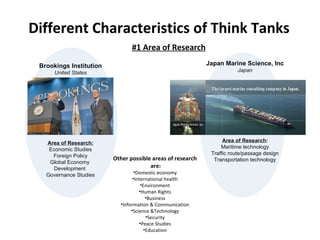
Different Characteristics of Think Tanks #1 Area of Research Brookings Institution United States Area of Research: Economic Studies Foreign Policy Global Economy  Development  Governance Studies Japan Marine Science, Inc Japan Area of Research : Maritime technology Traffic route/passage design Transportation technology Other possible areas of research are: Domestic economy International health Environment Human Rights Business Information & Communication Science &Technology Security Peace Studies Education
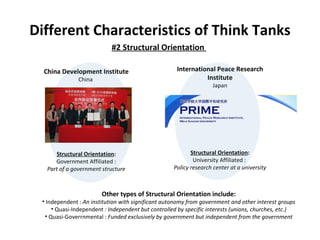
Different Characteristics of Think Tanks #2 Structural Orientation  China Development Institute China   Structural Orientation : Government Affiliated : Part of a government structure International Peace Research Institute Japan Structural Orientation : University Affiliated :  Policy research center at a university Other types of Structural Orientation include: Independent :  An institution with significant autonomy from government and other interest groups Quasi-Independent  : Independent but controlled by specific interests (unions, churches, etc.) Quasi-Goverrnmental :  Funded exclusively by government but independent from the government
Different Characteristics of Think Tanks #3 Budget  Rand Corporation United States Specialties: Military strategy, political economy, health and education policy Budget:  $251,000,000 Adam Smith Institute London Specialties: Free market and social policies Budget:  $500,000 Some have  budgets in the tens of millions of dollars and some are one-man operations
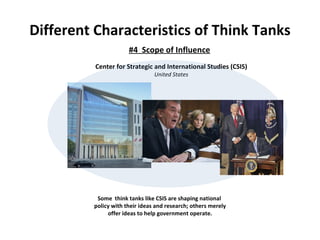
Different Characteristics of Think Tanks #4  Scope of Influence Some  think tanks like CSIS are shaping national  policy with their ideas and research; others merely offer ideas to help government operate. Center for Strategic and International Studies (CSIS) United States
Global Think Tanks
Global Think Tank Distribution 2008
United States Think Tanks  Some facts of US think tanks: There are 5465 think tanks in the world now found in 169 countries and the vast majority of think tanks are found in the United States.  In the United States, think tanks are filled with individuals who go in and out of government Government rely on think tanks because they generate and offer solutions to some of the most complex issues of the day.
The Top 15 U.S. Think Tanks 1) Brookings Institution Location: Washington Budget: $60.7 million Specialties: U.S. foreign policy, Middle East, economic and social policy 2) Council on Foreign Relations Location: New York Budget: $38.3 million Specialties: U.S. foreign policy, national security 3) Carnegie Endowment for International Peace Location: Washington Budget: $22 million Specialties: Nuclear nonproliferation, China 4) Rand Corporation Location: Santa Monica, Calif. Budget: $251 million Specialties: Military strategy, political economy, health and education 5) Heritage Foundation Location: Washington Budget: $48.4 million Specialties: Tax policy, national defense, social policy 6) Woodrow Wilson International Center for Scholars Location: Washington Budget: $34.5 million Specialties: Regional studies, democracy promotion, international development 7) Center for Strategic & International Studies Location: Washington Budget: $29 million Specialties: Defense policy, diplomacy, regional studies 8) American Enterprise Institute Location: Washington Budget: $23.6 million (2006) Specialties: Trade, defense, economic policy 9) Cato Institute Location: Washington Budget: $19 million Specialties: Libertarianism, deregulation, social policy and defense policy 10) Hoover Institution Location: Stanford, Calif. Budget: $34.1 million Specialties: Defense policy, deregulation, US-Russian relations 11) Human Rights Watch Location: New York Budget: $35.5 million Specialties: Human rights, international justice 12) Peterson Institute for International Economics Location: Washington Budget: $9.5 million Specialties: Trade, globalization, international political economy 13) United States Institute of Peace Location: Washington Budget: $24.7 million Specialties: Conflict resolution, post conflict stability 14) National Bureau of Economic Research Location: Cambridge, Mass. Budget: $29.8 million Specialties: Economic growth, economic analysis and forecasting 15) Center for Global Development Location: Washington Budget: $9.8 million Specialties: Globalization, international development, aid effectiveness
Think Tank Distribution in Asia
Number of Think Tanks Think Tank Distribution in Asia
Asian Think Tanks Analysis on Asian Think Tanks: Often focus on  economic, strategic and security issues  within the region. Sometimes are more constrained in their research than their European counterparts because of the Asian think tanks’  close ties to government .  Public policy research organizations  have grown quite rapidly and are now playing a significant role in public debate and discussion in their respective countries.  While many of these organizations started out as governmental or quasi-governmental entities, they have slowly moved out of the orbit of government and become  independent actors  in civil society.
Bibliography Global “Go-To-Think Tanks” Report 2008  by James McGann  http://www.foreignpolicy.com/files/2008_Global_Go_To_Think_Tanks.pdf Made by: Kaede Kawauchi University of Pennsylvania  Class of 2011

Think tank

  • 1.
    What is aThink Tank? A think tank is an organization that conducts research and engages in advocacy in areas of public policy. Functions: Generate new information through research Evaluate public policies and programs Provide policy advice to government Educate public through publications and seminars Engage policymakers, media and the public
  • 2.
    Different Characteristics ofThink Tanks #1 Area of Research Brookings Institution United States Area of Research: Economic Studies Foreign Policy Global Economy Development Governance Studies Japan Marine Science, Inc Japan Area of Research : Maritime technology Traffic route/passage design Transportation technology Other possible areas of research are: Domestic economy International health Environment Human Rights Business Information & Communication Science &Technology Security Peace Studies Education
  • 3.
    Different Characteristics ofThink Tanks #2 Structural Orientation China Development Institute China Structural Orientation : Government Affiliated : Part of a government structure International Peace Research Institute Japan Structural Orientation : University Affiliated : Policy research center at a university Other types of Structural Orientation include: Independent : An institution with significant autonomy from government and other interest groups Quasi-Independent : Independent but controlled by specific interests (unions, churches, etc.) Quasi-Goverrnmental : Funded exclusively by government but independent from the government
  • 4.
    Different Characteristics ofThink Tanks #3 Budget Rand Corporation United States Specialties: Military strategy, political economy, health and education policy Budget: $251,000,000 Adam Smith Institute London Specialties: Free market and social policies Budget: $500,000 Some have budgets in the tens of millions of dollars and some are one-man operations
  • 5.
    Different Characteristics ofThink Tanks #4 Scope of Influence Some think tanks like CSIS are shaping national policy with their ideas and research; others merely offer ideas to help government operate. Center for Strategic and International Studies (CSIS) United States
  • 6.
  • 7.
    Global Think TankDistribution 2008
  • 8.
    United States ThinkTanks Some facts of US think tanks: There are 5465 think tanks in the world now found in 169 countries and the vast majority of think tanks are found in the United States. In the United States, think tanks are filled with individuals who go in and out of government Government rely on think tanks because they generate and offer solutions to some of the most complex issues of the day.
  • 9.
    The Top 15U.S. Think Tanks 1) Brookings Institution Location: Washington Budget: $60.7 million Specialties: U.S. foreign policy, Middle East, economic and social policy 2) Council on Foreign Relations Location: New York Budget: $38.3 million Specialties: U.S. foreign policy, national security 3) Carnegie Endowment for International Peace Location: Washington Budget: $22 million Specialties: Nuclear nonproliferation, China 4) Rand Corporation Location: Santa Monica, Calif. Budget: $251 million Specialties: Military strategy, political economy, health and education 5) Heritage Foundation Location: Washington Budget: $48.4 million Specialties: Tax policy, national defense, social policy 6) Woodrow Wilson International Center for Scholars Location: Washington Budget: $34.5 million Specialties: Regional studies, democracy promotion, international development 7) Center for Strategic & International Studies Location: Washington Budget: $29 million Specialties: Defense policy, diplomacy, regional studies 8) American Enterprise Institute Location: Washington Budget: $23.6 million (2006) Specialties: Trade, defense, economic policy 9) Cato Institute Location: Washington Budget: $19 million Specialties: Libertarianism, deregulation, social policy and defense policy 10) Hoover Institution Location: Stanford, Calif. Budget: $34.1 million Specialties: Defense policy, deregulation, US-Russian relations 11) Human Rights Watch Location: New York Budget: $35.5 million Specialties: Human rights, international justice 12) Peterson Institute for International Economics Location: Washington Budget: $9.5 million Specialties: Trade, globalization, international political economy 13) United States Institute of Peace Location: Washington Budget: $24.7 million Specialties: Conflict resolution, post conflict stability 14) National Bureau of Economic Research Location: Cambridge, Mass. Budget: $29.8 million Specialties: Economic growth, economic analysis and forecasting 15) Center for Global Development Location: Washington Budget: $9.8 million Specialties: Globalization, international development, aid effectiveness
  • 10.
  • 11.
    Number of ThinkTanks Think Tank Distribution in Asia
  • 12.
    Asian Think TanksAnalysis on Asian Think Tanks: Often focus on economic, strategic and security issues within the region. Sometimes are more constrained in their research than their European counterparts because of the Asian think tanks’ close ties to government . Public policy research organizations have grown quite rapidly and are now playing a significant role in public debate and discussion in their respective countries. While many of these organizations started out as governmental or quasi-governmental entities, they have slowly moved out of the orbit of government and become independent actors in civil society.
  • 13.
    Bibliography Global “Go-To-ThinkTanks” Report 2008 by James McGann http://www.foreignpolicy.com/files/2008_Global_Go_To_Think_Tanks.pdf Made by: Kaede Kawauchi University of Pennsylvania Class of 2011