ASSINGMENT
SUBJECT: ADVANCED ANALYTICAL CHEMISTRY
TOPIC: THIN LAYER CHROMATOGRAPhy
SUBMITTED TO: MISS FATIMA
SUBMITTED BY: IRAM, ALIZA, ANAM, HUMAIRA.
BS CHEMISTRY 5TH SEMESTER
Thin layer chromatography
Thin Layer Chromatography is a technique used to isolate non-volatile
mixtures. The experiment is conducted on a sheet of aluminium foil,
plastic, or glass which is coated with a thin layer of adsorbent
material. The material usually used is aluminium oxide, cellulose, or
silica gel.
On completion of the separation, each component appears as spots
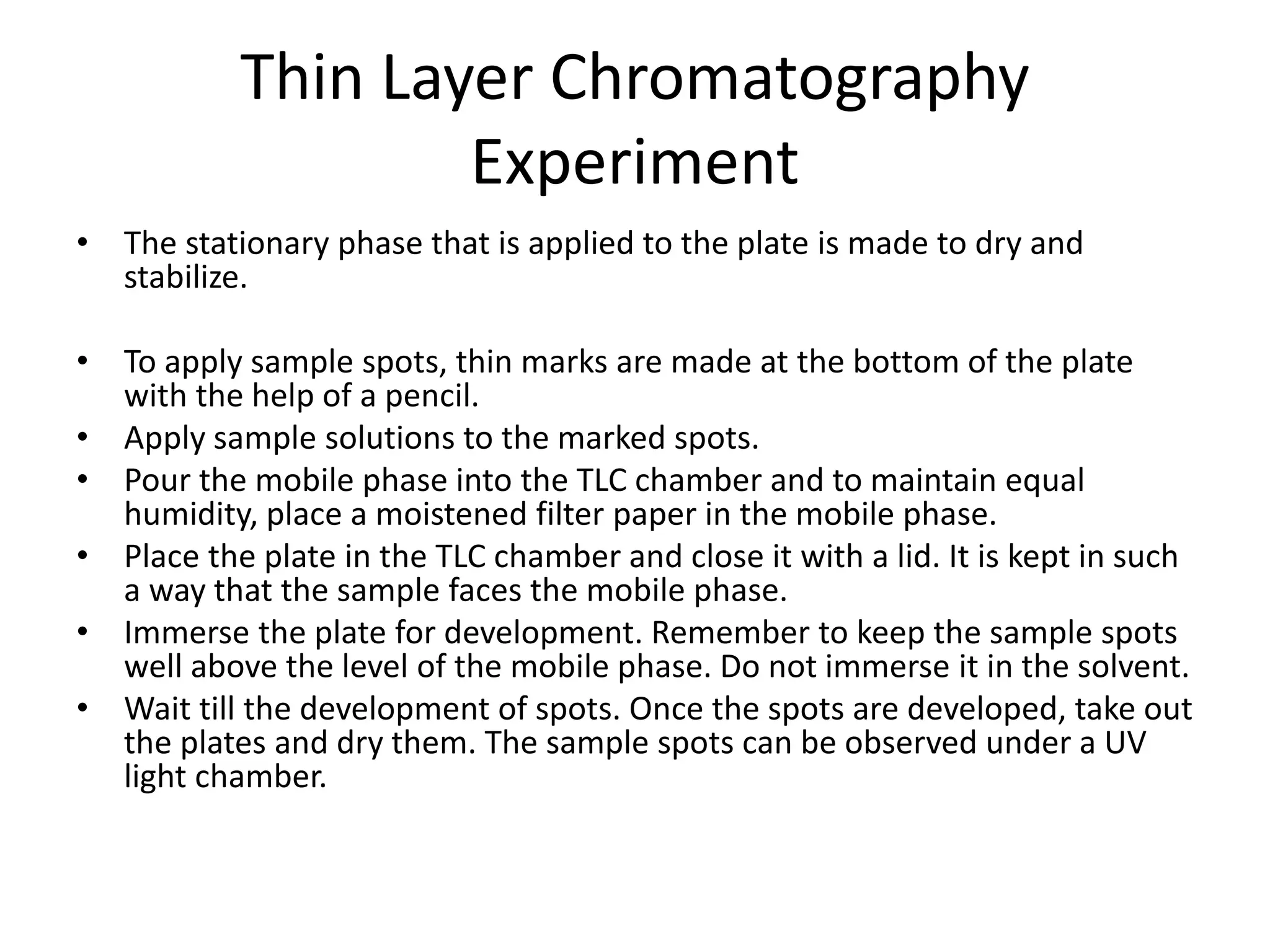
separated vertically. Each spot has a retention factor (Rf) expressed
as:
Rf = dist. travelled by sample / dist. travelled by solvent
The factors affecting retardation factor are the solvent system,
amount of material spotted, adsorbent and temperature. TLC is one
of the fastest, least expensive, simplest and easiest chromatography
technique.
Thin Layer Chromatography Principle
 Chromatographic techniques, thin-layer chromatography
(TLC) depends on the separation principle. The separation
relies on the relative affinity of compounds towards both
the phases. The compounds in the mobile phase move over
the surface of the stationary phase. The movement occurs
in such a way that the compounds which have a higher
affinity to the stationary phase move slowly while the other
compounds travel fast. Therefore, the separation of the
mixture is attained. On completion of the separation
process, the individual components from the mixture
appear as spots at respective levels on the plates. Their
character and nature are identified by suitable detection
techniques.
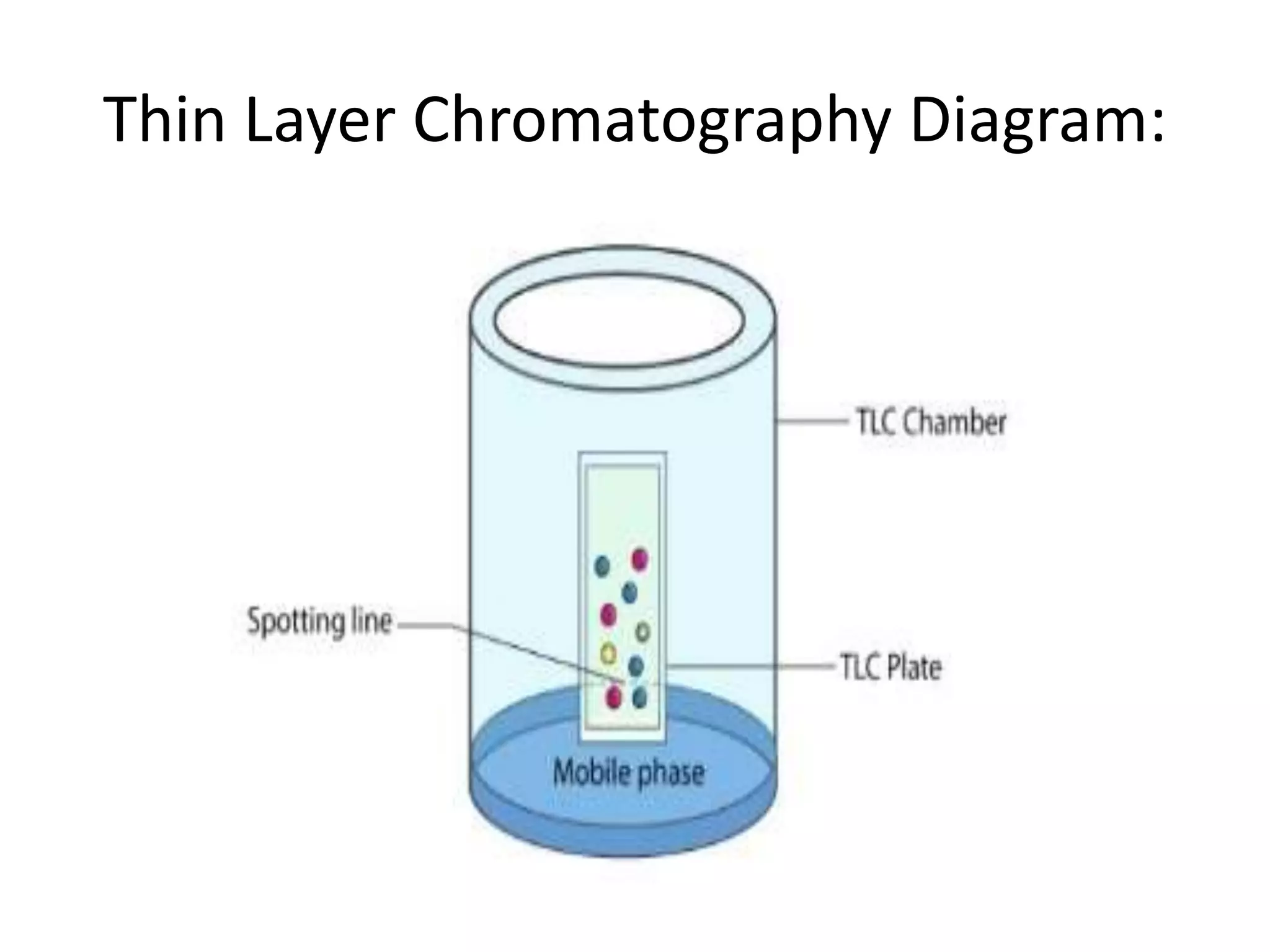
Thin Layer Chromatography Diagram:
Thin Layer Chromatography Procedure
• Before starting with the Thin Layer Chromatography Experiment, let us understand
the different components required to conduct the procedure along with the
phases involved.
• Thin Layer Chromatography Plates – ready-made plates are used which are
chemically inert and stable. The stationary phase is applied on its surface in the
form of a thin layer. The stationary phase on the plate has a fine particle size and
also has a uniform thickness.
• Thin Layer Chromatography Chamber – Chamber is used to develop plates. It is
responsible to keep a steady environment inside which will help in developing
spots. Also, it prevents the solvent evaporation and keeps the entire process dust-
free.
• Thin Layer Chromatography Mobile phase – Mobile phase is the one that moves
and consists of a solvent mixture or a solvent. This phase should be particulate-
free. The higher the quality of purity the development of spots is better.
• Thin Layer Chromatography Filter Paper – It has to be placed inside the chamber. It
is moistened in the mobile phase.
Steps Of Thin Layer Chromatogrephy
Thin Layer Chromatography
Experiment
• The stationary phase that is applied to the plate is made to dry and
stabilize.
• To apply sample spots, thin marks are made at the bottom of the plate
with the help of a pencil.
• Apply sample solutions to the marked spots.
• Pour the mobile phase into the TLC chamber and to maintain equal
humidity, place a moistened filter paper in the mobile phase.
• Place the plate in the TLC chamber and close it with a lid. It is kept in such
a way that the sample faces the mobile phase.
• Immerse the plate for development. Remember to keep the sample spots
well above the level of the mobile phase. Do not immerse it in the solvent.
• Wait till the development of spots. Once the spots are developed, take out
the plates and dry them. The sample spots can be observed under a UV
light chamber.
Thin Layer Chromatography
Applications
• The qualitative testing of Various medicines such as sedatives, local
anaesthetics, anticonvulsant tranquilisers, analgesics, antihistamines,
steroids, hypnotics is done by TLC.
• TLC is extremely useful in Biochemical analysis such as separation or
isolation of biochemical metabolites from its blood plasma, urine, body
fluids, serum, etc.
• Thin layer chromatography can be used to identify natural products like
essential oils or volatile oil, fixed oil, glycosides, waxes, alkaloids, etc.
• It is widely used in separating multicomponent pharmaceutical
formulations.
• It is used for the purification of samples and direct comparison is done
between the sample and the authentic sample.
• It is used in the food industry, to separate and identify colours, sweetening
agent, and preservatives
• It is used in the cosmetic industry.
• It is used to study if a reaction is complete.
Disadvantages Of Thin Layer
Chromatography:
• Thin Layer Chromatography plates do not have longer
stationary phase.
• When compared to other chromatographic techniques the
length of separation is limited.
• The results generated from TLC are difficult to reproduce.
• Since TLC operates as an open system, some factors such as
humidity and temperature can be can affect the final
outcome of the chromatogram.
• The detection limit is high and therefore if you want a
lower detection limit, you cannot use TLC.
• It is only a qualitative analysis technique and not
quantitative.
Advantages of Thin Layer
Chromatography (TLC)
• It is a simple process with a short development time.
• It helps with the visualization of separated compound
spots easily.
• It helps in isolating of most of the compounds.
• The separation process is faster and the selectivity for
compounds is higher (even small differences in
chemistry is enough for clear separation).
• The purity standards of the given sample can be
assessed easily.
• It is a cheaper chromatographic technique.
Retention Factor (Rf ) Value
• The behaviour of a compound on a TLC is usually
described in terms of its relative mobility or Rf value.
• Rf or Retention factor is a unique value for each
compound under the same conditions.
• The Rf for a compound is a constant from one
experiment to the next only if the chromatography
conditions below are also constant:
• solvent system
• adsorbent
• thickness of the adsorbent
• amount of material spotted
• temperature
• Since these factors are difficult to keep
constant from experiment to experiment,
relative Rf values are generally considered.
• Relative Rf” means that the values are
reported relative to a standard.
• The Rf value is calculated using the following
equation:
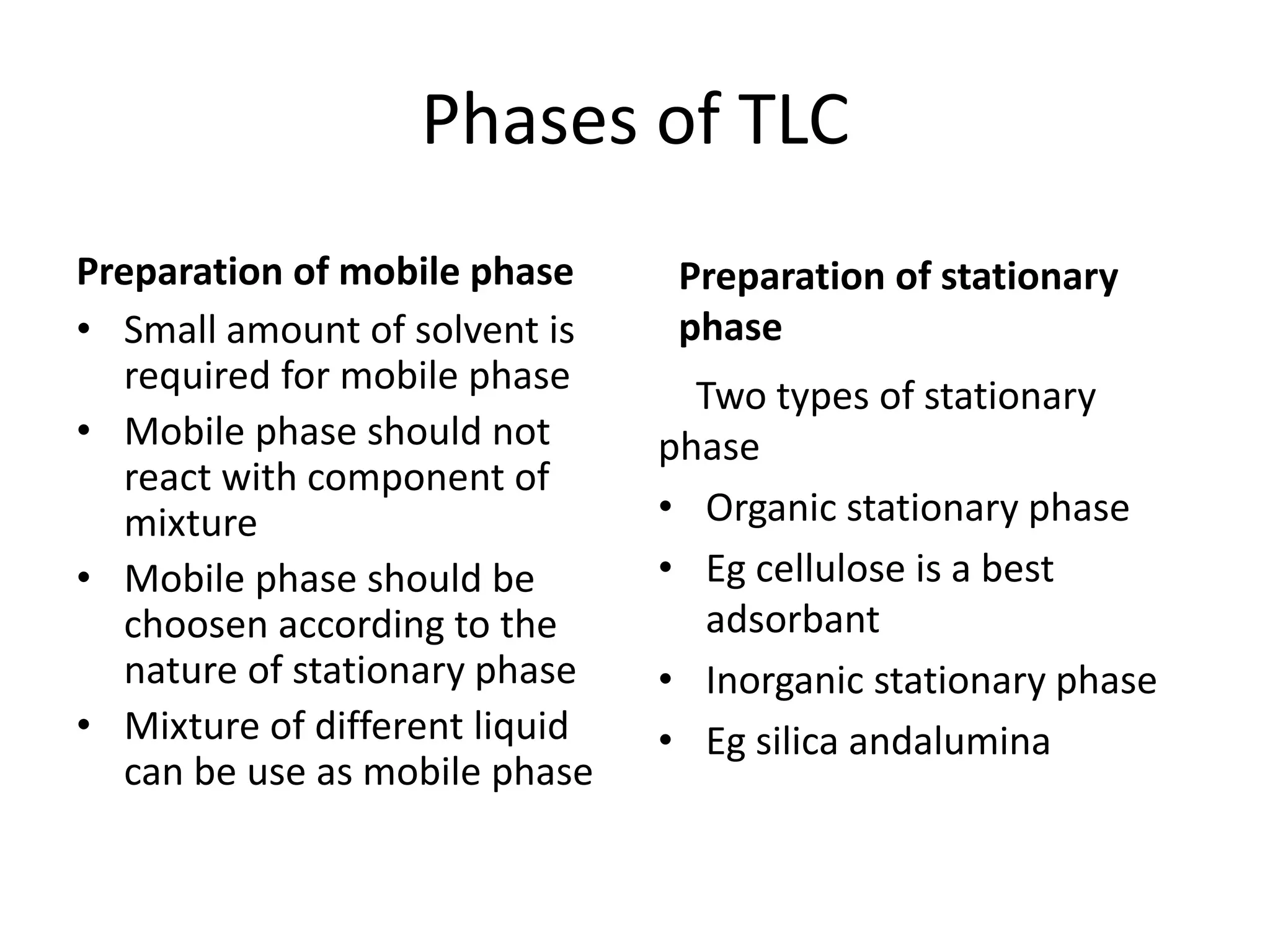
Phases of TLC
Preparation of mobile phase
• Small amount of solvent is
required for mobile phase
• Mobile phase should not
react with component of
mixture
• Mobile phase should be
choosen according to the
nature of stationary phase
• Mixture of different liquid
can be use as mobile phase
Preparation of stationary
phase
Two types of stationary
phase
• Organic stationary phase
• Eg cellulose is a best
adsorbant
• Inorganic stationary phase
• Eg silica andalumina
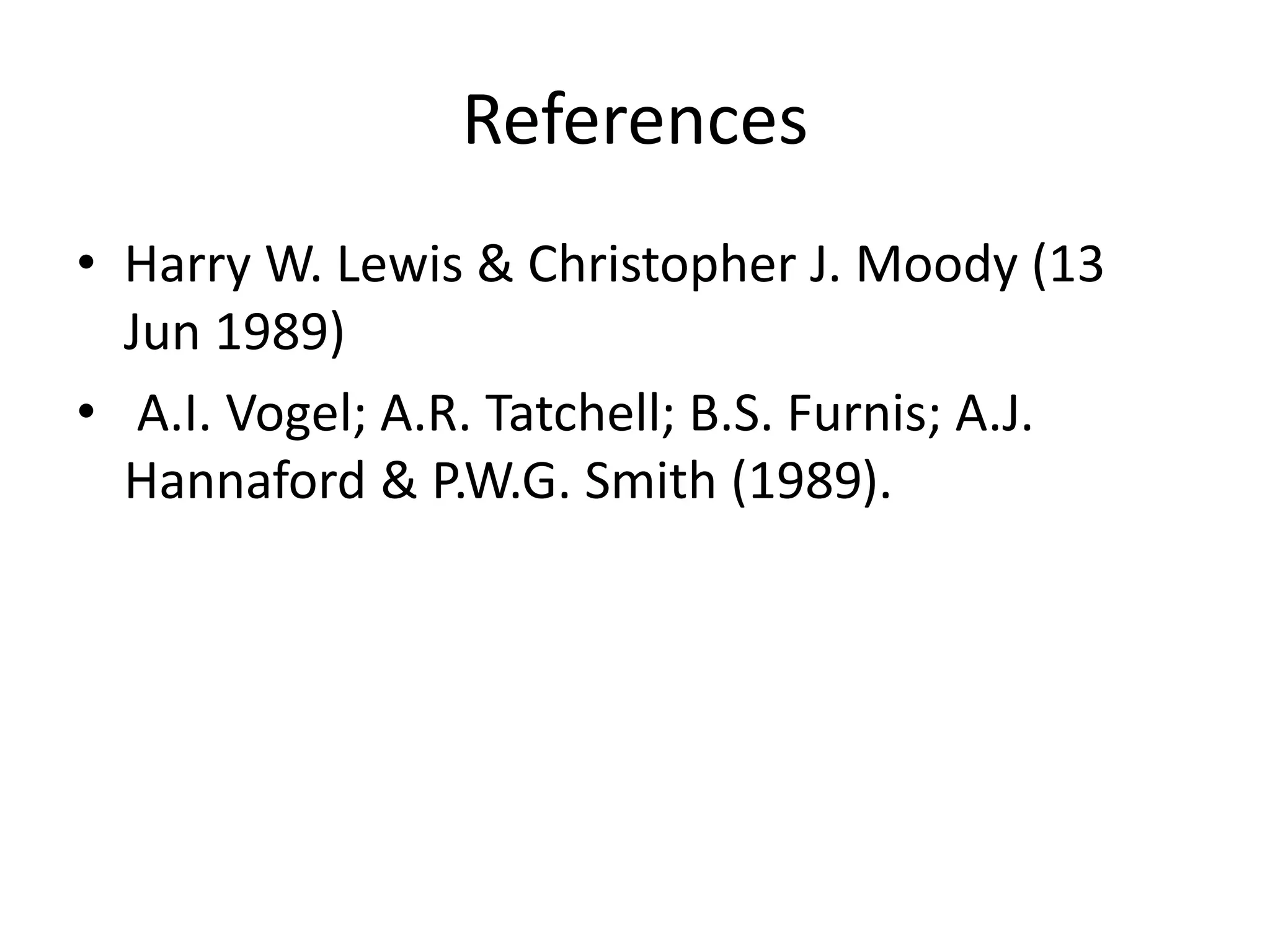
References
• Harry W. Lewis & Christopher J. Moody (13
Jun 1989)
• A.I. Vogel; A.R. Tatchell; B.S. Furnis; A.J.
Hannaford & P.W.G. Smith (1989).

Thin layer chromatography

  • 1.
    ASSINGMENT SUBJECT: ADVANCED ANALYTICALCHEMISTRY TOPIC: THIN LAYER CHROMATOGRAPhy SUBMITTED TO: MISS FATIMA SUBMITTED BY: IRAM, ALIZA, ANAM, HUMAIRA. BS CHEMISTRY 5TH SEMESTER
  • 2.
    Thin layer chromatography ThinLayer Chromatography is a technique used to isolate non-volatile mixtures. The experiment is conducted on a sheet of aluminium foil, plastic, or glass which is coated with a thin layer of adsorbent material. The material usually used is aluminium oxide, cellulose, or silica gel. On completion of the separation, each component appears as spots separated vertically. Each spot has a retention factor (Rf) expressed as: Rf = dist. travelled by sample / dist. travelled by solvent The factors affecting retardation factor are the solvent system, amount of material spotted, adsorbent and temperature. TLC is one of the fastest, least expensive, simplest and easiest chromatography technique.
  • 3.
    Thin Layer ChromatographyPrinciple  Chromatographic techniques, thin-layer chromatography (TLC) depends on the separation principle. The separation relies on the relative affinity of compounds towards both the phases. The compounds in the mobile phase move over the surface of the stationary phase. The movement occurs in such a way that the compounds which have a higher affinity to the stationary phase move slowly while the other compounds travel fast. Therefore, the separation of the mixture is attained. On completion of the separation process, the individual components from the mixture appear as spots at respective levels on the plates. Their character and nature are identified by suitable detection techniques.
  • 4.
  • 5.
    Thin Layer ChromatographyProcedure • Before starting with the Thin Layer Chromatography Experiment, let us understand the different components required to conduct the procedure along with the phases involved. • Thin Layer Chromatography Plates – ready-made plates are used which are chemically inert and stable. The stationary phase is applied on its surface in the form of a thin layer. The stationary phase on the plate has a fine particle size and also has a uniform thickness. • Thin Layer Chromatography Chamber – Chamber is used to develop plates. It is responsible to keep a steady environment inside which will help in developing spots. Also, it prevents the solvent evaporation and keeps the entire process dust- free. • Thin Layer Chromatography Mobile phase – Mobile phase is the one that moves and consists of a solvent mixture or a solvent. This phase should be particulate- free. The higher the quality of purity the development of spots is better. • Thin Layer Chromatography Filter Paper – It has to be placed inside the chamber. It is moistened in the mobile phase.
  • 6.
    Steps Of ThinLayer Chromatogrephy
  • 7.
    Thin Layer Chromatography Experiment •The stationary phase that is applied to the plate is made to dry and stabilize. • To apply sample spots, thin marks are made at the bottom of the plate with the help of a pencil. • Apply sample solutions to the marked spots. • Pour the mobile phase into the TLC chamber and to maintain equal humidity, place a moistened filter paper in the mobile phase. • Place the plate in the TLC chamber and close it with a lid. It is kept in such a way that the sample faces the mobile phase. • Immerse the plate for development. Remember to keep the sample spots well above the level of the mobile phase. Do not immerse it in the solvent. • Wait till the development of spots. Once the spots are developed, take out the plates and dry them. The sample spots can be observed under a UV light chamber.
  • 8.
    Thin Layer Chromatography Applications •The qualitative testing of Various medicines such as sedatives, local anaesthetics, anticonvulsant tranquilisers, analgesics, antihistamines, steroids, hypnotics is done by TLC. • TLC is extremely useful in Biochemical analysis such as separation or isolation of biochemical metabolites from its blood plasma, urine, body fluids, serum, etc. • Thin layer chromatography can be used to identify natural products like essential oils or volatile oil, fixed oil, glycosides, waxes, alkaloids, etc. • It is widely used in separating multicomponent pharmaceutical formulations. • It is used for the purification of samples and direct comparison is done between the sample and the authentic sample. • It is used in the food industry, to separate and identify colours, sweetening agent, and preservatives • It is used in the cosmetic industry. • It is used to study if a reaction is complete.
  • 9.
    Disadvantages Of ThinLayer Chromatography: • Thin Layer Chromatography plates do not have longer stationary phase. • When compared to other chromatographic techniques the length of separation is limited. • The results generated from TLC are difficult to reproduce. • Since TLC operates as an open system, some factors such as humidity and temperature can be can affect the final outcome of the chromatogram. • The detection limit is high and therefore if you want a lower detection limit, you cannot use TLC. • It is only a qualitative analysis technique and not quantitative.
  • 10.
    Advantages of ThinLayer Chromatography (TLC) • It is a simple process with a short development time. • It helps with the visualization of separated compound spots easily. • It helps in isolating of most of the compounds. • The separation process is faster and the selectivity for compounds is higher (even small differences in chemistry is enough for clear separation). • The purity standards of the given sample can be assessed easily. • It is a cheaper chromatographic technique.
  • 11.
    Retention Factor (Rf) Value • The behaviour of a compound on a TLC is usually described in terms of its relative mobility or Rf value. • Rf or Retention factor is a unique value for each compound under the same conditions. • The Rf for a compound is a constant from one experiment to the next only if the chromatography conditions below are also constant: • solvent system • adsorbent • thickness of the adsorbent
  • 12.
    • amount ofmaterial spotted • temperature • Since these factors are difficult to keep constant from experiment to experiment, relative Rf values are generally considered. • Relative Rf” means that the values are reported relative to a standard. • The Rf value is calculated using the following equation:
  • 13.
    Phases of TLC Preparationof mobile phase • Small amount of solvent is required for mobile phase • Mobile phase should not react with component of mixture • Mobile phase should be choosen according to the nature of stationary phase • Mixture of different liquid can be use as mobile phase Preparation of stationary phase Two types of stationary phase • Organic stationary phase • Eg cellulose is a best adsorbant • Inorganic stationary phase • Eg silica andalumina
  • 14.
    References • Harry W.Lewis & Christopher J. Moody (13 Jun 1989) • A.I. Vogel; A.R. Tatchell; B.S. Furnis; A.J. Hannaford & P.W.G. Smith (1989).