
A thin client is a computer program which
depends heavily on some other computer to
fulfill its traditional computational roles. This
stands in contrast to the traditional fat client, a
computer designed to take on these roles by
itself. The exact roles assumed by the server
may vary, from providing data persistence (for
example, for diskles nodes) to
actual information processing on the client's
behalf.
HISTORY
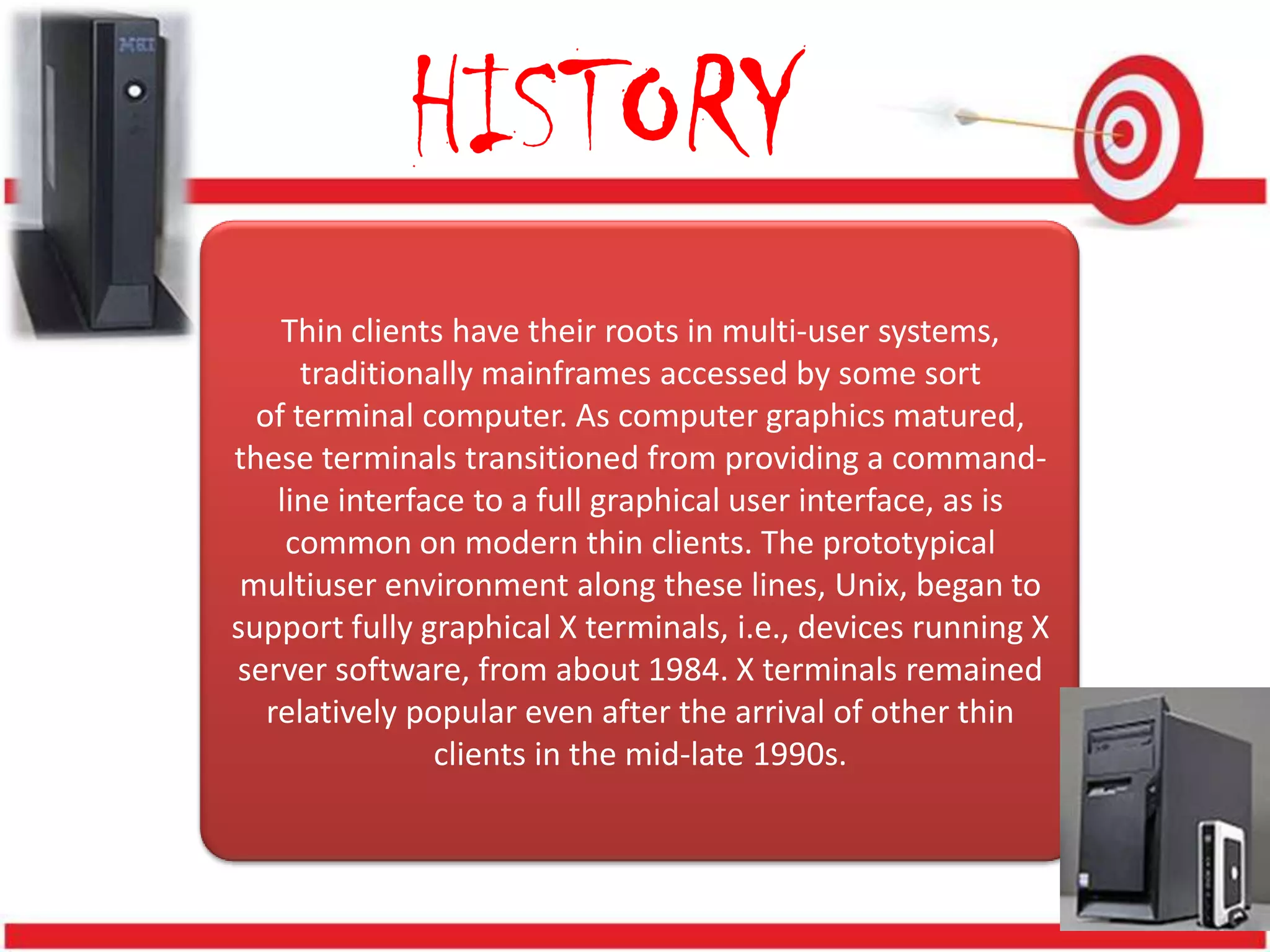
    Thin clients have their roots in multi-user systems,
      traditionally mainframes accessed by some sort
  of terminal computer. As computer graphics matured,
these terminals transitioned from providing a command-
    line interface to a full graphical user interface, as is
     common on modern thin clients. The prototypical
 multiuser environment along these lines, Unix, began to
support fully graphical X terminals, i.e., devices running X
server software, from about 1984. X terminals remained
   relatively popular even after the arrival of other thin
                clients in the mid-late 1990s.
 Thin clients occur as components of a broader
  computer infrastructure, where many clients share
  their computations with the same server.
 As such, thin client infrastructures can be viewed as
  the amortization of some computing service across
  several user-interfaces.
 This is desirable in contexts where individual fat
  clients have much more functionality or power than
  the infrastructure either requires or uses.
 This can be contrasted, for example, with grid
  computing.
•The notion of a thin client extends directly to
 any client–server architecture: in which
 case, a thin client application is simply one
 which relies on its server to process most or
 all of its business logic. This idiom is
 relatively common for computer security
 reasons: a client obviously cannot be trusted
 with the logic that determines how
 trustworthy they are; an adversary would
 simply skip the logic and say "I'm as
 trustworthy as possible!"
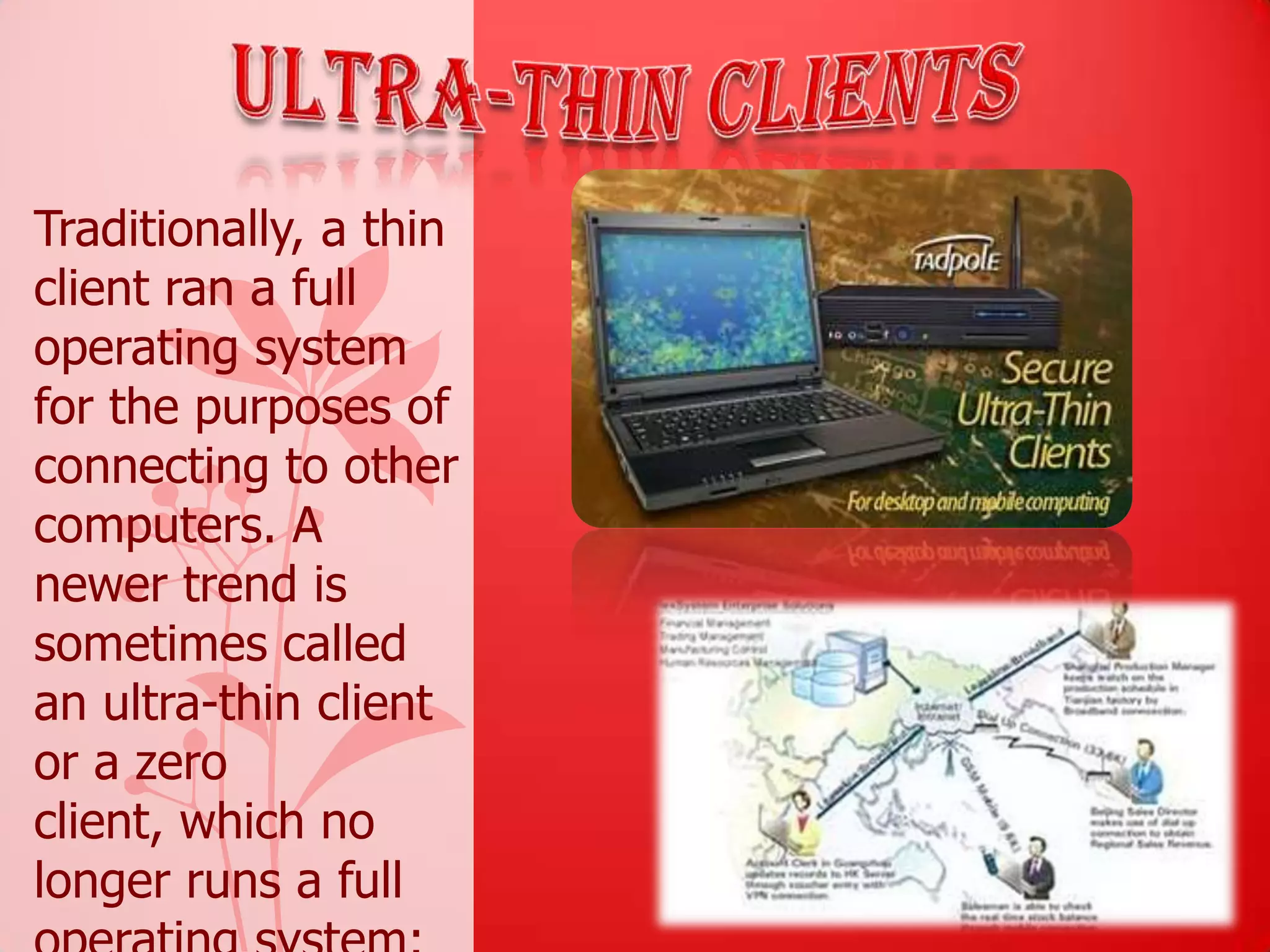
Traditionally, a thin
client ran a full
operating system
for the purposes of
connecting to other
computers. A
newer trend is
sometimes called
an ultra-thin client
or a zero
client, which no
longer runs a full
Thin client

Thin client

  • 2.
    A thin clientis a computer program which depends heavily on some other computer to fulfill its traditional computational roles. This stands in contrast to the traditional fat client, a computer designed to take on these roles by itself. The exact roles assumed by the server may vary, from providing data persistence (for example, for diskles nodes) to actual information processing on the client's behalf.
  • 3.
    HISTORY Thin clients have their roots in multi-user systems, traditionally mainframes accessed by some sort of terminal computer. As computer graphics matured, these terminals transitioned from providing a command- line interface to a full graphical user interface, as is common on modern thin clients. The prototypical multiuser environment along these lines, Unix, began to support fully graphical X terminals, i.e., devices running X server software, from about 1984. X terminals remained relatively popular even after the arrival of other thin clients in the mid-late 1990s.
  • 4.
     Thin clientsoccur as components of a broader computer infrastructure, where many clients share their computations with the same server.  As such, thin client infrastructures can be viewed as the amortization of some computing service across several user-interfaces.  This is desirable in contexts where individual fat clients have much more functionality or power than the infrastructure either requires or uses.  This can be contrasted, for example, with grid computing.
  • 5.
    •The notion ofa thin client extends directly to any client–server architecture: in which case, a thin client application is simply one which relies on its server to process most or all of its business logic. This idiom is relatively common for computer security reasons: a client obviously cannot be trusted with the logic that determines how trustworthy they are; an adversary would simply skip the logic and say "I'm as trustworthy as possible!"
  • 6.
    Traditionally, a thin clientran a full operating system for the purposes of connecting to other computers. A newer trend is sometimes called an ultra-thin client or a zero client, which no longer runs a full