Client/Server
Computing
See chapter 7, Stalling’s book
Ho Sooi Hock
Outlines
 Elements of Client/Server Computing
 Reasons for Growing Interest of Client/Server
Paradigm
 Characteristics of Client/Server Computing
 Classes of Client/Server Applications
 Role of Middleware
 Three Middleware Mechanisms
Elements of Client/Server
Computing
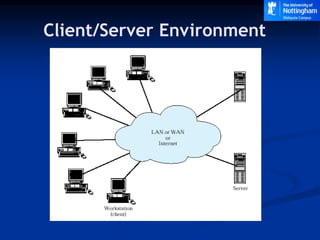
 An environment populated by clients and
servers
 Clients are generally single-user workstations that
provide user friendly interfaces
 Servers provide a set of shared user services to the
clients, e.g. database server
 As a form of distributed computing, networking
is the third essential ingredient linking the
distributed resources
Client/Server Environment
Why Client/Server Computing is
Gaining Popularity?
 Trend # 1:
 An effort by companies to downsize and streamline
processes in a competitive business environment
 Trend # 2:
 The introduction of the small business units (SBUs)
concept
Client/Server computing is a new technical
approach providing new ways of organising
business, automating tasks and eliminating
barriers to information
Characteristics of Client/Server
Computing
 It brings user friendly applications to the
desktops, giving users greater control over
timing and style of computer usage, and
allowing departments to be more responsive to
local needs
 Enables databases, network management and
utility functions to be centralised
 Commitment to open and modular systems by
the user organisations and vendors
 Networking is fundamental to the operation,
thus good network management and security
functions are necessary
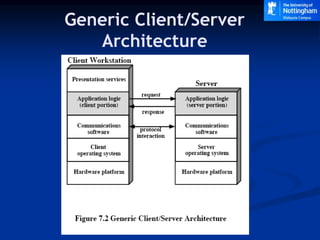
Generic Client/Server
Architecture
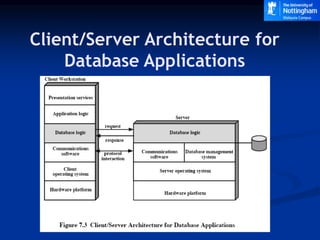
Client/Server Architecture for
Database Applications
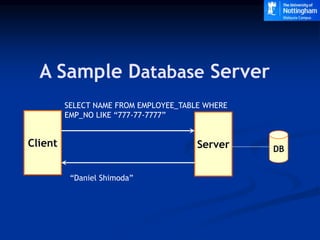
A Sample Database Server
Client Server DB
SELECT NAME FROM EMPLOYEE_TABLE WHERE
EMP_NO LIKE “777-77-7777”
“Daniel Shimoda”
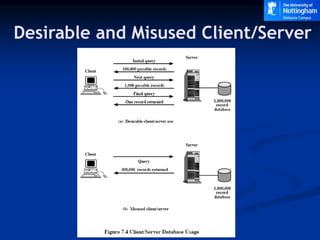
Desirable and Misused Client/Server
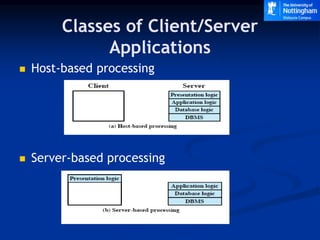
Classes of Client/Server
Applications
 Host-based processing
 Server-based processing
 Client-based processing
Classes of Client/Server
Applications
 Cooperative processing
Thin Clients vs Fat Clients*
 Thin client is a minimal client. Thin clients
utilize as few resources on the host PC as
possible. A thin client's job is generally just to
graphically display information from the
application server. This allows a company the
ease of managing their business logic for all
applications at a central location.
 Fat client (also known as rich client or thick
client) is a client that performs the bulk of the
data processing operations. The data itself is
stored on the server.
* source: Wikipedia, the free encyclopedia.
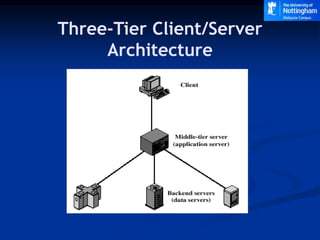
Three-Tier Client/Server
Architecture
 To overcome the limitations of two-tier
architecture, a middle tier server (also called
gateway) is added between the user machine
(typically a thin client) and the backend servers
(database servers)
 The middle tier is where the application/business
logic of the system resides and it performs a
number of different functions like mapping
different database queries, integrating results
from different data sources and interfacing with
backend legacy applications
Three-Tier Client/Server
Architecture
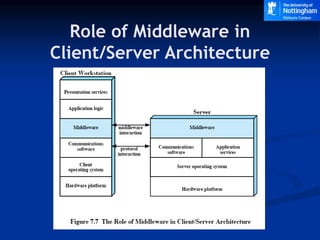
Middleware
 A software layer introduced between the
application above and communications
software, operating systems below to provide a
standardised programming interfaces and
protocols
 Hides complexities and disparities of network
protocols, operating systems and hardware
platforms
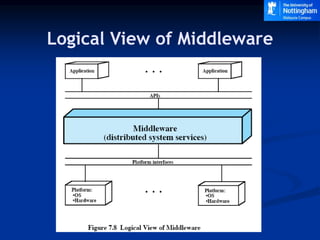
 All applications use a uniform application
programming interface (API)
Role of Middleware in
Client/Server Architecture
Logical View of Middleware
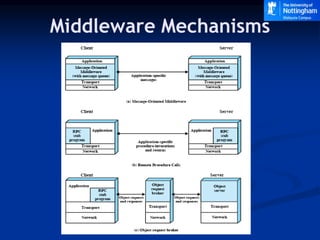
Middleware Mechanisms
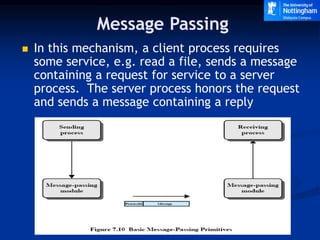
Message Passing
 In this mechanism, a client process requires
some service, e.g. read a file, sends a message
containing a request for service to a server
process. The server process honors the request
and sends a message containing a reply
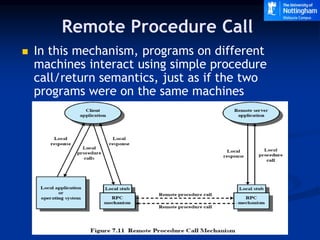
Remote Procedure Call
 In this mechanism, programs on different
machines interact using simple procedure
call/return semantics, just as if the two
programs were on the same machines
RPC Advantages
 Widely accepted, used and understood
 Specifies named operations with designated
types
 Because the interface is standard and precisely
defined, the communication code can be
generated automatically
 Developer can write module which are portable
among computers and operating systems with
little modification and recoding
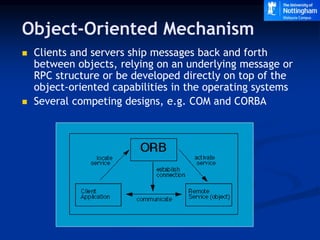
Object-Oriented Mechanism
 Clients and servers ship messages back and forth
between objects, relying on an underlying message or
RPC structure or be developed directly on top of the
object-oriented capabilities in the operating systems
 Several competing designs, e.g. COM and CORBA
Summary
 Reasons for the growing interest of client
server computing systems
 Characteristics of client/server computing
 Architecture of client/server applications
 Middleware and the three middleware
mechanisms
Acknowlegements
This module was taught by Dr. Payam
Mamaani Barnaghi since 2005. Most slides
have been adopted from his lecture
materials and original works from William
Stallings with some changes.

client-server-architecture ss.ppt

  • 1.
    Client/Server Computing See chapter 7,Stalling’s book Ho Sooi Hock
  • 2.
    Outlines  Elements ofClient/Server Computing  Reasons for Growing Interest of Client/Server Paradigm  Characteristics of Client/Server Computing  Classes of Client/Server Applications  Role of Middleware  Three Middleware Mechanisms
  • 3.
    Elements of Client/Server Computing An environment populated by clients and servers  Clients are generally single-user workstations that provide user friendly interfaces  Servers provide a set of shared user services to the clients, e.g. database server  As a form of distributed computing, networking is the third essential ingredient linking the distributed resources
  • 4.
  • 5.
    Why Client/Server Computingis Gaining Popularity?  Trend # 1:  An effort by companies to downsize and streamline processes in a competitive business environment  Trend # 2:  The introduction of the small business units (SBUs) concept Client/Server computing is a new technical approach providing new ways of organising business, automating tasks and eliminating barriers to information
  • 6.
    Characteristics of Client/Server Computing It brings user friendly applications to the desktops, giving users greater control over timing and style of computer usage, and allowing departments to be more responsive to local needs  Enables databases, network management and utility functions to be centralised  Commitment to open and modular systems by the user organisations and vendors  Networking is fundamental to the operation, thus good network management and security functions are necessary
  • 7.
  • 8.
  • 9.
    A Sample DatabaseServer Client Server DB SELECT NAME FROM EMPLOYEE_TABLE WHERE EMP_NO LIKE “777-77-7777” “Daniel Shimoda”
  • 10.
    Desirable and MisusedClient/Server
  • 11.
    Classes of Client/Server Applications Host-based processing  Server-based processing
  • 12.
     Client-based processing Classesof Client/Server Applications  Cooperative processing
  • 13.
    Thin Clients vsFat Clients*  Thin client is a minimal client. Thin clients utilize as few resources on the host PC as possible. A thin client's job is generally just to graphically display information from the application server. This allows a company the ease of managing their business logic for all applications at a central location.  Fat client (also known as rich client or thick client) is a client that performs the bulk of the data processing operations. The data itself is stored on the server. * source: Wikipedia, the free encyclopedia.
  • 14.
    Three-Tier Client/Server Architecture  Toovercome the limitations of two-tier architecture, a middle tier server (also called gateway) is added between the user machine (typically a thin client) and the backend servers (database servers)  The middle tier is where the application/business logic of the system resides and it performs a number of different functions like mapping different database queries, integrating results from different data sources and interfacing with backend legacy applications
  • 15.
  • 16.
    Middleware  A softwarelayer introduced between the application above and communications software, operating systems below to provide a standardised programming interfaces and protocols  Hides complexities and disparities of network protocols, operating systems and hardware platforms  All applications use a uniform application programming interface (API)
  • 17.
    Role of Middlewarein Client/Server Architecture
  • 18.
    Logical View ofMiddleware
  • 19.
  • 20.
    Message Passing  Inthis mechanism, a client process requires some service, e.g. read a file, sends a message containing a request for service to a server process. The server process honors the request and sends a message containing a reply
  • 21.
    Remote Procedure Call In this mechanism, programs on different machines interact using simple procedure call/return semantics, just as if the two programs were on the same machines
  • 22.
    RPC Advantages  Widelyaccepted, used and understood  Specifies named operations with designated types  Because the interface is standard and precisely defined, the communication code can be generated automatically  Developer can write module which are portable among computers and operating systems with little modification and recoding
  • 23.
    Object-Oriented Mechanism  Clientsand servers ship messages back and forth between objects, relying on an underlying message or RPC structure or be developed directly on top of the object-oriented capabilities in the operating systems  Several competing designs, e.g. COM and CORBA
  • 24.
    Summary  Reasons forthe growing interest of client server computing systems  Characteristics of client/server computing  Architecture of client/server applications  Middleware and the three middleware mechanisms
  • 25.
    Acknowlegements This module wastaught by Dr. Payam Mamaani Barnaghi since 2005. Most slides have been adopted from his lecture materials and original works from William Stallings with some changes.