The Analytical Essay “ The thing is, to put a motor in yourself.” Frank Zappa, Postmodern Composer DeCubellis
BENEFITS Is extremely thorough and nearly fool-proof in “on-demand” testing situations. Equips you with a ready-made, universally recognized, analytical structure that helps you to communicate your ideas clearly in an academic setting. Allows for creative expression (e.g. in the title, introduction, and conclusion).
Snappy Title One  clever — but not cute— clause that includes the essay’s TOPIC , AUTHOR , and  TITLE  of work you will be examining.
Helpful Devices to Make Your Titles “Pop” Alliteration Consonance Assonance Chiasmus Paradox Pun Irony Metaphor Simile Oxymoron Understatement .
EXAMPLE: Prejudice, Paternalism, and Pride  in Shakespeare’s  The Merchant of Venice
Snappy Title P rejudice,  P aternalism, and  P ride in Shakespeare’s   The Merchant of Venice Alliteration Author Title of work
Snappy Title NOTE:  Never  underline your essay’s title.  Do, however, underline the titles of longer works.  Surround shorter works in quotation marks.
Snappy Title Memory Hint:  Use the mnemonic  SPACE  to remember which works belong in quotation marks: S  hort story titles P  oem titles A  rticle titles C  hapter titles E  ssay titles.
Snappy Title Memory Hint:  Use the mnemonic  New England (NE) Map  to “guide” you toward the works which belong in quotation marks: N  ovel and Newspaper titles E  pic poem titles M  agazine and movie titles A  lbum titles P  lay and Periodical titles
Your title MUST be Aligned with your Thesis
INTRODUCTORY PARAGRAPH Contains… Hook (Stinger) Thesis Pivot-Point Projected Organization Occa$ion
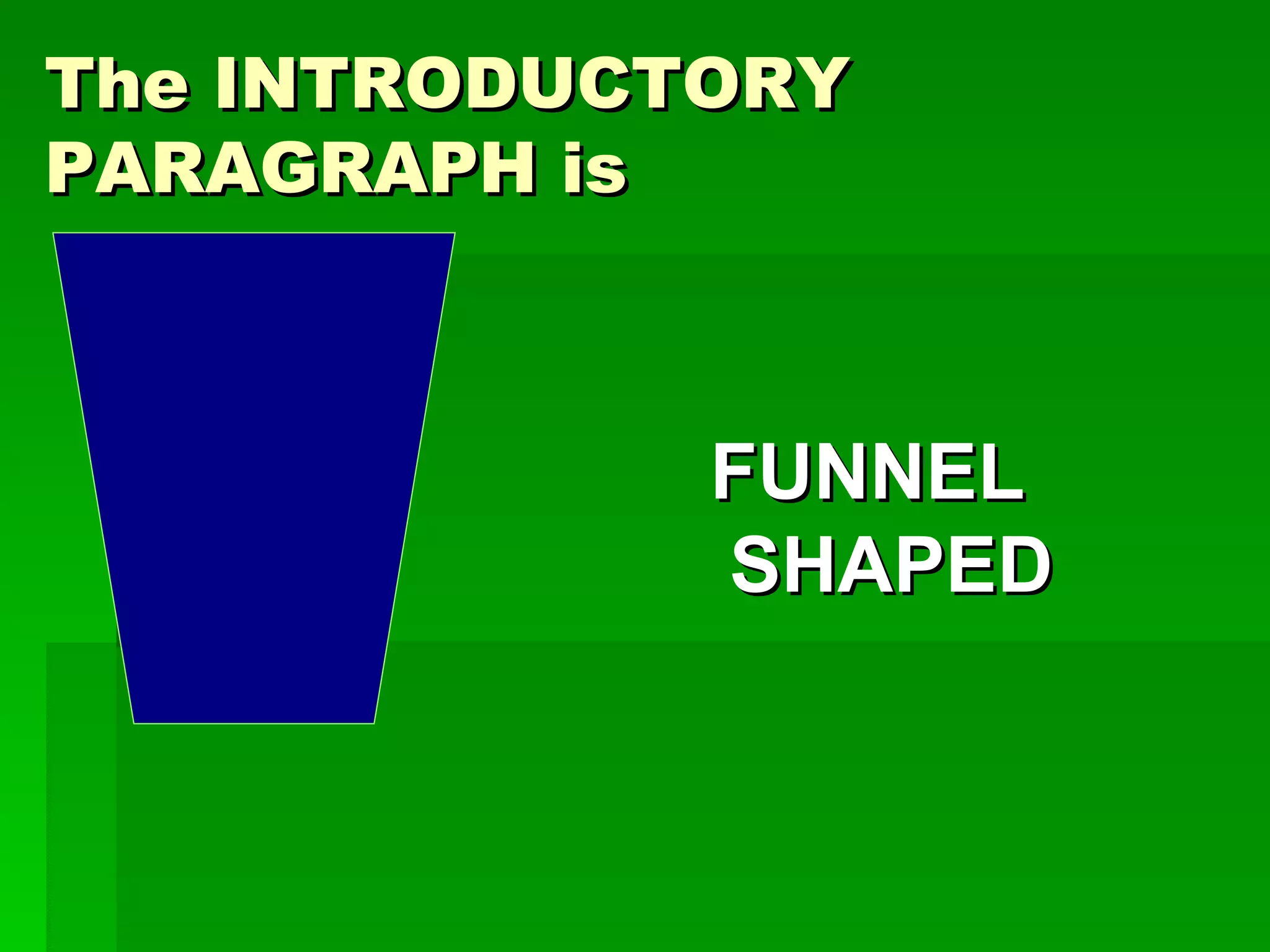
The INTRODUCTORY PARAGRAPH is FUNNEL SHAPED
The INTRODUCTORY PARAGRAPH Starts  BROADLY  by connecting with the audience. Finishes  NARROWLY  by stating the essay’s thesis and upcoming “proofs.”
A Hook is… One to three sentences that cleverly captures your reader’s attention.
Helpful Devices for Crafting Hooks Question Alliteration Consonance Assonance Chiasmus Paradox Pun Irony Metaphor Simile Oxymoron Understatement Avoid false drama!
An Occa$ion consists of… Several sentences that establish a relevant  CONTEXT  which hints at the potential personal  payoff  for reading your essay.
Examples Anecdote Celebrity appeal Cultural commentary Historical context Etc.
Helpful Devices: Baby-steps Slo-mo Dialog Etc.
A Pivot-Point is… ONE sentence that echoes back to the occasion and signals forward toward the thesis.
Pivot-Point EXAMPLE: Today’s comedians often cover their pain with humor, and similarly Stevie Smith’s poetry explores such contradictions between feelings and behaviors.
A Thesis is… ONE sentence that “powers” your entire essay.  It’s the essay’s motor. It’s the point you are trying to prove. In a thematic essay, your essay’s thesis is the literature’s theme.
Thesis EXAMPLE:   Smith creates a paradox of a living death in “Not Waving But Drowning.”
Projected Organization  (PO) ONE sentence that enumerates-- in the exact order you will later present them-- the  “PROOFS”   that support your thesis.  Typically, you should use three proofs.
Projected Organization (PO) NOTE:  Your PO MUST be written in grammatically parallel form. THESIS PROOF 1 PROOF 2 PROOF 3
Projected Organization (PO) Hamlet’s indecision causes his apparently contradictory  thoughts ,  emotions , and  actions . Parallel form:  This PO is in the form of a string of nouns. EXAMPLE
Projected Organization (PO) Your PO may also be a string of phrases tacked to the beginning or end of your thesis sentence.
Projected Organization (PO) Be ing  promoted ,  earn ing  an advanced college degree , and  winn ing  the lottery  ironically leads to Lumpy’s suicide. This PO is in the form of a string of gerund phrases.
Projected Organization (PO) Three characters Three stanzas Three symbols Three aspects of the literature’s theme A character’s attire, behavior, and  feelings The setting, dialog, and imagery Samples of proofs you could use in your PO:
INTRO HOOK OCCASION PIVOT POINT THESIS PO PROOF 1 PROOF 2 PROOF 3
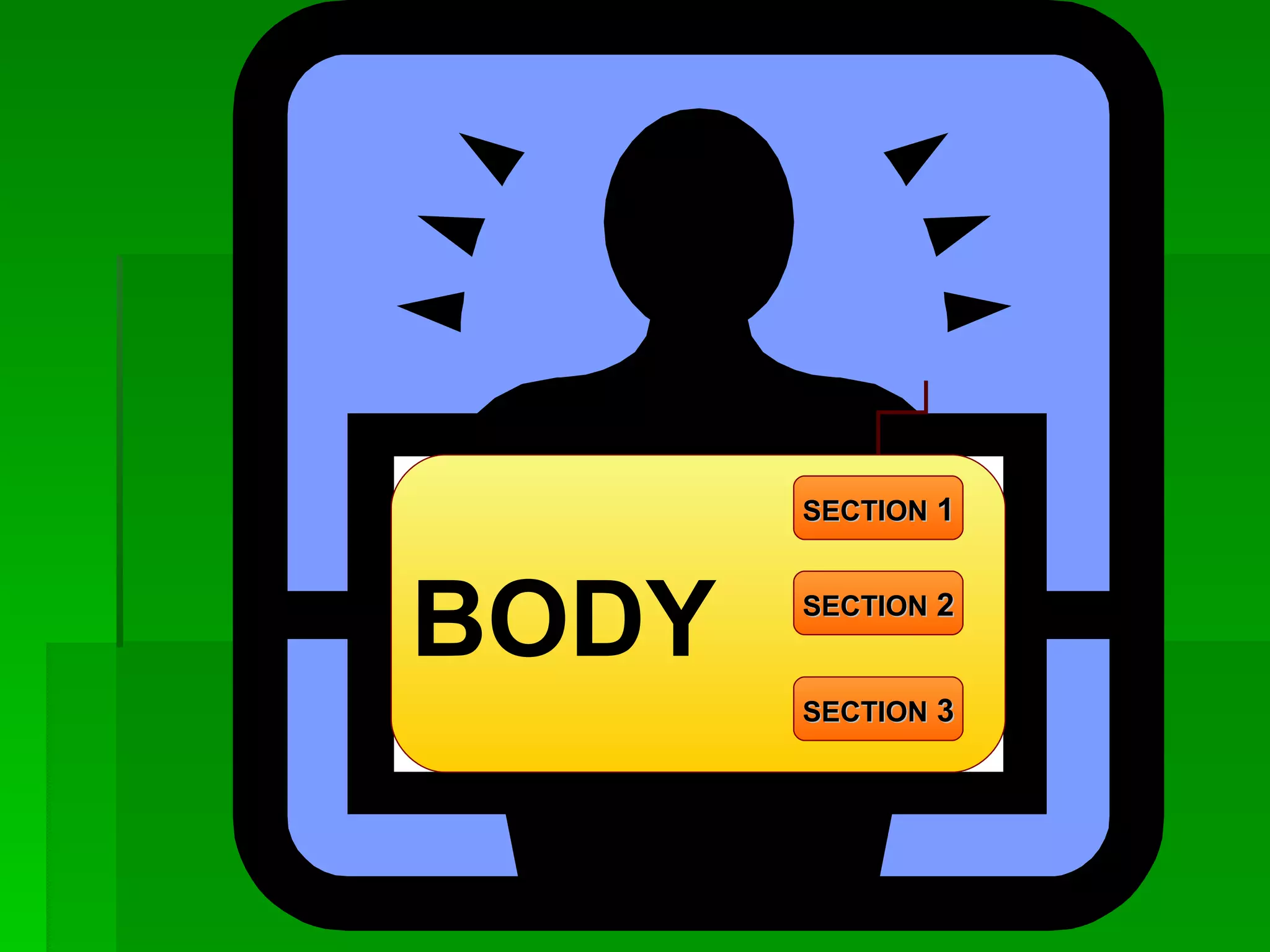
BODY SECTION  1 SECTION  2 SECTION  3
BODY Usually consists of three SECTIONS. Sections are presented in the exact order stated in the PROJECTED ORGANIZATION. Each section contains a TOPIC SENTENCE at its beginning which ties back to one segment of the PO. Sections may contain more than one paragraph depending on how much supporting evidence you need to prove your point.
BODY PARAGRAPHS Set up the quotation by providing a CONTEXT which contains only the 5W,H essential to clarifying the quotation. You should assume your reader only has a passing familiarity with the text.)
BODY SECTION #1 Use additional, similarly structured paragraphs as needed by each body section. PROOF 1 TOPIC SENTENCE CONTEXT SET-UP CLINCHER QUOTE TRANSITION word, phrase, clause, or sentence ANALYSIS OF QUOTE
BODY SECTION #2 Use additional, similarly structured paragraphs as needed by each body section. PROOF 2 TOPIC SENTENCE CONTEXT SET-UP CLINCHER QUOTE TRANSITION word, phrase, clause, or sentence ANALYSIS OF QUOTE
BODY SECTION #3 Use additional, similarly structured paragraphs as needed by each body section. PROOF 3 TOPIC SENTENCE CONTEXT SET-UP CLINCHER QUOTE TRANSITION word, phrase, clause, or sentence ANALYSIS OF QUOTE
The CONCLUDING PARAGRAPH
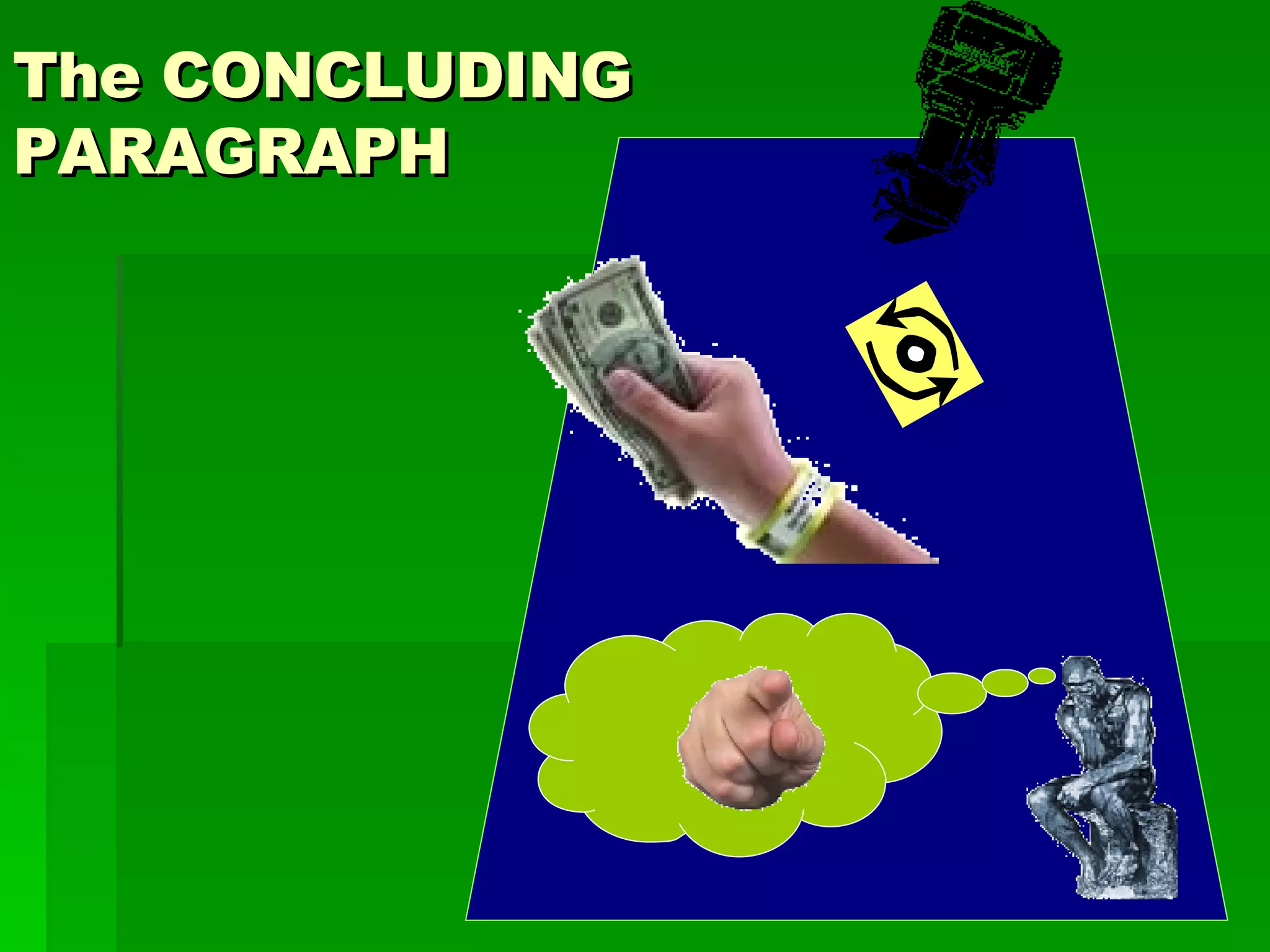
The CONCLUDING PARAGRAPH Starts  NARROWLY  by REPHRASING the essay’s thesis and “proofs.” REVERSES the introduction’s PIVOT-POINT sentence. States the PAYOFF by revisiting and completing the introduction’s OCCASION. Finishes  BROADLY  by leaving the reader something profound to think about.
CONCLUSION THESIS REPHRASED PIVOT POINT REVERSED OCCASION COMPLETED FINAL CLINCHER PO
The CONCLUDING PARAGRAPH PowerPoint ™ Presentation by Greg DeCubellis

Analytical Essay

  • 1.
    The Analytical Essay“ The thing is, to put a motor in yourself.” Frank Zappa, Postmodern Composer DeCubellis
  • 2.
    BENEFITS Is extremelythorough and nearly fool-proof in “on-demand” testing situations. Equips you with a ready-made, universally recognized, analytical structure that helps you to communicate your ideas clearly in an academic setting. Allows for creative expression (e.g. in the title, introduction, and conclusion).
  • 3.
    Snappy Title One clever — but not cute— clause that includes the essay’s TOPIC , AUTHOR , and TITLE of work you will be examining.
  • 4.
    Helpful Devices toMake Your Titles “Pop” Alliteration Consonance Assonance Chiasmus Paradox Pun Irony Metaphor Simile Oxymoron Understatement .
  • 5.
    EXAMPLE: Prejudice, Paternalism,and Pride in Shakespeare’s The Merchant of Venice
  • 6.
    Snappy Title Prejudice, P aternalism, and P ride in Shakespeare’s The Merchant of Venice Alliteration Author Title of work
  • 7.
    Snappy Title NOTE: Never underline your essay’s title. Do, however, underline the titles of longer works. Surround shorter works in quotation marks.
  • 8.
    Snappy Title MemoryHint: Use the mnemonic SPACE to remember which works belong in quotation marks: S hort story titles P oem titles A rticle titles C hapter titles E ssay titles.
  • 9.
    Snappy Title MemoryHint: Use the mnemonic New England (NE) Map to “guide” you toward the works which belong in quotation marks: N ovel and Newspaper titles E pic poem titles M agazine and movie titles A lbum titles P lay and Periodical titles
  • 10.
    Your title MUSTbe Aligned with your Thesis
  • 11.
    INTRODUCTORY PARAGRAPH Contains…Hook (Stinger) Thesis Pivot-Point Projected Organization Occa$ion
  • 12.
  • 13.
    The INTRODUCTORY PARAGRAPHStarts BROADLY by connecting with the audience. Finishes NARROWLY by stating the essay’s thesis and upcoming “proofs.”
  • 14.
    A Hook is…One to three sentences that cleverly captures your reader’s attention.
  • 15.
    Helpful Devices forCrafting Hooks Question Alliteration Consonance Assonance Chiasmus Paradox Pun Irony Metaphor Simile Oxymoron Understatement Avoid false drama!
  • 16.
    An Occa$ion consistsof… Several sentences that establish a relevant CONTEXT which hints at the potential personal payoff for reading your essay.
  • 17.
    Examples Anecdote Celebrityappeal Cultural commentary Historical context Etc.
  • 18.
    Helpful Devices: Baby-stepsSlo-mo Dialog Etc.
  • 19.
    A Pivot-Point is…ONE sentence that echoes back to the occasion and signals forward toward the thesis.
  • 20.
    Pivot-Point EXAMPLE: Today’scomedians often cover their pain with humor, and similarly Stevie Smith’s poetry explores such contradictions between feelings and behaviors.
  • 21.
    A Thesis is…ONE sentence that “powers” your entire essay. It’s the essay’s motor. It’s the point you are trying to prove. In a thematic essay, your essay’s thesis is the literature’s theme.
  • 22.
    Thesis EXAMPLE: Smith creates a paradox of a living death in “Not Waving But Drowning.”
  • 23.
    Projected Organization (PO) ONE sentence that enumerates-- in the exact order you will later present them-- the “PROOFS” that support your thesis. Typically, you should use three proofs.
  • 24.
    Projected Organization (PO)NOTE: Your PO MUST be written in grammatically parallel form. THESIS PROOF 1 PROOF 2 PROOF 3
  • 25.
    Projected Organization (PO)Hamlet’s indecision causes his apparently contradictory thoughts , emotions , and actions . Parallel form: This PO is in the form of a string of nouns. EXAMPLE
  • 26.
    Projected Organization (PO)Your PO may also be a string of phrases tacked to the beginning or end of your thesis sentence.
  • 27.
    Projected Organization (PO)Be ing promoted , earn ing an advanced college degree , and winn ing the lottery ironically leads to Lumpy’s suicide. This PO is in the form of a string of gerund phrases.
  • 28.
    Projected Organization (PO)Three characters Three stanzas Three symbols Three aspects of the literature’s theme A character’s attire, behavior, and feelings The setting, dialog, and imagery Samples of proofs you could use in your PO:
  • 29.
    INTRO HOOK OCCASIONPIVOT POINT THESIS PO PROOF 1 PROOF 2 PROOF 3
  • 30.
    BODY SECTION 1 SECTION 2 SECTION 3
  • 31.
    BODY Usually consistsof three SECTIONS. Sections are presented in the exact order stated in the PROJECTED ORGANIZATION. Each section contains a TOPIC SENTENCE at its beginning which ties back to one segment of the PO. Sections may contain more than one paragraph depending on how much supporting evidence you need to prove your point.
  • 32.
    BODY PARAGRAPHS Setup the quotation by providing a CONTEXT which contains only the 5W,H essential to clarifying the quotation. You should assume your reader only has a passing familiarity with the text.)
  • 33.
    BODY SECTION #1Use additional, similarly structured paragraphs as needed by each body section. PROOF 1 TOPIC SENTENCE CONTEXT SET-UP CLINCHER QUOTE TRANSITION word, phrase, clause, or sentence ANALYSIS OF QUOTE
  • 34.
    BODY SECTION #2Use additional, similarly structured paragraphs as needed by each body section. PROOF 2 TOPIC SENTENCE CONTEXT SET-UP CLINCHER QUOTE TRANSITION word, phrase, clause, or sentence ANALYSIS OF QUOTE
  • 35.
    BODY SECTION #3Use additional, similarly structured paragraphs as needed by each body section. PROOF 3 TOPIC SENTENCE CONTEXT SET-UP CLINCHER QUOTE TRANSITION word, phrase, clause, or sentence ANALYSIS OF QUOTE
  • 36.
  • 37.
    The CONCLUDING PARAGRAPHStarts NARROWLY by REPHRASING the essay’s thesis and “proofs.” REVERSES the introduction’s PIVOT-POINT sentence. States the PAYOFF by revisiting and completing the introduction’s OCCASION. Finishes BROADLY by leaving the reader something profound to think about.
  • 38.
    CONCLUSION THESIS REPHRASEDPIVOT POINT REVERSED OCCASION COMPLETED FINAL CLINCHER PO
  • 39.
    The CONCLUDING PARAGRAPHPowerPoint ™ Presentation by Greg DeCubellis