GL111AA Academic Writing Instructor: Elaine de Vries
 
Levels of Language Informal Medium/Semi-Formal Formal 1-3
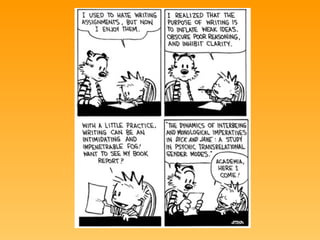
What makes personal/informal writing  different from academic writing? Some quotes to ponder from  Writing at University  by Phyllis Creme and Mary R. Lea “ University teachers sometimes seem to be asking for two contradictory things in their students’ assignments. They say that they want to know what you are thinking, and, at the same time, insist that you make use of what academic writers have said” (Creme and Lea 102).
“ At university much of your ‘experience’ and knowledge come from reading what other people have said . . . .what is important is that you are able to make your own use of your sources when you re-form them for your own purposes for writing” (Creme and Lea 102). “ Personal and individual viewpoints may well be relevant, but they have to be set in a context. This may mean that you have to distance yourself from your personal perspective and see it in a wider framework” (Creme and Lea 102).
Informal Language Purpose: Recounts, tells a personal story Vocabulary: Non-technical vocabulary; casual, everyday; written in 1 st  and 2 nd  person Point of View expressed: Information comes from the writers’ experience; personal feelings and views Tone: Conversational, casual; sounds like ordinary speech
Informal Language (continued) Sentence/Paragraph structure: short, simple sentences; short paragraphs Typical uses: personal letters, e-mail
Medium/Semi-Formal Language Vocabulary/Style: language of educated persons; nonspecialized; balance of abstract and concrete; readily understood; can use 1 st , 2 nd  and 3 rd  persons Sentence/Paragraph structure: complete sentences of varying length; paragraphs vary, but are often fairly short Tone: Varies to suit message and purpose of writer Typical uses: newspapers, magazines, novels, business correspondence
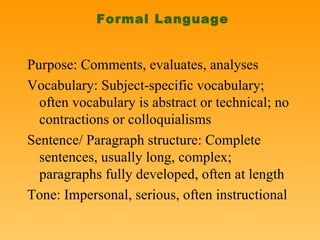
Formal Language Purpose: Comments, evaluates, analyses Vocabulary: Subject-specific vocabulary; often vocabulary is abstract or technical; no contractions or colloquialisms Sentence/ Paragraph structure: Complete sentences, usually long, complex; paragraphs fully developed, often at length Tone: Impersonal, serious, often instructional
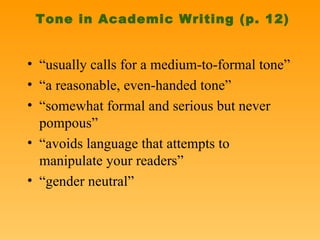
Tone in Academic Writing (p. 12) “ usually calls for a medium-to-formal tone” “ a reasonable, even-handed tone” “ somewhat formal and serious but never pompous” “ avoids language that attempts to manipulate your readers” “ gender neutral”
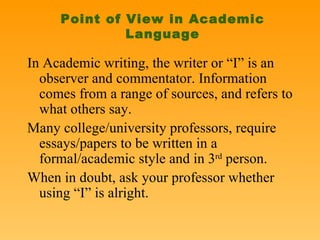
Point of View in Academic Language In Academic writing, the writer or “I” is an observer and commentator. Information comes from a range of sources, and refers to what others say.  Many college/university professors, require essays/papers to be written in a formal/academic style and in 3 rd  person. When in doubt, ask your professor whether using “I” is alright.
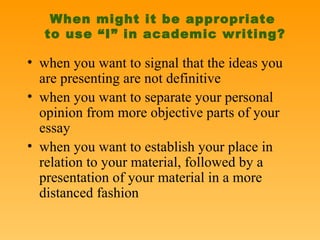
When might it be appropriate  to use “I” in academic writing? when you want to signal that the ideas you are presenting are not definitive when you want to separate your personal opinion from more objective parts of your essay when you want to establish your place in relation to your material, followed by a presentation of your material in a more distanced fashion
What do you need to remember  if you decide to use “I” in academic writing? You still must stand “outside” your material and be able to be objective about it. You must think about your material without being emotional or one-sided in your opinions.
When is it definitely inappropriate  to use “I” in academic writing? when your professor has specifically told you not to use “I” in your assignment
Chapter 3: Writing Paragraphs
A Good Topic Sentence  Does Three Things:  Introduces the topic of the paragraph. Makes a point about the topic. Makes a statement that is neither too broad nor too narrow. 7-1
How can topic sentences create unity? “ A topic sentence contains the main idea of a paragraph and controls its content.” (p. 67) It can occur at the beginning of a paragraph or the end of a paragraph, or it can not appear at all and be implied, not stated. [See examples on p. 67]
How NOT to start a paragraph (from p. 64) Don’t write statements about your purpose, such as “I am going to discuss the causes of falling oil prices.” Don’t apologize, as in “I am not sure this is right, but this is my opinion.” Don’t use overworked expressions, such as “Haste makes waste, as I recently discovered” or “Love is grand.”

Lesson 1

  • 1.
    GL111AA Academic WritingInstructor: Elaine de Vries
  • 2.
  • 3.
    Levels of LanguageInformal Medium/Semi-Formal Formal 1-3
  • 4.
    What makes personal/informalwriting different from academic writing? Some quotes to ponder from Writing at University by Phyllis Creme and Mary R. Lea “ University teachers sometimes seem to be asking for two contradictory things in their students’ assignments. They say that they want to know what you are thinking, and, at the same time, insist that you make use of what academic writers have said” (Creme and Lea 102).
  • 5.
    “ At universitymuch of your ‘experience’ and knowledge come from reading what other people have said . . . .what is important is that you are able to make your own use of your sources when you re-form them for your own purposes for writing” (Creme and Lea 102). “ Personal and individual viewpoints may well be relevant, but they have to be set in a context. This may mean that you have to distance yourself from your personal perspective and see it in a wider framework” (Creme and Lea 102).
  • 6.
    Informal Language Purpose:Recounts, tells a personal story Vocabulary: Non-technical vocabulary; casual, everyday; written in 1 st and 2 nd person Point of View expressed: Information comes from the writers’ experience; personal feelings and views Tone: Conversational, casual; sounds like ordinary speech
  • 7.
    Informal Language (continued)Sentence/Paragraph structure: short, simple sentences; short paragraphs Typical uses: personal letters, e-mail
  • 8.
    Medium/Semi-Formal Language Vocabulary/Style:language of educated persons; nonspecialized; balance of abstract and concrete; readily understood; can use 1 st , 2 nd and 3 rd persons Sentence/Paragraph structure: complete sentences of varying length; paragraphs vary, but are often fairly short Tone: Varies to suit message and purpose of writer Typical uses: newspapers, magazines, novels, business correspondence
  • 9.
    Formal Language Purpose:Comments, evaluates, analyses Vocabulary: Subject-specific vocabulary; often vocabulary is abstract or technical; no contractions or colloquialisms Sentence/ Paragraph structure: Complete sentences, usually long, complex; paragraphs fully developed, often at length Tone: Impersonal, serious, often instructional
  • 10.
    Tone in AcademicWriting (p. 12) “ usually calls for a medium-to-formal tone” “ a reasonable, even-handed tone” “ somewhat formal and serious but never pompous” “ avoids language that attempts to manipulate your readers” “ gender neutral”
  • 11.
    Point of Viewin Academic Language In Academic writing, the writer or “I” is an observer and commentator. Information comes from a range of sources, and refers to what others say. Many college/university professors, require essays/papers to be written in a formal/academic style and in 3 rd person. When in doubt, ask your professor whether using “I” is alright.
  • 12.
    When might itbe appropriate to use “I” in academic writing? when you want to signal that the ideas you are presenting are not definitive when you want to separate your personal opinion from more objective parts of your essay when you want to establish your place in relation to your material, followed by a presentation of your material in a more distanced fashion
  • 13.
    What do youneed to remember if you decide to use “I” in academic writing? You still must stand “outside” your material and be able to be objective about it. You must think about your material without being emotional or one-sided in your opinions.
  • 14.
    When is itdefinitely inappropriate to use “I” in academic writing? when your professor has specifically told you not to use “I” in your assignment
  • 15.
  • 16.
    A Good TopicSentence Does Three Things: Introduces the topic of the paragraph. Makes a point about the topic. Makes a statement that is neither too broad nor too narrow. 7-1
  • 17.
    How can topicsentences create unity? “ A topic sentence contains the main idea of a paragraph and controls its content.” (p. 67) It can occur at the beginning of a paragraph or the end of a paragraph, or it can not appear at all and be implied, not stated. [See examples on p. 67]
  • 18.
    How NOT tostart a paragraph (from p. 64) Don’t write statements about your purpose, such as “I am going to discuss the causes of falling oil prices.” Don’t apologize, as in “I am not sure this is right, but this is my opinion.” Don’t use overworked expressions, such as “Haste makes waste, as I recently discovered” or “Love is grand.”