Thermal Properties:
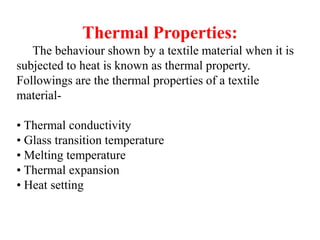
The behaviour shown by a textile material when it is
subjected to heat is known as thermal property.
Followings are the thermal properties of a textile
material-
• Thermal conductivity
• Glass transition temperature
• Melting temperature
• Thermal expansion
• Heat setting
Thermal conductivity:
Thermal conductivity is the rate of transfer of heat
along the body of a textile material by conduction. Higher
conductivity of a material indicates that the heat will pass
through the material very easily.
Woolen dresses are comfortable to wear during
winter season due to its lower conductivity and cotton
dresses are comfortable to wear in summer season because
of its higher conductivity.
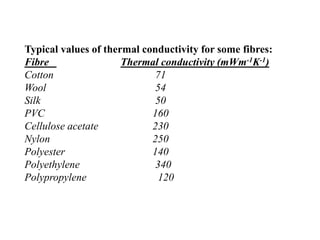
Typical values of thermal conductivity for some fibres:
Fibre Thermal conductivity (mWm-1K-1)
Cotton 71
Wool 54
Silk 50
PVC 160
Cellulose acetate 230
Nylon 250
Polyester 140
Polyethylene 340
Polypropylene 120
Glass transition temperature:
The temperature up to which a textile material
behaves hard as like glass and after which it
behaves soft as like rubber is known as glass
transition temperature and it is expressed by Tg.
The range of Tg lies between -1000 C to 3000 C.
Factors influence the Tg value of polymers:
a) Higher the flexibility of chain bond, lower will be the Tg value.
b) Composition of ring structure in molecular chain raises the value
of Tg.
c) Bulky side groups raise the value of Tg.
d) Flexibility of side groups decrease the value of Tg.
e) Tg increases with molecular weight upto 20,000.
f) Polarity of side groups increase the value of Tg.
g) Co-polymers have lower value of Tg than homo-polymers.
h) Increase of orientation restrict the chain movement and increase
the value of Tg. (Tg of undrawn polymer fibre is 1100C whereas Tg
of fully drawn polymer fibre is 1500C)
03. Melting temperature:
The temperature at which a textile material melts is known as
melting temperature and it is expressed by Tm. At melting
temperature a polymer losses its identity and change into viscous
liquid. It losses its strength and some molecular weight at melting
temperature. Cellulose and protein fibres decompose before melting.
Typical values of Tg and Tm for some MMF:
Fibre Tg (0C) Tm (0C)
Nylon-6 50 215
Nylon-6.6 50 260
Polyester 69 260
PVC 81 310
PAN 97 314
Rubber -73 36
Cellulose tri-acetate - 300
04. Thermal expansion:
Thermal expansion is the increment of length of a
textile material after heating. Thermal expansion is
measured by co- efficient of thermal expansion. Co-
efficient of thermal expansion can be defined as the
fractional increase in length of a material due to rise in
temperature by 10 c.
Co-efficient of thermal expansion=
Increase in length x 100
Initial length of a material
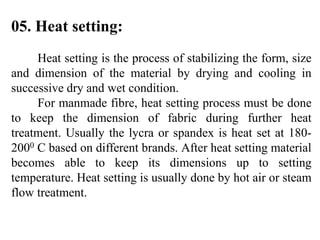
05. Heat setting:
Heat setting is the process of stabilizing the form, size
and dimension of the material by drying and cooling in
successive dry and wet condition.
For manmade fibre, heat setting process must be done
to keep the dimension of fabric during further heat
treatment. Usually the lycra or spandex is heat set at 180-
2000 C based on different brands. After heat setting material
becomes able to keep its dimensions up to setting
temperature. Heat setting is usually done by hot air or steam
flow treatment.
Thermal Properties.pptx

Thermal Properties.pptx

  • 1.
    Thermal Properties: The behaviourshown by a textile material when it is subjected to heat is known as thermal property. Followings are the thermal properties of a textile material- • Thermal conductivity • Glass transition temperature • Melting temperature • Thermal expansion • Heat setting
  • 2.
    Thermal conductivity: Thermal conductivityis the rate of transfer of heat along the body of a textile material by conduction. Higher conductivity of a material indicates that the heat will pass through the material very easily. Woolen dresses are comfortable to wear during winter season due to its lower conductivity and cotton dresses are comfortable to wear in summer season because of its higher conductivity.
  • 3.
    Typical values ofthermal conductivity for some fibres: Fibre Thermal conductivity (mWm-1K-1) Cotton 71 Wool 54 Silk 50 PVC 160 Cellulose acetate 230 Nylon 250 Polyester 140 Polyethylene 340 Polypropylene 120
  • 4.
    Glass transition temperature: Thetemperature up to which a textile material behaves hard as like glass and after which it behaves soft as like rubber is known as glass transition temperature and it is expressed by Tg. The range of Tg lies between -1000 C to 3000 C.
  • 5.
    Factors influence theTg value of polymers: a) Higher the flexibility of chain bond, lower will be the Tg value. b) Composition of ring structure in molecular chain raises the value of Tg. c) Bulky side groups raise the value of Tg. d) Flexibility of side groups decrease the value of Tg. e) Tg increases with molecular weight upto 20,000. f) Polarity of side groups increase the value of Tg. g) Co-polymers have lower value of Tg than homo-polymers. h) Increase of orientation restrict the chain movement and increase the value of Tg. (Tg of undrawn polymer fibre is 1100C whereas Tg of fully drawn polymer fibre is 1500C)
  • 6.
    03. Melting temperature: Thetemperature at which a textile material melts is known as melting temperature and it is expressed by Tm. At melting temperature a polymer losses its identity and change into viscous liquid. It losses its strength and some molecular weight at melting temperature. Cellulose and protein fibres decompose before melting. Typical values of Tg and Tm for some MMF: Fibre Tg (0C) Tm (0C) Nylon-6 50 215 Nylon-6.6 50 260 Polyester 69 260 PVC 81 310 PAN 97 314 Rubber -73 36 Cellulose tri-acetate - 300
  • 7.
    04. Thermal expansion: Thermalexpansion is the increment of length of a textile material after heating. Thermal expansion is measured by co- efficient of thermal expansion. Co- efficient of thermal expansion can be defined as the fractional increase in length of a material due to rise in temperature by 10 c. Co-efficient of thermal expansion= Increase in length x 100 Initial length of a material
  • 8.
    05. Heat setting: Heatsetting is the process of stabilizing the form, size and dimension of the material by drying and cooling in successive dry and wet condition. For manmade fibre, heat setting process must be done to keep the dimension of fabric during further heat treatment. Usually the lycra or spandex is heat set at 180- 2000 C based on different brands. After heat setting material becomes able to keep its dimensions up to setting temperature. Heat setting is usually done by hot air or steam flow treatment.