Download to read offline
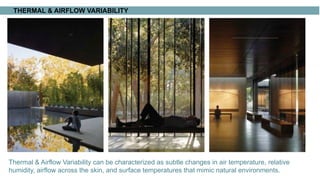



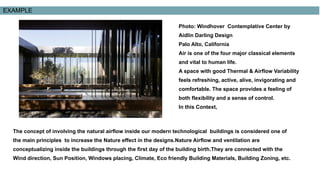


The document discusses thermal and airflow variability, emphasizing its importance in creating environments that enhance human comfort while allowing for personal control over thermal conditions. Unlike traditional thermal design that minimizes variability, the proposed approach aims to mimic natural ventilation and temperature variations to improve user satisfaction. Incorporating these elements can also aid in reducing energy demands for heating and cooling, making it essential for sustainable building practices.


