18-1
GAS CHROMATOGRAPHY
Dr. N.ANJANEYULU
M.PHARM,PhD
Professor&HOD
Department of Pharmaceutical Analysis
18-2
• Vaporization of sample
 Gas-solid
Physical absorption
 Gas-liquid
Liquid immobilized on inert solid
• Principles
• Instrumentation
• Applications
18-3
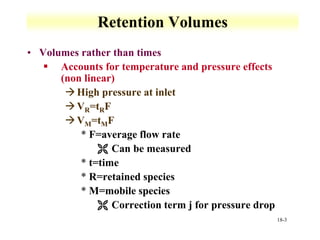
Retention Volumes
• Volumes rather than times
 Accounts for temperature and pressure effects
(non linear)
High pressure at inlet
VR=tRF
VM=tMF
* F=average flow rate
 Can be measured
* t=time
* R=retained species
* M=mobile species
 Correction term j for pressure drop
18-4
Retention Volumes
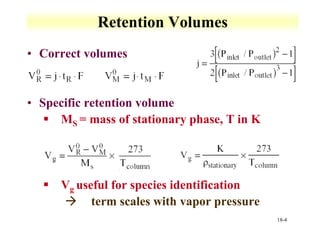
• Correct volumes
• Specific retention volume
 MS = mass of stationary phase, T in K
 Vg useful for species identification
 term scales with vapor pressure
18-5
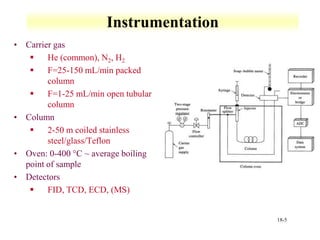
Instrumentation
• Carrier gas
 He (common), N2, H2
 F=25-150 mL/min packed
column
 F=1-25 mL/min open tubular
column
• Column
 2-50 m coiled stainless
steel/glass/Teflon
• Oven: 0-400 °C ~ average boiling
point of sample
• Detectors
 FID, TCD, ECD, (MS)
18-6
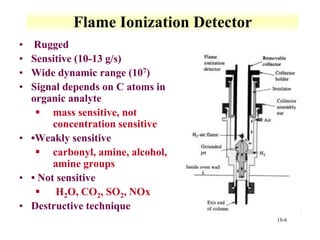
Flame Ionization Detector
• Rugged
• Sensitive (10-13 g/s)
• Wide dynamic range (107)
• Signal depends on C atoms in
organic analyte
 mass sensitive, not
concentration sensitive
• •Weakly sensitive
 carbonyl, amine, alcohol,
amine groups
• • Not sensitive
 H2O, CO2, SO2, NOx
• Destructive technique
18-7
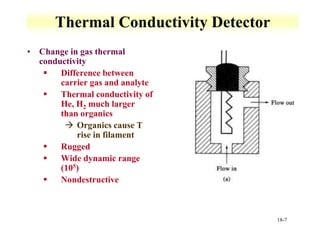
Thermal Conductivity Detector
• Change in gas thermal
conductivity
 Difference between
carrier gas and analyte
 Thermal conductivity of
He, H2 much larger
than organics
 Organics cause T
rise in filament
 Rugged
 Wide dynamic range
(105)
 Nondestructive
18-8
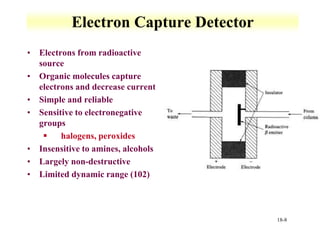
Electron Capture Detector
• Electrons from radioactive
source
• Organic molecules capture
electrons and decrease current
• Simple and reliable
• Sensitive to electronegative
groups
 halogens, peroxides
• Insensitive to amines, alcohols
• Largely non-destructive
• Limited dynamic range (102)
18-9
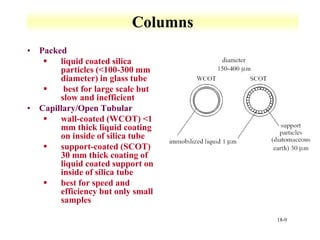
Columns
• Packed
 liquid coated silica
particles (<100-300 mm
diameter) in glass tube
 best for large scale but
slow and inefficient
• Capillary/Open Tubular
 wall-coated (WCOT) <1
mm thick liquid coating
on inside of silica tube
 support-coated (SCOT)
30 mm thick coating of
liquid coated support on
inside of silica tube
 best for speed and
efficiency but only small
samples
18-10
18-11
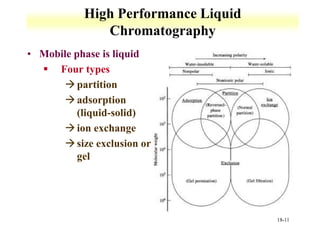
High Performance Liquid
Chromatography
• Mobile phase is liquid
 Four types
partition
adsorption
(liquid-solid)
ion exchange
size exclusion or
gel
18-12
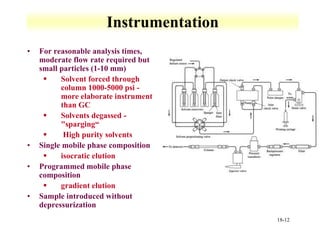
Instrumentation
• For reasonable analysis times,
moderate flow rate required but
small particles (1-10 mm)
 Solvent forced through
column 1000-5000 psi -
more elaborate instrument
than GC
 Solvents degassed -
"sparging“
 High purity solvents
• Single mobile phase composition
 isocratic elution
• Programmed mobile phase
composition
 gradient elution
• Sample introduced without
depressurization
18-13
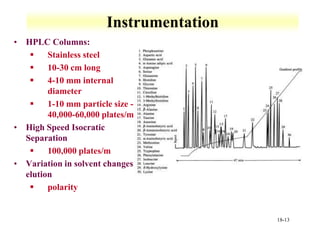
Instrumentation
• HPLC Columns:
 Stainless steel
 10-30 cm long
 4-10 mm internal
diameter
 1-10 mm particle size -
40,000-60,000 plates/m
• High Speed Isocratic
Separation
 100,000 plates/m
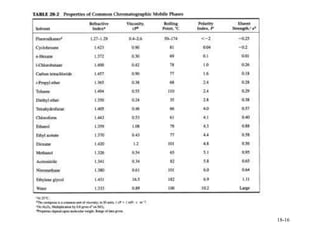
• Variation in solvent changes
elution
 polarity
18-14
18-15
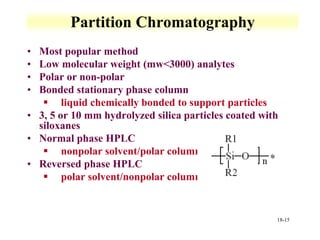
Partition Chromatography
• Most popular method
• Low molecular weight (mw<3000) analytes
• Polar or non-polar
• Bonded stationary phase column
 liquid chemically bonded to support particles
• 3, 5 or 10 mm hydrolyzed silica particles coated with
siloxanes
• Normal phase HPLC
 nonpolar solvent/polar column
• Reversed phase HPLC
 polar solvent/nonpolar column
18-16
18-17
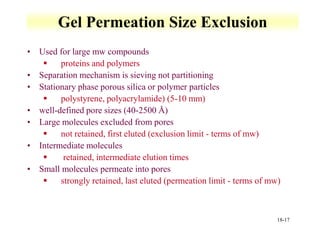
Gel Permeation Size Exclusion
• Used for large mw compounds
 proteins and polymers
• Separation mechanism is sieving not partitioning
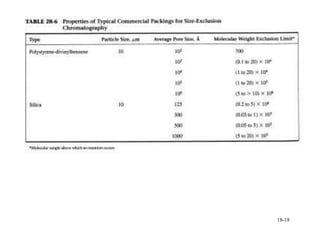
• Stationary phase porous silica or polymer particles
 polystyrene, polyacrylamide) (5-10 mm)
• well-defined pore sizes (40-2500 Å)
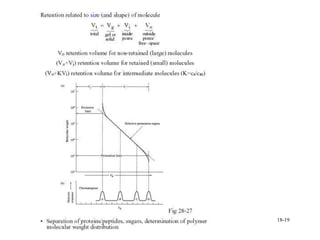
• Large molecules excluded from pores
 not retained, first eluted (exclusion limit - terms of mw)
• Intermediate molecules
 retained, intermediate elution times
• Small molecules permeate into pores
 strongly retained, last eluted (permeation limit - terms of mw)
18-18
18-19

Gas Chromatography.ppt

  • 1.
  • 2.
    18-2 • Vaporization ofsample  Gas-solid Physical absorption  Gas-liquid Liquid immobilized on inert solid • Principles • Instrumentation • Applications
  • 3.
    18-3 Retention Volumes • Volumesrather than times  Accounts for temperature and pressure effects (non linear) High pressure at inlet VR=tRF VM=tMF * F=average flow rate  Can be measured * t=time * R=retained species * M=mobile species  Correction term j for pressure drop
  • 4.
    18-4 Retention Volumes • Correctvolumes • Specific retention volume  MS = mass of stationary phase, T in K  Vg useful for species identification  term scales with vapor pressure
  • 5.
    18-5 Instrumentation • Carrier gas He (common), N2, H2  F=25-150 mL/min packed column  F=1-25 mL/min open tubular column • Column  2-50 m coiled stainless steel/glass/Teflon • Oven: 0-400 °C ~ average boiling point of sample • Detectors  FID, TCD, ECD, (MS)
  • 6.
    18-6 Flame Ionization Detector •Rugged • Sensitive (10-13 g/s) • Wide dynamic range (107) • Signal depends on C atoms in organic analyte  mass sensitive, not concentration sensitive • •Weakly sensitive  carbonyl, amine, alcohol, amine groups • • Not sensitive  H2O, CO2, SO2, NOx • Destructive technique
  • 7.
    18-7 Thermal Conductivity Detector •Change in gas thermal conductivity  Difference between carrier gas and analyte  Thermal conductivity of He, H2 much larger than organics  Organics cause T rise in filament  Rugged  Wide dynamic range (105)  Nondestructive
  • 8.
    18-8 Electron Capture Detector •Electrons from radioactive source • Organic molecules capture electrons and decrease current • Simple and reliable • Sensitive to electronegative groups  halogens, peroxides • Insensitive to amines, alcohols • Largely non-destructive • Limited dynamic range (102)
  • 9.
    18-9 Columns • Packed  liquidcoated silica particles (<100-300 mm diameter) in glass tube  best for large scale but slow and inefficient • Capillary/Open Tubular  wall-coated (WCOT) <1 mm thick liquid coating on inside of silica tube  support-coated (SCOT) 30 mm thick coating of liquid coated support on inside of silica tube  best for speed and efficiency but only small samples
  • 10.
  • 11.
    18-11 High Performance Liquid Chromatography •Mobile phase is liquid  Four types partition adsorption (liquid-solid) ion exchange size exclusion or gel
  • 12.
    18-12 Instrumentation • For reasonableanalysis times, moderate flow rate required but small particles (1-10 mm)  Solvent forced through column 1000-5000 psi - more elaborate instrument than GC  Solvents degassed - "sparging“  High purity solvents • Single mobile phase composition  isocratic elution • Programmed mobile phase composition  gradient elution • Sample introduced without depressurization
  • 13.
    18-13 Instrumentation • HPLC Columns: Stainless steel  10-30 cm long  4-10 mm internal diameter  1-10 mm particle size - 40,000-60,000 plates/m • High Speed Isocratic Separation  100,000 plates/m • Variation in solvent changes elution  polarity
  • 14.
  • 15.
    18-15 Partition Chromatography • Mostpopular method • Low molecular weight (mw<3000) analytes • Polar or non-polar • Bonded stationary phase column  liquid chemically bonded to support particles • 3, 5 or 10 mm hydrolyzed silica particles coated with siloxanes • Normal phase HPLC  nonpolar solvent/polar column • Reversed phase HPLC  polar solvent/nonpolar column
  • 16.
  • 17.
    18-17 Gel Permeation SizeExclusion • Used for large mw compounds  proteins and polymers • Separation mechanism is sieving not partitioning • Stationary phase porous silica or polymer particles  polystyrene, polyacrylamide) (5-10 mm) • well-defined pore sizes (40-2500 Å) • Large molecules excluded from pores  not retained, first eluted (exclusion limit - terms of mw) • Intermediate molecules  retained, intermediate elution times • Small molecules permeate into pores  strongly retained, last eluted (permeation limit - terms of mw)
  • 18.
  • 19.