SURFACE TOPOGRAPHY
Presented by
A. Sabiha Khathun
M.TECH (Machine Design)
16481D1501
Subject: Tribology
GUDLAVALLERU ENGINEERING COLLEGE
Sheshadri Rao Knowledge Village, Gudlavalleru,PIN:521356
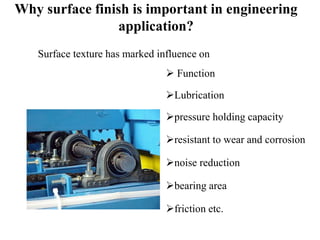
Why surface finish is important in engineering
application?
Surface texture has marked influence on
 Function
Lubrication
pressure holding capacity
resistant to wear and corrosion
noise reduction
bearing area
friction etc.
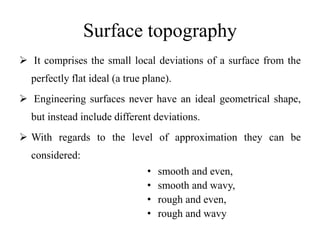
Surface topography
 It comprises the small local deviations of a surface from the
perfectly flat ideal (a true plane).
 Engineering surfaces never have an ideal geometrical shape,
but instead include different deviations.
 With regards to the level of approximation they can be
considered:
• smooth and even,
• smooth and wavy,
• rough and even,
• rough and wavy
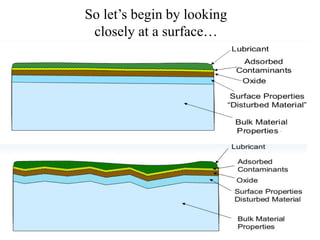
So let’s begin by looking
closely at a surface…
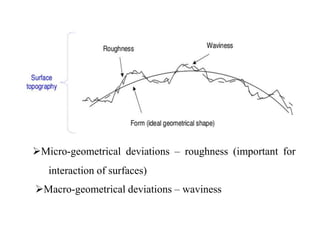
Micro-geometrical deviations – roughness (important for
interaction of surfaces)
Macro-geometrical deviations – waviness
Continued…
Surface texture is one of the important factors that control friction and
transfer layer formation during sliding.
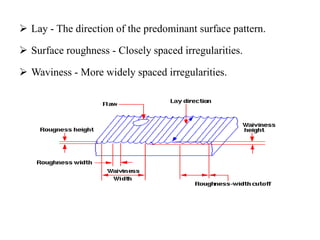
It is the nature of a surface as defined by the three characteristics of
1. Lay
2. Surface roughness and
3. waviness
 Lay - The direction of the predominant surface pattern.
 Surface roughness - Closely spaced irregularities.
 Waviness - More widely spaced irregularities.
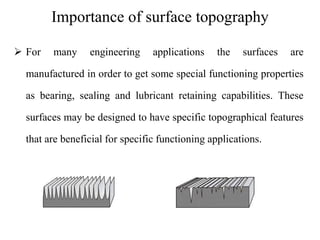
Importance of surface topography
 For many engineering applications the surfaces are
manufactured in order to get some special functioning properties
as bearing, sealing and lubricant retaining capabilities. These
surfaces may be designed to have specific topographical features
that are beneficial for specific functioning applications.
Surface roughness measurement methods
and parameters
1. Profilometer
2. Optical interferometer
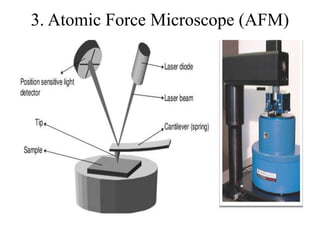
3. Atomic Force Microscope (AFM)
Parameters: arithmetic mean value (Ra) and root mean square
average (Rq)
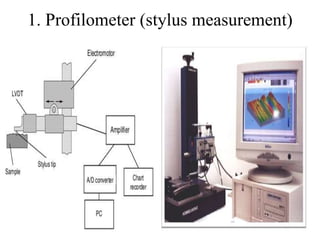
1. Profilometer (stylus measurement)
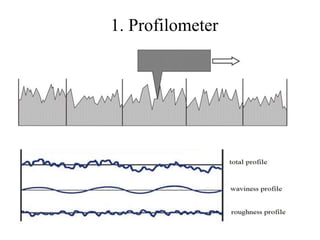
1. Profilometer
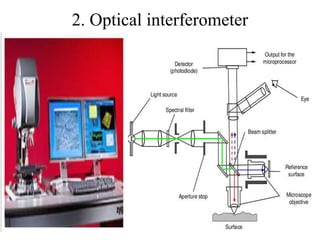
2. Optical interferometer
3. Atomic Force Microscope (AFM)
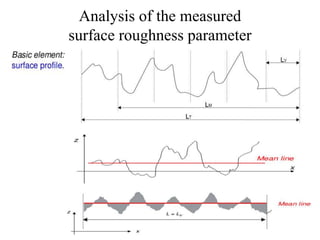
Analysis of the measured
surface roughness parameter
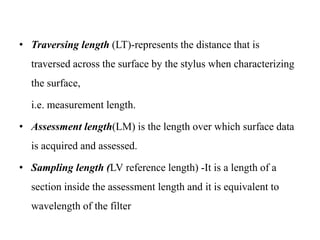
• Traversing length (LT)-represents the distance that is
traversed across the surface by the stylus when characterizing
the surface,
i.e. measurement length.
• Assessment length(LM) is the length over which surface data
is acquired and assessed.
• Sampling length (LV reference length) -It is a length of a
section inside the assessment length and it is equivalent to
wavelength of the filter
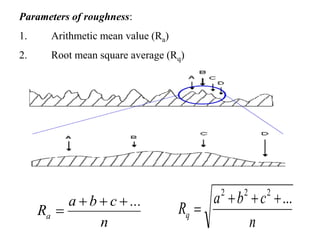
Parameters of roughness:
1. Arithmetic mean value (Ra)
2. Root mean square average (Rq)
n
...cba
Ra


n
cba
Rq
...222


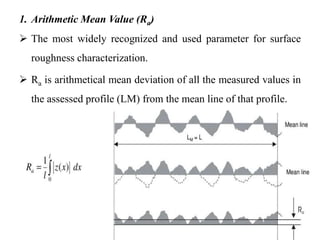
1. Arithmetic Mean Value (Ra)
 The most widely recognized and used parameter for surface
roughness characterization.
 Ra is arithmetical mean deviation of all the measured values in
the assessed profile (LM) from the mean line of that profile.
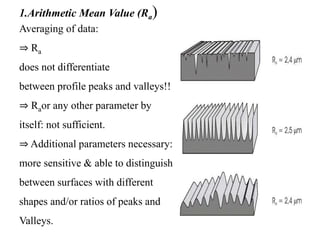
1.Arithmetic Mean Value (Ra)
Averaging of data:
⇒ Ra
does not differentiate
between profile peaks and valleys!!
⇒ Raor any other parameter by
itself: not sufficient.
⇒ Additional parameters necessary:
more sensitive & able to distinguish
between surfaces with different
shapes and/or ratios of peaks and
Valleys.
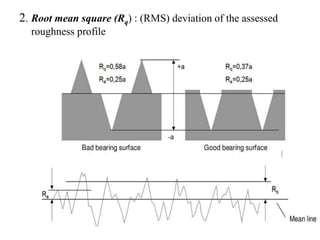
2. Root mean square (Rq) : (RMS) deviation of the assessed
roughness profile
Surface Roughness in Practice
 Surface roughness design requirements for typical engineering applications
can vary by as much as two orders of magnitude for different parts. The
reasons and considerations for this wide range include:
– Precision required on mating surfaces,
– Frictional considerations
– Fatigue and notch sensitivity,
– Electrical and thermal contact resistance, Corrosion resistance,.
– Subsequent processing,.
– Appearance
– Cost considerations,
CONCLUSION
 These factors should be carefully considered before a decision
is made as to the recommendation about surface roughness for
a certain product. As in all manufacturing processes, the cost
involved in the selection should also be a major consideration.
THANK YOU

surface topography

  • 1.
    SURFACE TOPOGRAPHY Presented by A.Sabiha Khathun M.TECH (Machine Design) 16481D1501 Subject: Tribology GUDLAVALLERU ENGINEERING COLLEGE Sheshadri Rao Knowledge Village, Gudlavalleru,PIN:521356
  • 2.
    Why surface finishis important in engineering application? Surface texture has marked influence on  Function Lubrication pressure holding capacity resistant to wear and corrosion noise reduction bearing area friction etc.
  • 3.
    Surface topography  Itcomprises the small local deviations of a surface from the perfectly flat ideal (a true plane).  Engineering surfaces never have an ideal geometrical shape, but instead include different deviations.  With regards to the level of approximation they can be considered: • smooth and even, • smooth and wavy, • rough and even, • rough and wavy
  • 4.
    So let’s beginby looking closely at a surface…
  • 5.
    Micro-geometrical deviations –roughness (important for interaction of surfaces) Macro-geometrical deviations – waviness
  • 6.
    Continued… Surface texture isone of the important factors that control friction and transfer layer formation during sliding. It is the nature of a surface as defined by the three characteristics of 1. Lay 2. Surface roughness and 3. waviness
  • 7.
     Lay -The direction of the predominant surface pattern.  Surface roughness - Closely spaced irregularities.  Waviness - More widely spaced irregularities.
  • 8.
    Importance of surfacetopography  For many engineering applications the surfaces are manufactured in order to get some special functioning properties as bearing, sealing and lubricant retaining capabilities. These surfaces may be designed to have specific topographical features that are beneficial for specific functioning applications.
  • 9.
    Surface roughness measurementmethods and parameters 1. Profilometer 2. Optical interferometer 3. Atomic Force Microscope (AFM) Parameters: arithmetic mean value (Ra) and root mean square average (Rq)
  • 10.
  • 11.
  • 12.
  • 13.
    3. Atomic ForceMicroscope (AFM)
  • 14.
    Analysis of themeasured surface roughness parameter
  • 15.
    • Traversing length(LT)-represents the distance that is traversed across the surface by the stylus when characterizing the surface, i.e. measurement length. • Assessment length(LM) is the length over which surface data is acquired and assessed. • Sampling length (LV reference length) -It is a length of a section inside the assessment length and it is equivalent to wavelength of the filter
  • 16.
    Parameters of roughness: 1.Arithmetic mean value (Ra) 2. Root mean square average (Rq) n ...cba Ra   n cba Rq ...222  
  • 17.
    1. Arithmetic MeanValue (Ra)  The most widely recognized and used parameter for surface roughness characterization.  Ra is arithmetical mean deviation of all the measured values in the assessed profile (LM) from the mean line of that profile.
  • 18.
    1.Arithmetic Mean Value(Ra) Averaging of data: ⇒ Ra does not differentiate between profile peaks and valleys!! ⇒ Raor any other parameter by itself: not sufficient. ⇒ Additional parameters necessary: more sensitive & able to distinguish between surfaces with different shapes and/or ratios of peaks and Valleys.
  • 19.
    2. Root meansquare (Rq) : (RMS) deviation of the assessed roughness profile
  • 20.
    Surface Roughness inPractice  Surface roughness design requirements for typical engineering applications can vary by as much as two orders of magnitude for different parts. The reasons and considerations for this wide range include: – Precision required on mating surfaces, – Frictional considerations – Fatigue and notch sensitivity, – Electrical and thermal contact resistance, Corrosion resistance,. – Subsequent processing,. – Appearance – Cost considerations,
  • 21.
    CONCLUSION  These factorsshould be carefully considered before a decision is made as to the recommendation about surface roughness for a certain product. As in all manufacturing processes, the cost involved in the selection should also be a major consideration.
  • 22.