MINDTOOLS FOR PROJECT MANAGERS
RICHARD DETTLING, SCHOOL OF BUSINESS
MINDTOOLS FOR PROJECT MANAGERS


 Project management is a complex process that requires a wide
 range of skills.
 Whether you manage projects on a regular basis or only once or
 twice a year, the skills learned in project management are
 applicable to many managerial and leadership positions.
WHAT IS MINDTOOLS.COM?

 Established in 1996,
 The site helps more than 15,000,000 people each
  year
 MindTools.com provides resources, tools and
  teaches leadership, team management, problem-
  solving, project management, personal
  productivity, and team-working skills
 Major corporations and government agencies
  around the world use MindTools.com to improve
  management and leadership skills, and support
  organizational development initiatives.
 Mind Tools is awarded a Queen's Award for
  Enterprise – the UK's top business award
WHAT IS MINDTOOLS.COM?
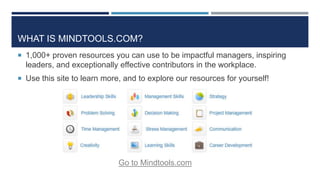
 1,000+ proven resources you can use to be impactful managers, inspiring
  leaders, and exceptionally effective contributors in the workplace.
 Use this site to learn more, and to explore our resources for yourself!


                             Go to Mindtools.com
ASSESS YOUR CURRENT SKILL LEVEL

 Whether you succeed or fail with projects depends on how good you are at
  project management
                                   (Take Assessment)
 Use the information you gain here to improve specific project management
  skills – as well as your general workplace skills
 Mind Tools teaches more than 50 individual project management skills.
   Explore the key areas of project management,
   Develop your skills on how to schedule projects
   Find out how to manage change so that your projects are accepted and embraced by the
    people they affect
PROJECT MANAGEMENT FRAMEWORK
 Formal project management involves following an established project
  management methodology. In turn, most of these methodologies follow a set
  of common project phases, with common processes that run across each
  phase.
 The Planning Cycle is a process that helps you to make good, well-
  considered, robust plans.
 The project management methodology that your organization uses may also
  determine whether you should use a Project Charter or a Project Initiation
  Document.
                              Go to Mindtools.com
PROJECT MANAGEMENT FRAMEWORK


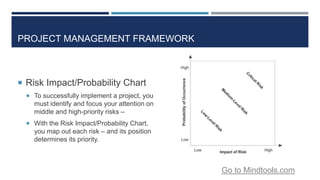
 Risk Impact/Probability Chart
   To successfully implement a project, you
    must identify and focus your attention on
    middle and high-priority risks –
   With the Risk Impact/Probability Chart,
    you map out each risk – and its position
    determines its priority.


                                                Go to Mindtools.com
SCHEDULING TOOLS
 Scheduling aims to predict the future, and it has to consider many
  uncertainties and assumptions.
 But whether you're planning a team retreat, or leading a
  multimillion-dollar IT project, the schedule is a critical part of your
  efforts.
 It identifies and organizes project tasks into a sequence of events
  that create the project management plan.
 A variety of inputs and tools are used in the scheduling process, all
  of which are designed to help you understand your resources, your
  constraints, and your risks.
SCHEDULING TOOLS


 Action Planning – To-Do Lists, Urgent/Important Matrix
 Small Projects
 Gantt Charts – Microsoft Project, Critical Path Analysis, PERT
 Network Analysis (for large projects)
SCOPE MANAGEMENT TOOLS
 BUSINESS REQUIREMENTS ANALYSIS
  Many organizations already have established
   procedures and methodologies for conducting
   business requirements analyses, which may have
   been optimized specifically for that organization or
   industry. If these exist, use them!
  However, if they do not Mindtools.com provides
   the following tools:
  Stakeholder Planning
  Impact Analysis
  Scenario Analysis
BUILDING SUPPORT FOR YOUR PROJECTS

 Stakeholder management is critical to
  the success of every project in every
  organization. By engaging the right
  people in the right way in your
  project, you can make a big difference
  to its success.
 Stakeholder Analysis
 Communications Worksheet
CHANGE MANAGEMENT TOOLS

  If part of your project involves implementing change, Mindtools.com offers a
    number of tools for each of the change stages:
 Understanding       Planning             Implementing              Communicating
  Change:              Change:               Change:                    Change:
 The Change Curve    Impact Analysis      Kotter's 8-Step Change    Stakeholder Analysis
                      Burke-Litwin          Model
 Lewin's Change       Change Model                                    Stakeholder
  Management Model                          Training Needs             Management
                      McKinsey 7S           Assessment
 Beckhard and         Framework                                       Mission Statements
  Harris's Change                           Why Change Can Fail        and Visions
                      Leavitt's Diamond
  Model                                                                 Statements
                      Organization
                       Design
                      SIPOC Diagrams
PROJECT IMPROVEMENT TOOLS

 Completing a project is not the same thing as
  ending the project management process. Simply
  finishing doesn't ensure that the organization
  benefits from the project's outcome
 After Action Review Process
 Post-Implementation Reviews
 Project Healthcheck
QUESTIONS

Mind tools for project managers

  • 1.
    MINDTOOLS FOR PROJECTMANAGERS RICHARD DETTLING, SCHOOL OF BUSINESS
  • 2.
    MINDTOOLS FOR PROJECTMANAGERS  Project management is a complex process that requires a wide range of skills.  Whether you manage projects on a regular basis or only once or twice a year, the skills learned in project management are applicable to many managerial and leadership positions.
  • 3.
    WHAT IS MINDTOOLS.COM? Established in 1996,  The site helps more than 15,000,000 people each year  MindTools.com provides resources, tools and teaches leadership, team management, problem- solving, project management, personal productivity, and team-working skills  Major corporations and government agencies around the world use MindTools.com to improve management and leadership skills, and support organizational development initiatives.  Mind Tools is awarded a Queen's Award for Enterprise – the UK's top business award
  • 4.
    WHAT IS MINDTOOLS.COM? 1,000+ proven resources you can use to be impactful managers, inspiring leaders, and exceptionally effective contributors in the workplace.  Use this site to learn more, and to explore our resources for yourself! Go to Mindtools.com
  • 5.
    ASSESS YOUR CURRENTSKILL LEVEL  Whether you succeed or fail with projects depends on how good you are at project management (Take Assessment)  Use the information you gain here to improve specific project management skills – as well as your general workplace skills  Mind Tools teaches more than 50 individual project management skills.  Explore the key areas of project management,  Develop your skills on how to schedule projects  Find out how to manage change so that your projects are accepted and embraced by the people they affect
  • 6.
    PROJECT MANAGEMENT FRAMEWORK Formal project management involves following an established project management methodology. In turn, most of these methodologies follow a set of common project phases, with common processes that run across each phase.  The Planning Cycle is a process that helps you to make good, well- considered, robust plans.  The project management methodology that your organization uses may also determine whether you should use a Project Charter or a Project Initiation Document. Go to Mindtools.com
  • 7.
    PROJECT MANAGEMENT FRAMEWORK Risk Impact/Probability Chart  To successfully implement a project, you must identify and focus your attention on middle and high-priority risks –  With the Risk Impact/Probability Chart, you map out each risk – and its position determines its priority. Go to Mindtools.com
  • 8.
    SCHEDULING TOOLS  Schedulingaims to predict the future, and it has to consider many uncertainties and assumptions.  But whether you're planning a team retreat, or leading a multimillion-dollar IT project, the schedule is a critical part of your efforts.  It identifies and organizes project tasks into a sequence of events that create the project management plan.  A variety of inputs and tools are used in the scheduling process, all of which are designed to help you understand your resources, your constraints, and your risks.
  • 9.
    SCHEDULING TOOLS  ActionPlanning – To-Do Lists, Urgent/Important Matrix  Small Projects  Gantt Charts – Microsoft Project, Critical Path Analysis, PERT  Network Analysis (for large projects)
  • 10.
    SCOPE MANAGEMENT TOOLS BUSINESS REQUIREMENTS ANALYSIS  Many organizations already have established procedures and methodologies for conducting business requirements analyses, which may have been optimized specifically for that organization or industry. If these exist, use them!  However, if they do not Mindtools.com provides the following tools:  Stakeholder Planning  Impact Analysis  Scenario Analysis
  • 11.
    BUILDING SUPPORT FORYOUR PROJECTS  Stakeholder management is critical to the success of every project in every organization. By engaging the right people in the right way in your project, you can make a big difference to its success.  Stakeholder Analysis  Communications Worksheet
  • 12.
    CHANGE MANAGEMENT TOOLS  If part of your project involves implementing change, Mindtools.com offers a number of tools for each of the change stages:  Understanding  Planning  Implementing  Communicating Change: Change: Change: Change:  The Change Curve  Impact Analysis  Kotter's 8-Step Change  Stakeholder Analysis  Burke-Litwin Model  Lewin's Change Change Model  Stakeholder Management Model  Training Needs Management  McKinsey 7S Assessment  Beckhard and Framework  Mission Statements Harris's Change  Why Change Can Fail and Visions  Leavitt's Diamond Model Statements  Organization Design  SIPOC Diagrams
  • 13.
    PROJECT IMPROVEMENT TOOLS Completing a project is not the same thing as ending the project management process. Simply finishing doesn't ensure that the organization benefits from the project's outcome  After Action Review Process  Post-Implementation Reviews  Project Healthcheck
  • 14.