AYME 2015 CONFERENCE
Using MOOCS (Massively Open Online Courses) to
Develop Intentional CoP’s (Communities of Practice)
in Organizations
Dr. Charlotte McCorquodale
To MOOC or Not To MOOC?
What are the questions or
issues related to this topic
did you hope we would
discuss today?
https://goo.gl/rY1Wpd
Communities of practice are groups
of people who share a concern or a
passion for something they do and
learn how to do it better as they in
teract regularly.
(Wenger, 2011)
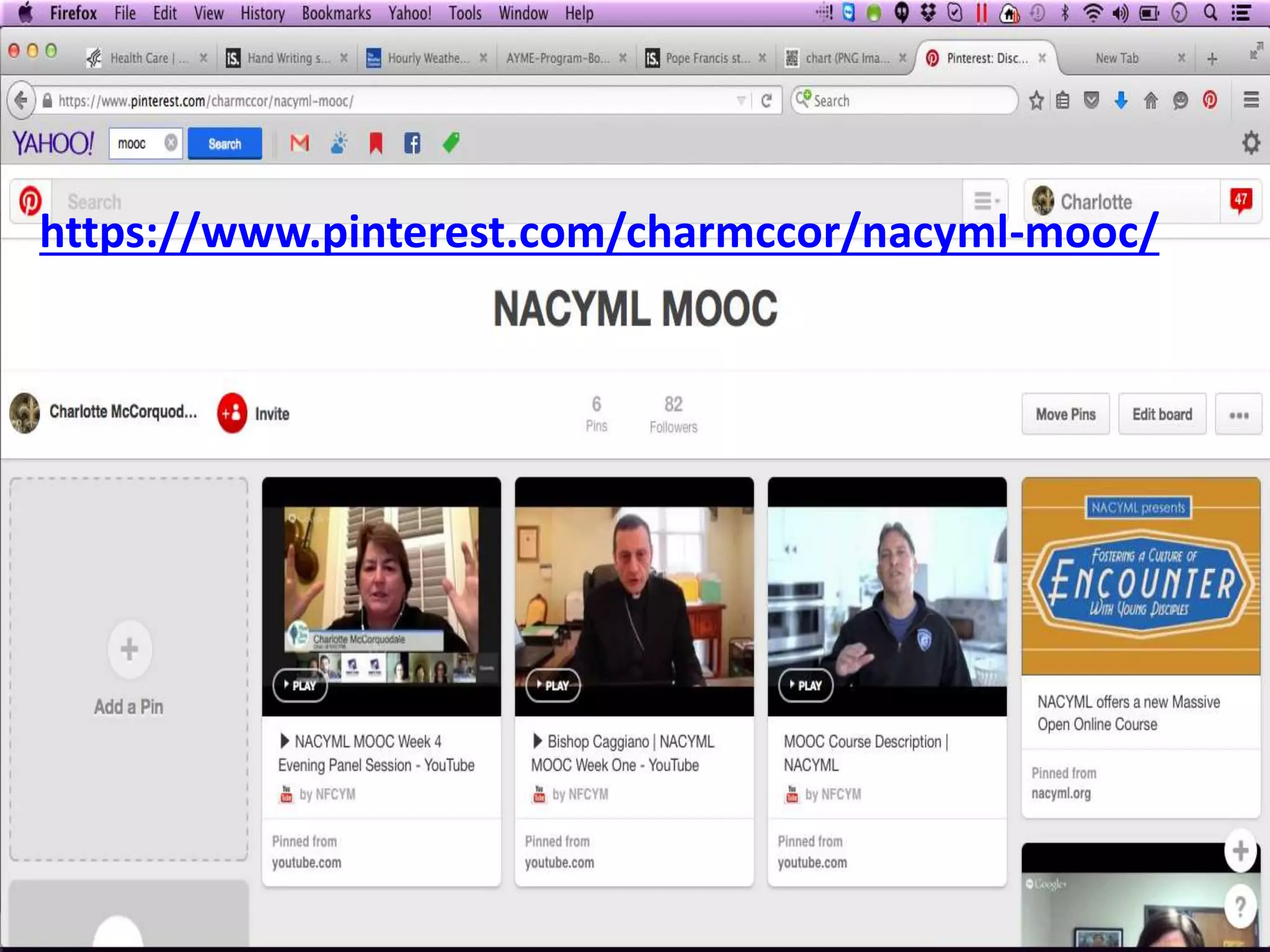
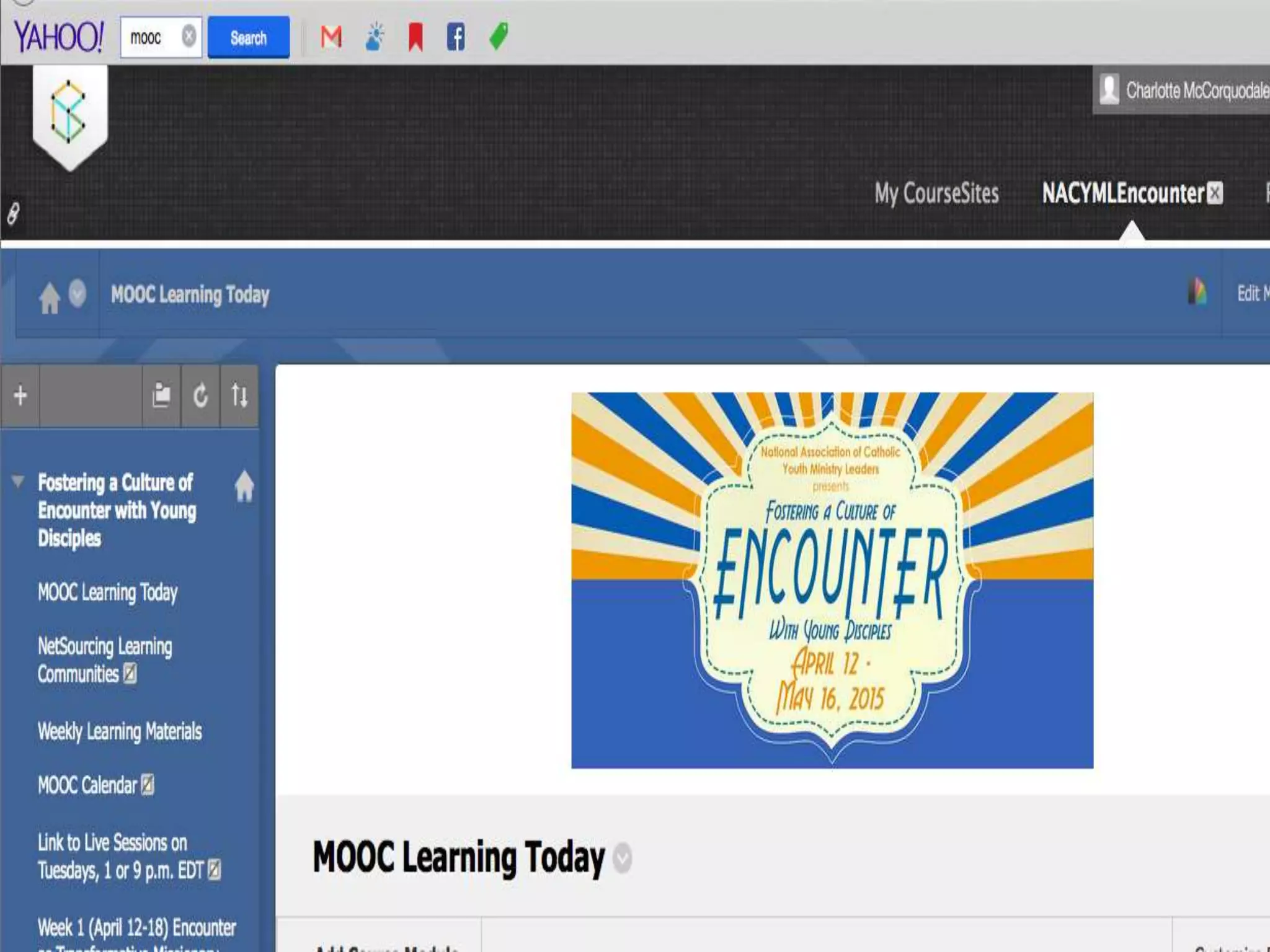
https://www.pinterest.com/charmccor/nacyml-mooc/
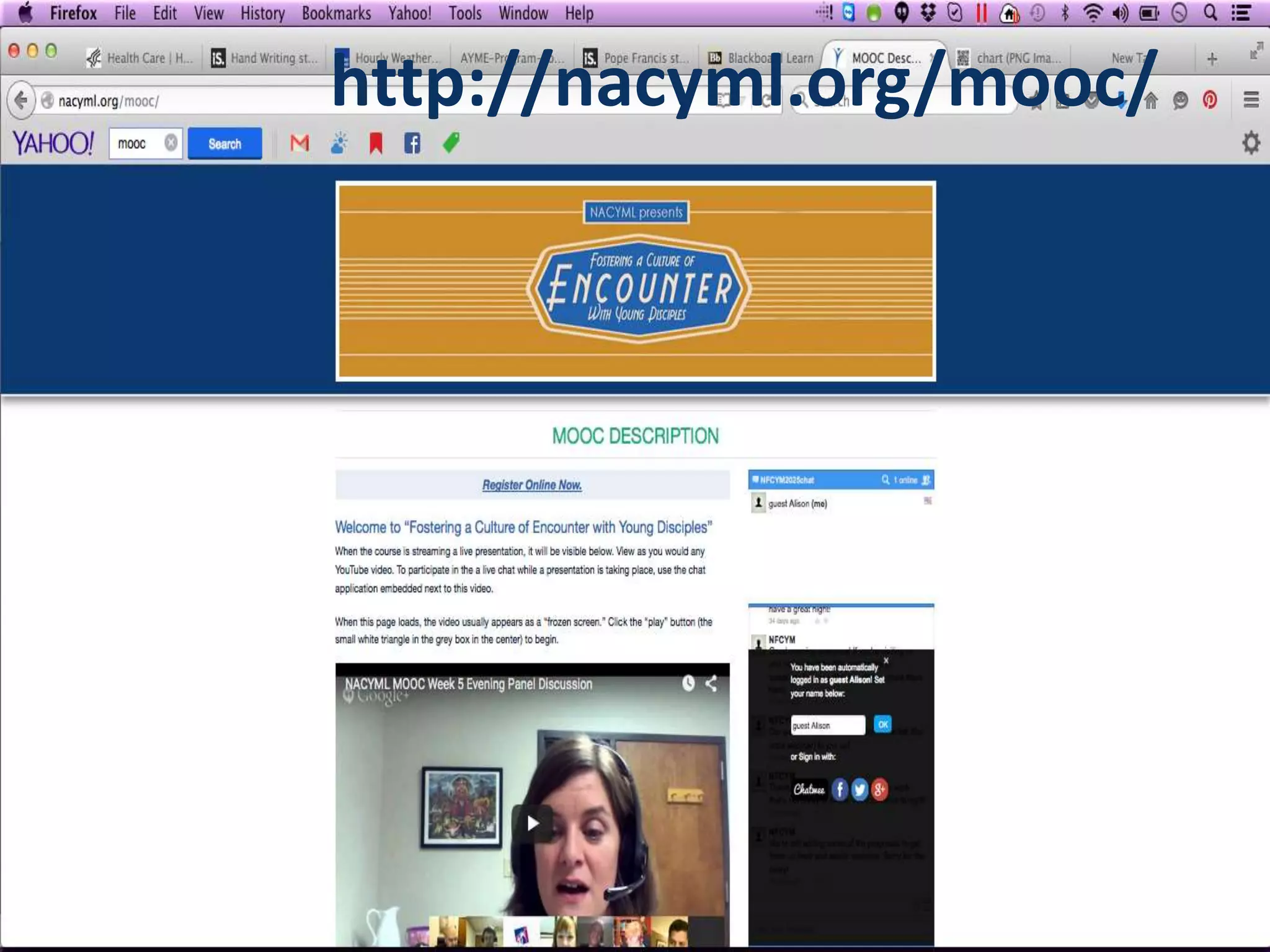
http://nacyml.org/mooc/
https://goo.gl/6jwBfr
WHAT MAKES A
GOOD
MOOC-TAIL?
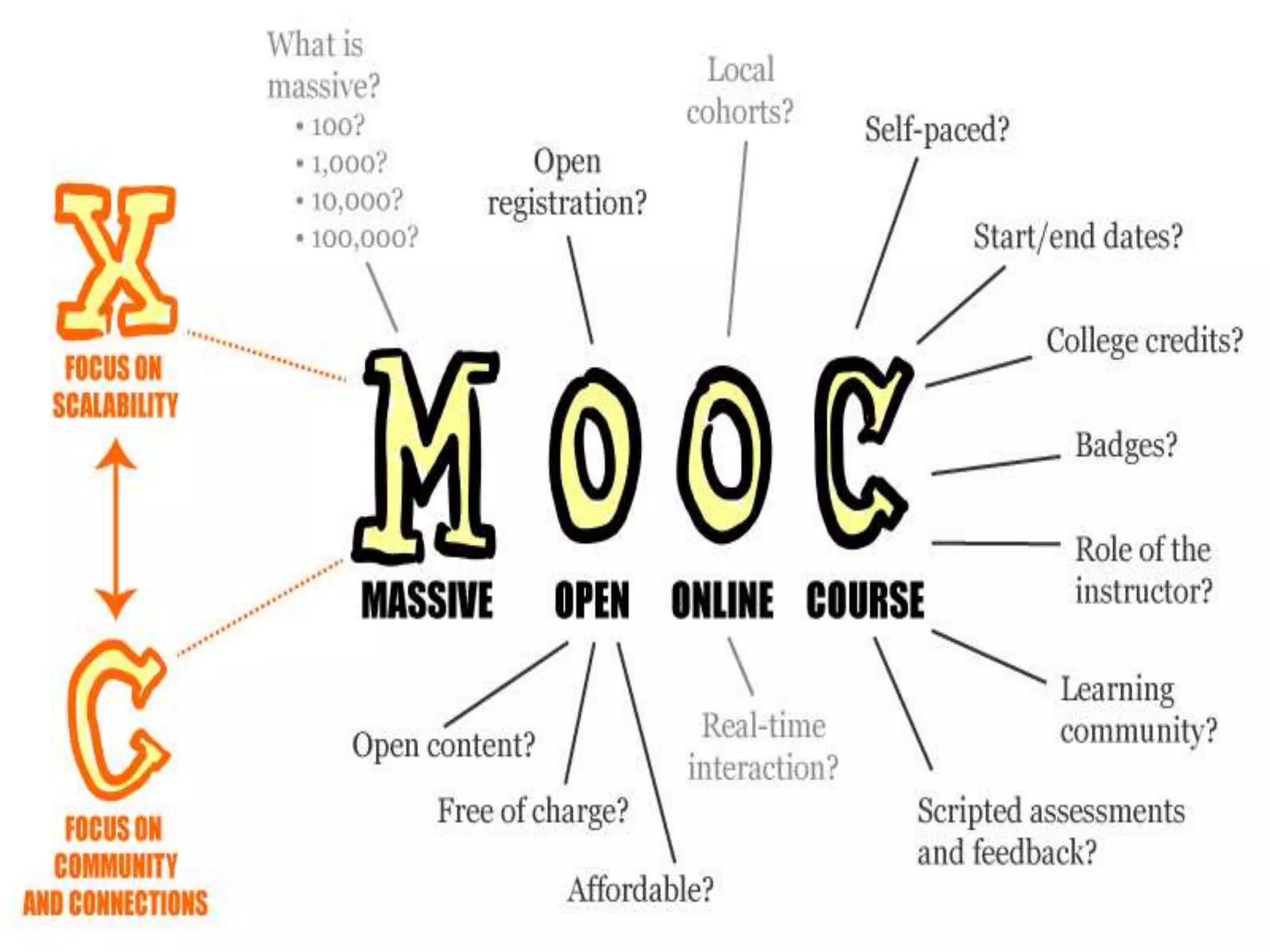
cMOOC
vs.
xMOOC
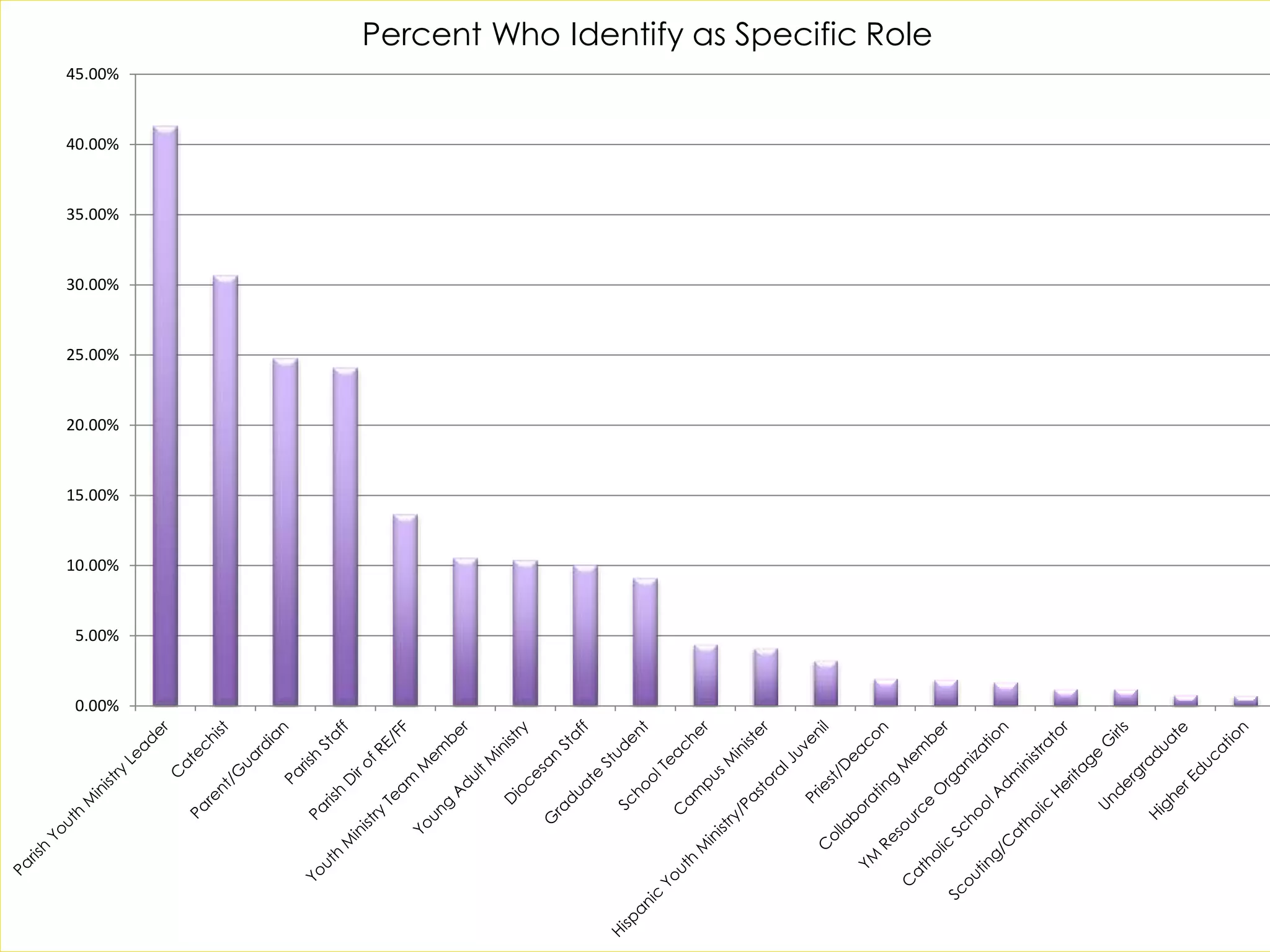
BY THE NUMBERS
1458 Registered at NACYML
1105 Enrolled on CourseSites
0.00%
5.00%
10.00%
15.00%
20.00%
25.00%
30.00%
35.00%
40.00%
45.00%
Percent Who Identify as Specific Role
“They indicated by a majority (59%) that they choose to participate
because of the overall topic and theme of MOOC. Only four percent were
interested in CEUs. The majority of these participants had at least a
bachelors degree with 37% having a graduate degree. Almost a third
(31%) of the week one survey participants found out about this event
through their diocesan leaders with another third (33%) finding out
about it from a national organization, and 11% finding out about it
through social media. (McCorquodale, 2015)”
From a MOOC Learner,
“The course pushed me
to read "Joy of the
Gospel." It is such a
pleasure to hear what our
pope has to say about
ministry and how down
to earth and real he is
about our ministries.”
How did people participate in the
MOOC?
Committed
Learners
vs.
Browsers
What Did People
Do?
0.00%
10.00%
20.00%
30.00%
40.00%
50.00%
60.00%
70.00%
80.00%
Read "The Joy of
the Gospel"
Watched Master
Teacher
Engaged in Live
Panel
Watched Live Panel
Video
Participated in
NetSourcing
Learning
Community
Used Learning
Content Partners
Shared on social
networks
Participated in a
gathering
Did Every or Almost Every Week
MOOC Participation
Options and Levels
• Passive Participants---11%
• Active Participants---52%
• Community Contributors---24%
Option 1: Self-Directed Individual Learner
What would you do each week as a learner?
Sunday-Tuesday
Read the weekly chapter in Evangelii Guadium
View video(s) by the Master Teacher(s) Tuesday
Participate In—or View the Recording—of the
live web discussion at 1:00pm or
9:00pm Eastern time zone
Wednesday-Saturday
Review and Reflect On the learning journal questions,
the educational and practical resources provided
by the theme content partners.
73.5% indicated
they thought
they were a self-
directed learner.
0
200
400
600
800
1000
1200
1400
1600
1800
2000
Week 1 2 3 4 5
Master Teacher
Afternoon Panel
Evening Panel
MOOC Video Views
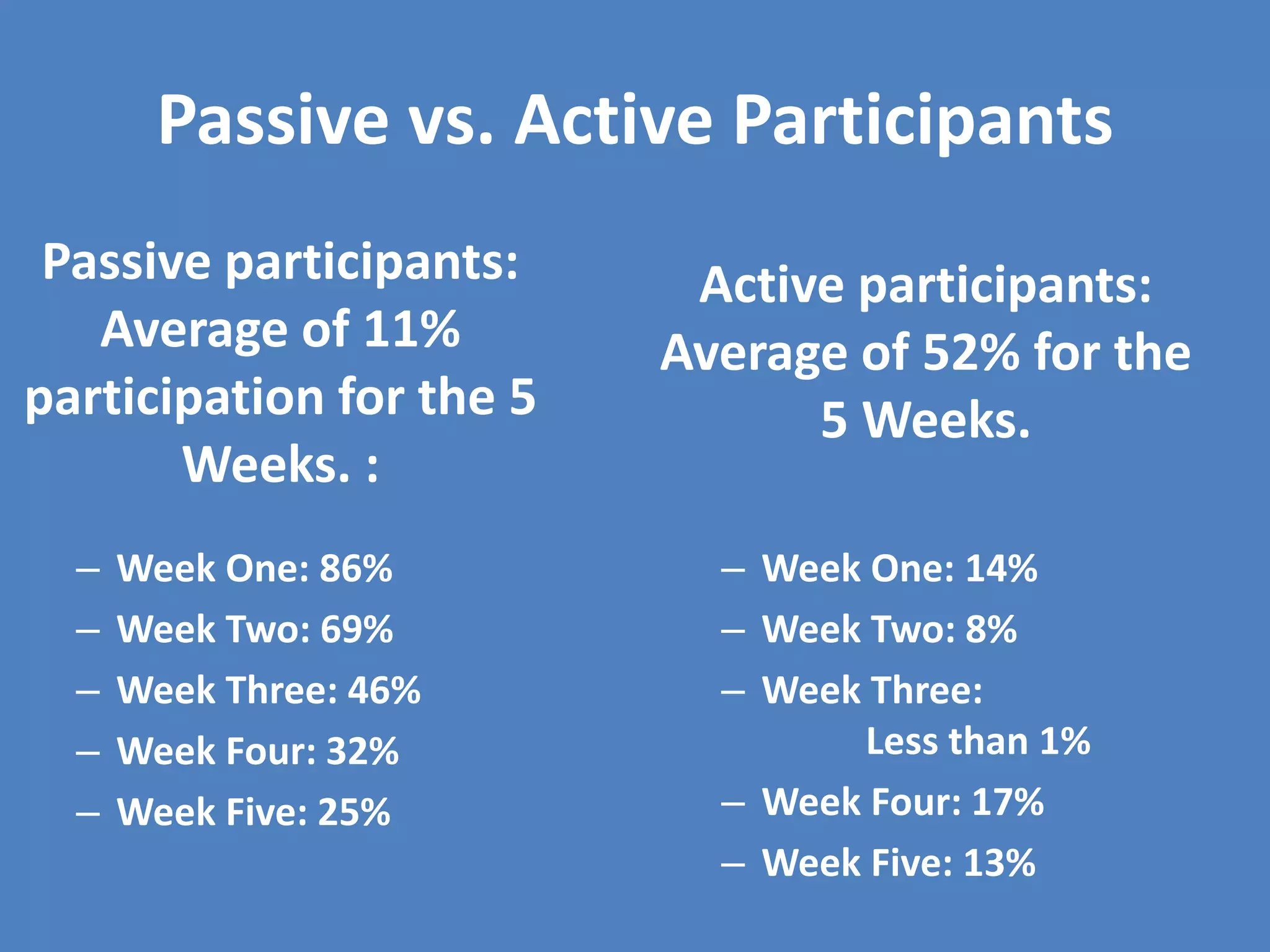
Passive vs. Active Participants
Passive participants:
Average of 11%
participation for the 5
Weeks. :
– Week One: 86%
– Week Two: 69%
– Week Three: 46%
– Week Four: 32%
– Week Five: 25%
Active participants:
Average of 52% for the
5 Weeks.
– Week One: 14%
– Week Two: 8%
– Week Three:
Less than 1%
– Week Four: 17%
– Week Five: 13%
Option 2: Join an Online
NetSourcing Learning Community
What would you do each
week as a learner?
Sunday-Tuesday
Read the weekly chapter in Evangelii Guadium
View video(s) by the Master Teacher(s)
Participate In—or View Recording of—the live web
discussions each Tuesday at 1:00pm or 9:00pm Eastern
Wednesday-Saturday
Engage with the theme partner resources, weekly questions, and discussions
in your chosen NetSourcing Learning Community
Friday-Saturday:
Share learrning with others via social media or in your local setting
Review summary posts from other NetSourcing Learning Communities
Complete and Submit online learning journal if interested in CEUs
Average of 23%
(N=252) for the
5 Weeks.
NetSourcing Learning Communities
• Parish Middle
School/Junior High
Ministry
• Catholic Middle
School/Junior High
Ministry
• Parish Senior High
Ministry
• Parents/Guardians
• Catholic High School
and Campus Ministry
• Young Adults and
College Campus
Ministry
• Catechetical Leaders
• Theology and
Ministry Formation
• Scouting
• Spanish Speaking
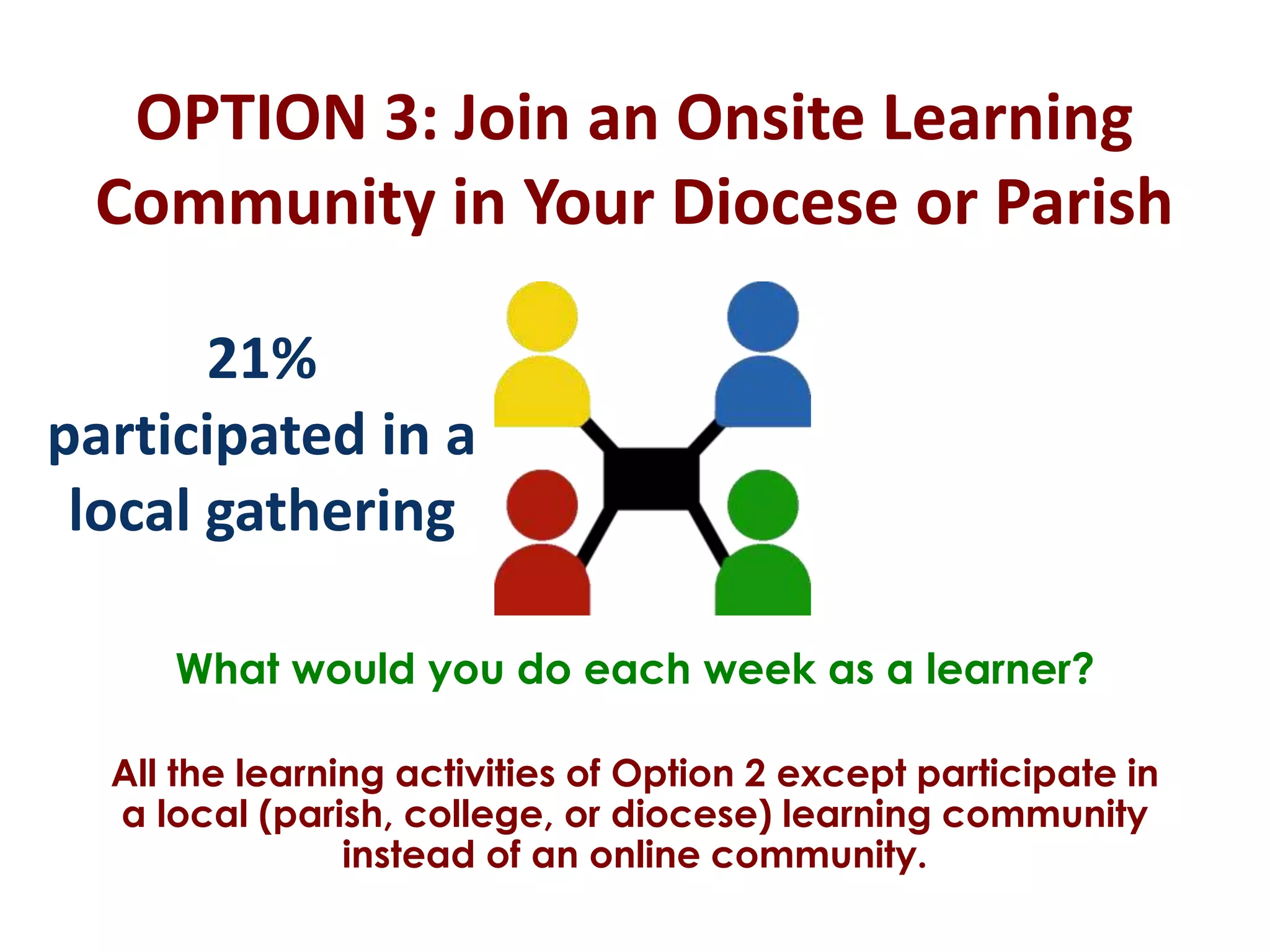
OPTION 3: Join an Onsite Learning
Community in Your Diocese or Parish
What would you do each week as a learner?
All the learning activities of Option 2 except participate in
a local (parish, college, or diocese) learning community
instead of an online community.
21%
participated in a
local gathering
How Did They Like It?
0.00%
10.00%
20.00%
30.00%
40.00%
50.00%
60.00%
70.00%
80.00%
90.00%
100.00%
Chapters from
"The Joy of the
Gospel"
Master Teacher
videos
Live Panels on
Tuesdays (or
videos)
NetSourcing
Learning
Communities
Materials from
Learning
Content
MOOC Face-to-
Face Gatherings
MOOC
Orientation
Ease of
Navigation of
CourseSites
Content of
Announcements
Explanation of
how to earn
CEUs
Percentage of Those Who Engaged in an Area and Rated Them
Excellent or Very Good
#NACYMLMOOC
Balch, T. (2013). About MOOC completion
rates: The importance of student investment.
“This is mainly because of the differing level of
investment the students make from the start. In
other words ’skin in the game’ matters. But MOOC
completion rates aren’t really low in the context of
Internet engagement. A click through rate of 5% for
a Google ad is considered a strong success.
Convincing 5% to engage intellectually for 8 weeks
is, I think, a big deal. If we continue to keep the
barrier to entry low, we’ll enable students to taste
many many courses, and that may be a good thing
for education.”
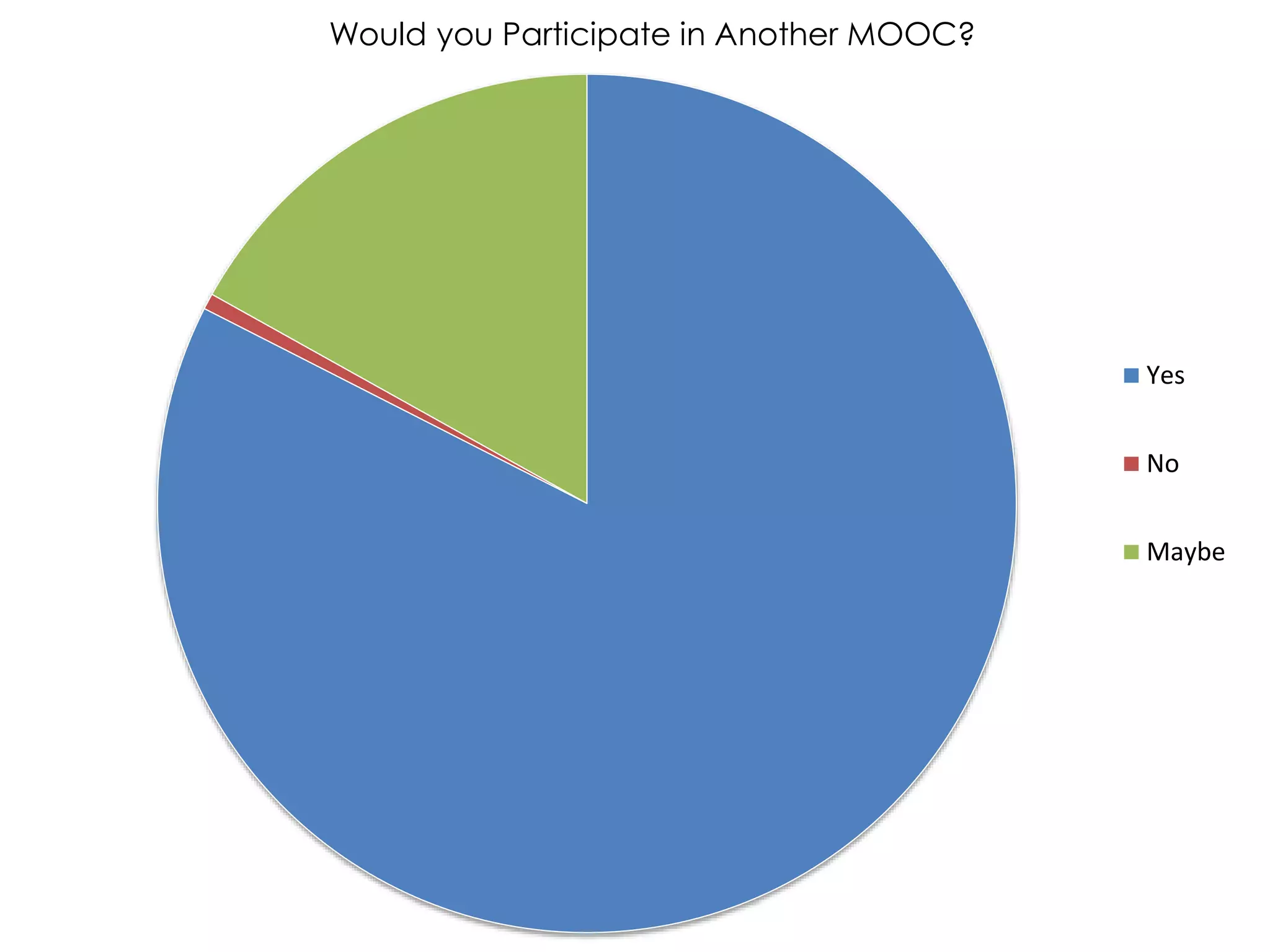
Would They Do It
Again?
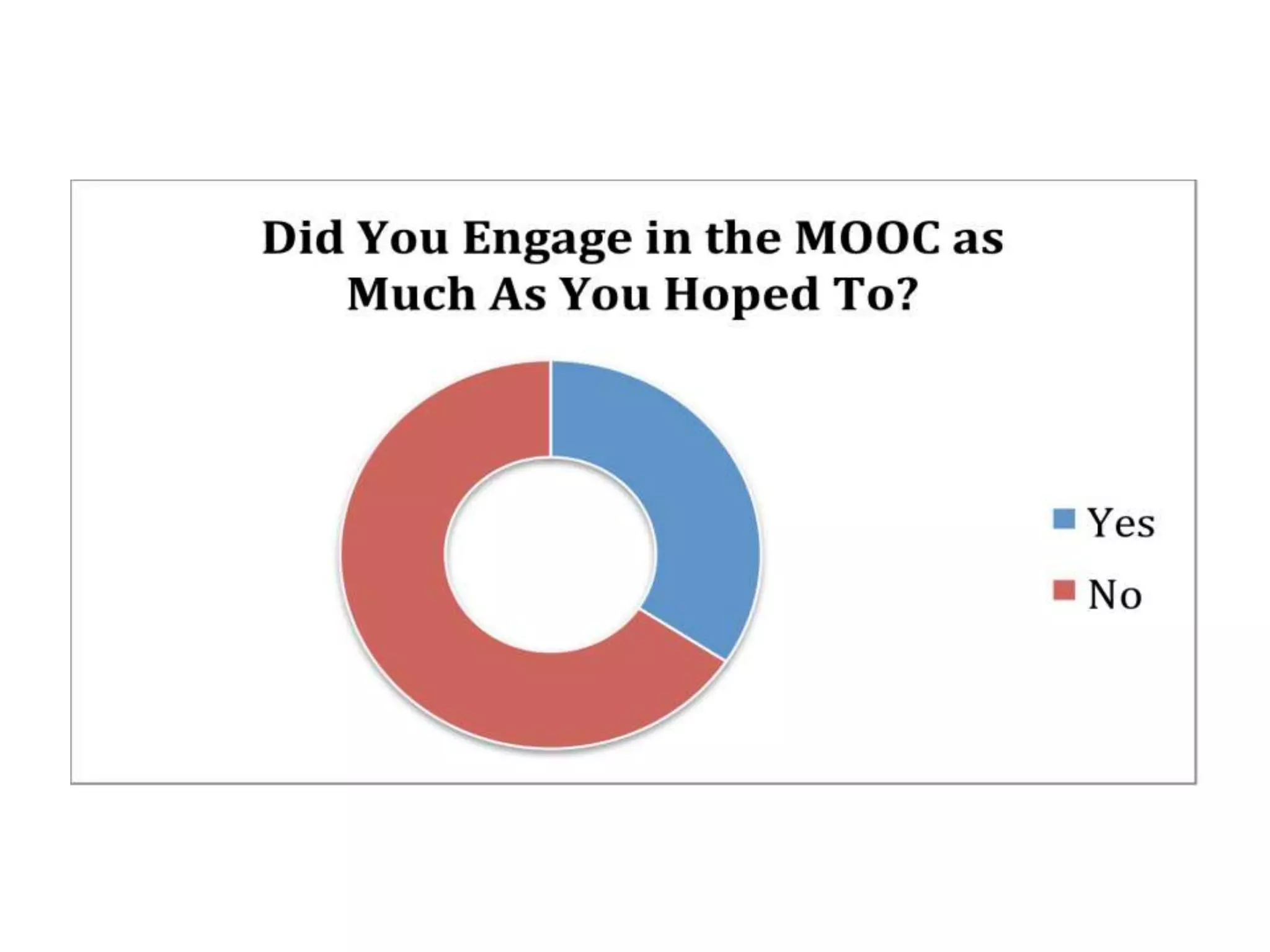
Would you Participate in Another MOOC?
Yes
No
Maybe
Join us for
NACYML MOOC #2
“Being a Church of Mercy”
February 28-March 19, 2016
2015 AYME MOOC PAPER

2015 AYME MOOC PAPER

  • 1.
    AYME 2015 CONFERENCE UsingMOOCS (Massively Open Online Courses) to Develop Intentional CoP’s (Communities of Practice) in Organizations Dr. Charlotte McCorquodale
  • 2.
    To MOOC orNot To MOOC?
  • 3.
    What are thequestions or issues related to this topic did you hope we would discuss today?
  • 4.
  • 5.
  • 6.
    Communities of practiceare groups of people who share a concern or a passion for something they do and learn how to do it better as they in teract regularly. (Wenger, 2011)
  • 7.
  • 8.
  • 9.
  • 10.
  • 12.
  • 15.
    BY THE NUMBERS 1458Registered at NACYML 1105 Enrolled on CourseSites 0.00% 5.00% 10.00% 15.00% 20.00% 25.00% 30.00% 35.00% 40.00% 45.00% Percent Who Identify as Specific Role
  • 16.
    “They indicated bya majority (59%) that they choose to participate because of the overall topic and theme of MOOC. Only four percent were interested in CEUs. The majority of these participants had at least a bachelors degree with 37% having a graduate degree. Almost a third (31%) of the week one survey participants found out about this event through their diocesan leaders with another third (33%) finding out about it from a national organization, and 11% finding out about it through social media. (McCorquodale, 2015)”
  • 17.
    From a MOOCLearner, “The course pushed me to read "Joy of the Gospel." It is such a pleasure to hear what our pope has to say about ministry and how down to earth and real he is about our ministries.”
  • 18.
    How did peopleparticipate in the MOOC?
  • 19.
  • 20.
    What Did People Do? 0.00% 10.00% 20.00% 30.00% 40.00% 50.00% 60.00% 70.00% 80.00% Read"The Joy of the Gospel" Watched Master Teacher Engaged in Live Panel Watched Live Panel Video Participated in NetSourcing Learning Community Used Learning Content Partners Shared on social networks Participated in a gathering Did Every or Almost Every Week
  • 21.
    MOOC Participation Options andLevels • Passive Participants---11% • Active Participants---52% • Community Contributors---24%
  • 22.
    Option 1: Self-DirectedIndividual Learner What would you do each week as a learner? Sunday-Tuesday Read the weekly chapter in Evangelii Guadium View video(s) by the Master Teacher(s) Tuesday Participate In—or View the Recording—of the live web discussion at 1:00pm or 9:00pm Eastern time zone Wednesday-Saturday Review and Reflect On the learning journal questions, the educational and practical resources provided by the theme content partners. 73.5% indicated they thought they were a self- directed learner.
  • 24.
    0 200 400 600 800 1000 1200 1400 1600 1800 2000 Week 1 23 4 5 Master Teacher Afternoon Panel Evening Panel MOOC Video Views
  • 25.
    Passive vs. ActiveParticipants Passive participants: Average of 11% participation for the 5 Weeks. : – Week One: 86% – Week Two: 69% – Week Three: 46% – Week Four: 32% – Week Five: 25% Active participants: Average of 52% for the 5 Weeks. – Week One: 14% – Week Two: 8% – Week Three: Less than 1% – Week Four: 17% – Week Five: 13%
  • 26.
    Option 2: Joinan Online NetSourcing Learning Community What would you do each week as a learner? Sunday-Tuesday Read the weekly chapter in Evangelii Guadium View video(s) by the Master Teacher(s) Participate In—or View Recording of—the live web discussions each Tuesday at 1:00pm or 9:00pm Eastern Wednesday-Saturday Engage with the theme partner resources, weekly questions, and discussions in your chosen NetSourcing Learning Community Friday-Saturday: Share learrning with others via social media or in your local setting Review summary posts from other NetSourcing Learning Communities Complete and Submit online learning journal if interested in CEUs Average of 23% (N=252) for the 5 Weeks.
  • 27.
    NetSourcing Learning Communities •Parish Middle School/Junior High Ministry • Catholic Middle School/Junior High Ministry • Parish Senior High Ministry • Parents/Guardians • Catholic High School and Campus Ministry • Young Adults and College Campus Ministry • Catechetical Leaders • Theology and Ministry Formation • Scouting • Spanish Speaking
  • 28.
    OPTION 3: Joinan Onsite Learning Community in Your Diocese or Parish What would you do each week as a learner? All the learning activities of Option 2 except participate in a local (parish, college, or diocese) learning community instead of an online community. 21% participated in a local gathering
  • 29.
    How Did TheyLike It? 0.00% 10.00% 20.00% 30.00% 40.00% 50.00% 60.00% 70.00% 80.00% 90.00% 100.00% Chapters from "The Joy of the Gospel" Master Teacher videos Live Panels on Tuesdays (or videos) NetSourcing Learning Communities Materials from Learning Content MOOC Face-to- Face Gatherings MOOC Orientation Ease of Navigation of CourseSites Content of Announcements Explanation of how to earn CEUs Percentage of Those Who Engaged in an Area and Rated Them Excellent or Very Good
  • 30.
  • 31.
    Balch, T. (2013).About MOOC completion rates: The importance of student investment. “This is mainly because of the differing level of investment the students make from the start. In other words ’skin in the game’ matters. But MOOC completion rates aren’t really low in the context of Internet engagement. A click through rate of 5% for a Google ad is considered a strong success. Convincing 5% to engage intellectually for 8 weeks is, I think, a big deal. If we continue to keep the barrier to entry low, we’ll enable students to taste many many courses, and that may be a good thing for education.”
  • 32.
    Would They DoIt Again? Would you Participate in Another MOOC? Yes No Maybe
  • 34.
    Join us for NACYMLMOOC #2 “Being a Church of Mercy” February 28-March 19, 2016

Editor's Notes

  • #4 What are your questions about this MOOC?
  • #7 Communities  of  practice  are  formed  by  people  who  engage  in  a  process  of  collective  learning  in  a  shared  domain  of  human  endeavor:  a  tribe  learning  to  survive,  a  band  of   artists  seeking  new  forms  of  expression,  a  group  of  engineers  working  on  similar  problems,  a  clique  of  pupils  defining  their  identity  in  the school,  a  network  of  surgeons  exploring  novel  techniques,  a  gathering  of  first-­‐time  managers  helping  each  other  cope.  In  a  nutshell: Communities  of  practice  are  groups  of  people  who  share  a  concern  or  a  passion  for  something  they  do  and  learn  how  to  do  it  better  as  they  interact  regularly.
  • #12 A distinction has been made between two types of MOOCs. Bates (2014) explains, “there are two quite different philosophical positions underpinning xMOOCs and cMOOCs…. xMOOCs primarily use a teaching model focused on the transmission of information, with high quality content delivery, computer-marked assessment (mainly for student feedback purposes), and automation of all key transactions between participants and the learning platform. There is almost no direct interaction between an individual participant and the instructor responsible for the course. cMOOCs have a very different educational philosophy from xMOOCs, in that cMOOCs place heavy emphasis on networking and in particular on strong content contributions from the participants themselves.”   Another way to see the distinction is by the learning theory that guides each type. The cMOOC model is based on the connectivism learning theory and xMOOC, on the behaviorism learning theory. The focus of cMOOCs is on knowledge construction and creation, putting emphasis on creation of new thinking, learner autonomy, and social network learning. xMOOCs are more traditional and focus on disseminating knowledge using common methods like teaching videos, assignments, and quizzes (Seimen 2012.) The most popular form is xMOOCs.   The NACYML MOOC was meant to be a hybrid of the two models by giving different paths of completion of the MOOC. It contained a traditional course format more like the xMOOC type but included the option for social learning in the Live Panel Sessions, via Social Media, in NetSourcing Learning Communities, and local learning groups (i.e. parish staff’s, diocesan gatherings, youth ministry leader networks) who gathered to discuss the insights gained from course materials. A large emphasis in this MOOC was on the learning dialogue that would take place on this central issue of encounter that impacts all that pass on faith to young disciples. Part of the goal was to identify new strategies and best practices and to explore new ideas to help with our knowledge creation in this area. This was done both through the creation of content through the MOOC and through the learning dialogue’s that took place.  
  • #13 A distinction has been made between two types of MOOCs. Bates (2014) explains, “there are two quite different philosophical positions underpinning xMOOCs and cMOOCs…. xMOOCs primarily use a teaching model focused on the transmission of information, with high quality content delivery, computer-marked assessment (mainly for student feedback purposes), and automation of all key transactions between participants and the learning platform. There is almost no direct interaction between an individual participant and the instructor responsible for the course. cMOOCs have a very different educational philosophy from xMOOCs, in that cMOOCs place heavy emphasis on networking and in particular on strong content contributions from the participants themselves.”   Another way to see the distinction is by the learning theory that guides each type. The cMOOC model is based on the connectivism learning theory and xMOOC, on the behaviorism learning theory. The focus of cMOOCs is on knowledge construction and creation, putting emphasis on creation of new thinking, learner autonomy, and social network learning. xMOOCs are more traditional and focus on disseminating knowledge using common methods like teaching videos, assignments, and quizzes (Seimen 2012.) The most popular form is xMOOCs.   The NACYML MOOC was meant to be a hybrid of the two models by giving different paths of completion of the MOOC. It contained a traditional course format more like the xMOOC type but included the option for social learning in the Live Panel Sessions, via Social Media, in NetSourcing Learning Communities, and local learning groups (i.e. parish staff’s, diocesan gatherings, youth ministry leader networks) who gathered to discuss the insights gained from course materials. A large emphasis in this MOOC was on the learning dialogue that would take place on this central issue of encounter that impacts all that pass on faith to young disciples. Part of the goal was to identify new strategies and best practices and to explore new ideas to help with our knowledge creation in this area. This was done both through the creation of content through the MOOC and through the learning dialogue’s that took place.
  • #17 The week one survey of 117 of the participants found that of those enrolled 77% were female and 23% male. They indicated by a majority (59%) that they choose to participate because of the overall topic and theme of MOOC. Only four percent were interested in CEUs. The majority of these participants had at least a bachelors degree with 37% having a graduate degree. Almost a third (31%) of the week one survey participants found out about this event through their diocesan leaders with another third (33%) finding out about it from a national organization, and 11% finding out about it through social media.  
  • #20 Koller, Ng and Chen (2013) denote the distinction between MOOCs “browsers” and committed learners, noting that “Committed learners, who tend to stay engaged throughout most or all of a class, can be divided into at least three partially overlapping groups: passive participants, active participants, and community contributors:
  • #21 However, through the evaluation, it was found that the majority of participants only participated in the core learning activities such as watching the master teacher videos (71%), reading the document (62%), and participating in the live sessions (50%).
  • #22 Passive participants engage with a MOOC predominantly through watching lecture videos, have limited participation on course forums, and typically attempt few assignments and quizzes (but may interact with in-video questions as needed to progress through the video content). Active participants engage in course content by completing homework assignments, quizzes, exams, and time-intensive programming or peer-graded assessments; they include the subset of "course completers" who do all the work necessary to earn a Statement of Accomplishment. Community contributors also actively participate in courses, but their specific means of interaction is through generation of new content, such as engaging in forum discussions or contributing foreign language subtitles.”
  • #23 In the Week One Survey, 73.5% indicated they thought they were a self-directed learner. identify existing resources or provide new resources to help further the learning and dialogue of the members of the learning communities. Resources could include video or written reflection, videos, webinar, or articles. • Provide a provocative question that links the theme and partner provided content.
  • #26 Passive participants: Average of 11% participation for the 5 Weeks. This participation level is defined in the MOOC as those who predominantly through watched master teacher videos and read the weekly Evangelii Gaudium. (The percentages were determined using the number of views of master teacher videos minus the number that participated in a live session that week.) Week One: 14% Week Two: 8% Week Three: Less than 1% Week Four: 17% Week Five: 13% Active participants: Average of 52% for the 5 Weeks. This participation level is defined predominantly through watching master teacher videos, reading of Evangelii Gaudium, and participating in the live panel sessions. (The percentages were determined using the number of views for each of the panel sessions each week.) Week One: 86% Week Two: 69% Week Three: 46% Week Four: 32% Week Five: 25%
  • #27 51% joined a NetSourcing Learning community but only 23% engaged at least at a minimal level Community contributors: Average of 23% (N=252) for the 5 Weeks. This participation level is defined by how many of the 1,105 enrolled made one or more posts in the NLC Discussion Forums. Since participation in an NLC was required for CEUs they are included in this level of participation. Six percent of those who participated at this level received CEUs.
  • #31 Social media ads where used on Facebook and a social media campaign was engaged to promote the MOOC. The majority of the MOOC learners (52%) had participated in an online course with 44% indicating that they had previously participated in an NFCYM youth or adult conference event.