South African Theological Response to
             Lausanne III

       Johannesburg, 1-2 November 2011

                 By Kevin G. Smith
ORIENTATION


South African Theological Response to Lausanne III
The Meeting
A group of 22 Christian leaders gathered on 1-2
Nov. 2011 in Johannesburg to explore a theological
response to Lausanne III for the South African
church. The meeting was initiated by TEASA and
organised by SATS. The participants included
theologians, pastors, and Christian leaders from
several missional organisations.


South African Theological Response to Lausanne III
The Purpose
The delegates spent the two days discussing the major
themes of Lausanne III with reference to the South
African context. The purpose was to address two
questions:
    1. How do the key issues raised by Lausanne III apply
       to the South African context?
    2. What critical issues in the South African context
       were not addressed by Lausanne III?

South African Theological Response to Lausanne III
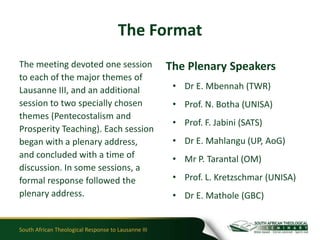
The Format
The meeting devoted one session                      The Plenary Speakers
to each of the major themes of
Lausanne III, and an additional                       • Dr E. Mbennah (TWR)
session to two specially chosen                       • Prof. N. Botha (UNISA)
themes (Pentecostalism and
                                                      • Prof. F. Jabini (SATS)
Prosperity Teaching). Each session
began with a plenary address,                         • Dr E. Mahlangu (UP, AoG)
and concluded with a time of                          • Mr P. Tarantal (OM)
discussion. In some sessions, a
formal response followed the                          • Prof. L. Kretzschmar (UNISA)
plenary address.                                      • Dr E. Mathole (GBC)


South African Theological Response to Lausanne III
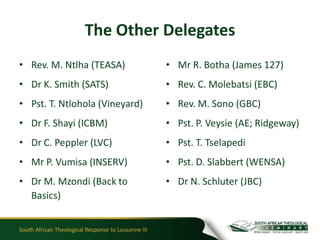
The Other Delegates
• Rev. M. Ntlha (TEASA)                              • Mr R. Botha (James 127)
• Dr K. Smith (SATS)                                 • Rev. C. Molebatsi (EBC)
• Pst. T. Ntlohola (Vineyard)                        • Rev. M. Sono (GBC)
• Dr F. Shayi (ICBM)                                 • Pst. P. Veysie (AE; Ridgeway)
• Dr C. Peppler (LVC)                                • Pst. T. Tselapedi
• Mr P. Vumisa (INSERV)                              • Pst. D. Slabbert (WENSA)
• Dr M. Mzondi (Back to                              • Dr N. Schluter (JBC)
  Basics)


South African Theological Response to Lausanne III
OUTCOMES


South African Theological Response to Lausanne III
Introduction                              The points that follow:
                                          • are not summaries of the
The slides that                             papers that were delivered;
follow present
                                          • are not presented in any
some of the issues
                                            particular order;
that were raised at
the consultation.                         • do not necessarily represent
                                            the consensus of the meeting
                                            or the views of the organisers;
                                          • are based on notes taken by
                                            Drs ZL Erdey and KG Smith.

South African Theological Response to Lausanne III
Exegetical Approach
• Our theological response to contextual issues must
  be an exegetical-hermeneutical approach. We cannot
  build evangelical theology purely or primarily by
  reflecting on praxis.
• Our practical or contextual theology must engage
  with present praxis, but it must formulate an
  exegetical response.


South African Theological Response to Lausanne III
Research
• There was a sense that something may be very
  wrong with the church in South Africa, and a
  balancing sense that our perceptions may not be
  based on a true understanding.
• We need to be engaged in ongoing research to
  ensure that we rightly understand the condition of
  the church in South Africa, and that we hear the
  perspectives of all segments of the church.


South African Theological Response to Lausanne III
The Truth of Christ
• We must bear witness to the true Christ in our
  pluralistic world. Many are preaching ‘christs’ other
  than the Lord Jesus Christ revealed in the word of
  God.
• There are many distorted portraits of Christ being
  propagated by well-meaning but ill-informed
  preachers (e.g. Christ the vending machine).


South African Theological Response to Lausanne III
Apologetics
The growing influence of pluralism in our country raises
the need for ongoing, robust, contextual apologetics.
  • We need more advanced training in apologetics for
    pastors and theologians within the African context.
  • Pluralism is not only a force in society; it is also a
    force at work in the church. We need to think
    through the growing trend towards theological and
    ecclesiastical pluralism.

South African Theological Response to Lausanne III
Theology of Power 1
• African Christianity needs to develop a biblical
  theology of power.
• Issues of power, especially economic power (who
  controls the purse), are important factors in issues of
  justice and peace (reconciliation).
• The shift of Christianity towards the global South is
  not yet reflected in its international power bases.


South African Theological Response to Lausanne III
Theology of Power 2
• Those with power often do not exercise their power
  to help the poor and the weak. The portrait of Jesus
  as the Suffering Servant needs to be recovered in the
  South African church.
• Prof. Botha called for a ‘power analysis’ (praxis and
  theology), leading to a theology of power and
  authority.


South African Theological Response to Lausanne III
Prophetic                                 • We may have lost our voice because
                                            we have lost ‘the moral high ground’,
Voice                                       i.e. lost credibility.
There was extensive
                                          • We can only speak with credibility
discussion about                            when we demonstrate that we are
regaining the                               taking the lead in the area of
church’s prophetic                          reconciliation.
voice in society, so
                                          • We need to be prophetic in terms of
that the church is                          understanding ‘the signs of the
able to speak into                          times’.
societal issues and
                                          • The prosperity movement may be
concerns.
                                            raising questions and meeting needs
                                            that we have not recognised.

South African Theological Response to Lausanne III
Two Portraits of Reality
• We need to listen to a statistical picture of what is
  happening in South Africa, but we must also balance
  that portrait with a narrative approach that listens to
  the stories of ordinary Christians living out their faith
  in extraordinary ways.
• An ideologically-based interpretation of the situation
  (e.g. reconciliation) runs the risk of skewing the
  stories that do not fit its framework.


South African Theological Response to Lausanne III
The Threat of Secularism
The primary ‘other faith’ in South Africa seems to be
secularism. Islam, Hinduism, Judaism are small minority
groups, but secularism is growing amongst all people
groups.
• The South African Constitution is overtly a secular
  constitution.
• The young, urban South African population is heavily
  influenced by secularism as a philosophy and value system.
• Pluralism is waging war against religion, especially Christianity.

South African Theological Response to Lausanne III
The Next Generation
• Robert Botha advocated an alternative approach to
  healing a nation: focus on the next generation. He
  argued that we spend too much energy trying to heal
  adults (therapeutic approach) and too little trying to
  shape the minds and futures of the children.
• We should focus more on those whose minds are not
  yet formed. If we can reach them, we can bring
  about positive and lasting change.


South African Theological Response to Lausanne III
Radical Discipleship
• We recognise the deficiency of transformative
  discipleship as a factor that permeates many of the
  problems facing the church today.
• Integrity, simplicity, and humility lie close to the
  heart of discipleship.
• Christians can only lead out of a place of wholeness,
  and minister effectively from the basis of a biblical
  worldview.

South African Theological Response to Lausanne III
Strategic                                 • The poor
Audiences                                 • Foreigners
We need a well-
                                          • Women and children at risk
developed
theology and                              • People of other faiths
strategy for living
                                          • Oral learners and non-readers
and ministering
among the
following groups in
our society:
                                            Question: What role should foreigners play in
                                            integrating other foreigners into the church?

South African Theological Response to Lausanne III
Issues of Christian Identity
• The critical issues of humility, simplicity, and integrity,
  together with their antitheses—pride, materialism, and
  hypocrisy—are closely related to people’s sense of
  identity.

• We need to understand the forces that shape the way
  believers think of themselves (e.g. issues of race, gender,
  and past experiences).

• Proper identity is vital if people are to live and lead out of
  a place of wholeness.

South African Theological Response to Lausanne III
Pentecostalism
• Pentecostalism was identified as an important sub-
  movement of the evangelical church in South Africa, but
  one that has often been misunderstood. We need to
  correct many popular misunderstandings about
  Pentecostalism.

• We need a proper understanding of Pentecostalism’s
  potential contribution to evangelism and missions in
  South Africa. The Pentecostal church needs to
  contextualise its mission.

South African Theological Response to Lausanne III
Prosperity Teaching
• We need to develop and promote a biblical theology of
  prosperity, which provides hope but avoids manipulation.

• We need to teach the younger generation the dignity of
  work and the value of education, inspiring them to
  become professionals with a biblical worldview.

• In the face of rampant secularism, materialism, and
  consumerism, it is critical to teach the church about
  simplicity and contentment (Matt. 6; 1 Tim. 6).


South African Theological Response to Lausanne III
African Models of Mission
• Several participants expressed frustration with the
  South African church’s over-dependence on western
  models of mission and ministry.
• We need to develop distinctly African alternatives. In
  some cases, we have already developed African
  approaches to mission and ministry, but we have not
  published and disseminated them as viable
  alternatives.


South African Theological Response to Lausanne III
Spiritual Forces
• We need to revisit our theology of the spirit realm,
  and the role of spiritual forces in breaking down
  society, assaulting the church, and promoting
  violence and crime.
• The biblical perspective surely lies between Western
  theology’s disregard for the spirit world and African
  traditional religion’s obsession with it.


South African Theological Response to Lausanne III
Contemporary Abuses
• Selling indulgences (healing oil; prayer cloths)
• Distorted concepts of ‘the anointing’
• Pastors as kings in their chiefdoms
   – Pastors with armour-bearers
   – Pastors with lofty titles (Apostle; King)
• Poor people, smart cars (mammon-based identity)
• Lack of accountability structures (e.g. offering deposited
  into pastor’s account)

South African Theological Response to Lausanne III
Islam
• Islam is a growing force in Africa, and is seeking a
  gateway into South Africa, which is the key nation in
  Southern Africa.
• We need a deeper social understanding of Islam. We
  need to move beyond teaching theological students
  the basics about Islam, and help them to understand
  the social forces of Islam more deeply.


South African Theological Response to Lausanne III
THE END


South African Theological Response to Lausanne III

South African Theological Response to Lausanne III

  • 1.
    South African TheologicalResponse to Lausanne III Johannesburg, 1-2 November 2011 By Kevin G. Smith
  • 2.
    ORIENTATION South African TheologicalResponse to Lausanne III
  • 3.
    The Meeting A groupof 22 Christian leaders gathered on 1-2 Nov. 2011 in Johannesburg to explore a theological response to Lausanne III for the South African church. The meeting was initiated by TEASA and organised by SATS. The participants included theologians, pastors, and Christian leaders from several missional organisations. South African Theological Response to Lausanne III
  • 4.
    The Purpose The delegatesspent the two days discussing the major themes of Lausanne III with reference to the South African context. The purpose was to address two questions: 1. How do the key issues raised by Lausanne III apply to the South African context? 2. What critical issues in the South African context were not addressed by Lausanne III? South African Theological Response to Lausanne III
  • 5.
    The Format The meetingdevoted one session The Plenary Speakers to each of the major themes of Lausanne III, and an additional • Dr E. Mbennah (TWR) session to two specially chosen • Prof. N. Botha (UNISA) themes (Pentecostalism and • Prof. F. Jabini (SATS) Prosperity Teaching). Each session began with a plenary address, • Dr E. Mahlangu (UP, AoG) and concluded with a time of • Mr P. Tarantal (OM) discussion. In some sessions, a formal response followed the • Prof. L. Kretzschmar (UNISA) plenary address. • Dr E. Mathole (GBC) South African Theological Response to Lausanne III
  • 6.
    The Other Delegates •Rev. M. Ntlha (TEASA) • Mr R. Botha (James 127) • Dr K. Smith (SATS) • Rev. C. Molebatsi (EBC) • Pst. T. Ntlohola (Vineyard) • Rev. M. Sono (GBC) • Dr F. Shayi (ICBM) • Pst. P. Veysie (AE; Ridgeway) • Dr C. Peppler (LVC) • Pst. T. Tselapedi • Mr P. Vumisa (INSERV) • Pst. D. Slabbert (WENSA) • Dr M. Mzondi (Back to • Dr N. Schluter (JBC) Basics) South African Theological Response to Lausanne III
  • 7.
    OUTCOMES South African TheologicalResponse to Lausanne III
  • 8.
    Introduction The points that follow: • are not summaries of the The slides that papers that were delivered; follow present • are not presented in any some of the issues particular order; that were raised at the consultation. • do not necessarily represent the consensus of the meeting or the views of the organisers; • are based on notes taken by Drs ZL Erdey and KG Smith. South African Theological Response to Lausanne III
  • 9.
    Exegetical Approach • Ourtheological response to contextual issues must be an exegetical-hermeneutical approach. We cannot build evangelical theology purely or primarily by reflecting on praxis. • Our practical or contextual theology must engage with present praxis, but it must formulate an exegetical response. South African Theological Response to Lausanne III
  • 10.
    Research • There wasa sense that something may be very wrong with the church in South Africa, and a balancing sense that our perceptions may not be based on a true understanding. • We need to be engaged in ongoing research to ensure that we rightly understand the condition of the church in South Africa, and that we hear the perspectives of all segments of the church. South African Theological Response to Lausanne III
  • 11.
    The Truth ofChrist • We must bear witness to the true Christ in our pluralistic world. Many are preaching ‘christs’ other than the Lord Jesus Christ revealed in the word of God. • There are many distorted portraits of Christ being propagated by well-meaning but ill-informed preachers (e.g. Christ the vending machine). South African Theological Response to Lausanne III
  • 12.
    Apologetics The growing influenceof pluralism in our country raises the need for ongoing, robust, contextual apologetics. • We need more advanced training in apologetics for pastors and theologians within the African context. • Pluralism is not only a force in society; it is also a force at work in the church. We need to think through the growing trend towards theological and ecclesiastical pluralism. South African Theological Response to Lausanne III
  • 13.
    Theology of Power1 • African Christianity needs to develop a biblical theology of power. • Issues of power, especially economic power (who controls the purse), are important factors in issues of justice and peace (reconciliation). • The shift of Christianity towards the global South is not yet reflected in its international power bases. South African Theological Response to Lausanne III
  • 14.
    Theology of Power2 • Those with power often do not exercise their power to help the poor and the weak. The portrait of Jesus as the Suffering Servant needs to be recovered in the South African church. • Prof. Botha called for a ‘power analysis’ (praxis and theology), leading to a theology of power and authority. South African Theological Response to Lausanne III
  • 15.
    Prophetic • We may have lost our voice because we have lost ‘the moral high ground’, Voice i.e. lost credibility. There was extensive • We can only speak with credibility discussion about when we demonstrate that we are regaining the taking the lead in the area of church’s prophetic reconciliation. voice in society, so • We need to be prophetic in terms of that the church is understanding ‘the signs of the able to speak into times’. societal issues and • The prosperity movement may be concerns. raising questions and meeting needs that we have not recognised. South African Theological Response to Lausanne III
  • 16.
    Two Portraits ofReality • We need to listen to a statistical picture of what is happening in South Africa, but we must also balance that portrait with a narrative approach that listens to the stories of ordinary Christians living out their faith in extraordinary ways. • An ideologically-based interpretation of the situation (e.g. reconciliation) runs the risk of skewing the stories that do not fit its framework. South African Theological Response to Lausanne III
  • 17.
    The Threat ofSecularism The primary ‘other faith’ in South Africa seems to be secularism. Islam, Hinduism, Judaism are small minority groups, but secularism is growing amongst all people groups. • The South African Constitution is overtly a secular constitution. • The young, urban South African population is heavily influenced by secularism as a philosophy and value system. • Pluralism is waging war against religion, especially Christianity. South African Theological Response to Lausanne III
  • 18.
    The Next Generation •Robert Botha advocated an alternative approach to healing a nation: focus on the next generation. He argued that we spend too much energy trying to heal adults (therapeutic approach) and too little trying to shape the minds and futures of the children. • We should focus more on those whose minds are not yet formed. If we can reach them, we can bring about positive and lasting change. South African Theological Response to Lausanne III
  • 19.
    Radical Discipleship • Werecognise the deficiency of transformative discipleship as a factor that permeates many of the problems facing the church today. • Integrity, simplicity, and humility lie close to the heart of discipleship. • Christians can only lead out of a place of wholeness, and minister effectively from the basis of a biblical worldview. South African Theological Response to Lausanne III
  • 20.
    Strategic • The poor Audiences • Foreigners We need a well- • Women and children at risk developed theology and • People of other faiths strategy for living • Oral learners and non-readers and ministering among the following groups in our society: Question: What role should foreigners play in integrating other foreigners into the church? South African Theological Response to Lausanne III
  • 21.
    Issues of ChristianIdentity • The critical issues of humility, simplicity, and integrity, together with their antitheses—pride, materialism, and hypocrisy—are closely related to people’s sense of identity. • We need to understand the forces that shape the way believers think of themselves (e.g. issues of race, gender, and past experiences). • Proper identity is vital if people are to live and lead out of a place of wholeness. South African Theological Response to Lausanne III
  • 22.
    Pentecostalism • Pentecostalism wasidentified as an important sub- movement of the evangelical church in South Africa, but one that has often been misunderstood. We need to correct many popular misunderstandings about Pentecostalism. • We need a proper understanding of Pentecostalism’s potential contribution to evangelism and missions in South Africa. The Pentecostal church needs to contextualise its mission. South African Theological Response to Lausanne III
  • 23.
    Prosperity Teaching • Weneed to develop and promote a biblical theology of prosperity, which provides hope but avoids manipulation. • We need to teach the younger generation the dignity of work and the value of education, inspiring them to become professionals with a biblical worldview. • In the face of rampant secularism, materialism, and consumerism, it is critical to teach the church about simplicity and contentment (Matt. 6; 1 Tim. 6). South African Theological Response to Lausanne III
  • 24.
    African Models ofMission • Several participants expressed frustration with the South African church’s over-dependence on western models of mission and ministry. • We need to develop distinctly African alternatives. In some cases, we have already developed African approaches to mission and ministry, but we have not published and disseminated them as viable alternatives. South African Theological Response to Lausanne III
  • 25.
    Spiritual Forces • Weneed to revisit our theology of the spirit realm, and the role of spiritual forces in breaking down society, assaulting the church, and promoting violence and crime. • The biblical perspective surely lies between Western theology’s disregard for the spirit world and African traditional religion’s obsession with it. South African Theological Response to Lausanne III
  • 26.
    Contemporary Abuses • Sellingindulgences (healing oil; prayer cloths) • Distorted concepts of ‘the anointing’ • Pastors as kings in their chiefdoms – Pastors with armour-bearers – Pastors with lofty titles (Apostle; King) • Poor people, smart cars (mammon-based identity) • Lack of accountability structures (e.g. offering deposited into pastor’s account) South African Theological Response to Lausanne III
  • 27.
    Islam • Islam isa growing force in Africa, and is seeking a gateway into South Africa, which is the key nation in Southern Africa. • We need a deeper social understanding of Islam. We need to move beyond teaching theological students the basics about Islam, and help them to understand the social forces of Islam more deeply. South African Theological Response to Lausanne III
  • 28.
    THE END South AfricanTheological Response to Lausanne III