DOING SYSTEMATIC THEOLOGY

From Grant Osborne's Hermeneutical Spiral


              By Kevin G. Smith
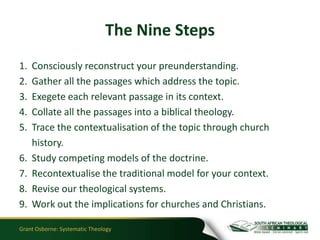
The Nine Steps
1.   Consciously reconstruct your preunderstanding.
2.   Gather all the passages which address the topic.
3.   Exegete each relevant passage in its context.
4.   Collate all the passages into a biblical theology.
5.   Trace the contextualisation of the topic through church
     history.
6.   Study competing models of the doctrine.
7.   Recontextualise the traditional model for your context.
8.   Revise our theological systems.
9.   Work out the implications for churches and Christians.

Grant Osborne: Systematic Theology
1. Preunderstanding
Consciously reconstruct our preunderstanding.
   1. We must define where we and our tradition stand on the
      doctrine before we begin our study. This needs to happen at
      three levels: individual, church, and denomination.
   2. Unless we do this consciously, our preunderstanding will
      dominate and skew our conclusions, for we naturally want our
      study to confirm rather than challenge our beliefs.
   3. Placing our preunderstanding in front of the biblical data helps
      us to use it positive (to analyse the evidence) rather than
      negatively (to shape our conclusions).


Grant Osborne: Systematic Theology
2. Passages
We must gather all the passages of scripture which address our
topic.
   1. We should make use of a concordance approach to identify
      the texts.
   2. We should consult books and articles on the topic to see
      which passages are discussed.
   3. We should pay particular attention to passages which
      seem to disagree with tradition's position.


Grant Osborne: Systematic Theology
3. Exegesis
We must exegete all the relevant passages in their context.
   1. This is seldom possible for practical reasons of space and
      time, but it remains the only right way to formulate sound
      doctrine.
   2. There is a danger in placing scriptural texts side by side, since it
      can distort their intended meaning, which is a variation of the
      facility called “illegitimate totality transfer”.
   3. We must discover what aspect of the topic a text addresses in its
      context before bring it into dialogue with other texts, that
      is, before we consider the larger theological truth that emerges
      when we bring all the texts together.
Grant Osborne: Systematic Theology
4. Biblical Theology
We must collate all the passages into a biblical theology.
   1. Diachronic: We need to see to the diachronic development of
      the doctrine in scripture, using the history of salvation as our
      framework.
   2. Synchronic: We need to understand the beliefs of Israel or the
      early church with respect to the doctrine, and viewed on their
      own terms.
   3. We can think of this as a systematic theology of the biblical
      writers’ beliefs. We must understand what they believed before
      we can contextualise or reconstruct it for the contemporary
      church.
Grant Osborne: Systematic Theology
5. Historical Theology
We must trace the developing contextualisation of the doctrine
through church history.
   1. We should study how the church has restated and applied
      the doctrine to meet different situations and needs.
   2. We learn from both negative restatements (heresy) and
      positive restatements (creeds; confessions).
   3. We should pay particular attention to the development of
      our own tradition to see where it fits into the development
      of doctrine.


Grant Osborne: Systematic Theology
6. Doctrinal Models
We must study competing models of the doctrine.
   1. Our own models of theological truth are influenced by our
      tradition, community, and experience. We need to critique
      them in the light of alternative models.
   2. Giving serious and continuous consideration to alternative
      models of constructing the doctrine will help to keep us
      intellectually honest by pinpointing the weaknesses in our
      model.


Grant Osborne: Systematic Theology
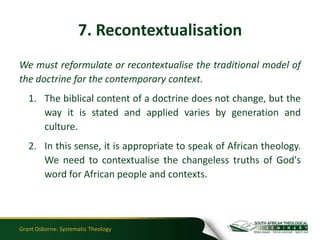
7. Recontextualisation
We must reformulate or recontextualise the traditional model of
the doctrine for the contemporary context.
   1. The biblical content of a doctrine does not change, but the
      way it is stated and applied varies by generation and
      culture.
   2. In this sense, it is appropriate to speak of African theology.
      We need to contextualise the changeless truths of God's
      word for African people and contexts.


Grant Osborne: Systematic Theology
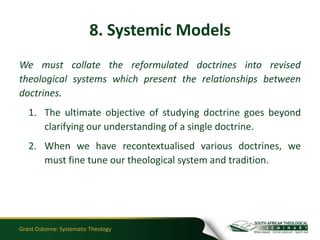
8. Systemic Models
We must collate the reformulated doctrines into revised
theological systems which present the relationships between
doctrines.
   1. The ultimate objective of studying doctrine goes beyond
      clarifying our understanding of a single doctrine.
   2. When we have recontextualised various doctrines, we
      must fine tune our theological system and tradition.


Grant Osborne: Systematic Theology
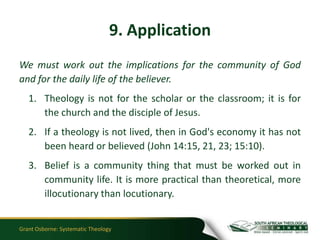
9. Application
We must work out the implications for the community of God
and for the daily life of the believer.
   1. Theology is not for the scholar or the classroom; it is for
      the church and the disciple of Jesus.
   2. If a theology is not lived, then in God's economy it has not
      been heard or believed (John 14:15, 21, 23; 15:10).
   3. Belief is a community thing that must be worked out in
      community life. It is more practical than theoretical, more
      illocutionary than locutionary.


Grant Osborne: Systematic Theology

Systematic Theology (Osborne's Model)

  • 1.
    DOING SYSTEMATIC THEOLOGY FromGrant Osborne's Hermeneutical Spiral By Kevin G. Smith
  • 2.
    The Nine Steps 1. Consciously reconstruct your preunderstanding. 2. Gather all the passages which address the topic. 3. Exegete each relevant passage in its context. 4. Collate all the passages into a biblical theology. 5. Trace the contextualisation of the topic through church history. 6. Study competing models of the doctrine. 7. Recontextualise the traditional model for your context. 8. Revise our theological systems. 9. Work out the implications for churches and Christians. Grant Osborne: Systematic Theology
  • 3.
    1. Preunderstanding Consciously reconstructour preunderstanding. 1. We must define where we and our tradition stand on the doctrine before we begin our study. This needs to happen at three levels: individual, church, and denomination. 2. Unless we do this consciously, our preunderstanding will dominate and skew our conclusions, for we naturally want our study to confirm rather than challenge our beliefs. 3. Placing our preunderstanding in front of the biblical data helps us to use it positive (to analyse the evidence) rather than negatively (to shape our conclusions). Grant Osborne: Systematic Theology
  • 4.
    2. Passages We mustgather all the passages of scripture which address our topic. 1. We should make use of a concordance approach to identify the texts. 2. We should consult books and articles on the topic to see which passages are discussed. 3. We should pay particular attention to passages which seem to disagree with tradition's position. Grant Osborne: Systematic Theology
  • 5.
    3. Exegesis We mustexegete all the relevant passages in their context. 1. This is seldom possible for practical reasons of space and time, but it remains the only right way to formulate sound doctrine. 2. There is a danger in placing scriptural texts side by side, since it can distort their intended meaning, which is a variation of the facility called “illegitimate totality transfer”. 3. We must discover what aspect of the topic a text addresses in its context before bring it into dialogue with other texts, that is, before we consider the larger theological truth that emerges when we bring all the texts together. Grant Osborne: Systematic Theology
  • 6.
    4. Biblical Theology Wemust collate all the passages into a biblical theology. 1. Diachronic: We need to see to the diachronic development of the doctrine in scripture, using the history of salvation as our framework. 2. Synchronic: We need to understand the beliefs of Israel or the early church with respect to the doctrine, and viewed on their own terms. 3. We can think of this as a systematic theology of the biblical writers’ beliefs. We must understand what they believed before we can contextualise or reconstruct it for the contemporary church. Grant Osborne: Systematic Theology
  • 7.
    5. Historical Theology Wemust trace the developing contextualisation of the doctrine through church history. 1. We should study how the church has restated and applied the doctrine to meet different situations and needs. 2. We learn from both negative restatements (heresy) and positive restatements (creeds; confessions). 3. We should pay particular attention to the development of our own tradition to see where it fits into the development of doctrine. Grant Osborne: Systematic Theology
  • 8.
    6. Doctrinal Models Wemust study competing models of the doctrine. 1. Our own models of theological truth are influenced by our tradition, community, and experience. We need to critique them in the light of alternative models. 2. Giving serious and continuous consideration to alternative models of constructing the doctrine will help to keep us intellectually honest by pinpointing the weaknesses in our model. Grant Osborne: Systematic Theology
  • 9.
    7. Recontextualisation We mustreformulate or recontextualise the traditional model of the doctrine for the contemporary context. 1. The biblical content of a doctrine does not change, but the way it is stated and applied varies by generation and culture. 2. In this sense, it is appropriate to speak of African theology. We need to contextualise the changeless truths of God's word for African people and contexts. Grant Osborne: Systematic Theology
  • 10.
    8. Systemic Models Wemust collate the reformulated doctrines into revised theological systems which present the relationships between doctrines. 1. The ultimate objective of studying doctrine goes beyond clarifying our understanding of a single doctrine. 2. When we have recontextualised various doctrines, we must fine tune our theological system and tradition. Grant Osborne: Systematic Theology
  • 11.
    9. Application We mustwork out the implications for the community of God and for the daily life of the believer. 1. Theology is not for the scholar or the classroom; it is for the church and the disciple of Jesus. 2. If a theology is not lived, then in God's economy it has not been heard or believed (John 14:15, 21, 23; 15:10). 3. Belief is a community thing that must be worked out in community life. It is more practical than theoretical, more illocutionary than locutionary. Grant Osborne: Systematic Theology