Thomas R. Connors
tommosaic@gmail.com

 A concept which originated with the Hebrew nation, adopted
by the early church, and was inclusive of all God’s people
 Changed its meaning to only refer to clergy after Constantine
became Roman emperor in 325 C.E.
 Reformation broadened its definition to regain its earlier
definition with a strong emphasis on one’s employment
 Presently, most calling research is career centered without a
theistic caller (Myers, 2015).
Background and Context of
Calling as a Construct
Vocational Clergy
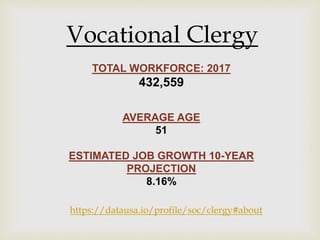
TOTAL WORKFORCE: 2017
432,559
AVERAGE AGE
51
ESTIMATED JOB GROWTH 10-YEAR
PROJECTION
8.16%
https://datausa.io/profile/soc/clergy#about

This large workforce cite a calling from God as the
over-whelming reason why they attend seminaries and
go into ministry (Lose, 2015), and yet, the experience of
that phenomenon has been hardly researched. Thus,
much ambiguity and confusion exists about the
existential nature of a pastoral calling.
Problem Statement

The paucity of research literature in theistic callings
is found in several areas:
 Vocational calling research that has a theistic component
(Myers, 2015)
 Phenomenological and descriptive research rather than
prescriptive and exegetical commentaries
(McKenna, 2015)
 Epistemic analysis and research of a pastoral calling
(Duffy, Allan, Bott, & Dik, 2014)
Gap in Literature

“Finally, this was an exploratory study that used
relatively simple analyses and did not take into account
potential third variables such as religiousness that may
explain why certain individuals endorse particular
calling sources. Investigating these predictors is an
important area of future research.”
Duffy, Allan, Bott, & Dik, 2014, p. 572
Gap in Literature

Thus, the purpose of this phenomenological study is to
describe the experience of seasoned pastors in the
search and sense of their calling to the ministry.
Purpose

Research Questions
 How do seasoned pastors describe their initial
experiences of calling?
 How do they describe the ways in which they have
critically reflected on the experiences of their
calling?
 How do seasoned pastors describe the subsequent
actions that have resulted from their calling?
 How do pastors describe the development of their
calling?

Literature Review
A Phenomenological Understanding of a Calling with Implications
for Pastoral and Vocational Education

Introduction
“…our results suggest that a holistic and systematic
approach to studying the unique belief in a transcendent
caller may advance our understanding of one's calling.”
(McKenna et al., 2015, p. 301)
Literature Review

Introduction
The scarcity of phenomenological literature on a pastoral
calling led to an eclectic survey of research that explored
various disciplines of the human sciences and theology
that addressed the phenomenon of a theistic calling.
Literature Review
Psychology Theology
Vocational Epistemology

Psychology Literature
A pastor’s calling is a deep structured professional identity
which fundamentally shapes one’s self-definition. Being a
pastor is not just a job, or an occupation, or even a
profession, but a calling that involves commitment to
pastoral vows and to God.
(Cafferata, 2017, p. 314)
Literature Review

Psychology Literature
 Meaning as coherence, purpose, and significance in a
pastoral calling
 Well-being literature used as a measure for a pastor’s
calling
 Self-Identity as a theistic social-construct in a pastor’s
calling
(O’Neal, 2017)
Literature Review

Theological Literature
A phenomenological research of a theistic calling must
engage the theological constructs of that calling.
 Natural theology: posits God’s order and design is
found in all creation which would include human
nature.
 Special revelation: affirms metaphysical realities that
cannot be empirically proven and require faith.
Literature Review

Calling Literature
 Has greatly increased in the last 15 years (Duffy & Dik,
2013).
 Since 2007, approximately 40 studies have established the
association of well-being with living the call (O’Neal,
2017). A pursued and lived calling is shown to have
benefits:
 Meaning and purpose (Duffy, Allan, & Bott, 2012)
 A sense of fulfillment and satisfaction (Hirschi, 2012)
 Career engagement and efficacy (Domene, 2012)
Literature Review

Calling Literature (continued)
 Calling literature has identified three prevailing views on
the source of one’s calling (Duffy & Dik, 2015):
 External summons (Can be God, family legacy, the
universe, etc.)
 Destiny
 Perfect fit. Most common calling-source construct; used
extensively in vocational/career curriculum and counselors
Literature Review

Calling Literature (continued)
“How individuals find a calling, represents perhaps the
most controversial issue within the calling literature.”
(Duffy, Allan, Bott, & Dik, 2014, p. 564)
Literature Review

Epistemological Literature
 Semiotics theory: Peirce and a triadic theory
of semiosis (Civish, 2013)
 Embodied Cognition: Affective constructs
associated with calling beliefs (Smith, J.K., 2010)
Literature Review

 Theology
 Moustakas’ Phenomenology (Moustakas, 1994)
 Transformational Learning Theory
 Mezirow (1991)
 Loder (1989)
 Peircean Semiotics
Theoretical Framework

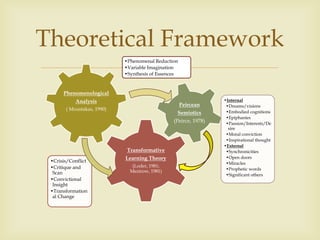
Theoretical Framework
Phenomenological
Analysis
( Moustakas, 1990)
•Phenomenal Reduction
•Variable Imagination
•Synthesis of Essences
Transformative
Learning Theory
(Loder, 1981;
Mezirow, 1981)
•Crisis/Conflict
•Critique and
Scan
•Convictional
Insight
•Transformation
al Change
Peircean
Semiotics
(Peirce, 1978)
•Internal
•Dreams/visions
•Embodied cognitions
•Epiphanies
•Passion/Interests/De
sire
•Moral conviction
•Inspirational thought
•External
•Synchronicities
•Open doors
•Miracles
•Prophetic words
•Significant others

Methodology
A Phenomenological Understanding of a Calling with Implications
for Pastoral and Vocational Education

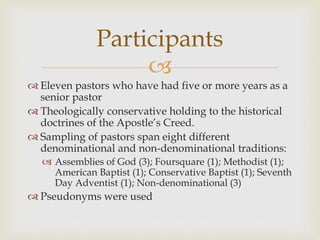
 Eleven pastors who have had five or more years as a
senior pastor
 Theologically conservative holding to the historical
doctrines of the Apostle’s Creed.
 Sampling of pastors span eight different
denominational and non-denominational traditions:
 Assemblies of God (3); Foursquare (1); Methodist (1);
American Baptist (1); Conservative Baptist (1); Seventh
Day Adventist (1); Non-denominational (3)
 Pseudonyms were used
Participants

 Interviews:
 Semi-structured with pre-formed questions
 Recorded with SonyICDUX533BLK Digital Voice
Recorder and transcribed by Temi, a transcribing
service which uses voice recognition software.
 Length of interviews varied from 60-90 minutes
 Transcription of interview with brief analysis of
essences were sent to each pastor
Data Collection

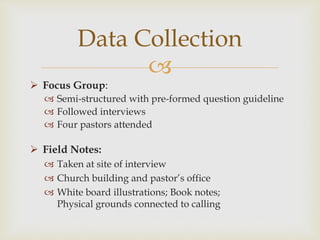
Data Collection
 Focus Group:
 Semi-structured with pre-formed question guideline

 Followed interviews
 Four pastors attended
 Field Notes:
 Taken at site of interview
 Church building and pastor’s office
 White board illustrations; Book notes;
Physical grounds connected to calling

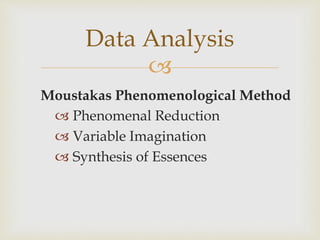
Moustakas Phenomenological Method
 Phenomenal Reduction
 Variable Imagination
 Synthesis of Essences
Data Analysis

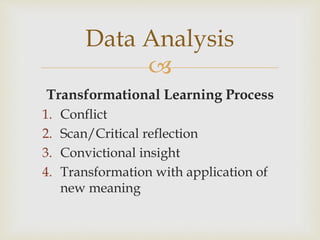
Transformational Learning Process
1. Conflict
2. Scan/Critical reflection
3. Convictional insight
4. Transformation with application of
new meaning
Data Analysis

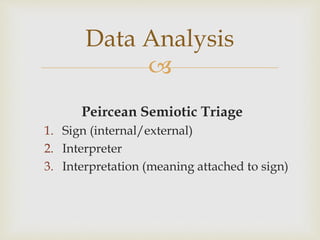
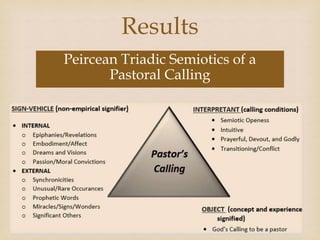
Peircean Semiotic Triage
1. Sign (internal/external)
2. Interpreter
3. Interpretation (meaning attached to sign)
Data Analysis

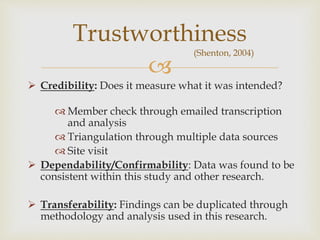
 Credibility: Does it measure what it was intended?
 Member check through emailed transcription
and analysis
 Triangulation through multiple data sources
 Site visit
 Dependability/Confirmability: Data was found to be
consistent within this study and other research.
 Transferability: Findings can be duplicated through
methodology and analysis used in this research.
Trustworthiness
(Shenton, 2004)

Results
A Phenomenological Understanding of a Calling with Implications
for Pastoral and Vocational Education

Results:
Phenomenological Essences
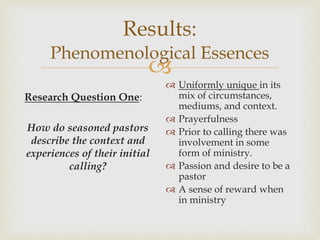
Research Question One:
How do seasoned pastors
describe the context and
experiences of their initial
calling?
 Uniformly unique in its
mix of circumstances,
mediums, and context.
 Prayerfulness
 Prior to calling there was
involvement in some
form of ministry.
 Passion and desire to be a
pastor
 A sense of reward when
in ministry

Results:
Phenomenological Essences
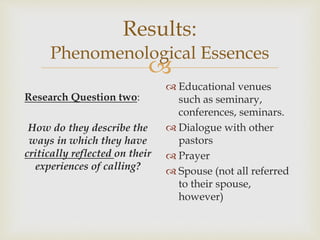
Research Question two:
How do they describe the
ways in which they have
critically reflected on their
experiences of calling?
 Educational venues
such as seminary,
conferences, seminars.
 Dialogue with other
pastors
 Prayer
 Spouse (not all referred
to their spouse,
however)

Results:
Phenomenological Essences
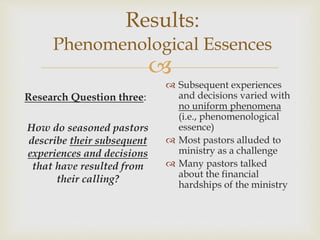
Research Question three:
How do seasoned pastors
describe their subsequent
experiences and decisions
that have resulted from
their calling?
 Subsequent experiences
and decisions varied with
no uniform phenomena
(i.e., phenomenological
essence)
 Most pastors alluded to
ministry as a challenge
 Many pastors talked
about the financial
hardships of the ministry

Results:
Phenomenological Essences
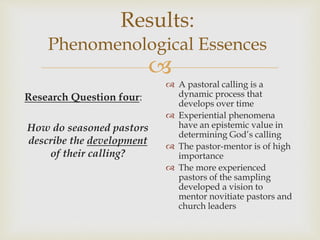
Research Question four:
How do seasoned pastors
describe the development
of their calling?
 A pastoral calling is a
dynamic process that
develops over time
 Experiential phenomena
have an epistemic value in
determining God’s calling
 The pastor-mentor is of high
importance
 The more experienced
pastors of the sampling
developed a vision to
mentor novitiate pastors and
church leaders

Results
Peircean Triadic Semiotics of a
Pastoral Calling

Discussion
A Phenomenological Understanding of a Calling with Implications
for Pastoral and Vocational Education

Discussion
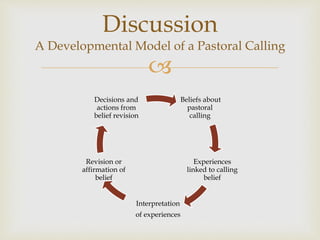
A Developmental Model of a Pastoral Calling
Beliefs about
pastoral
calling
Experiences
linked to calling
belief
Interpretation
of experiences
Revision or
affirmation of
belief
Decisions and
actions from
belief revision

Discussion
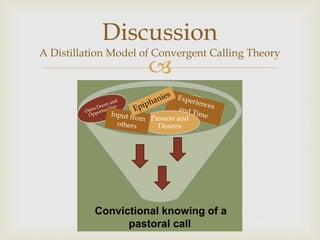
A Distillation Model of Convergent Calling Theory
Passion and
Desires
Convictional knowing of a
pastoral call

Discussion
A Holistic Pedagogy of a Pastoral Calling
 Theological Foundations (Natural and Special
Revelation)
 Psychological Considerations (Identity, Meaning,
Well-being)
 Epistemological Reflections (Semiotic hermeneutic,
Affective data, Theistic presence)

Limitations and Future
Research
A Phenomenological Understanding of a Calling with Implications
for Pastoral and Vocational Education

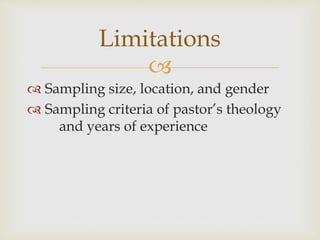
Limitations
 Sampling size, location, and gender
 Sampling criteria of pastor’s theology
and years of experience

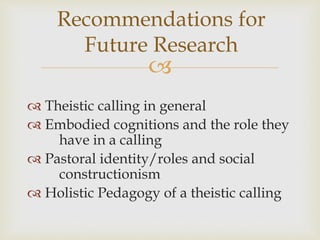
Recommendations for
Future Research
 Theistic calling in general
 Embodied cognitions and the role they
have in a calling
 Pastoral identity/roles and social
constructionism
 Holistic Pedagogy of a theistic calling

Recommendations for
Future Research
“…our results suggest that a holistic and systematic
approach to studying the unique belief in a transcendent
caller may advance our understanding of one's calling.”
(McKenna et al., 2015, p. 301)

Conclusion
“An unfulfilled vocation drains the
color from a man’s entire existence”
(Balzac, 1837, p. 23).

Bibliography
Balzac, H. de. (1837). La Maison Nucingen. Retrieved from
http://www.feedbooks. com/book/1901/la-maison-nucingen
Cafferata, G. (2017). Respect, challenges, and stress among Protestant pastors
closing a church: Structural and identity theory perspectives. Pastoral
Psychology, 66(3), 311-333. doi:10.1007/s11089-016-0751-z
Civish, G. (2013). The calling: A study of personal spiritual experiences of
seminary students. Journal of Spirituality in Mental Health, 15(3), 186.
Data: USA. Retrieved online October 13, 2019 from
https://datausa.io/profile/soc/clergy#about
Duffy, R. D., Allan, B. A., Bott, E. M., & Dik, B. J. (2014). Does the source
of a calling matter? External summons, destiny, and perfect
fit. Journal of Career Assessment, 22(4), 562-574.
doi:10.1177/1069072713514812

Bibliography
Duffy, R. D., & Dik, B. J. (2013). Research on calling: What have we
learned and where are we going? Journal of Vocational
Behavior, 83(3), 428-436.
Loder, J. (1989). The transforming moment: Understanding convictional
experiences. San Francisco, CA: Harper.
Lose, D., Mikoski, S., Crowley, D., Jacobson, R., Cormode, S., &
Conklin‐Miller, J. (2015). Equipping the equippers: The
pedagogical and programmatic implications of the Christians’
callings in the world project. Teaching Theology & Religion, 18(4),
387-408. doi:10.1111/teth.12309
McKenna, R., Matson, J., Haney, D., Becker, O., Hickory, M., Ecker, D.,
Boyd, T. (2015). Calling, the caller, and being called: A
qualitative study of transcendent calling. Journal of Psychology and
Christianity, 34(4), 294-303.
Mezirow, J. (1991). Transformative dimensions of adult learning. San
Francisco, CA: Jossey-Bass.

Bibliography
Moustakas, C. (1994). Phenomenological research methods. Thousand
Oaks, CA: Sage.
Myers, V. (2014). Conversations about calling: Advancing management
perspectives. New York, NY: Routledge.
O'Neal, A. M. (2017). The effects of calling and vocational presence and
search on psychological well-being. (Doctoral dissertation,
Bowling Green State University) Retrieved from ProQuest
Dissertations & Theses Global, (1889950066).
Shenton, A. K. (2004). Strategies for ensuring trustworthiness in
qualitative research projects. Education For Information, 22(2),
63-75.

Understanding a pastor's calling

  • 1.
  • 2.
      A conceptwhich originated with the Hebrew nation, adopted by the early church, and was inclusive of all God’s people  Changed its meaning to only refer to clergy after Constantine became Roman emperor in 325 C.E.  Reformation broadened its definition to regain its earlier definition with a strong emphasis on one’s employment  Presently, most calling research is career centered without a theistic caller (Myers, 2015). Background and Context of Calling as a Construct
  • 3.
    Vocational Clergy TOTAL WORKFORCE:2017 432,559 AVERAGE AGE 51 ESTIMATED JOB GROWTH 10-YEAR PROJECTION 8.16% https://datausa.io/profile/soc/clergy#about
  • 4.
     This large workforcecite a calling from God as the over-whelming reason why they attend seminaries and go into ministry (Lose, 2015), and yet, the experience of that phenomenon has been hardly researched. Thus, much ambiguity and confusion exists about the existential nature of a pastoral calling. Problem Statement
  • 5.
     The paucity ofresearch literature in theistic callings is found in several areas:  Vocational calling research that has a theistic component (Myers, 2015)  Phenomenological and descriptive research rather than prescriptive and exegetical commentaries (McKenna, 2015)  Epistemic analysis and research of a pastoral calling (Duffy, Allan, Bott, & Dik, 2014) Gap in Literature
  • 6.
     “Finally, this wasan exploratory study that used relatively simple analyses and did not take into account potential third variables such as religiousness that may explain why certain individuals endorse particular calling sources. Investigating these predictors is an important area of future research.” Duffy, Allan, Bott, & Dik, 2014, p. 572 Gap in Literature
  • 7.
     Thus, the purposeof this phenomenological study is to describe the experience of seasoned pastors in the search and sense of their calling to the ministry. Purpose
  • 8.
     Research Questions  Howdo seasoned pastors describe their initial experiences of calling?  How do they describe the ways in which they have critically reflected on the experiences of their calling?  How do seasoned pastors describe the subsequent actions that have resulted from their calling?  How do pastors describe the development of their calling?
  • 9.
     Literature Review A PhenomenologicalUnderstanding of a Calling with Implications for Pastoral and Vocational Education
  • 10.
     Introduction “…our results suggestthat a holistic and systematic approach to studying the unique belief in a transcendent caller may advance our understanding of one's calling.” (McKenna et al., 2015, p. 301) Literature Review
  • 11.
     Introduction The scarcity ofphenomenological literature on a pastoral calling led to an eclectic survey of research that explored various disciplines of the human sciences and theology that addressed the phenomenon of a theistic calling. Literature Review Psychology Theology Vocational Epistemology
  • 12.
     Psychology Literature A pastor’scalling is a deep structured professional identity which fundamentally shapes one’s self-definition. Being a pastor is not just a job, or an occupation, or even a profession, but a calling that involves commitment to pastoral vows and to God. (Cafferata, 2017, p. 314) Literature Review
  • 13.
     Psychology Literature  Meaningas coherence, purpose, and significance in a pastoral calling  Well-being literature used as a measure for a pastor’s calling  Self-Identity as a theistic social-construct in a pastor’s calling (O’Neal, 2017) Literature Review
  • 14.
     Theological Literature A phenomenologicalresearch of a theistic calling must engage the theological constructs of that calling.  Natural theology: posits God’s order and design is found in all creation which would include human nature.  Special revelation: affirms metaphysical realities that cannot be empirically proven and require faith. Literature Review
  • 15.
     Calling Literature  Hasgreatly increased in the last 15 years (Duffy & Dik, 2013).  Since 2007, approximately 40 studies have established the association of well-being with living the call (O’Neal, 2017). A pursued and lived calling is shown to have benefits:  Meaning and purpose (Duffy, Allan, & Bott, 2012)  A sense of fulfillment and satisfaction (Hirschi, 2012)  Career engagement and efficacy (Domene, 2012) Literature Review
  • 16.
     Calling Literature (continued) Calling literature has identified three prevailing views on the source of one’s calling (Duffy & Dik, 2015):  External summons (Can be God, family legacy, the universe, etc.)  Destiny  Perfect fit. Most common calling-source construct; used extensively in vocational/career curriculum and counselors Literature Review
  • 17.
     Calling Literature (continued) “Howindividuals find a calling, represents perhaps the most controversial issue within the calling literature.” (Duffy, Allan, Bott, & Dik, 2014, p. 564) Literature Review
  • 18.
     Epistemological Literature  Semioticstheory: Peirce and a triadic theory of semiosis (Civish, 2013)  Embodied Cognition: Affective constructs associated with calling beliefs (Smith, J.K., 2010) Literature Review
  • 19.
      Theology  Moustakas’Phenomenology (Moustakas, 1994)  Transformational Learning Theory  Mezirow (1991)  Loder (1989)  Peircean Semiotics Theoretical Framework
  • 20.
     Theoretical Framework Phenomenological Analysis ( Moustakas,1990) •Phenomenal Reduction •Variable Imagination •Synthesis of Essences Transformative Learning Theory (Loder, 1981; Mezirow, 1981) •Crisis/Conflict •Critique and Scan •Convictional Insight •Transformation al Change Peircean Semiotics (Peirce, 1978) •Internal •Dreams/visions •Embodied cognitions •Epiphanies •Passion/Interests/De sire •Moral conviction •Inspirational thought •External •Synchronicities •Open doors •Miracles •Prophetic words •Significant others
  • 21.
     Methodology A Phenomenological Understandingof a Calling with Implications for Pastoral and Vocational Education
  • 22.
      Eleven pastorswho have had five or more years as a senior pastor  Theologically conservative holding to the historical doctrines of the Apostle’s Creed.  Sampling of pastors span eight different denominational and non-denominational traditions:  Assemblies of God (3); Foursquare (1); Methodist (1); American Baptist (1); Conservative Baptist (1); Seventh Day Adventist (1); Non-denominational (3)  Pseudonyms were used Participants
  • 23.
      Interviews:  Semi-structuredwith pre-formed questions  Recorded with SonyICDUX533BLK Digital Voice Recorder and transcribed by Temi, a transcribing service which uses voice recognition software.  Length of interviews varied from 60-90 minutes  Transcription of interview with brief analysis of essences were sent to each pastor Data Collection
  • 24.
     Data Collection  FocusGroup:  Semi-structured with pre-formed question guideline  Followed interviews  Four pastors attended  Field Notes:  Taken at site of interview  Church building and pastor’s office  White board illustrations; Book notes; Physical grounds connected to calling
  • 25.
     Moustakas Phenomenological Method Phenomenal Reduction  Variable Imagination  Synthesis of Essences Data Analysis
  • 26.
     Transformational Learning Process 1.Conflict 2. Scan/Critical reflection 3. Convictional insight 4. Transformation with application of new meaning Data Analysis
  • 27.
     Peircean Semiotic Triage 1.Sign (internal/external) 2. Interpreter 3. Interpretation (meaning attached to sign) Data Analysis
  • 28.
      Credibility: Doesit measure what it was intended?  Member check through emailed transcription and analysis  Triangulation through multiple data sources  Site visit  Dependability/Confirmability: Data was found to be consistent within this study and other research.  Transferability: Findings can be duplicated through methodology and analysis used in this research. Trustworthiness (Shenton, 2004)
  • 29.
     Results A Phenomenological Understandingof a Calling with Implications for Pastoral and Vocational Education
  • 30.
     Results: Phenomenological Essences Research QuestionOne: How do seasoned pastors describe the context and experiences of their initial calling?  Uniformly unique in its mix of circumstances, mediums, and context.  Prayerfulness  Prior to calling there was involvement in some form of ministry.  Passion and desire to be a pastor  A sense of reward when in ministry
  • 31.
     Results: Phenomenological Essences Research Questiontwo: How do they describe the ways in which they have critically reflected on their experiences of calling?  Educational venues such as seminary, conferences, seminars.  Dialogue with other pastors  Prayer  Spouse (not all referred to their spouse, however)
  • 32.
     Results: Phenomenological Essences Research Questionthree: How do seasoned pastors describe their subsequent experiences and decisions that have resulted from their calling?  Subsequent experiences and decisions varied with no uniform phenomena (i.e., phenomenological essence)  Most pastors alluded to ministry as a challenge  Many pastors talked about the financial hardships of the ministry
  • 33.
     Results: Phenomenological Essences Research Questionfour: How do seasoned pastors describe the development of their calling?  A pastoral calling is a dynamic process that develops over time  Experiential phenomena have an epistemic value in determining God’s calling  The pastor-mentor is of high importance  The more experienced pastors of the sampling developed a vision to mentor novitiate pastors and church leaders
  • 34.
  • 35.
     Discussion A Phenomenological Understandingof a Calling with Implications for Pastoral and Vocational Education
  • 36.
     Discussion A Developmental Modelof a Pastoral Calling Beliefs about pastoral calling Experiences linked to calling belief Interpretation of experiences Revision or affirmation of belief Decisions and actions from belief revision
  • 37.
     Discussion A Distillation Modelof Convergent Calling Theory Passion and Desires Convictional knowing of a pastoral call
  • 38.
     Discussion A Holistic Pedagogyof a Pastoral Calling  Theological Foundations (Natural and Special Revelation)  Psychological Considerations (Identity, Meaning, Well-being)  Epistemological Reflections (Semiotic hermeneutic, Affective data, Theistic presence)
  • 39.
     Limitations and Future Research APhenomenological Understanding of a Calling with Implications for Pastoral and Vocational Education
  • 40.
     Limitations  Sampling size,location, and gender  Sampling criteria of pastor’s theology and years of experience
  • 41.
     Recommendations for Future Research Theistic calling in general  Embodied cognitions and the role they have in a calling  Pastoral identity/roles and social constructionism  Holistic Pedagogy of a theistic calling
  • 42.
     Recommendations for Future Research “…ourresults suggest that a holistic and systematic approach to studying the unique belief in a transcendent caller may advance our understanding of one's calling.” (McKenna et al., 2015, p. 301)
  • 43.
     Conclusion “An unfulfilled vocationdrains the color from a man’s entire existence” (Balzac, 1837, p. 23).
  • 44.
     Bibliography Balzac, H. de.(1837). La Maison Nucingen. Retrieved from http://www.feedbooks. com/book/1901/la-maison-nucingen Cafferata, G. (2017). Respect, challenges, and stress among Protestant pastors closing a church: Structural and identity theory perspectives. Pastoral Psychology, 66(3), 311-333. doi:10.1007/s11089-016-0751-z Civish, G. (2013). The calling: A study of personal spiritual experiences of seminary students. Journal of Spirituality in Mental Health, 15(3), 186. Data: USA. Retrieved online October 13, 2019 from https://datausa.io/profile/soc/clergy#about Duffy, R. D., Allan, B. A., Bott, E. M., & Dik, B. J. (2014). Does the source of a calling matter? External summons, destiny, and perfect fit. Journal of Career Assessment, 22(4), 562-574. doi:10.1177/1069072713514812
  • 45.
     Bibliography Duffy, R. D.,& Dik, B. J. (2013). Research on calling: What have we learned and where are we going? Journal of Vocational Behavior, 83(3), 428-436. Loder, J. (1989). The transforming moment: Understanding convictional experiences. San Francisco, CA: Harper. Lose, D., Mikoski, S., Crowley, D., Jacobson, R., Cormode, S., & Conklin‐Miller, J. (2015). Equipping the equippers: The pedagogical and programmatic implications of the Christians’ callings in the world project. Teaching Theology & Religion, 18(4), 387-408. doi:10.1111/teth.12309 McKenna, R., Matson, J., Haney, D., Becker, O., Hickory, M., Ecker, D., Boyd, T. (2015). Calling, the caller, and being called: A qualitative study of transcendent calling. Journal of Psychology and Christianity, 34(4), 294-303. Mezirow, J. (1991). Transformative dimensions of adult learning. San Francisco, CA: Jossey-Bass.
  • 46.
     Bibliography Moustakas, C. (1994).Phenomenological research methods. Thousand Oaks, CA: Sage. Myers, V. (2014). Conversations about calling: Advancing management perspectives. New York, NY: Routledge. O'Neal, A. M. (2017). The effects of calling and vocational presence and search on psychological well-being. (Doctoral dissertation, Bowling Green State University) Retrieved from ProQuest Dissertations & Theses Global, (1889950066). Shenton, A. K. (2004). Strategies for ensuring trustworthiness in qualitative research projects. Education For Information, 22(2), 63-75.

Editor's Notes

  • #7 Quoted from a broad meta-study on the source of a calling (Does the source of a calling matter?
  • #14 Three re-occurring themes surface in calling literature that especially relate to pastors. Meaning: Coherence-When coherence is experienced as meaning there is a coming together of loose ends, unresolved dilemmas find solutions, and behavior/belief incongruities get harmonized. A pastoral calling has meaning when faith expectations coincide with experience. Experiences that are contrary to pastoral expectations (e.g., unanswered prayer, declining attendance, church splits) can erode the sense of calling and meaningful ministry. For example, research has shown pastors often serve a church expecting growth or revival through their leadership. When that does not occur, their sense of calling can be impacted Purpose- purpose concerns itself with goals and direction in life (King, Heintzelman, & Ward, 2016). When a pastor is directionless and without concrete goals, the literature indicates the absence of meaning and the erosion of calling are being experienced. Self identity: . Identity is comprised of an individual’s values, beliefs, and expectations (Horton et al., 2014). In a theistic calling, a new identity is formed as seen in the disciple Peter (Grey, 2012; Matthew 4:19). Former roles, commitments, and expectations are loosed for the adoption of a new identity that is forged by the call.
  • #15 Natural Theology: Makes use of empirical data derived from research. Interests, personality tests, psychological testing, in the pursuit of a call. Special Revelation: Constructs taken from scripture and the Holy Spirit which lead pastors to believe they are called. [e.g. Callings, Placher. Called to the Ministry: Edmund P. Clowney)
  • #17 External summons: Destiny: Perfect fit (most common)
  • #20 These theories help explain what motivates teachers to teach a certain way and to keep improving… Maslow’s – in order for teachers to reach the highest level, actualization (achieving goals and continuing to develop) they must progress in each level…
  • #23 The recruitment process included a short demographic questionnaire to ensure
  • #31 These theories help explain what motivates teachers to teach a certain way and to keep improving… Maslow’s – in order for teachers to reach the highest level, actualization (achieving goals and continuing to develop) they must progress in each level…
  • #32 These theories help explain what motivates teachers to teach a certain way and to keep improving… Maslow’s – in order for teachers to reach the highest level, actualization (achieving goals and continuing to develop) they must progress in each level…
  • #33 These theories help explain what motivates teachers to teach a certain way and to keep improving… Maslow’s – in order for teachers to reach the highest level, actualization (achieving goals and continuing to develop) they must progress in each level…
  • #34 These theories help explain what motivates teachers to teach a certain way and to keep improving… Maslow’s – in order for teachers to reach the highest level, actualization (achieving goals and continuing to develop) they must progress in each level…