Seven Basic Steps for a Highly
Successful Campaign
Steve Wasser
Seven Basic Steps for a Highly
Successful Campaign
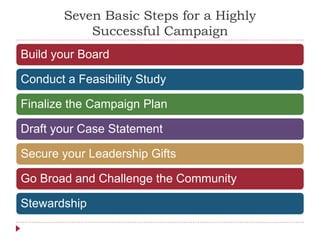
Build your Board
Conduct a Feasibility Study
Finalize the Campaign Plan
Draft your Case Statement
Secure your Leadership Gifts
Go Broad and Challenge the Community
Stewardship
Why even consider launching a
campaign?
Reasons to Launch a Campaign
Obvious Not-so-obvious
 Organization has needs
larger than regular
fundraising goals
 Grow endowment; launch
new program; construct or
expand a building
 Permanently grow your
overall donor base
 Increase your population
of major donors
 Permanently move all of
your fundraising goals up a
level
 Campaigns should be a
“stair stepper” to growth
 Increase the visibility of your
organization in community
 Prove your worth. Pure
philanthropy has a
remarkably high ROI. Your
CEO, CFO and Board will
take notice
Build your Board
Build your Board
 Influence AND affluence
 Minimum of 12 members
 Think about 16-20 members
 Need to achieve a critical mass
 These are the door openers
 Identify the askers
 Be calculating when it comes to composition:
gender, ages and occupations
 An impressive roster lends instant credibility and
can be spotlighted immediately in case
statement
 Secure those gifts first and build momentum fast
Role of the Board
in a campaign
#1 Rule: Make your own personal gift
100% Board participation is key
“If your own board isn’t giving, why
should I?”
7
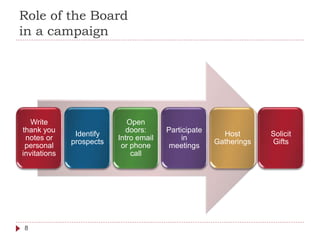
Role of the Board
in a campaign
Write
thank you
notes or
personal
invitations
Identify
prospects
Open
doors:
Intro email
or phone
call
Participate
in
meetings
Host
Gatherings
Solicit
Gifts
8
Conduct a Feasibility Study
Why Conduct a Feasibility Study?
 Determine if your donors and the community support
the cause.
 Learn what resonates with them
 Discover their concerns
 Test your case statement: Which elements work?
 Validate campaign goal. Or not!
 Deliver results to CEO/Board/senior team
 Objective recommendation of goal
 Interviewees will be honored
 May even disclose giving plans
Key Steps to a Successful Study
 Who to use?
 Choose a firm that best represents you and is a
comfortable fit with your culture and donors
 Fits within your budget
 Provides you with the key services you need
 Interview 4-5 potential partners
 Develop draft case statement and send in advance
 Conduct 40-60 interviews (depending on campaign
goals)
 Include as many top donors and prospects as
possible
 Ask for specific (but anonymous) feedback
Finalize the Campaign Plan
 Modify early draft to incorporate:
 Feasibility study results
 Donor/prospect feedback from feasibility study
 Finalized fundraising priorities, financial goals, and
timeline
 Bring back in the major shareholders
 CEO/CFO, senior leadership team, key board members
 Should have consensus
Contents of the Campaign Plan
 Your challenge
 Results of the feasibility study
 Populations of potential donors
 Financial goals
 Tactics to achieve your goals
 Timeline
 Budget
 Campaign gift chart/donor pyramid
Finalizing your Case Statement
 You have more building blocks than you realize
 Early business plan for feasibility study
 Draft used during interviews
 Feasibility study report
 Various internal documents from day to day business
 Package the information for the public
 Who should do this?
 Feasibility study partner
 Marketing and communications
 Completely new partner
 At some point…YOU
Finalizing your Case Statement
 Why you should consider having two versions
 High-end for leadership donors (die-cut cover with a built-in
pouch for business cards and naming opportunities)
 Lower cost second print for smaller asks (eliminate the bells
and whistles)
 Landing on a tone
 Write conversationally. Be succinct.
 Be urgent and compelling
 Directly answer the question: “Why should I care?”
 Focus on community impact and not JUST your organization
 In retrospect, we would cut our first statement by 20-30%
 However, don’t be too brief…the weight gets noticed. It has
gravity.
Finalizing your Case Statement
 Additional factors to consider
 Offer detailed plans, timelines and the overall cost
 Can you include early renderings?
 Do you have floor plans?
 Highlight the campaign dollar goal
 Deciding on cost per unit and how nice the piece should
be
 You know your organization’s culture
 Is a $15 case statement paired with a $75 meal worth
a $10,000 commitment? Of course. Can the $15
case statement help get you that conversation? Only
your team will know
Secure your Leadership Gifts
Campaign Rules of Thumb
 Three key statistics to act as your guide
 The 80/20 Rule…or is it 90/10??
 80% of your revenue will come from 20% of your donors
 Think about how this should affect your time management!
 At least one lead gift of 10-25% of overall goal
 Much needed revenue AND a figurehead to rally around
 The next 50-60% of revenue from leadership and best of
the major donors
 Importance of stratifying your donors
 Campaign pyramid
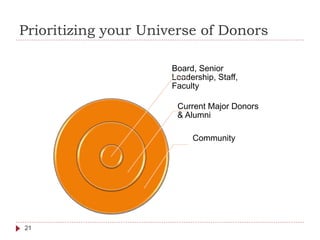
Prioritizing your Universe of Donors
Board, Senior
Leadership, Staff,
Faculty
Current Major Donors
& Alumni
Community
21
Getting Started: Qualification
 Identify Prospects
 Existing major donors
 Alumni and others who have made smaller gifts regularly
over a period of years
 People close to your organization: current and former
board members, volunteers, faculty and staff
 Enlist board members to help identify prospects
 Focus on securing lead gifts first; then smaller gifts
 Divide donor base into A, B and C tiers
 Tier A: Leadership prospects
 Tier B: Major gift prospects
 Tier C: Community phase/direct mail
Getting Started: Qualification
 Send case statement package and cover letter
 Introduces the case for support
 Call in two weeks to set up appointment
 Include naming opportunities list
 Demonstrates community support
 Shows that they would be in “good company”
Go Broad and Challenge the
Community
Go Broad and Challenge the Community
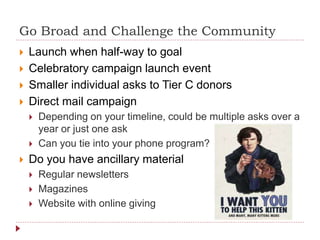
 Launch when half-way to goal
 Celebratory campaign launch event
 Smaller individual asks to Tier C donors
 Direct mail campaign
 Depending on your timeline, could be multiple asks over a
year or just one ask
 Can you tie into your phone program?
 Do you have ancillary material
 Regular newsletters
 Magazines
 Website with online giving
Go Broad and Challenge the Community
 Power of a matching gift challenge
 Put your arms around all of your donors
 Part of the final sweep
 “Turn your $25 gift into $50 instantly”
 Opportunity to go BACK to a major donor
 Our $25,000 challenge raised additional $57,000
 Secure the gift up front!
 Be tactical
 We leaned heavily on major donors and our community
donors/grateful patients
 We chose to insulate 3,200 employees in order to protect
the annual fund. It worked
Stewardship
Stewardship: the key to the next gift
 People want to give THROUGH you, not TO you
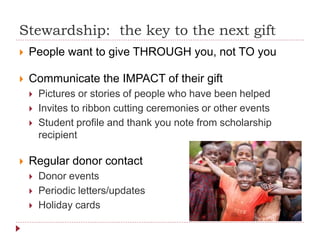
 Communicate the IMPACT of their gift
 Pictures or stories of people who have been helped
 Invites to ribbon cutting ceremonies or other events
 Student profile and thank you note from scholarship
recipient
 Regular donor contact
 Donor events
 Periodic letters/updates
 Holiday cards
How to say thank you
 Letter from leadership
 Periodic impact letters or reports
 Event invitations
 Segment of phonathon
 Post cards on unusual holidays
 Past donors are your most likely future donors
Questions??
 Steve Wasser
 Director of Development
 steve.wasser@unitypoint.org
 309-764-3579

Seven Basic Steps for a Highly Successful Campaign - 2016

  • 1.
    Seven Basic Stepsfor a Highly Successful Campaign Steve Wasser
  • 2.
    Seven Basic Stepsfor a Highly Successful Campaign Build your Board Conduct a Feasibility Study Finalize the Campaign Plan Draft your Case Statement Secure your Leadership Gifts Go Broad and Challenge the Community Stewardship
  • 3.
    Why even considerlaunching a campaign?
  • 4.
    Reasons to Launcha Campaign Obvious Not-so-obvious  Organization has needs larger than regular fundraising goals  Grow endowment; launch new program; construct or expand a building  Permanently grow your overall donor base  Increase your population of major donors  Permanently move all of your fundraising goals up a level  Campaigns should be a “stair stepper” to growth  Increase the visibility of your organization in community  Prove your worth. Pure philanthropy has a remarkably high ROI. Your CEO, CFO and Board will take notice
  • 5.
  • 6.
    Build your Board Influence AND affluence  Minimum of 12 members  Think about 16-20 members  Need to achieve a critical mass  These are the door openers  Identify the askers  Be calculating when it comes to composition: gender, ages and occupations  An impressive roster lends instant credibility and can be spotlighted immediately in case statement  Secure those gifts first and build momentum fast
  • 7.
    Role of theBoard in a campaign #1 Rule: Make your own personal gift 100% Board participation is key “If your own board isn’t giving, why should I?” 7
  • 8.
    Role of theBoard in a campaign Write thank you notes or personal invitations Identify prospects Open doors: Intro email or phone call Participate in meetings Host Gatherings Solicit Gifts 8
  • 9.
  • 10.
    Why Conduct aFeasibility Study?  Determine if your donors and the community support the cause.  Learn what resonates with them  Discover their concerns  Test your case statement: Which elements work?  Validate campaign goal. Or not!  Deliver results to CEO/Board/senior team  Objective recommendation of goal  Interviewees will be honored  May even disclose giving plans
  • 11.
    Key Steps toa Successful Study  Who to use?  Choose a firm that best represents you and is a comfortable fit with your culture and donors  Fits within your budget  Provides you with the key services you need  Interview 4-5 potential partners  Develop draft case statement and send in advance  Conduct 40-60 interviews (depending on campaign goals)  Include as many top donors and prospects as possible  Ask for specific (but anonymous) feedback
  • 12.
  • 13.
    Finalize the CampaignPlan  Modify early draft to incorporate:  Feasibility study results  Donor/prospect feedback from feasibility study  Finalized fundraising priorities, financial goals, and timeline  Bring back in the major shareholders  CEO/CFO, senior leadership team, key board members  Should have consensus
  • 14.
    Contents of theCampaign Plan  Your challenge  Results of the feasibility study  Populations of potential donors  Financial goals  Tactics to achieve your goals  Timeline  Budget  Campaign gift chart/donor pyramid
  • 15.
  • 16.
    Finalizing your CaseStatement  You have more building blocks than you realize  Early business plan for feasibility study  Draft used during interviews  Feasibility study report  Various internal documents from day to day business  Package the information for the public  Who should do this?  Feasibility study partner  Marketing and communications  Completely new partner  At some point…YOU
  • 17.
    Finalizing your CaseStatement  Why you should consider having two versions  High-end for leadership donors (die-cut cover with a built-in pouch for business cards and naming opportunities)  Lower cost second print for smaller asks (eliminate the bells and whistles)  Landing on a tone  Write conversationally. Be succinct.  Be urgent and compelling  Directly answer the question: “Why should I care?”  Focus on community impact and not JUST your organization  In retrospect, we would cut our first statement by 20-30%  However, don’t be too brief…the weight gets noticed. It has gravity.
  • 18.
    Finalizing your CaseStatement  Additional factors to consider  Offer detailed plans, timelines and the overall cost  Can you include early renderings?  Do you have floor plans?  Highlight the campaign dollar goal  Deciding on cost per unit and how nice the piece should be  You know your organization’s culture  Is a $15 case statement paired with a $75 meal worth a $10,000 commitment? Of course. Can the $15 case statement help get you that conversation? Only your team will know
  • 19.
  • 20.
    Campaign Rules ofThumb  Three key statistics to act as your guide  The 80/20 Rule…or is it 90/10??  80% of your revenue will come from 20% of your donors  Think about how this should affect your time management!  At least one lead gift of 10-25% of overall goal  Much needed revenue AND a figurehead to rally around  The next 50-60% of revenue from leadership and best of the major donors  Importance of stratifying your donors  Campaign pyramid
  • 21.
    Prioritizing your Universeof Donors Board, Senior Leadership, Staff, Faculty Current Major Donors & Alumni Community 21
  • 22.
    Getting Started: Qualification Identify Prospects  Existing major donors  Alumni and others who have made smaller gifts regularly over a period of years  People close to your organization: current and former board members, volunteers, faculty and staff  Enlist board members to help identify prospects  Focus on securing lead gifts first; then smaller gifts  Divide donor base into A, B and C tiers  Tier A: Leadership prospects  Tier B: Major gift prospects  Tier C: Community phase/direct mail
  • 23.
    Getting Started: Qualification Send case statement package and cover letter  Introduces the case for support  Call in two weeks to set up appointment  Include naming opportunities list  Demonstrates community support  Shows that they would be in “good company”
  • 24.
    Go Broad andChallenge the Community
  • 25.
    Go Broad andChallenge the Community  Launch when half-way to goal  Celebratory campaign launch event  Smaller individual asks to Tier C donors  Direct mail campaign  Depending on your timeline, could be multiple asks over a year or just one ask  Can you tie into your phone program?  Do you have ancillary material  Regular newsletters  Magazines  Website with online giving
  • 26.
    Go Broad andChallenge the Community  Power of a matching gift challenge  Put your arms around all of your donors  Part of the final sweep  “Turn your $25 gift into $50 instantly”  Opportunity to go BACK to a major donor  Our $25,000 challenge raised additional $57,000  Secure the gift up front!  Be tactical  We leaned heavily on major donors and our community donors/grateful patients  We chose to insulate 3,200 employees in order to protect the annual fund. It worked
  • 27.
  • 28.
    Stewardship: the keyto the next gift  People want to give THROUGH you, not TO you  Communicate the IMPACT of their gift  Pictures or stories of people who have been helped  Invites to ribbon cutting ceremonies or other events  Student profile and thank you note from scholarship recipient  Regular donor contact  Donor events  Periodic letters/updates  Holiday cards
  • 29.
    How to saythank you  Letter from leadership  Periodic impact letters or reports  Event invitations  Segment of phonathon  Post cards on unusual holidays  Past donors are your most likely future donors
  • 30.
    Questions??  Steve Wasser Director of Development  steve.wasser@unitypoint.org  309-764-3579

Editor's Notes

  • #5 Differences between annual fund and major gifts Annual fund donations are generally undesignated and are used to fund operations. Major gifts are designated by the donor. They are often made to areas where the donor’s passion aligns with the needs of the organization. For example, funding cancer research, developing programs for underserved children, increasing literacy or promoting STEM education. Most organizations conduct their annual fund solicitations through a direct mail campaign with no personal interaction. Some organizations take this a step further by utilizing a team of volunteers who write personal notes, make phone calls, and perhaps visit with a few prospects. If your organization meets personally with annual fund prospects, there is often an ask during the first call. With a major gift solicitation, there are multiple visits and the ask may not occur for months or even a couple of years. With an annual fund solicitation, the prospect is often unfamiliar with philanthropy and may be unaccustomed to one-on-one visits. They are used to glancing at the direct mail materials (average time allotted to reading the materials is 3 seconds!) and writing a check. With a major gift solicitation, the prospect is usually already quite involved with your institution and you are deepening an existing discussion. With an annual fund solicitation, you can often represent the institution very well with a direct mailer and just a little bit of pre-visit prospect research (maybe ten or fifteen minutes). With a major gift solicitation, you are asking someone for a significant amount of money for what could and should be a transformational project. You need to do your prep work. This takes time.
  • #7 Starting from a strong base: everything you need to get started Clear, succinct strategic plan that outlines your organization’s mission, vision, and goals. Need to be able to communicate what you want to accomplish/where you want to be in 3-5 years Executive leadership in place – people give to people. Need to have confidence in the leadership team Strong, influential board. Need people with BOTH influence and affluence. Critical mass is 12-18 people. Don’t be shy about involving them in the fundraising process. (sample board agreement attached) Up-to-date database such as Raiser’s Edge where you have been tracking donors’ gifts, event participation, memberships (if applicable), board or volunteer involvement, any specific interests, etc. Several years of successful annual fund campaign drives (people know your organization, your goals and your needs, and are used to supporting you)
  • #11 Identifying major gift prospects Dollar threshold – consider $50 and up; play with the number until you have a manageable list (dependent up on the organization. For a smaller non-profit, it may be $25. For a college or hospital, it may be $500 or even $1,000)) Consistency – consider donors who have made a gift every year for the past five years (again, play with the number). The amount of the gift is less important than consistency. Pay attention to the little old lady who has given you $25 each year for the last 20 years! People currently engaged in the organization – board members, volunteers, members, class/event participants, beneficiaries of your services (e.g. grateful patients, former scholarship recipients, etc . Lapsed donors – who has an unusually large total giving history? Don’t miss them just because they haven’t given recently! Former board members or organizational members, volunteers, and retirees – who used to be engaged but may have fallen away? Ask your board members, volunteers and consistent donors for referrals. Consider creating a “green sheet” to be used at retreats and meetings. Wealth Screening – consider investing in a wealth screening service to help you identify top prospects
  • #14 Identifying major gift prospects Dollar threshold – consider $50 and up; play with the number until you have a manageable list (dependent up on the organization. For a smaller non-profit, it may be $25. For a college or hospital, it may be $500 or even $1,000)) Consistency – consider donors who have made a gift every year for the past five years (again, play with the number). The amount of the gift is less important than consistency. Pay attention to the little old lady who has given you $25 each year for the last 20 years! People currently engaged in the organization – board members, volunteers, members, class/event participants, beneficiaries of your services (e.g. grateful patients, former scholarship recipients, etc . Lapsed donors – who has an unusually large total giving history? Don’t miss them just because they haven’t given recently! Former board members or organizational members, volunteers, and retirees – who used to be engaged but may have fallen away? Ask your board members, volunteers and consistent donors for referrals. Consider creating a “green sheet” to be used at retreats and meetings. Wealth Screening – consider investing in a wealth screening service to help you identify top prospects
  • #17 Securing the visit Always send a lead letter or lead email. Cold calls are deadly. Be clear that you will NOT immediately ask for a gift in this first visit. Samples of both a lead letter and a lead email are attached. Always provide your contact information so that the person can respond if they wish. At the same time, be clear about when you will follow up. If you have time, consider being explicit about what email address or phone number you intend to use. This demonstrates both determination and the fact that this is not a mass message. Schedule your follow-up on your calendar like you would an appointment. Have a template of both your email and phone follow-up at the ready. You will quickly have them memorized but it is always useful to have them handy for days when you are feeling tired. It is a good idea to have your phone follow-up script printed and on your desk for if you choose to leave a voice mail. Leave your name and phone number at the beginning and end. Be brief (20-30 seconds) and upbeat. Resending emails works extremely well. The second email, which is simply a “forward” from your first, should just be two sentences – the recipient can and will simply read the first email if they are really interested so don’t waste time by repeating the same information.
  • #21 Your first visit Goal is to get to know them and to discover their passions. Ask lots of open-ended questions and LISTEN!! Are you from the Quad Cities originally? How did you first become involved with our organization? I understand you are a volunteer. What led you to do this? What is your favorite part of volunteering? I understand you are a member. What led you to purchase a family membership? You have been such a faithful donor to our children’s programs. Do you have a passion for kids? Keep detailed notes of everything you learn in your database. Details such as the age of their children, their marital status, or whether or not they are supporting elderly parents can have a large impact on their capacity. Be sure to engage them in your organization through events, volunteering, and subsequent personal visits
  • #30 Make them feel appreciated and help them to feel good about their gift. Invite them to the opening of new facilities, arrange dinners for them with scholarship recipients, invite them to attend programs or exhibits they have funded. Past donors are your best pool for future gifts. If you steward them well, their gift may only be the first in a long partnership. This could be an entire presentation (and really should be), it is so crucially important If there is time, we should have a lightning round in which people raise their hands and very briefly share a stewardship example that they really love Past donors are your best pool for future gifts. If you steward them well, their gift may only be the first in a long partnership.