8 Steps to
Fundraising Success
July 16, 2013
Kirsten Bullock, CFRE| Jay Love
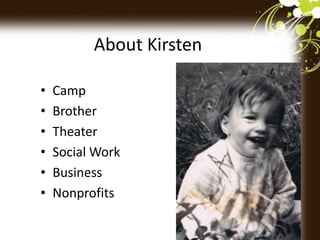
About Kirsten
• Camp
• Brother
• Theater
• Social Work
• Business
• Nonprofits
STEP ONE:
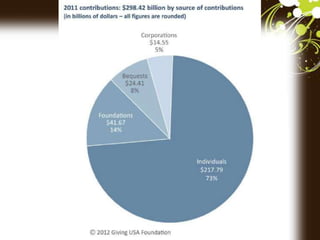
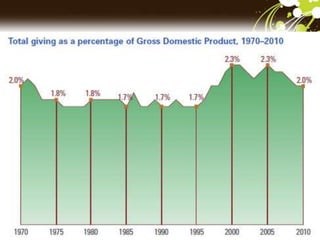
Understand Your Environment
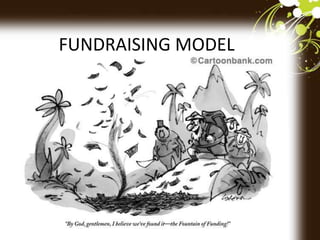
FUNDRAISING MODEL
STEP TWO:
Crystalize Your Vision
STEP THREE:
Communicating Your Vision
(or the case for support)
Case Statement
• The Need
• The Program
• The Cost
• Why You?
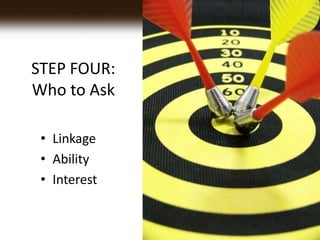
STEP FOUR:
Who to Ask
• Linkage
• Ability
• Interest
STEP FIVE:
Get the Word Out
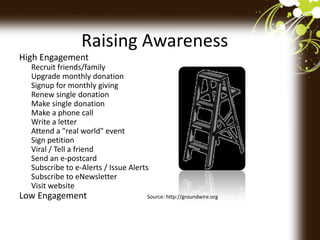
Raising Awareness
High Engagement
Recruit friends/family
Upgrade monthly donation
Signup for monthly giving
Renew single donation
Make single donation
Make a phone call
Write a letter
Attend a "real world" event
Sign petition
Viral / Tell a friend
Send an e-postcard
Subscribe to e-Alerts / Issue Alerts
Subscribe to eNewsletter
Visit website
Low Engagement Source: http://groundwire.org
STEP SIX: Ask
Asking for a Gift
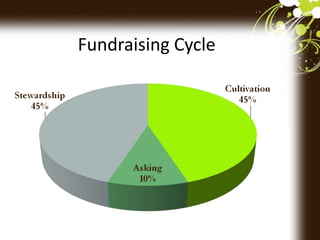
Fundraising Cycle
STEP 7: YOUR PLAN
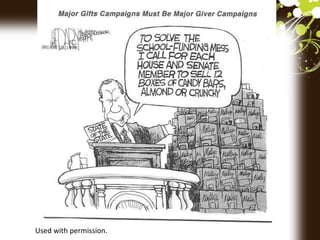
Used with permission.
STEP EIGHT: Build Your Team
Visit www.HelpforSmallNonProfits.com/goldmine
to request your Fundraising Training Gold-Mine!
*Just $19.95 for shipping
Double the Lifetime Value of
Your Database!
Jay B. Love
CEO & Co-Founder
Bloomerang
22
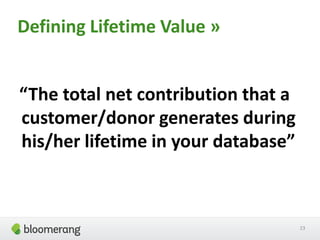
“The total net contribution that a
customer/donor generates during
his/her lifetime in your database”
23
Defining Lifetime Value »
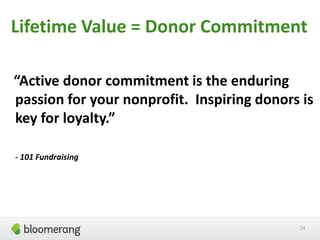
“Active donor commitment is the enduring
passion for your nonprofit. Inspiring donors is
key for loyalty.”
- 101 Fundraising
Lifetime Value = Donor Commitment
24
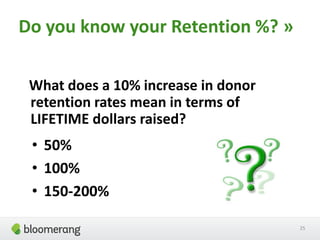
What does a 10% increase in donor
retention rates mean in terms of
LIFETIME dollars raised?
• 50%
• 100%
• 150-200%
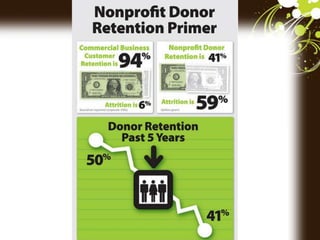
Do you know your Retention %? »
25
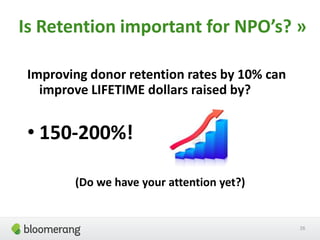
Improving donor retention rates by 10% can
improve LIFETIME dollars raised by?
• 150-200%!
(Do we have your attention yet?)
26
Is Retention important for NPO’s? »
Let’s dig even deeper into “actual” NPO data . . .
27
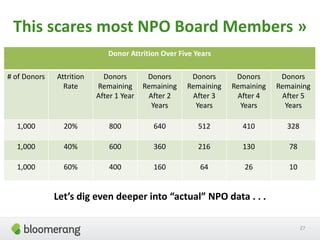
This scares most NPO Board Members »
Donor Attrition Over Five Years
# of Donors Attrition
Rate
Donors
Remaining
After 1 Year
Donors
Remaining
After 2
Years
Donors
Remaining
After 3
Years
Donors
Remaining
After 4
Years
Donors
Remaining
After 5
Years
1,000 20% 800 640 512 410 328
1,000 40% 600 360 216 130 78
1,000 60% 400 160 64 26 10
28
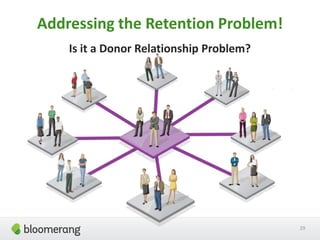
Addressing the Retention Problem!
Is it a Donor Relationship Problem?
29
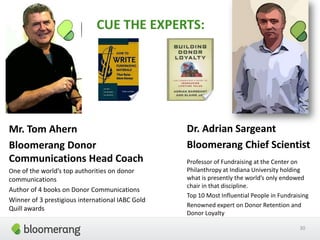
CUE THE EXPERTS:
Dr. Adrian Sargeant
Bloomerang Chief Scientist
Professor of Fundraising at the Center on
Philanthropy at Indiana University holding
what is presently the world’s only endowed
chair in that discipline.
Top 10 Most Influential People in Fundraising
Renowned expert on Donor Retention and
Donor Loyalty
30
Mr. Tom Ahern
Bloomerang Donor
Communications Head Coach
One of the world’s top authorities on donor
communications
Author of 4 books on Donor Communications
Winner of 3 prestigious international IABC Gold
Quill awards
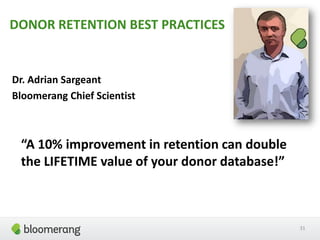
DONOR RETENTION BEST PRACTICES
Dr. Adrian Sargeant
Bloomerang Chief Scientist
31
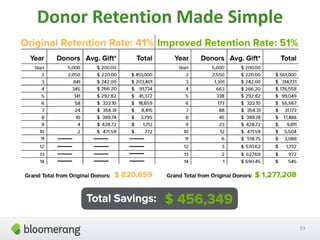
“A 10% improvement in retention can double
the LIFETIME value of your donor database!”
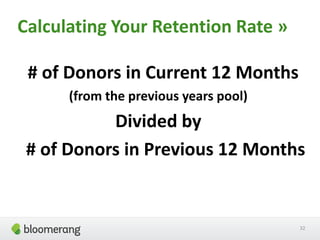
# of Donors in Current 12 Months
(from the previous years pool)
Divided by
# of Donors in Previous 12 Months
Calculating Your Retention Rate »
32
Donor Retention Made Simple
33
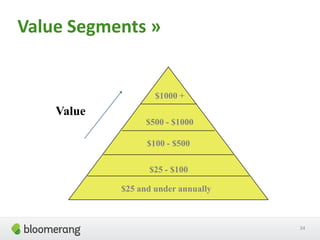
$1000 +
$500 - $1000
$100 - $500
$25 and under annually
$25 - $100
Value
34
Value Segments »
35
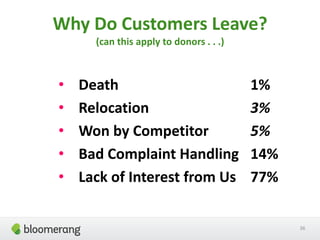
Why Do Customers Leave?
(can this apply to donors . . .)
• Death 1%
• Relocation 3%
• Won by Competitor 5%
• Bad Complaint Handling 14%
• Lack of Interest from Us 77%
36
Key Reasons For Donors Leaving
• No longer able to afford support
• No memory of ever supporting!
• Organization asked for inappropriate sums
• Feeling that other causes are more deserving
• Not reminded to give again
• Organization did not inform how monies were
used
• Did not feel connected!
37
38
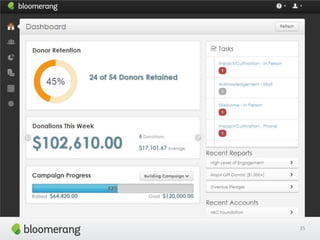
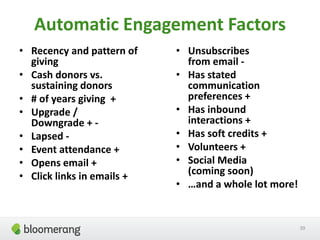
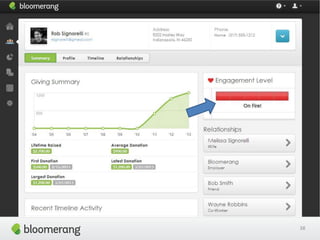
Automatic Engagement Factors
39
• Recency and pattern of
giving
• Cash donors vs.
sustaining donors
• # of years giving +
• Upgrade /
Downgrade + -
• Lapsed -
• Event attendance +
• Opens email +
• Click links in emails +
• Unsubscribes
from email -
• Has stated
communication
preferences +
• Has inbound
interactions +
• Has soft credits +
• Volunteers +
• Social Media
(coming soon)
• …and a whole lot more!
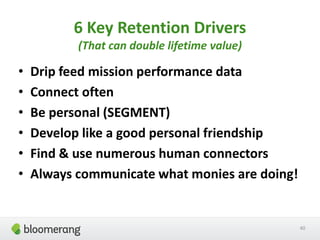
6 Key Retention Drivers
(That can double lifetime value)
• Drip feed mission performance data
• Connect often
• Be personal (SEGMENT)
• Develop like a good personal friendship
• Find & use numerous human connectors
• Always communicate what monies are doing!
40
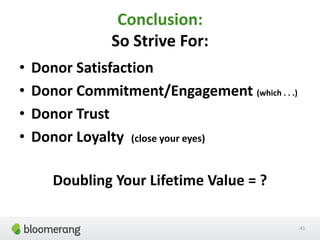
Conclusion:
So Strive For:
• Donor Satisfaction
• Donor Commitment/Engagement (which . . .)
• Donor Trust
• Donor Loyalty (close your eyes)
Doubling Your Lifetime Value = ?
41
Questions?
Contact Information:
Kirsten M. Bullock, MBA, CFRE
Growing Your Donors
kirsten@growingyourdonors.com
502.708.1020

8 Steps to Fundraising Success

  • 1.
    8 Steps to FundraisingSuccess July 16, 2013 Kirsten Bullock, CFRE| Jay Love
  • 2.
    About Kirsten • Camp •Brother • Theater • Social Work • Business • Nonprofits
  • 3.
  • 6.
  • 7.
  • 9.
    STEP THREE: Communicating YourVision (or the case for support)
  • 10.
    Case Statement • TheNeed • The Program • The Cost • Why You?
  • 11.
    STEP FOUR: Who toAsk • Linkage • Ability • Interest
  • 12.
  • 13.
    Raising Awareness High Engagement Recruitfriends/family Upgrade monthly donation Signup for monthly giving Renew single donation Make single donation Make a phone call Write a letter Attend a "real world" event Sign petition Viral / Tell a friend Send an e-postcard Subscribe to e-Alerts / Issue Alerts Subscribe to eNewsletter Visit website Low Engagement Source: http://groundwire.org
  • 14.
  • 15.
  • 16.
  • 18.
  • 19.
  • 20.
  • 21.
    Visit www.HelpforSmallNonProfits.com/goldmine to requestyour Fundraising Training Gold-Mine! *Just $19.95 for shipping
  • 22.
    Double the LifetimeValue of Your Database! Jay B. Love CEO & Co-Founder Bloomerang 22
  • 23.
    “The total netcontribution that a customer/donor generates during his/her lifetime in your database” 23 Defining Lifetime Value »
  • 24.
    “Active donor commitmentis the enduring passion for your nonprofit. Inspiring donors is key for loyalty.” - 101 Fundraising Lifetime Value = Donor Commitment 24
  • 25.
    What does a10% increase in donor retention rates mean in terms of LIFETIME dollars raised? • 50% • 100% • 150-200% Do you know your Retention %? » 25
  • 26.
    Improving donor retentionrates by 10% can improve LIFETIME dollars raised by? • 150-200%! (Do we have your attention yet?) 26 Is Retention important for NPO’s? »
  • 27.
    Let’s dig evendeeper into “actual” NPO data . . . 27 This scares most NPO Board Members » Donor Attrition Over Five Years # of Donors Attrition Rate Donors Remaining After 1 Year Donors Remaining After 2 Years Donors Remaining After 3 Years Donors Remaining After 4 Years Donors Remaining After 5 Years 1,000 20% 800 640 512 410 328 1,000 40% 600 360 216 130 78 1,000 60% 400 160 64 26 10
  • 28.
  • 29.
    Addressing the RetentionProblem! Is it a Donor Relationship Problem? 29
  • 30.
    CUE THE EXPERTS: Dr.Adrian Sargeant Bloomerang Chief Scientist Professor of Fundraising at the Center on Philanthropy at Indiana University holding what is presently the world’s only endowed chair in that discipline. Top 10 Most Influential People in Fundraising Renowned expert on Donor Retention and Donor Loyalty 30 Mr. Tom Ahern Bloomerang Donor Communications Head Coach One of the world’s top authorities on donor communications Author of 4 books on Donor Communications Winner of 3 prestigious international IABC Gold Quill awards
  • 31.
    DONOR RETENTION BESTPRACTICES Dr. Adrian Sargeant Bloomerang Chief Scientist 31 “A 10% improvement in retention can double the LIFETIME value of your donor database!”
  • 32.
    # of Donorsin Current 12 Months (from the previous years pool) Divided by # of Donors in Previous 12 Months Calculating Your Retention Rate » 32
  • 33.
  • 34.
    $1000 + $500 -$1000 $100 - $500 $25 and under annually $25 - $100 Value 34 Value Segments »
  • 35.
  • 36.
    Why Do CustomersLeave? (can this apply to donors . . .) • Death 1% • Relocation 3% • Won by Competitor 5% • Bad Complaint Handling 14% • Lack of Interest from Us 77% 36
  • 37.
    Key Reasons ForDonors Leaving • No longer able to afford support • No memory of ever supporting! • Organization asked for inappropriate sums • Feeling that other causes are more deserving • Not reminded to give again • Organization did not inform how monies were used • Did not feel connected! 37
  • 38.
  • 39.
    Automatic Engagement Factors 39 •Recency and pattern of giving • Cash donors vs. sustaining donors • # of years giving + • Upgrade / Downgrade + - • Lapsed - • Event attendance + • Opens email + • Click links in emails + • Unsubscribes from email - • Has stated communication preferences + • Has inbound interactions + • Has soft credits + • Volunteers + • Social Media (coming soon) • …and a whole lot more!
  • 40.
    6 Key RetentionDrivers (That can double lifetime value) • Drip feed mission performance data • Connect often • Be personal (SEGMENT) • Develop like a good personal friendship • Find & use numerous human connectors • Always communicate what monies are doing! 40
  • 41.
    Conclusion: So Strive For: •Donor Satisfaction • Donor Commitment/Engagement (which . . .) • Donor Trust • Donor Loyalty (close your eyes) Doubling Your Lifetime Value = ? 41
  • 42.
  • 43.
    Contact Information: Kirsten M.Bullock, MBA, CFRE Growing Your Donors kirsten@growingyourdonors.com 502.708.1020

Editor's Notes

  • #3 Now I have to confess, when I was growing up, I did not dream about becoming a fundraising professional some day. I’m pretty sure I didn’t even know that it was a possibility.But, I was introduced to nonprofits from a very young age. I spent about 10 summers, from age 2 to age 12, at a camp for kids with physical disabilities. That experience, combined with having a brother with Duchenne Muscular Dystrophy, had a profound impact on my life. It taught me to get to know people on the inside – rather than making assumptions. And, it taught me that there are lots of little ways that I can help make the world a better place.It was at an Arts school in North Carolina, majoring in Stage Management, when I was first introduced to philanthropy. My work study assignment was in the Foundation, making copies of news clippings about famous graduates. Four years later, when I was working towards my Bachelors degree in social work, I ended up completing my internship at the foundation at a local hospital – and I was hooked. After taking a break to complete my Masters in Business, I returned to nonprofits as the development director for a community health center. It was there that I experienced the thrill of growing a development program from the ground up. In a three-year time period, we went from $200,000 to $1,378,249 in non-federal grant funds raised. In addition, they had been through five different development directors in the five years prior to my arrival. But since I left that position over ten years ago, they’ve had just one.Since that time, I’ve had the honor and privilege to work with over two dozen organizations in various capacities. These have ranged from small local startups to multi-million dollar organizations. But enough about me. Let’s get started!
  • #39 Donor Engagement