1
INNNNTTTTRRRROOOODDDDUUUUCCCCTTTTIIIIOOOONNNN OF ACCCCTTTTIIIIVVVVAAAATTTTEEEEDDDD SLLLLUUUUDDDDGGGGEEEE 
 Biological Treatment Process:- 
 Use of Microorganisms to break down the organic matter in 
wastewater 
Organic Matter O2 CO2 + H2O + Energy + New Biomass 
 Suspended-Growth mechanisms 
mechanisms:- 
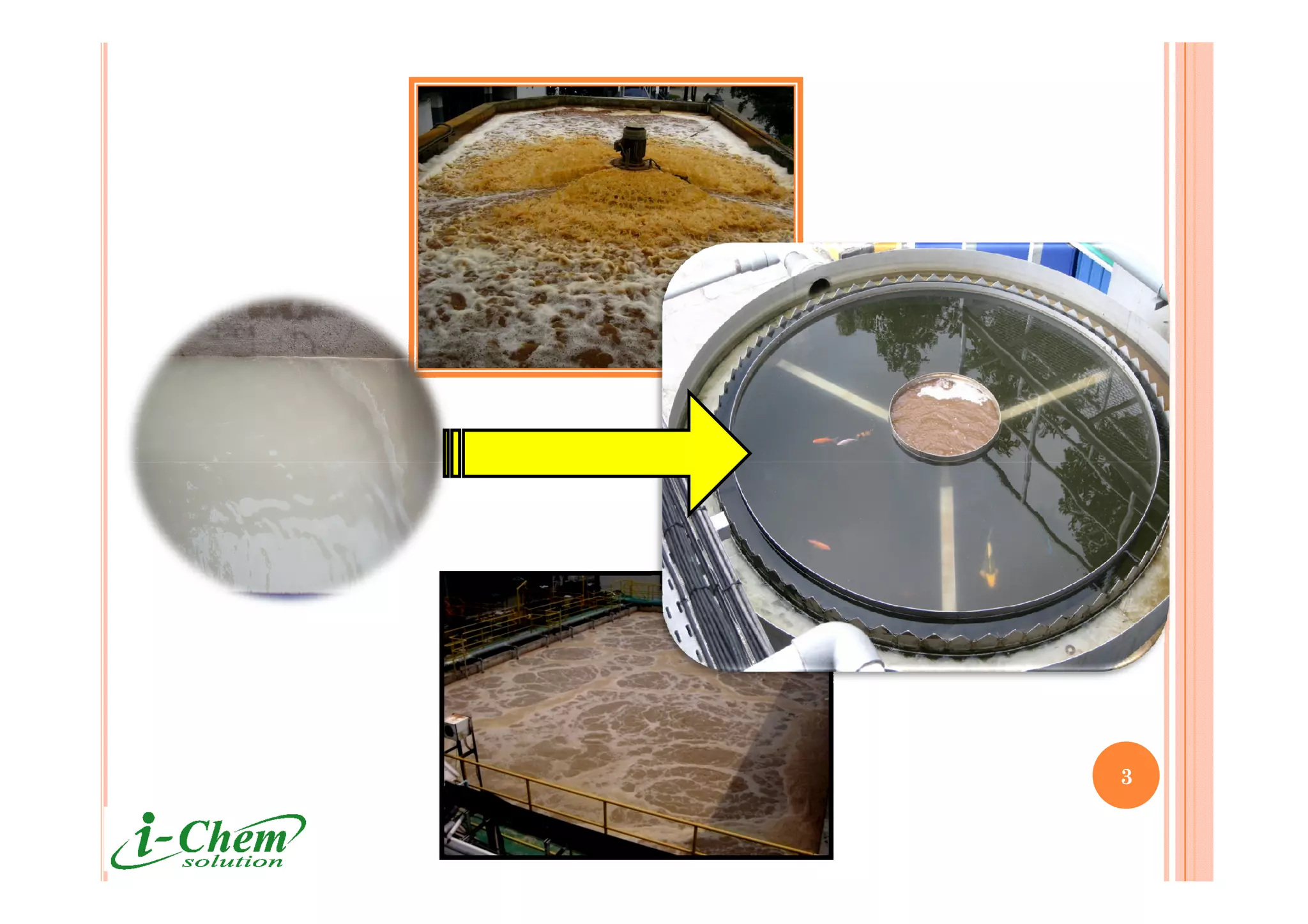
 This process maintain a culture of organisms in suspension of 
wastewater liquid, either by vigorously aerating the liquid or 
by mechanical mixing. 
 Aerobic Bacteria grow and form particles that clump together. 
 These particles (flocs) are allowed to settle to the bottom of the 
clarifier, leaving a relatively clear liquid free of organic material 
and suspended solids after aeration process. 
2
3
MMMMiiiiccccrrrroooooooorrrrggggaaaannnniiiissssmmmmssss 
iiiinnnn 
AAAAccccttttiiiivvvvaaaatttteeeedddd SSSSlllluuuuddddggggeeee 
4
BAAAACCCCTTTTEEEERRRRIIIIAAAA 
 Composition:- C60H87O23N12P 
 Characteristic:- 
 Ability to flocculate to form floc and their separation from the 
liquid phase for complete stabilization. 
 Removal of organic matter from wastewater is carried out 
through 2 process:- 
11.. BBiioollooggiiccaall OOxxiiddaattiioonn // RReessppiirraattiioonn 
COHNS + 02 + BACTERIA  CO2 + H2O + ENERGY + others 
2. Biosynthesis 
COHNS + O2 + BACTERIA  C5H7NO2 (New Cells) 
 Examples:- 
 Zooglea, Bacillius spp. , Pseudomonas, Flavobacterium, Alcaligenes, 
Acinetobacter 5
GROWTH OF BACTERIA - HHHHIIIIGGGGHHHH LLLLEEEEVVVVEEEELLLL OOOOFFFF FFFFOOOOOOOODDDD 
 When abundance of food is 
available 
 Bacteria are grow, motile,  
extremely active 
 They are multiply rapidly. 
6 
 Bacteria will not flocculate and 
settle as long as they are growing 
at a lag phase. 
 Biosynthesis (new cell); 
Respiration (energy) 
 Activated Sludge with a 
poor settling properties
GROWTH OF BACTERIA - LLLLOOOOWWWW LLLLEEEEVVVVEEEELLLL OOOOFFFF FFFFOOOOOOOODDDD 
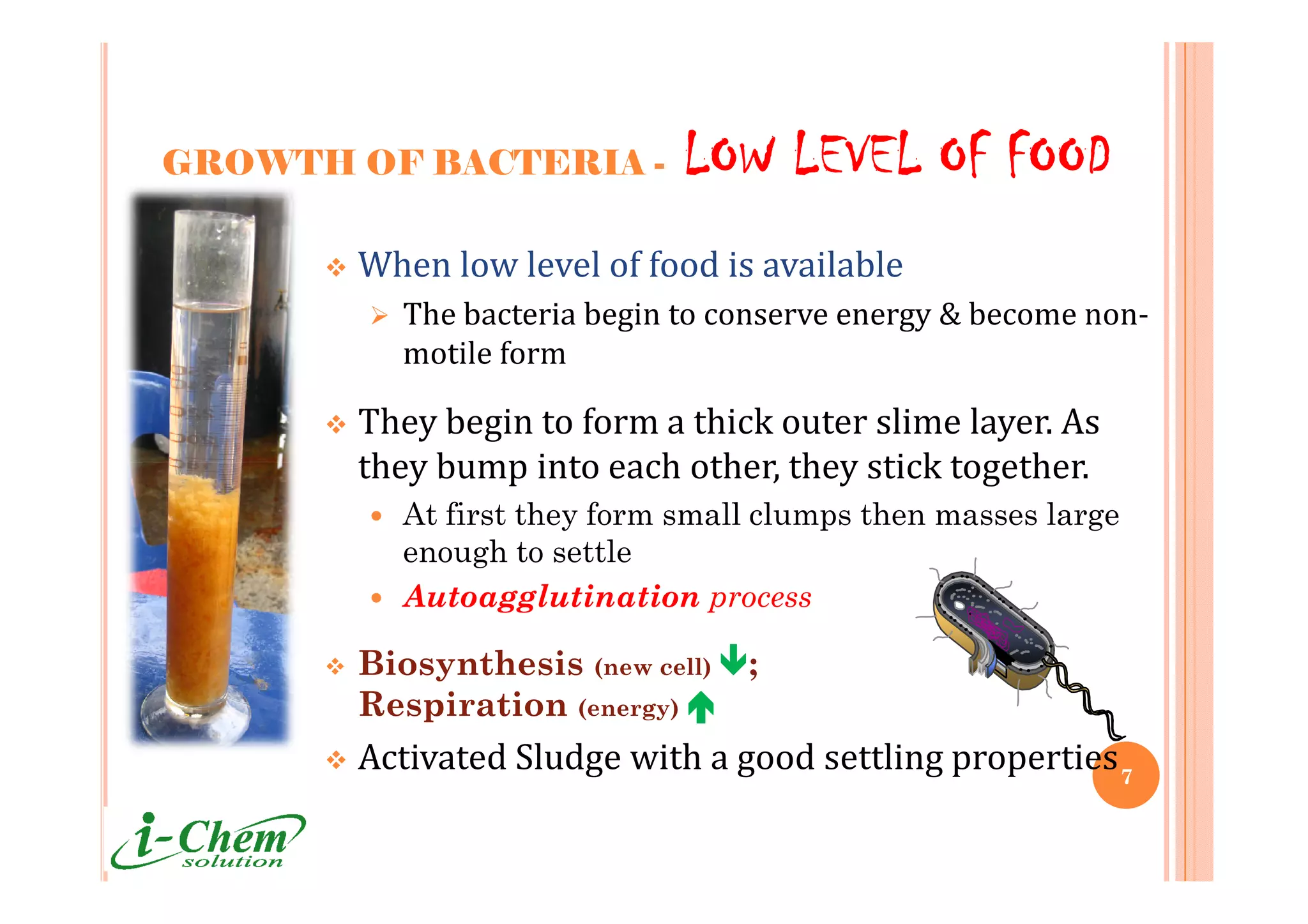
 When low level of food is available 
 The bacteria begin to conserve energy  become non-motile 
form 
 They begin to form a thick outer slime layer. As 
they bump into each other, they stick together. 
 At first they form small clumps then masses large 
enough to settle 
 Autoagglutination process 
 Biosynthesis (new cell); 
Respiration (energy)  
 Activated Sludge with a good settling properties 
7
FIIIILLLLAAAAMMMMEEEENNNNTTTTOOOOUUUUSSSS BAAAACCCCTTTTEEEERRRRIIIIAAAA 
 Characteristic:- 
 Filaments do not have the same flocculating characteristics 
as the bacteria which do not compact to a readily settleable 
mass. 
 Roles:- 
11.. BBOODD//CCOODD rreemmoovvaall 
2. Add a backbone for strengthen purpose to the floc structure 
 Examples of Filaments:- 
 S. natans, 
 Nocardia, 
 Beggiatoa… 
8
When filaments abundant in 
activated sludge:- 
 Foaming 
Predominate over the bacteria when:- 
9 
1. Low Dissolve Oxygen 
2. Low pH 
3. Low Nutrients 
4. F/M ratio not stable 
5. High level of Oil  Grease
PRRRROOOOTTTTOOOOZZZZOOOOAAAA 
 Roles:- 
 Removing  digesting free-swimming dispersed bacteria 
and other suspended particles. This improves the clarity 
of the effluent 
 Biological Indicator of the activated sludge condition:- 
 SSttrriicctt AAeerroobbeess 
 More sensitive to toxic organic compound 
 Examples:- 
1. Ciliates (Opercularia, Carchesium polypinum …) 
2. Amoebae (Arcella,Euglypha…) 
3. Flagellates (Peranema… ) 
10
PROTOZOA -AMMMMOOOOEEEEBBBBAAAAEEEE 
 Food:- 
 They feed on small organic particulates 
 When abundant present in Activated sludge:- 
 Plant start-up. 
 AA sshhoocckk llooaadd ooff BBOODD // llaarrggee aammoouunntt ooff oorrggaanniicc 
particulates has entered the treatment system 
 They move slowly  cannot compete with bacteria / protozoa for 
food. Sudden increase in food allows them to compete  multiply 
 They required less O2  able to 
compete with other protozoa 
when the O2 is limited. 
11
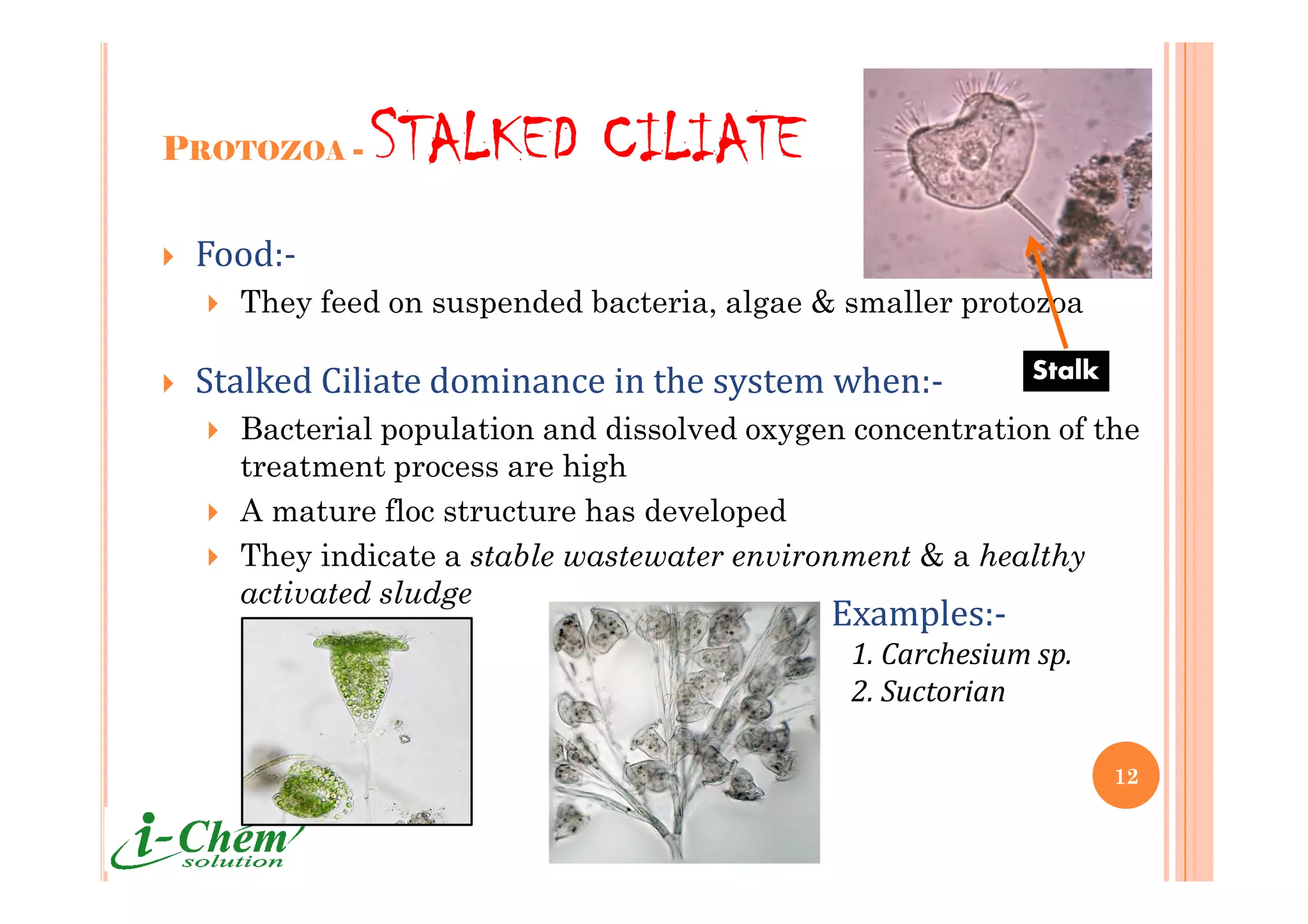
PROTOZOA - STTTTAAAALLLLKKKKEEEEDDDD CCCCIIIILLLLIIIIAAAATTTTEEEE 
 Food:- 
 They feed on suspended bacteria, algae  smaller protozoa 
 Stalked Ciliate dominance in the system when:- 
 Bacterial population and dissolved oxygen concentration of the 
treatment process are high 
Stalk 
 A mature floc structure has developed 
 They indicate a stable wastewater environment  a healthy 
activated sludge 
12 
Examples:- 
1. Carchesium sp. 
2. Suctorian
PROTOZOA -CCCCRRRRAAAAWWWWLLLLIIIINNNNGGGG CCCCIIIILLLLIIIIAAAATTTTEEEESSSS 
 Food:- 
 They feed on suspended bacteria, algae  smaller protozoa 
 Characteristic:- 
 They are free forms, inhabit the surface of sludge flocs or 
bbiiooffiillmm 
 They dominance in the system when:- 
 After most soluble nutrients have been removed which are 
reflect a stable wastewater 
environment  healthy 
activated sludge 
13
METAZOA 
 They are multicellular organisms  include all animals 
except the protozoa 
 Roles:- 
 Feed on bacteria, bacteria floc, fungi, protozoa 
 rotifer 
 EExxaammpplleess::-- 
 Nematode worms (Genus Aelosoma, Rhabditis) 
 Rotifers 
 Tartigrades (water bear) 
14
METAZOA - ROOOOTTTTIIIIFFFFEEEERRRR 
 Roles:- 
 Feed on good, stabilized floc; They graze on the floc 
structure and increase oxygen penetration 
 As environmental indicator due to they are usually the first 
to be affected by a toxic load. 
 When abundant present in activated sludge:- 
 Old sludge age with high MLSS 
 Low F/M ratio 
15
EVALUATION OF ACTIVATED 
SLUDGE 
Bacteria 16 Testing Report
Lab 
Lab Testing 
Testing 
Routine Microscopic 
Examination 
17 
Microscopic 
Examination 
Microscopic 
Examination
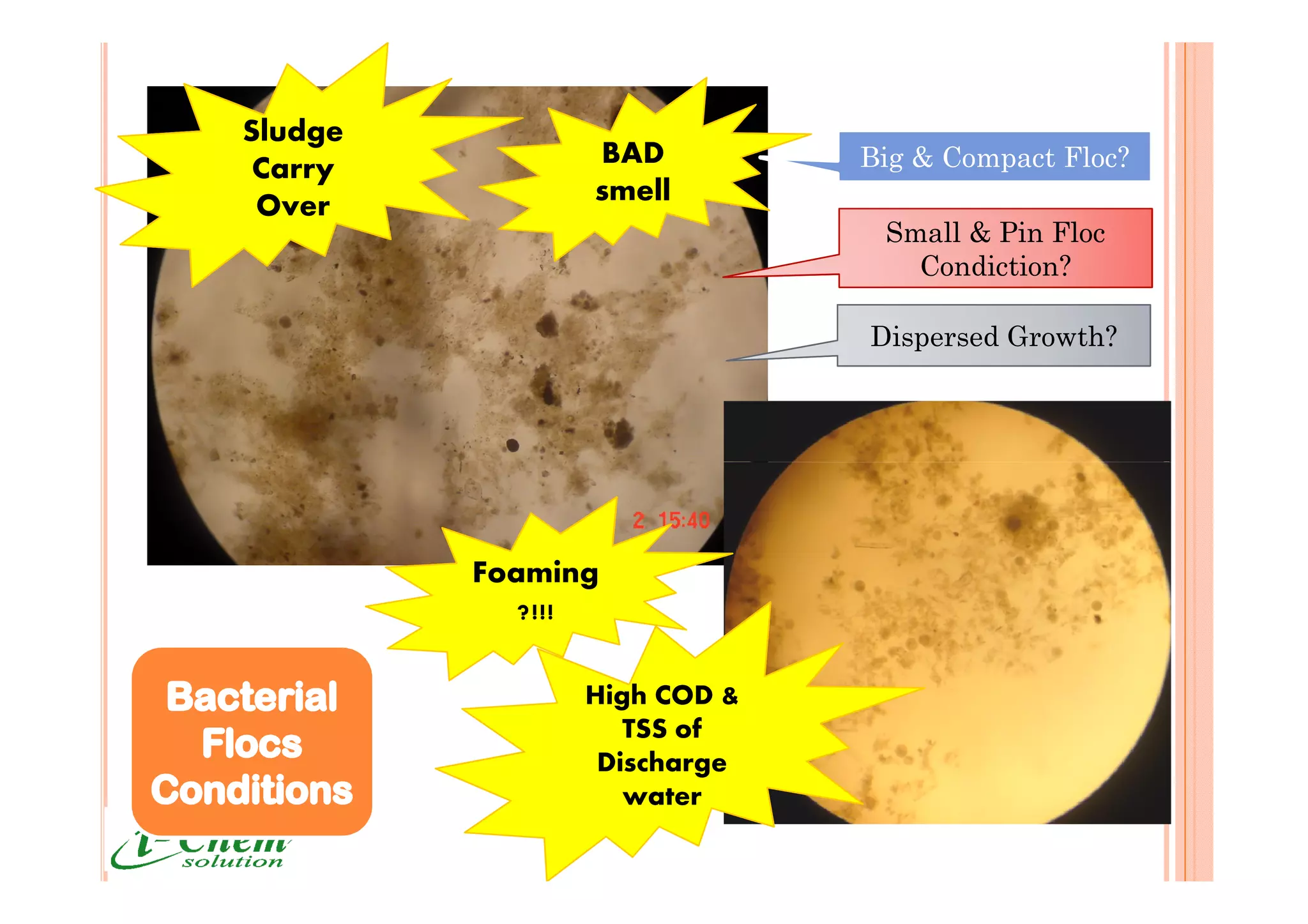
Big  Compact Floc? 
Small  Pin Floc 
Condiction? 
Dispersed Growth? 
Sludge 
Carry 
Over 
BAD 
smell 
18 
Foaming 
?!!! 
HHiigghh CCOODD  
TSS of 
Discharge 
water
Protozoa? 
Filaments? 
19 
Rotifer?
Secondary 
Clarifier 
20 
Final 
Discharged
Booth L220 
21 
i-Chem Solution Sdn Bhd 
20, Jalan TPP 6/8, Taman Perindustrian Puchong, 
47100 Puchong, Selangor, Malaysia. 
TTTTeeeellll:::: ++++666600003333-- 88880000666622221111666688886666 
FFFFaaaaxxxx:::: ++++666600003333--88880000666622226666444455557777 
EEEEmmmmaaaaiiiillll:::: ssssaaaalllleeeessss@@@@iiii--cccchhhheeeemmmmssssoooolllluuuuttttiiiioooonnnn....ccccoooommmm 
WWWWeeeebbbb:::: wwwwwwwwwwww....iiii--cccchhhheeeemmmmssssoooolllluuuuttttiiiioooonnnn....ccccoooommmm

The world-of-activated-sludge

  • 1.
  • 2.
    INNNNTTTTRRRROOOODDDDUUUUCCCCTTTTIIIIOOOONNNN OF ACCCCTTTTIIIIVVVVAAAATTTTEEEEDDDDSLLLLUUUUDDDDGGGGEEEE Biological Treatment Process:- Use of Microorganisms to break down the organic matter in wastewater Organic Matter O2 CO2 + H2O + Energy + New Biomass Suspended-Growth mechanisms mechanisms:- This process maintain a culture of organisms in suspension of wastewater liquid, either by vigorously aerating the liquid or by mechanical mixing. Aerobic Bacteria grow and form particles that clump together. These particles (flocs) are allowed to settle to the bottom of the clarifier, leaving a relatively clear liquid free of organic material and suspended solids after aeration process. 2
  • 3.
  • 4.
  • 5.
    BAAAACCCCTTTTEEEERRRRIIIIAAAA Composition:-C60H87O23N12P Characteristic:- Ability to flocculate to form floc and their separation from the liquid phase for complete stabilization. Removal of organic matter from wastewater is carried out through 2 process:- 11.. BBiioollooggiiccaall OOxxiiddaattiioonn // RReessppiirraattiioonn COHNS + 02 + BACTERIA CO2 + H2O + ENERGY + others 2. Biosynthesis COHNS + O2 + BACTERIA C5H7NO2 (New Cells) Examples:- Zooglea, Bacillius spp. , Pseudomonas, Flavobacterium, Alcaligenes, Acinetobacter 5
  • 6.
    GROWTH OF BACTERIA- HHHHIIIIGGGGHHHH LLLLEEEEVVVVEEEELLLL OOOOFFFF FFFFOOOOOOOODDDD When abundance of food is available Bacteria are grow, motile, extremely active They are multiply rapidly. 6 Bacteria will not flocculate and settle as long as they are growing at a lag phase. Biosynthesis (new cell); Respiration (energy) Activated Sludge with a poor settling properties
  • 7.
    GROWTH OF BACTERIA- LLLLOOOOWWWW LLLLEEEEVVVVEEEELLLL OOOOFFFF FFFFOOOOOOOODDDD When low level of food is available The bacteria begin to conserve energy become non-motile form They begin to form a thick outer slime layer. As they bump into each other, they stick together. At first they form small clumps then masses large enough to settle Autoagglutination process Biosynthesis (new cell); Respiration (energy) Activated Sludge with a good settling properties 7
  • 8.
    FIIIILLLLAAAAMMMMEEEENNNNTTTTOOOOUUUUSSSS BAAAACCCCTTTTEEEERRRRIIIIAAAA Characteristic:- Filaments do not have the same flocculating characteristics as the bacteria which do not compact to a readily settleable mass. Roles:- 11.. BBOODD//CCOODD rreemmoovvaall 2. Add a backbone for strengthen purpose to the floc structure Examples of Filaments:- S. natans, Nocardia, Beggiatoa… 8
  • 9.
    When filaments abundantin activated sludge:- Foaming Predominate over the bacteria when:- 9 1. Low Dissolve Oxygen 2. Low pH 3. Low Nutrients 4. F/M ratio not stable 5. High level of Oil Grease
  • 10.
    PRRRROOOOTTTTOOOOZZZZOOOOAAAA Roles:- Removing digesting free-swimming dispersed bacteria and other suspended particles. This improves the clarity of the effluent Biological Indicator of the activated sludge condition:- SSttrriicctt AAeerroobbeess More sensitive to toxic organic compound Examples:- 1. Ciliates (Opercularia, Carchesium polypinum …) 2. Amoebae (Arcella,Euglypha…) 3. Flagellates (Peranema… ) 10
  • 11.
    PROTOZOA -AMMMMOOOOEEEEBBBBAAAAEEEE Food:- They feed on small organic particulates When abundant present in Activated sludge:- Plant start-up. AA sshhoocckk llooaadd ooff BBOODD // llaarrggee aammoouunntt ooff oorrggaanniicc particulates has entered the treatment system They move slowly cannot compete with bacteria / protozoa for food. Sudden increase in food allows them to compete multiply They required less O2 able to compete with other protozoa when the O2 is limited. 11
  • 12.
    PROTOZOA - STTTTAAAALLLLKKKKEEEEDDDDCCCCIIIILLLLIIIIAAAATTTTEEEE Food:- They feed on suspended bacteria, algae smaller protozoa Stalked Ciliate dominance in the system when:- Bacterial population and dissolved oxygen concentration of the treatment process are high Stalk A mature floc structure has developed They indicate a stable wastewater environment a healthy activated sludge 12 Examples:- 1. Carchesium sp. 2. Suctorian
  • 13.
    PROTOZOA -CCCCRRRRAAAAWWWWLLLLIIIINNNNGGGG CCCCIIIILLLLIIIIAAAATTTTEEEESSSS Food:- They feed on suspended bacteria, algae smaller protozoa Characteristic:- They are free forms, inhabit the surface of sludge flocs or bbiiooffiillmm They dominance in the system when:- After most soluble nutrients have been removed which are reflect a stable wastewater environment healthy activated sludge 13
  • 14.
    METAZOA Theyare multicellular organisms include all animals except the protozoa Roles:- Feed on bacteria, bacteria floc, fungi, protozoa rotifer EExxaammpplleess::-- Nematode worms (Genus Aelosoma, Rhabditis) Rotifers Tartigrades (water bear) 14
  • 15.
    METAZOA - ROOOOTTTTIIIIFFFFEEEERRRR Roles:- Feed on good, stabilized floc; They graze on the floc structure and increase oxygen penetration As environmental indicator due to they are usually the first to be affected by a toxic load. When abundant present in activated sludge:- Old sludge age with high MLSS Low F/M ratio 15
  • 16.
    EVALUATION OF ACTIVATED SLUDGE Bacteria 16 Testing Report
  • 17.
    Lab Lab Testing Testing Routine Microscopic Examination 17 Microscopic Examination Microscopic Examination
  • 18.
    Big CompactFloc? Small Pin Floc Condiction? Dispersed Growth? Sludge Carry Over BAD smell 18 Foaming ?!!! HHiigghh CCOODD TSS of Discharge water
  • 19.
  • 20.
    Secondary Clarifier 20 Final Discharged
  • 21.
    Booth L220 21 i-Chem Solution Sdn Bhd 20, Jalan TPP 6/8, Taman Perindustrian Puchong, 47100 Puchong, Selangor, Malaysia. TTTTeeeellll:::: ++++666600003333-- 88880000666622221111666688886666 FFFFaaaaxxxx:::: ++++666600003333--88880000666622226666444455557777 EEEEmmmmaaaaiiiillll:::: ssssaaaalllleeeessss@@@@iiii--cccchhhheeeemmmmssssoooolllluuuuttttiiiioooonnnn....ccccoooommmm WWWWeeeebbbb:::: wwwwwwwwwwww....iiii--cccchhhheeeemmmmssssoooolllluuuuttttiiiioooonnnn....ccccoooommmm