

STRATEGIES FOR BUILDING
A CULTURE OF
CONTINUOUS QUALITY
IMPROVEMENT (CQI) IN
INSTITUTIONS
Leon C. Wilson, PhD
Alabama State University
October 4, 2016
Our Workshop Plan
 1. BRIEF REVIEW (THINGS YOU ALREADY KNOW)
 2. ANCHOR MY THOUGHTS IN THE KNOWN
 3. FOCUS ON A FEW ELEMENTS OF THE QUALITY
ASSURANCE
 4. INTERACTIVE ACTIVITIES
CYCLE OF CONTINUOUS
IMPROVEMENT DEFINED
CQI, “A philosophical approach to quality that
contends most things can be improved. At its core, the
philosophy of CQI is lived in the belief that improving
the services we offer everyday better meets the needs
of those we serve. This assessment process enables
the university community to regularly review academic
standards and relevant outcomes facilitating
improvement of academic programs thus, the
university's status.” (Dormire, Green & Salivar, 2013, p.
3).
CYCLE OF CONTINUOUS
IMPROVEMENT DEFINED
CQI is an approach to quality management
that focuses on processes rather than
persons, recognizes both internal and
external customers of our services and
adheres to the value of objective data to
analyze and subsequently improve
processes (Dormire, Green & Salivar (2013,
9).
THE MAIN CONCEPTS: In
Brief
 Continuous Quality Improvement
 Quality
QUALITY:
Deming (1986), ‘”Satisfying the needs
the present and future”
Roberts (1993), “ Continually serving
customers better and more
economically, using scientific method
and team-work, focusing on removal
all forms of waste”
Juran (1989), “Fitness for use”
CONTINUOUS QUALITY
IMPROVEMENT (CQI)
Hogg & Hogg (1995), CQI requires
looking at the interdependence of
roles people play in a system of
continuous improvement.
CORE ASSUMPTIONS ABOUT CQI
 Dormire, Green, & Salivar (2013, p. 3).
1. Quality is defined as meeting or exceeding the
expectations of those we serve.
2. The CQI process serves as a mechanism to
strategically implement recommendations of
the university's strategic plans.
3. If an organization focuses on refining
and steadying the critical mechanisms
of maintenance, the outcomes will
improve for customers.
4. Problems are usually found in
processes, not necessarily persons;
improvements can be made in outcomes
by improving the processes, not
changing the people who manage
the flawed processes.
ASSUMPTIONS CONT’D
ASSUMPTIONS CONT’D
5. Incremental change can provide
continual improvement in outcomes
6. Continuous improvement is most
effective when it becomes a valued
component of daily work and not an
added responsibility episodically or as
an afterthought to a process
Employees: Provided with required training,
resources and tools for decision making.
Suppliers: Trusted members of decision-making
teams.
DATA EXPERTS: Getting relevant data
communicating statistical summaries, and
interpretation of data for better decision
making.
OTHER CONSIDERATIONS
o Demonstrate program success for
accreditation or funding requests
o Minimize risk
o Support program management
o Improve efficiency / save money
o Ensure baseline staff performance
o Improve staff morale
WHY WOULD AN
INSTITUTION
WANT TO DO CQI?
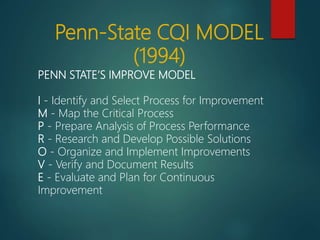
Penn-State CQI MODEL
(1994)
PENN STATE’S IMPROVE MODEL
I - Identify and Select Process for Improvement
M - Map the Critical Process
P - Prepare Analysis of Process Performance
R - Research and Develop Possible Solutions
O - Organize and Implement Improvements
V - Verify and Document Results
E - Evaluate and Plan for Continuous
Improvement
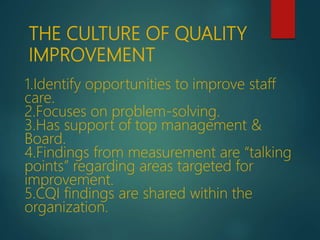
1.Identify opportunities to improve staff
care.
2.Focuses on problem-solving.
3.Has support of top management &
Board.
4.Findings from measurement are “talking
points” regarding areas targeted for
improvement.
5.CQI findings are shared within the
organization.
THE CULTURE OF QUALITY
IMPROVEMENT
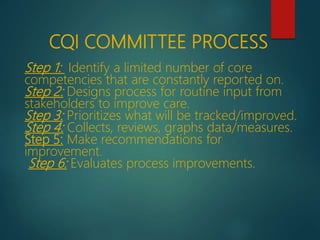
CQI COMMITTEE PROCESS
Step 1: Identify a limited number of core
competencies that are constantly reported on.
Step 2: Designs process for routine input from
stakeholders to improve care.
Step 3: Prioritizes what will be tracked/improved.
Step 4: Collects, reviews, graphs data/measures.
Step 5: Make recommendations for
improvement.
Step 6: Evaluates process improvements.
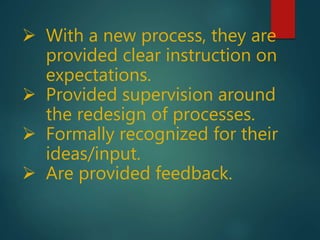
 With a new process, they are
provided clear instruction on
expectations.
 Provided supervision around
the redesign of processes.
 Formally recognized for their
ideas/input.
 Are provided feedback.
BENCHMARK YOUR
PERFORMANCE
Is your performance better, worse, or
about the same other like programs
SOME U.S. UNIVERSITIES AND
COLLEGES USING CQI
Georgia Tech, Maryland, North
Dakota, Oregon State, Penn State, Purdue, Rochester
Institute of Technology, and Wisconsin, Fox Valley
Technical College (FVTC), Boston College, the Maricopa
Community College system, and the University of
Wisconsin-Madison, Western Michigan University,
University of Minnesota, Eastern Michigan University,
University system of Georgia.
See May/June 1993 issue of the journal Change; April
1993 issue of Higher Education.
The University of Ulster in
Northern Ireland; the University of
Wolverhampton in Wolverhampton,
U.K.; South Bank University in London,
U.K.; and at Aston University in
Birmingham, U.K.
SOME U.K. INSTITUTIONS USING
CQI
Manage performance using “Total
Quality management”
Make data-driven decisions to
reduce waste (Hogg & Hogg, 1995, 35).
Allow an environment of joy and
pride for employees to feel
empowered to make changes.
The quality indicators of the
institution must be known.
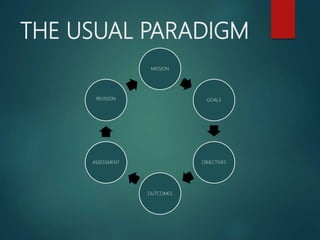
THE USUAL PARADIGM
MISSION
GOALS
OBJECTIVES
OUTCOMES
ASSESSMENT
REVISION
The strategies for
CQI must clearly
align with the
organization’s
mission.
Isolate elements of continuing
improvement that are pressing.
Think holistically and
synergistically about quality
improvement.
Align the outcomes with the various
functions of the institutions.
Have a design for improving, making
adjustments and retooling totally if
necessary.
Improvement cannot occur at one
level.
The Chancellor must define his broad
vision to every unit.
Once revealed, each unit can then
identify elements relevant to the
vision.
Though these are usually embedded
in the institutions' objectives, It is
essential to have quality indicators
clearly defined.
Having several mechanisms to
execute and evaluate effectiveness
are appropriate.
Diffusion of the concept must be
spread over the whole institution.
Total diffusion allows the vision of
continuous improvement to
become a framework within the
whole institution.
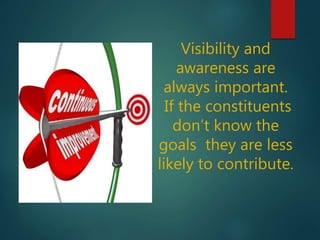
Visibility and
awareness are
always important.
If the constituents
don’t know the
goals they are less
likely to contribute.
ROLE OF FACULTY AND STAFF
Faculty and Staff Involvement:
o Identify opportunities to improve
services & problems.
o Staff submit ideas or concerns.
o Staff use rules of communication.
o Staff engage in measurement of
processes or outcomes.
o There is no retribution for staff input.
Weaknesses at any point in the cycle will
determine the effectiveness of the quality
assurance.
Outcomes must be properly defined and
measured
.
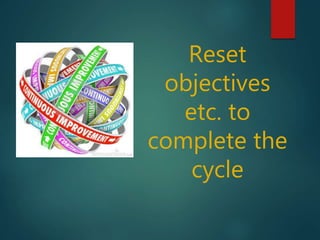
Reset
objectives
etc. to
complete the
cycle
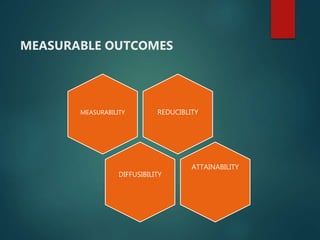
MEASURABLE OUTCOMES
REDUCIBLITYMEASURABILITY
DIFFUSIBILITY
ATTAINABILITY
MEASURABILITY
 Language of the specific outcomes must lend itself to
analytic scrutiny.
 Represent a benchmark to be reached
 Literature on Learning Outcomes (Kennedy, Declan,
2007; Krathwohl, David, 2001).
REDUCIBILITY
 The need to reduce the desired outcomes to the
simplest language
 SIMPLICITY NOT COMPLEXITY
 ENCAPSULATION (synthesis)
 PROMOTION (THE LANGUAGE OF CULTURE):uniform
interpretation.
DIFFUSIBILITY
STRATEGIC ALLIGNMENT
 INFORMS THE IMPLEMENTATION STRATEGY
 DRIVES THE COLLABORATIVE PROCESS
 DEFINES THE CULTURAL COHESION OF THE
COMMUNITY
 ORGANIZES THE COMMUNITY
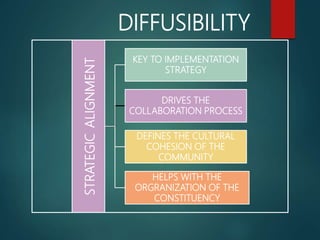
STRATEGICALIGNMENT
KEY TO IMPLEMENTATION
STRATEGY
DRIVES THE
COLLABORATION PROCESS
DEFINES THE CULTURAL
COHESION OF THE
COMMUNITY
HELPS WITH THE
ORGRANIZATION OF THE
CONSTITUENCY
DIFFUSIBILITY
ATTAINABILITY
 BE REALISTIC ABOUT PEER AND
ASPIRATIONAL INSTITUTIONS
 RESEARCH BENCHMARKS
 IDENTIFY SPECIFIC GOALS AT EACH
STAGE
 PROVIDE CONTINUOUS FEEDBACK
 ENSURE OBJECTIVES ARE MEASURABLE
 SECURE DATA
KNOW YOUR
CONSTITUENCY
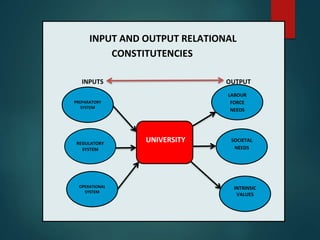
INPUT AND OUTPUT RELATIONAL
CONSTITUTENCIES
INPUTS OUTPUT
LABOUR
FORCE
NEEDS
PREPARATORY
SYSTEM
SOCIETAL
NEEDS
REGULATORY
SYSTEM
INTRINSIC
VALUES
OPERATIONAL
SYSTEM
UNIVERSITY
COMMUNICATE
 ORGANIZING AND MONITORING TEAMS
 DELIBERATE STRATEGY FOR INFORMATION
PROCESSING
 ENGAGING THE UNIVERSITY MECHANISM FOR
INTERNAL COMMUNICATION
 EXTERNAL RELATION TEAM (WORKFORCE/ TASK
FORCE)
EVALUATE
ESTABLISH EVALUATION
TARGETS
QEP A CENTRAL
MECHANISM
REGULATORY REQUIREMENTS
OF ACCREDITATION BODIES
 UG: The National Accreditation Council of
Guyana (NAC)
 UWI – Mona, Jamaica: The University Council
of Jamaica (UCJ)
 UWI- Cave Hill Barbados – Barbados
Accreditation Council’s (BAC)
 UWI – Open campus Barbados Accreditation
Council’s (BAC)
 UWI – St Augustine T&T – Accreditation
Council of Trinidad and Tobago (ACTT)
• What already exists?1
• Who is responsible for
what?
2
• How do we create a
cycle of continuous
improvement?
3
REFLECTION QUESTIONS...
SUMMARY
Define your challenges
Set realistic expectation
Keep your eye on the
goal
Appendix
Useful Resources
Quality: Transforming Postsecondary
Education, by Ellen Earle Chaffee
and Lawrence A. Sherr (1992)
provides a good start for any
university that wants to consider
such a major transformation in
culture.
Useful Resources
Two titles that are beneficial in terms of
learning about changes in leadership,
changes in thinking about customers,
and general organizational change are:
Thriving on Chaos, by Tom Peters; and
Re-Engineering the Corporation, by
Hammer & Champy (1993).
Useful Resources
Two books by Mary Walton (1986,1990) also serve as a good
starting place. After that, Deming's Out of the Crisis (1986) is an
excellent reference. In the health care area, Curing Health Care
(by Berwick, Godfrey, and Roessner, a 1990 publication) provides
many good case studies in which the elementary statistical tools
are used. Joiner Associates' The Team Handbook (1991), with
Peter Scholtes as the major contributing author, is particularly
useful in team building exercises, and a special edition for
education is due out in 1994.
Resources
Abdullah, Firdaus. (2006). Measuring service quality in higher
education: HEdPERF versus SERVPERF Marketing Intelligence &
Planning, Vol. 24 No. 1, pp. 31-47
Altbach, Philip G., Reisberg, Liz, and Rumbley, Laura E. (2009). Trends
in Global Higher Education: Tracking an Academic Revolution. A
Report Prepared for the UNESCO 2009 World Conference on Higher
Education.
Billing, David. (2004). International Comparisons and Trends in
External Quality Assurance of Higher Education: Commonality or
Diversity? Higher Education, Vol. 47, No. 1, pp. 113-137
Deem, Rosemary, Ka Ho Mok, Ka Ho, and Lucas, Lisa. (2008).
Transforming Higher Education in Whose Image? Exploring the
concept of the ‘world-class’ university in Europe and Asia. Higher
Education Policy, 21, 83–97.
Resources
Deming, W.E. (1986). Out of the Crisis. Cambridge, MA. Massachusetts
Institute of Technology Center for Advanced Engineering Study.
De Wit, Hans, Jaramillo, Isabel Cristina, Gacel-Ávila, Jocelyne, and
Knight, Jane. (Eds.). (2005). Higher Education in Latin America: The
International Dimension. Washington DC. The World Bank.
Dormire, S., Green, D. & Salivar, G. (2013). Student Learning Outcome
Assessment Plan: Continuous Quality Improvement Florida Atlantic
University. A Report to the Team for Assurance of Student Learning and
the Associate Provost for Assessment and Instruction. The TASL Best
Practices Subcommittee, Florida Atlantic University (FAU). Accessed
September 2, 2016. https://www.fau.edu/iea/assessment/sloap13
Eaton, Judith S. (2012). An Overview of U.S. Accreditation. Washington,
DC. Council for Higher Education Accreditation.
Green, Diana (Ed.). (1994). What Is Quality in Higher Education? Bristol,
PA. SRHE and Open University Press.
Resources
Harvey, Lee and Williams, James. (Fifteen Years of Quality in
Higher Education (Part I). Revista Educação e Cultura
Contemporânea, v. 11, n. 25
Hoecht, Andreas. (2006). Quality Assurance in UK Higher
Education: Issues of Trust, Control, ProfessionalAutonomy
and Accountability. Higher Education, Vol. 51, No. 4, pp.
541-563.
Hogg, Robert V. & Hogg, Mary C. (1995). Continuous
Quality improvement in education. International Statistical
Review, 63 (1) 35-48.
Juran, J.M. (1989). Juran on Leadership for Quality: An
Executive Handbook. New York, NY Free Press.
Resources
Martin, Michaela and Stella, Anthony (2007). External quality assurance
in higher education: Making choices. Paris. UNESCO: International
Institute for Educational Planning
Mizikaci, Fatma (2006). A systematic approach to program evaluation
model for quality in higher education. Quality Assurance in Education,
Vol. 14 No. 1, . 37-53
Mishra, Sanjay. (2006). Quality assurance in higher education: An
introduction. National Assessment and Accreditation Council (NAAC).
Karnataka, India.
Nicholson. Karen. (2011). Quality Assurance in Higher Education: A
Review of the Literature
Resources
OECD. (2009). Higher Education to 2030 VOLUME 2: Globalisation.
Centre for Educational Research and Innovation.
Ogbodo, Charles M. and Nwaoku, Ngozika A. ( ). Quality
Assurance in Higher Education. Towards Quality in African Higher
Education. Accessed August 26, 2016.
http://webcache.googleusercontent.com/search?q=cache:sBgzKoDh
VDsJ:http://citeseerx.ist.psu.edu/viewdoc/download?
Roberts, H.V. (1993). Using Personal Checklists to Facilitate TQM.
Quality Progress, 51-56.
Rice K.G. & Taylor, D.C. (2003). Continuous-improvement strategies
in higher education: A Progress Report. Educause Center for Applied
Research, Research Bulletin, 2003, 20: 1-12.
Rust, Val D., Portnoi, Laura M. and Bagley, Sylvia S. (2010). Higher
Education, Policy, and the Global Competition Phenomenon.
Resources
Singh, Mala (2010). Quality Assurance in Higher Education: which pasts
to build on, what futures to contemplate? Quality in Higher Education,
16(2) pp. 189–194.
Stensaker, Bjørn and Harvey, Lee (Ed.). (2011). Accountability in higher
education: Global Perspectives on Trust and Power. International
Studies in Higher Education. New York, NY. Routledge.
John Stephenson. John. (1998). The Concept of Capability and its
Importance in Higher Education in Stephenson J. & Yorke, M. (1998).
Capability & Quality in Higher Education. Kogan Page. Accessed August
27, 2016. www.heacademy.ac.uk
Tsinidou, Maria Gerogiannis, Vassilis and Fitsilis, Panos. (2010).
Evaluation of the factors that determine quality in higher education: An
empirical study. Quality Assurance in Education. Vol. 18 No. 3,
pp. 227-244.
Resources Cont’d
------. (2005). Leading for Continuous Improvement.
Retrieved September 4, 2016. Innovation Insight Series,
No. 10. The Pennsylvania State University
http://www.psu.edu/president/pia/innovation/

Dr Wilson pre-conference plenary presentation

  • 1.
    STRATEGIES FOR BUILDING ACULTURE OF CONTINUOUS QUALITY IMPROVEMENT (CQI) IN INSTITUTIONS Leon C. Wilson, PhD Alabama State University October 4, 2016
  • 2.
    Our Workshop Plan 1. BRIEF REVIEW (THINGS YOU ALREADY KNOW)  2. ANCHOR MY THOUGHTS IN THE KNOWN  3. FOCUS ON A FEW ELEMENTS OF THE QUALITY ASSURANCE  4. INTERACTIVE ACTIVITIES
  • 3.
    CYCLE OF CONTINUOUS IMPROVEMENTDEFINED CQI, “A philosophical approach to quality that contends most things can be improved. At its core, the philosophy of CQI is lived in the belief that improving the services we offer everyday better meets the needs of those we serve. This assessment process enables the university community to regularly review academic standards and relevant outcomes facilitating improvement of academic programs thus, the university's status.” (Dormire, Green & Salivar, 2013, p. 3).
  • 4.
    CYCLE OF CONTINUOUS IMPROVEMENTDEFINED CQI is an approach to quality management that focuses on processes rather than persons, recognizes both internal and external customers of our services and adheres to the value of objective data to analyze and subsequently improve processes (Dormire, Green & Salivar (2013, 9).
  • 5.
    THE MAIN CONCEPTS:In Brief  Continuous Quality Improvement  Quality
  • 6.
    QUALITY: Deming (1986), ‘”Satisfyingthe needs the present and future” Roberts (1993), “ Continually serving customers better and more economically, using scientific method and team-work, focusing on removal all forms of waste” Juran (1989), “Fitness for use”
  • 7.
    CONTINUOUS QUALITY IMPROVEMENT (CQI) Hogg& Hogg (1995), CQI requires looking at the interdependence of roles people play in a system of continuous improvement.
  • 8.
    CORE ASSUMPTIONS ABOUTCQI  Dormire, Green, & Salivar (2013, p. 3). 1. Quality is defined as meeting or exceeding the expectations of those we serve. 2. The CQI process serves as a mechanism to strategically implement recommendations of the university's strategic plans.
  • 9.
    3. If anorganization focuses on refining and steadying the critical mechanisms of maintenance, the outcomes will improve for customers. 4. Problems are usually found in processes, not necessarily persons; improvements can be made in outcomes by improving the processes, not changing the people who manage the flawed processes. ASSUMPTIONS CONT’D
  • 10.
    ASSUMPTIONS CONT’D 5. Incrementalchange can provide continual improvement in outcomes 6. Continuous improvement is most effective when it becomes a valued component of daily work and not an added responsibility episodically or as an afterthought to a process
  • 11.
    Employees: Provided withrequired training, resources and tools for decision making. Suppliers: Trusted members of decision-making teams. DATA EXPERTS: Getting relevant data communicating statistical summaries, and interpretation of data for better decision making. OTHER CONSIDERATIONS
  • 12.
    o Demonstrate programsuccess for accreditation or funding requests o Minimize risk o Support program management o Improve efficiency / save money o Ensure baseline staff performance o Improve staff morale WHY WOULD AN INSTITUTION WANT TO DO CQI?
  • 13.
    Penn-State CQI MODEL (1994) PENNSTATE’S IMPROVE MODEL I - Identify and Select Process for Improvement M - Map the Critical Process P - Prepare Analysis of Process Performance R - Research and Develop Possible Solutions O - Organize and Implement Improvements V - Verify and Document Results E - Evaluate and Plan for Continuous Improvement
  • 14.
    1.Identify opportunities toimprove staff care. 2.Focuses on problem-solving. 3.Has support of top management & Board. 4.Findings from measurement are “talking points” regarding areas targeted for improvement. 5.CQI findings are shared within the organization. THE CULTURE OF QUALITY IMPROVEMENT
  • 15.
    CQI COMMITTEE PROCESS Step1: Identify a limited number of core competencies that are constantly reported on. Step 2: Designs process for routine input from stakeholders to improve care. Step 3: Prioritizes what will be tracked/improved. Step 4: Collects, reviews, graphs data/measures. Step 5: Make recommendations for improvement. Step 6: Evaluates process improvements.
  • 16.
     With anew process, they are provided clear instruction on expectations.  Provided supervision around the redesign of processes.  Formally recognized for their ideas/input.  Are provided feedback.
  • 17.
    BENCHMARK YOUR PERFORMANCE Is yourperformance better, worse, or about the same other like programs
  • 18.
    SOME U.S. UNIVERSITIESAND COLLEGES USING CQI Georgia Tech, Maryland, North Dakota, Oregon State, Penn State, Purdue, Rochester Institute of Technology, and Wisconsin, Fox Valley Technical College (FVTC), Boston College, the Maricopa Community College system, and the University of Wisconsin-Madison, Western Michigan University, University of Minnesota, Eastern Michigan University, University system of Georgia. See May/June 1993 issue of the journal Change; April 1993 issue of Higher Education.
  • 19.
    The University ofUlster in Northern Ireland; the University of Wolverhampton in Wolverhampton, U.K.; South Bank University in London, U.K.; and at Aston University in Birmingham, U.K. SOME U.K. INSTITUTIONS USING CQI
  • 20.
    Manage performance using“Total Quality management” Make data-driven decisions to reduce waste (Hogg & Hogg, 1995, 35).
  • 21.
    Allow an environmentof joy and pride for employees to feel empowered to make changes. The quality indicators of the institution must be known.
  • 23.
  • 24.
    The strategies for CQImust clearly align with the organization’s mission.
  • 25.
    Isolate elements ofcontinuing improvement that are pressing. Think holistically and synergistically about quality improvement.
  • 26.
    Align the outcomeswith the various functions of the institutions. Have a design for improving, making adjustments and retooling totally if necessary.
  • 27.
    Improvement cannot occurat one level. The Chancellor must define his broad vision to every unit. Once revealed, each unit can then identify elements relevant to the vision.
  • 28.
    Though these areusually embedded in the institutions' objectives, It is essential to have quality indicators clearly defined. Having several mechanisms to execute and evaluate effectiveness are appropriate.
  • 29.
    Diffusion of theconcept must be spread over the whole institution. Total diffusion allows the vision of continuous improvement to become a framework within the whole institution.
  • 30.
    Visibility and awareness are alwaysimportant. If the constituents don’t know the goals they are less likely to contribute.
  • 31.
    ROLE OF FACULTYAND STAFF Faculty and Staff Involvement: o Identify opportunities to improve services & problems. o Staff submit ideas or concerns. o Staff use rules of communication. o Staff engage in measurement of processes or outcomes. o There is no retribution for staff input.
  • 32.
    Weaknesses at anypoint in the cycle will determine the effectiveness of the quality assurance. Outcomes must be properly defined and measured .
  • 33.
  • 34.
  • 35.
    MEASURABILITY  Language ofthe specific outcomes must lend itself to analytic scrutiny.  Represent a benchmark to be reached  Literature on Learning Outcomes (Kennedy, Declan, 2007; Krathwohl, David, 2001).
  • 36.
    REDUCIBILITY  The needto reduce the desired outcomes to the simplest language  SIMPLICITY NOT COMPLEXITY  ENCAPSULATION (synthesis)  PROMOTION (THE LANGUAGE OF CULTURE):uniform interpretation.
  • 37.
    DIFFUSIBILITY STRATEGIC ALLIGNMENT  INFORMSTHE IMPLEMENTATION STRATEGY  DRIVES THE COLLABORATIVE PROCESS  DEFINES THE CULTURAL COHESION OF THE COMMUNITY  ORGANIZES THE COMMUNITY
  • 38.
    STRATEGICALIGNMENT KEY TO IMPLEMENTATION STRATEGY DRIVESTHE COLLABORATION PROCESS DEFINES THE CULTURAL COHESION OF THE COMMUNITY HELPS WITH THE ORGRANIZATION OF THE CONSTITUENCY DIFFUSIBILITY
  • 39.
    ATTAINABILITY  BE REALISTICABOUT PEER AND ASPIRATIONAL INSTITUTIONS  RESEARCH BENCHMARKS  IDENTIFY SPECIFIC GOALS AT EACH STAGE  PROVIDE CONTINUOUS FEEDBACK  ENSURE OBJECTIVES ARE MEASURABLE  SECURE DATA
  • 41.
  • 42.
    INPUT AND OUTPUTRELATIONAL CONSTITUTENCIES INPUTS OUTPUT LABOUR FORCE NEEDS PREPARATORY SYSTEM SOCIETAL NEEDS REGULATORY SYSTEM INTRINSIC VALUES OPERATIONAL SYSTEM UNIVERSITY
  • 43.
    COMMUNICATE  ORGANIZING ANDMONITORING TEAMS  DELIBERATE STRATEGY FOR INFORMATION PROCESSING  ENGAGING THE UNIVERSITY MECHANISM FOR INTERNAL COMMUNICATION  EXTERNAL RELATION TEAM (WORKFORCE/ TASK FORCE)
  • 44.
  • 45.
    REGULATORY REQUIREMENTS OF ACCREDITATIONBODIES  UG: The National Accreditation Council of Guyana (NAC)  UWI – Mona, Jamaica: The University Council of Jamaica (UCJ)  UWI- Cave Hill Barbados – Barbados Accreditation Council’s (BAC)  UWI – Open campus Barbados Accreditation Council’s (BAC)  UWI – St Augustine T&T – Accreditation Council of Trinidad and Tobago (ACTT)
  • 46.
    • What alreadyexists?1 • Who is responsible for what? 2 • How do we create a cycle of continuous improvement? 3 REFLECTION QUESTIONS...
  • 47.
    SUMMARY Define your challenges Setrealistic expectation Keep your eye on the goal
  • 49.
  • 50.
    Useful Resources Quality: TransformingPostsecondary Education, by Ellen Earle Chaffee and Lawrence A. Sherr (1992) provides a good start for any university that wants to consider such a major transformation in culture.
  • 51.
    Useful Resources Two titlesthat are beneficial in terms of learning about changes in leadership, changes in thinking about customers, and general organizational change are: Thriving on Chaos, by Tom Peters; and Re-Engineering the Corporation, by Hammer & Champy (1993).
  • 52.
    Useful Resources Two booksby Mary Walton (1986,1990) also serve as a good starting place. After that, Deming's Out of the Crisis (1986) is an excellent reference. In the health care area, Curing Health Care (by Berwick, Godfrey, and Roessner, a 1990 publication) provides many good case studies in which the elementary statistical tools are used. Joiner Associates' The Team Handbook (1991), with Peter Scholtes as the major contributing author, is particularly useful in team building exercises, and a special edition for education is due out in 1994.
  • 53.
    Resources Abdullah, Firdaus. (2006).Measuring service quality in higher education: HEdPERF versus SERVPERF Marketing Intelligence & Planning, Vol. 24 No. 1, pp. 31-47 Altbach, Philip G., Reisberg, Liz, and Rumbley, Laura E. (2009). Trends in Global Higher Education: Tracking an Academic Revolution. A Report Prepared for the UNESCO 2009 World Conference on Higher Education. Billing, David. (2004). International Comparisons and Trends in External Quality Assurance of Higher Education: Commonality or Diversity? Higher Education, Vol. 47, No. 1, pp. 113-137 Deem, Rosemary, Ka Ho Mok, Ka Ho, and Lucas, Lisa. (2008). Transforming Higher Education in Whose Image? Exploring the concept of the ‘world-class’ university in Europe and Asia. Higher Education Policy, 21, 83–97.
  • 54.
    Resources Deming, W.E. (1986).Out of the Crisis. Cambridge, MA. Massachusetts Institute of Technology Center for Advanced Engineering Study. De Wit, Hans, Jaramillo, Isabel Cristina, Gacel-Ávila, Jocelyne, and Knight, Jane. (Eds.). (2005). Higher Education in Latin America: The International Dimension. Washington DC. The World Bank. Dormire, S., Green, D. & Salivar, G. (2013). Student Learning Outcome Assessment Plan: Continuous Quality Improvement Florida Atlantic University. A Report to the Team for Assurance of Student Learning and the Associate Provost for Assessment and Instruction. The TASL Best Practices Subcommittee, Florida Atlantic University (FAU). Accessed September 2, 2016. https://www.fau.edu/iea/assessment/sloap13 Eaton, Judith S. (2012). An Overview of U.S. Accreditation. Washington, DC. Council for Higher Education Accreditation. Green, Diana (Ed.). (1994). What Is Quality in Higher Education? Bristol, PA. SRHE and Open University Press.
  • 55.
    Resources Harvey, Lee andWilliams, James. (Fifteen Years of Quality in Higher Education (Part I). Revista Educação e Cultura Contemporânea, v. 11, n. 25 Hoecht, Andreas. (2006). Quality Assurance in UK Higher Education: Issues of Trust, Control, ProfessionalAutonomy and Accountability. Higher Education, Vol. 51, No. 4, pp. 541-563. Hogg, Robert V. & Hogg, Mary C. (1995). Continuous Quality improvement in education. International Statistical Review, 63 (1) 35-48. Juran, J.M. (1989). Juran on Leadership for Quality: An Executive Handbook. New York, NY Free Press.
  • 56.
    Resources Martin, Michaela andStella, Anthony (2007). External quality assurance in higher education: Making choices. Paris. UNESCO: International Institute for Educational Planning Mizikaci, Fatma (2006). A systematic approach to program evaluation model for quality in higher education. Quality Assurance in Education, Vol. 14 No. 1, . 37-53 Mishra, Sanjay. (2006). Quality assurance in higher education: An introduction. National Assessment and Accreditation Council (NAAC). Karnataka, India. Nicholson. Karen. (2011). Quality Assurance in Higher Education: A Review of the Literature
  • 57.
    Resources OECD. (2009). HigherEducation to 2030 VOLUME 2: Globalisation. Centre for Educational Research and Innovation. Ogbodo, Charles M. and Nwaoku, Ngozika A. ( ). Quality Assurance in Higher Education. Towards Quality in African Higher Education. Accessed August 26, 2016. http://webcache.googleusercontent.com/search?q=cache:sBgzKoDh VDsJ:http://citeseerx.ist.psu.edu/viewdoc/download? Roberts, H.V. (1993). Using Personal Checklists to Facilitate TQM. Quality Progress, 51-56. Rice K.G. & Taylor, D.C. (2003). Continuous-improvement strategies in higher education: A Progress Report. Educause Center for Applied Research, Research Bulletin, 2003, 20: 1-12. Rust, Val D., Portnoi, Laura M. and Bagley, Sylvia S. (2010). Higher Education, Policy, and the Global Competition Phenomenon.
  • 58.
    Resources Singh, Mala (2010).Quality Assurance in Higher Education: which pasts to build on, what futures to contemplate? Quality in Higher Education, 16(2) pp. 189–194. Stensaker, Bjørn and Harvey, Lee (Ed.). (2011). Accountability in higher education: Global Perspectives on Trust and Power. International Studies in Higher Education. New York, NY. Routledge. John Stephenson. John. (1998). The Concept of Capability and its Importance in Higher Education in Stephenson J. & Yorke, M. (1998). Capability & Quality in Higher Education. Kogan Page. Accessed August 27, 2016. www.heacademy.ac.uk Tsinidou, Maria Gerogiannis, Vassilis and Fitsilis, Panos. (2010). Evaluation of the factors that determine quality in higher education: An empirical study. Quality Assurance in Education. Vol. 18 No. 3, pp. 227-244.
  • 59.
    Resources Cont’d ------. (2005).Leading for Continuous Improvement. Retrieved September 4, 2016. Innovation Insight Series, No. 10. The Pennsylvania State University http://www.psu.edu/president/pia/innovation/