

The Visual Image - Analyzing the Photographic Image  - Use of Design - What is truth?
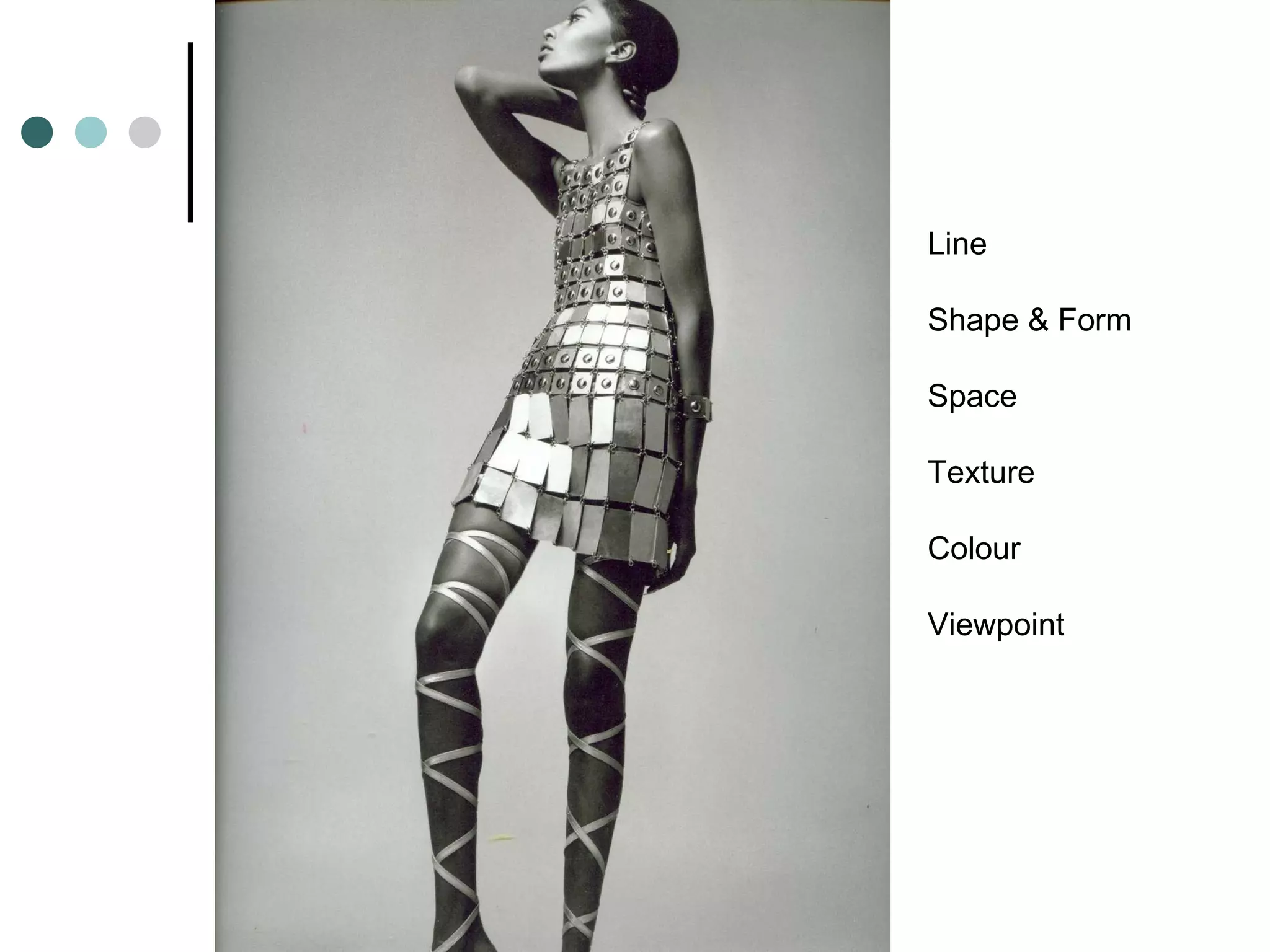
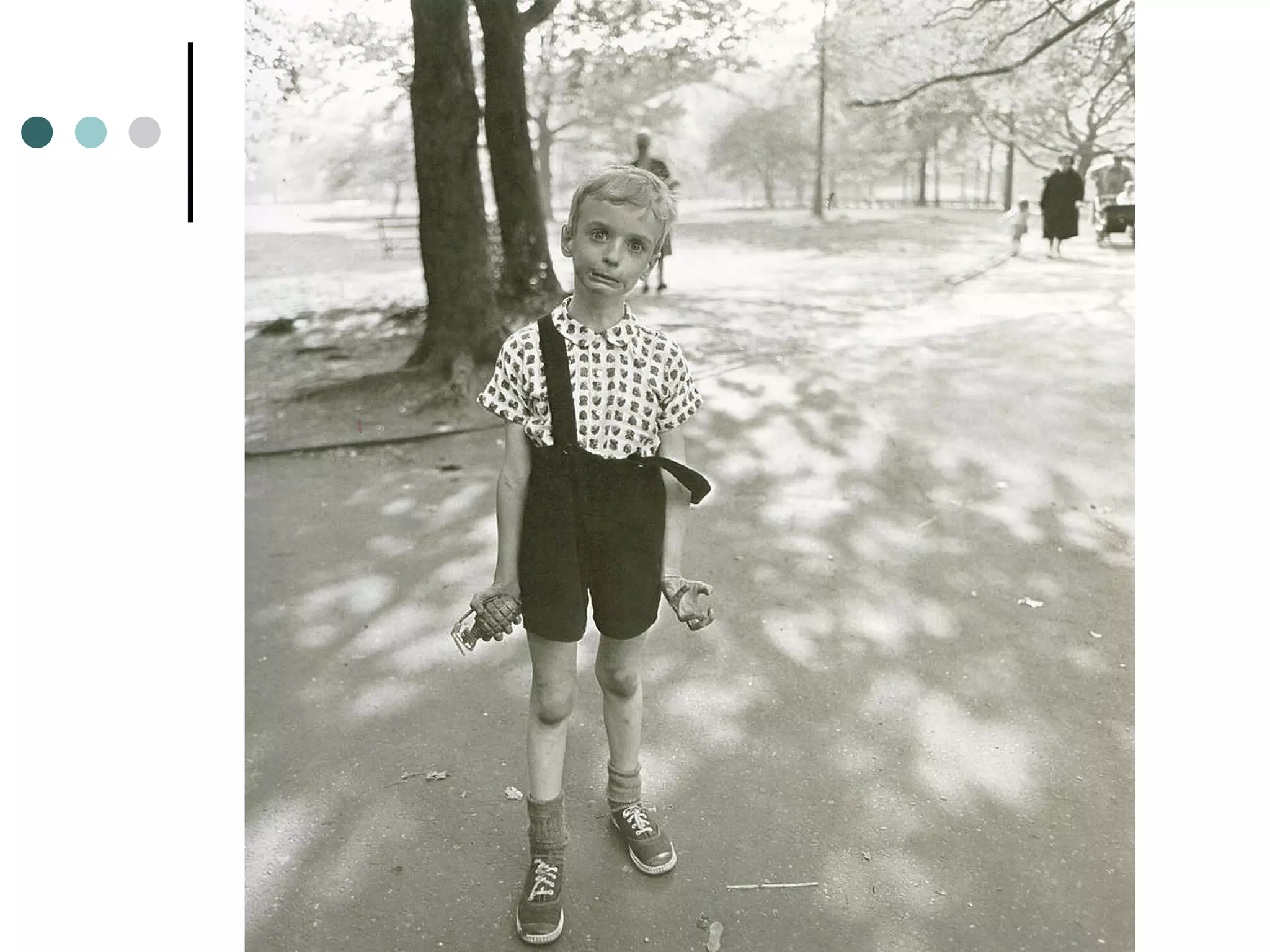
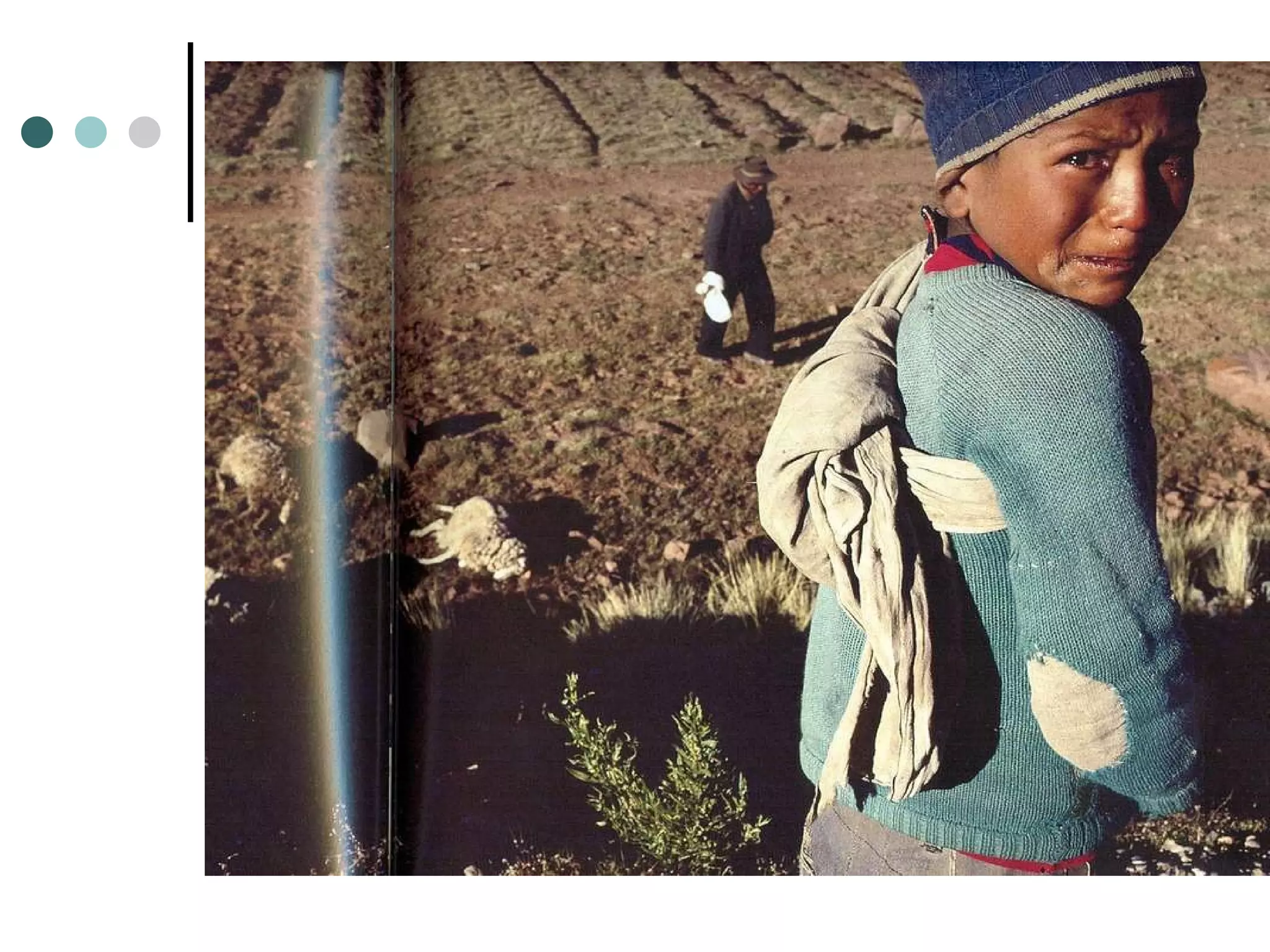
Design Elements Line (direction created) Shape & Form (outline - 2D & volume -3D) Space (positive and negative) Texture (surface quality) Colour (symbolic, choice of…) Viewpoint (not an actual element of art)
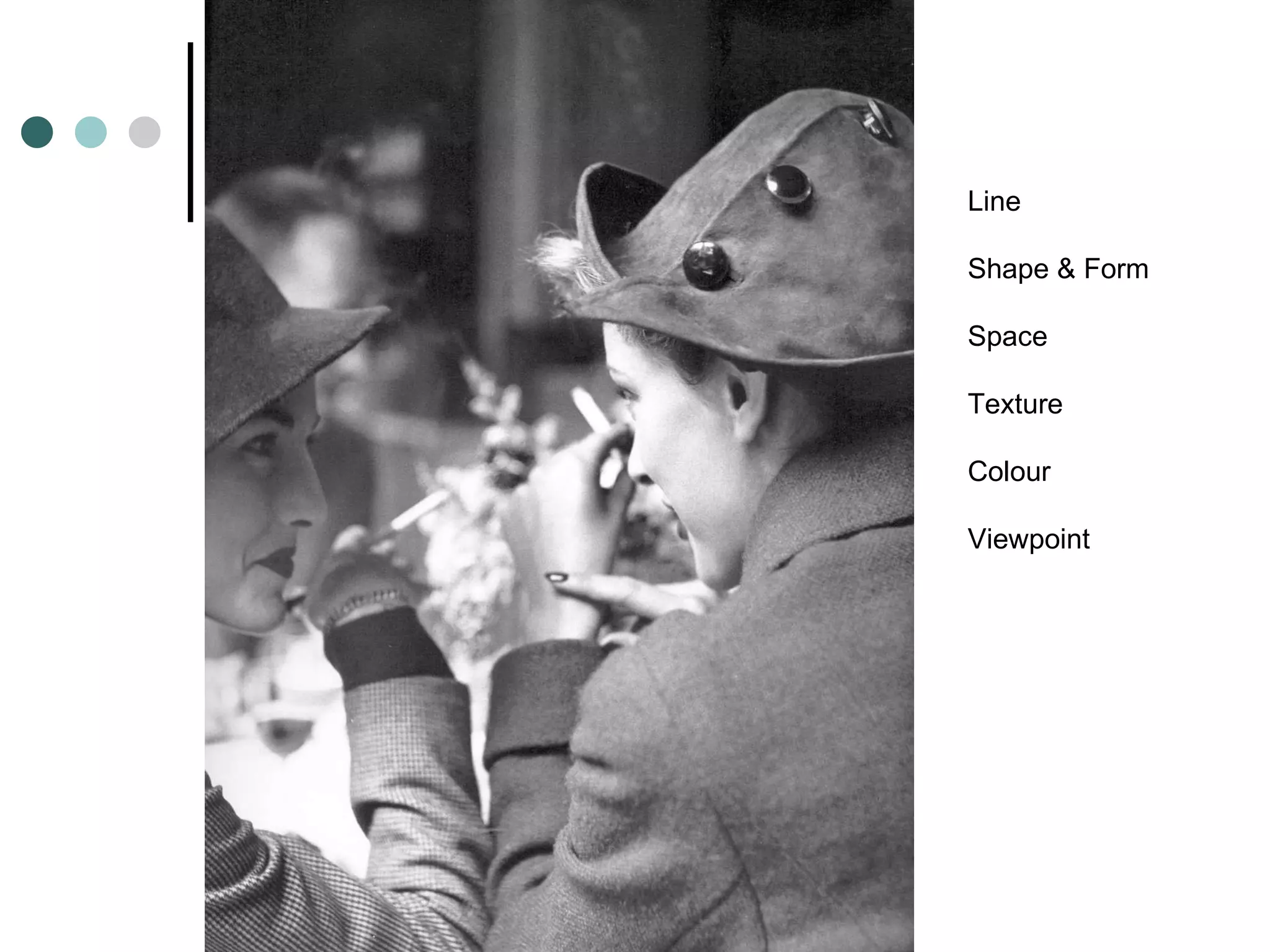
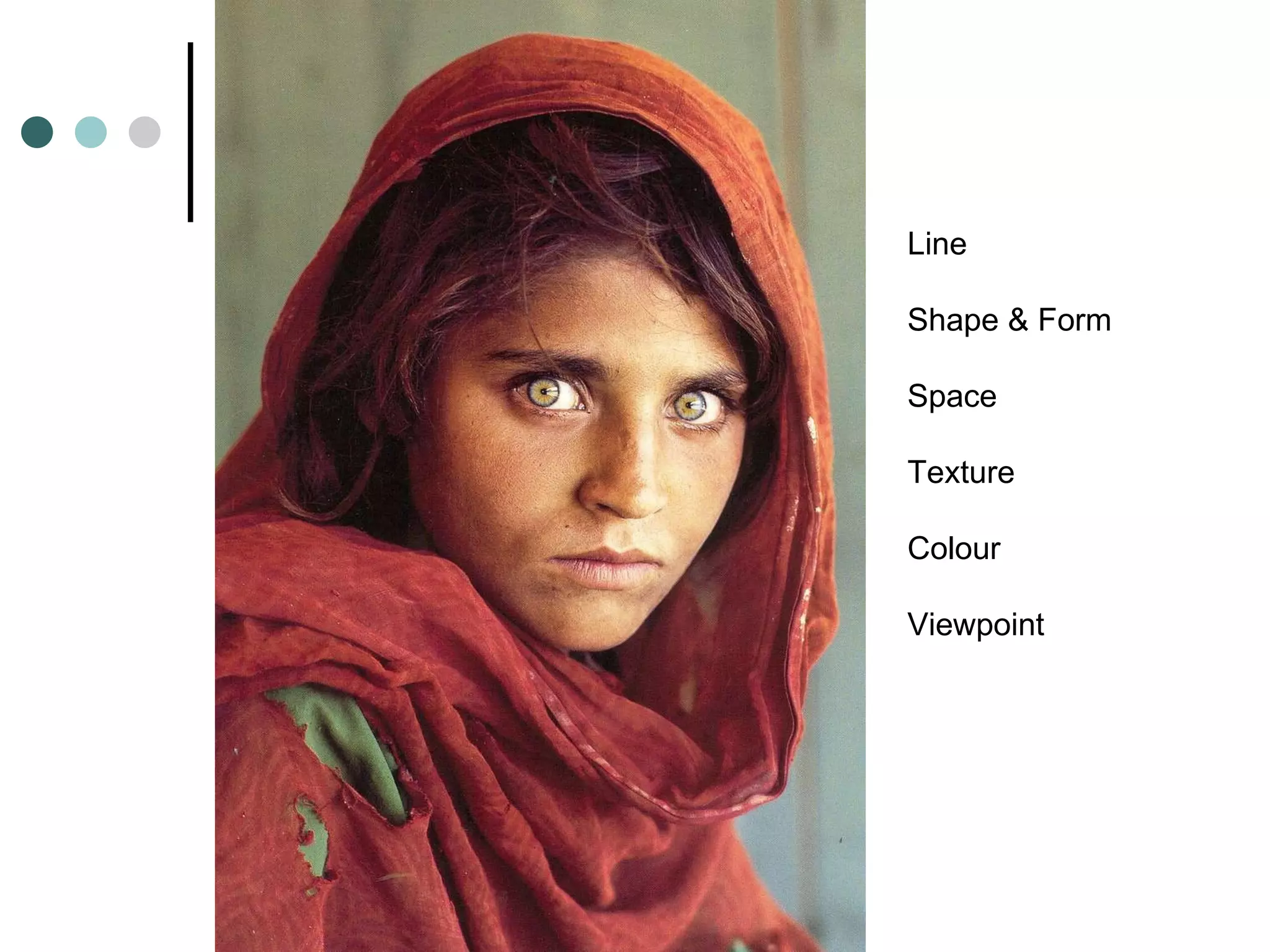
Line  Shape & Form Space  Texture  Colour  Viewpoint
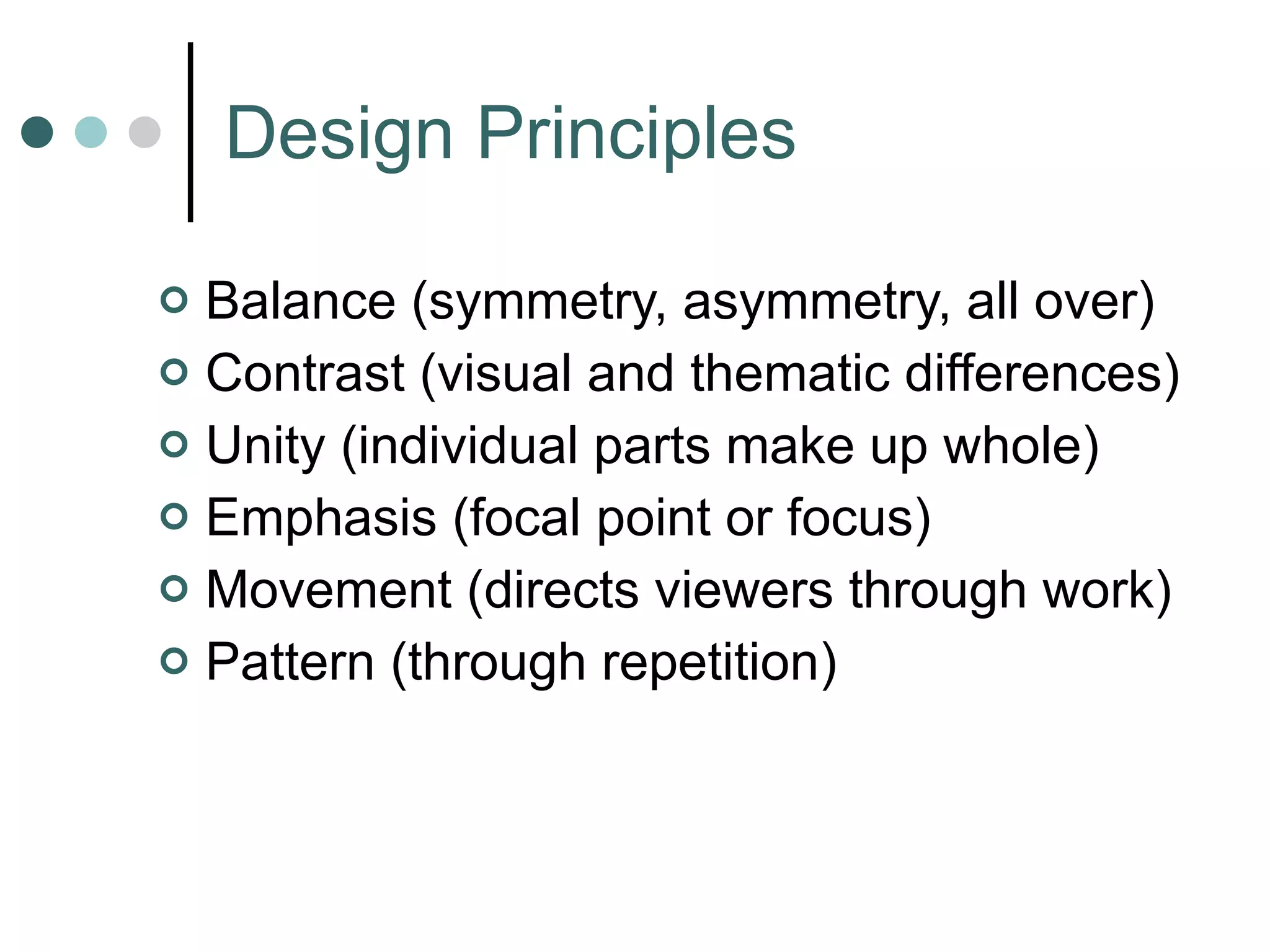
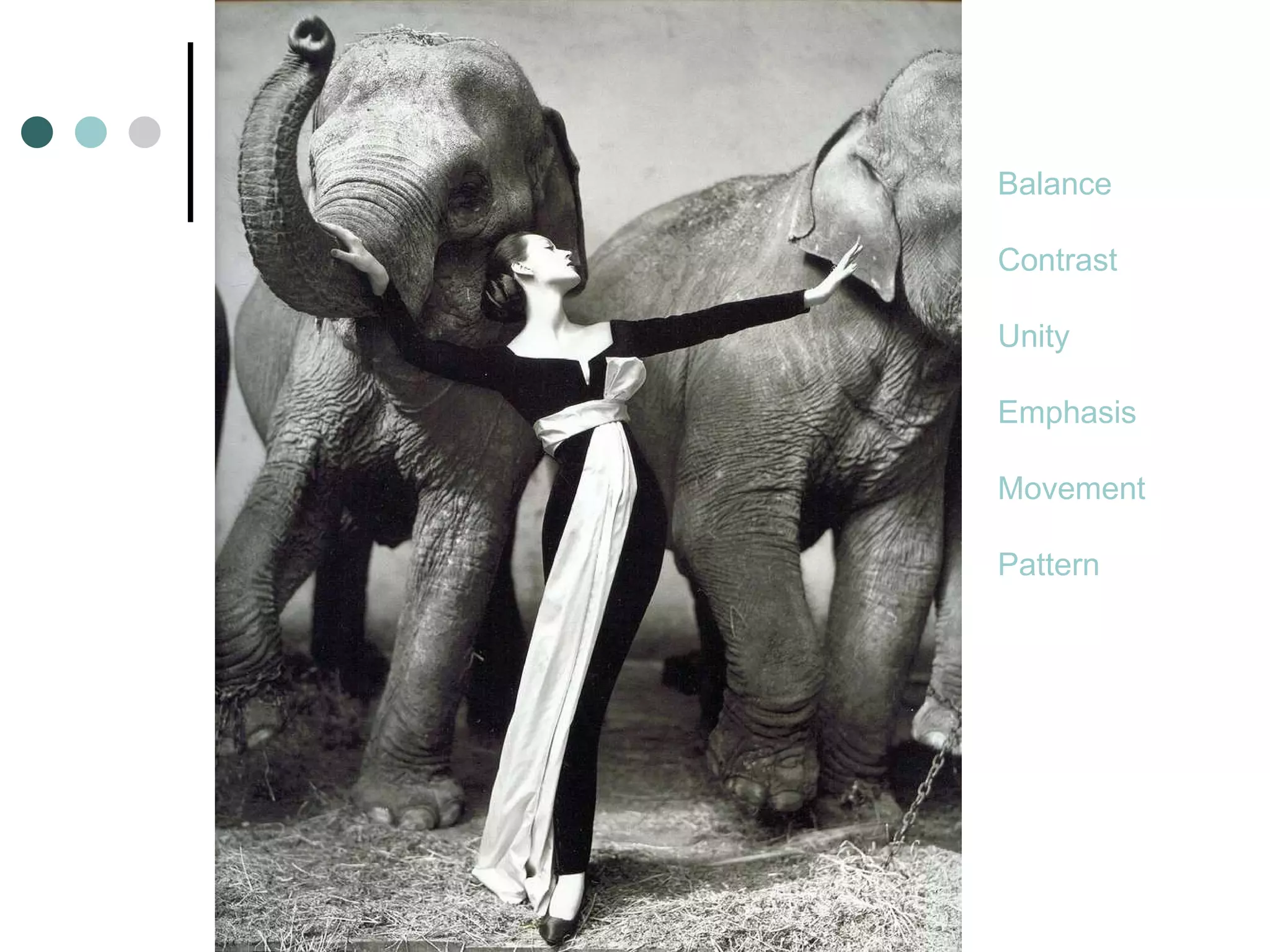
Design Principles Balance (symmetry, asymmetry, all over) Contrast (visual and thematic differences) Unity (individual parts make up whole) Emphasis (focal point or focus) Movement (directs viewers through work) Pattern (through repetition)
Balance  Contrast  Unity  Emphasis  Movement  Pattern


Analyzing Photographs Find an effective (grabs your attention in some way) ad on the internet (or in a magazine) which has a photograph as its main focus.  Answer the following questions: Which design elements and principles are most important to the photographs success and why? What is the purpose of the photograph?  Who is the target audience for the ad? How are the men/women/objects portrayed?  How might this influence the audience? What values or messages are emphasized?
Photographic Truth http://homepage.mac.com/gapodaca/digital/bikini/bikini2.html http://www.snopes.com/photos/politics/kerry2.asp http://www.autodesk.com/eng/etc/fakeorfoto/quiz.html http://www.autodesk.com/eng/etc/fakeorfoto/v1/index.html
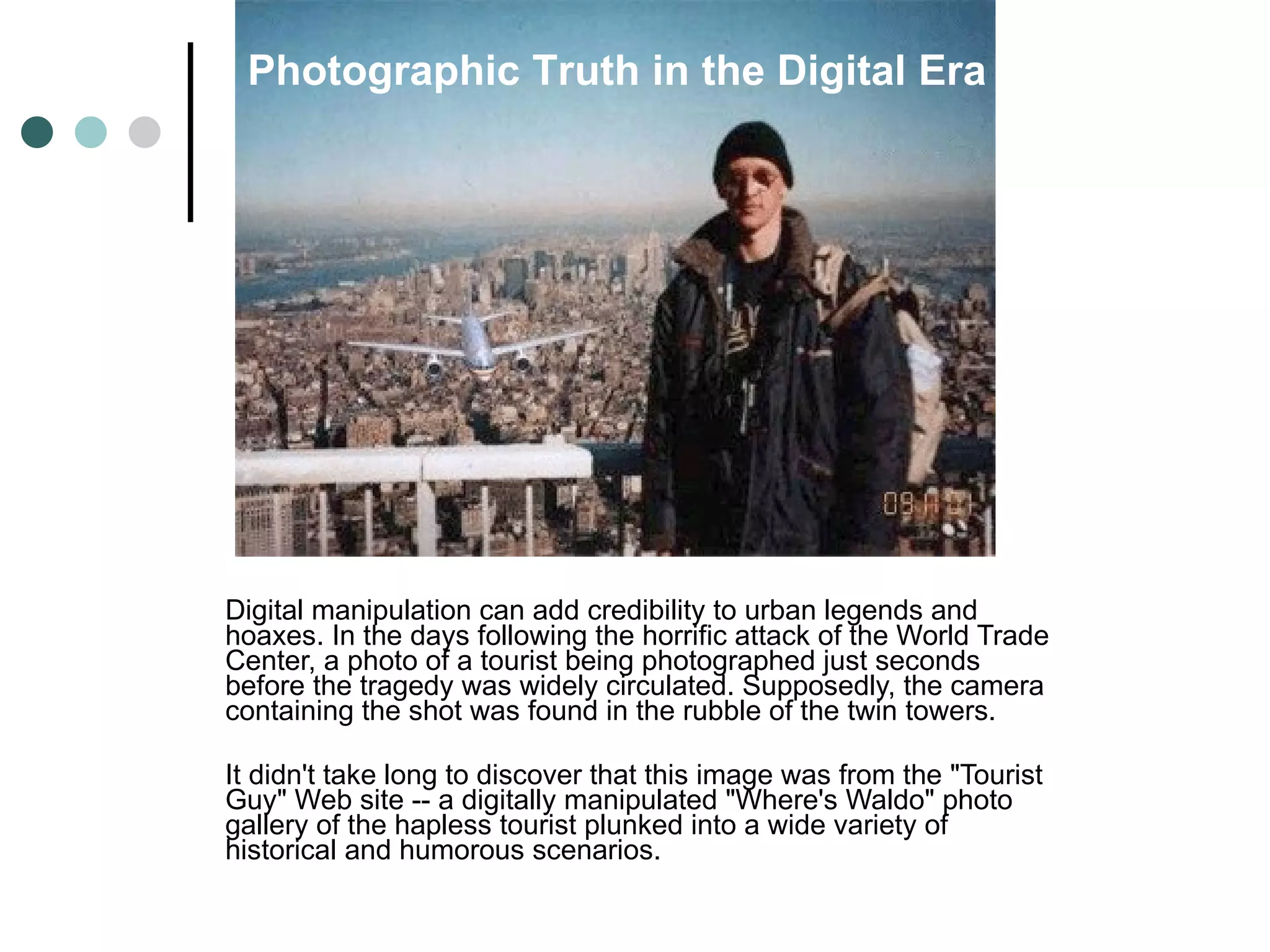
Digital manipulation can add credibility to urban legends and hoaxes. In the days following the horrific attack of the World Trade Center, a photo of a tourist being photographed just seconds before the tragedy was widely circulated. Supposedly, the camera containing the shot was found in the rubble of the twin towers. It didn't take long to discover that this image was from the "Tourist Guy" Web site -- a digitally manipulated "Where's Waldo" photo gallery of the hapless tourist plunked into a wide variety of historical and humorous scenarios. Photographic Truth in the Digital Era
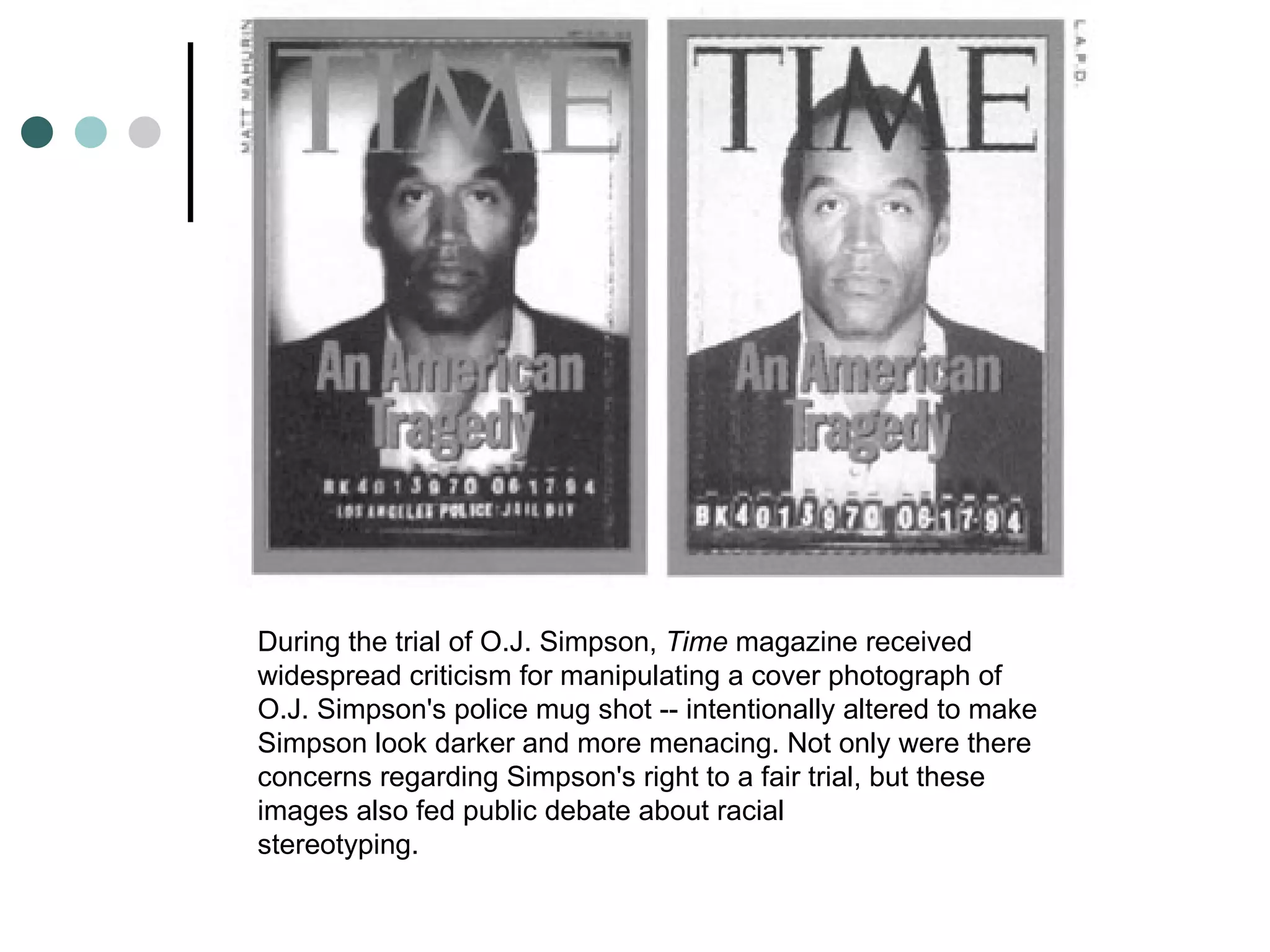
During the trial of O.J. Simpson,  Time  magazine received widespread criticism for manipulating a cover photograph of O.J. Simpson's police mug shot -- intentionally altered to make Simpson look darker and more menacing. Not only were there concerns regarding Simpson's right to a fair trial, but these images also fed public debate about racial  stereotyping.
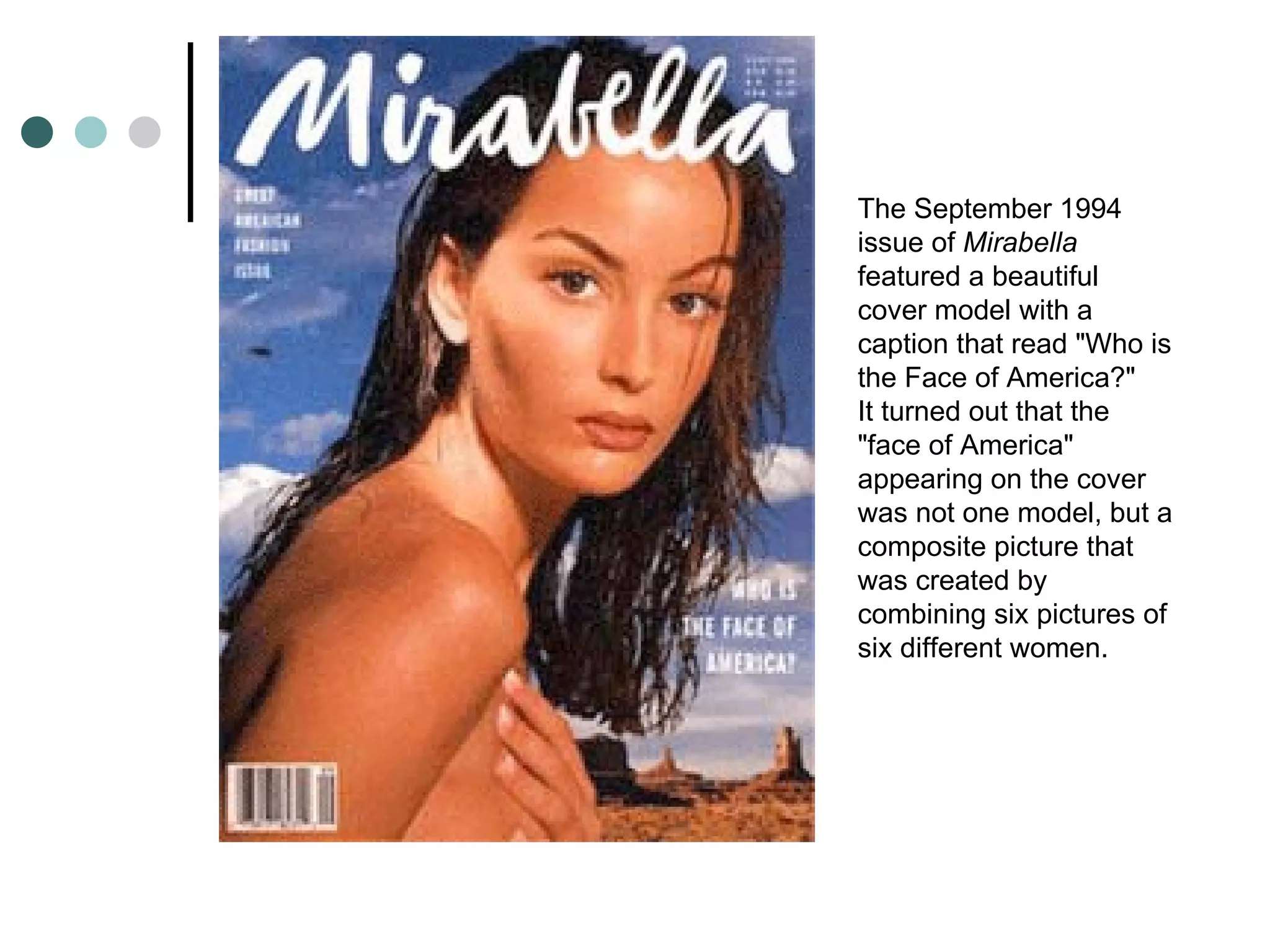
The September 1994 issue of  Mirabella  featured a beautiful cover model with a caption that read "Who is the Face of America?" It turned out that the "face of America" appearing on the cover was not one model, but a composite picture that was created by combining six pictures of six different women.
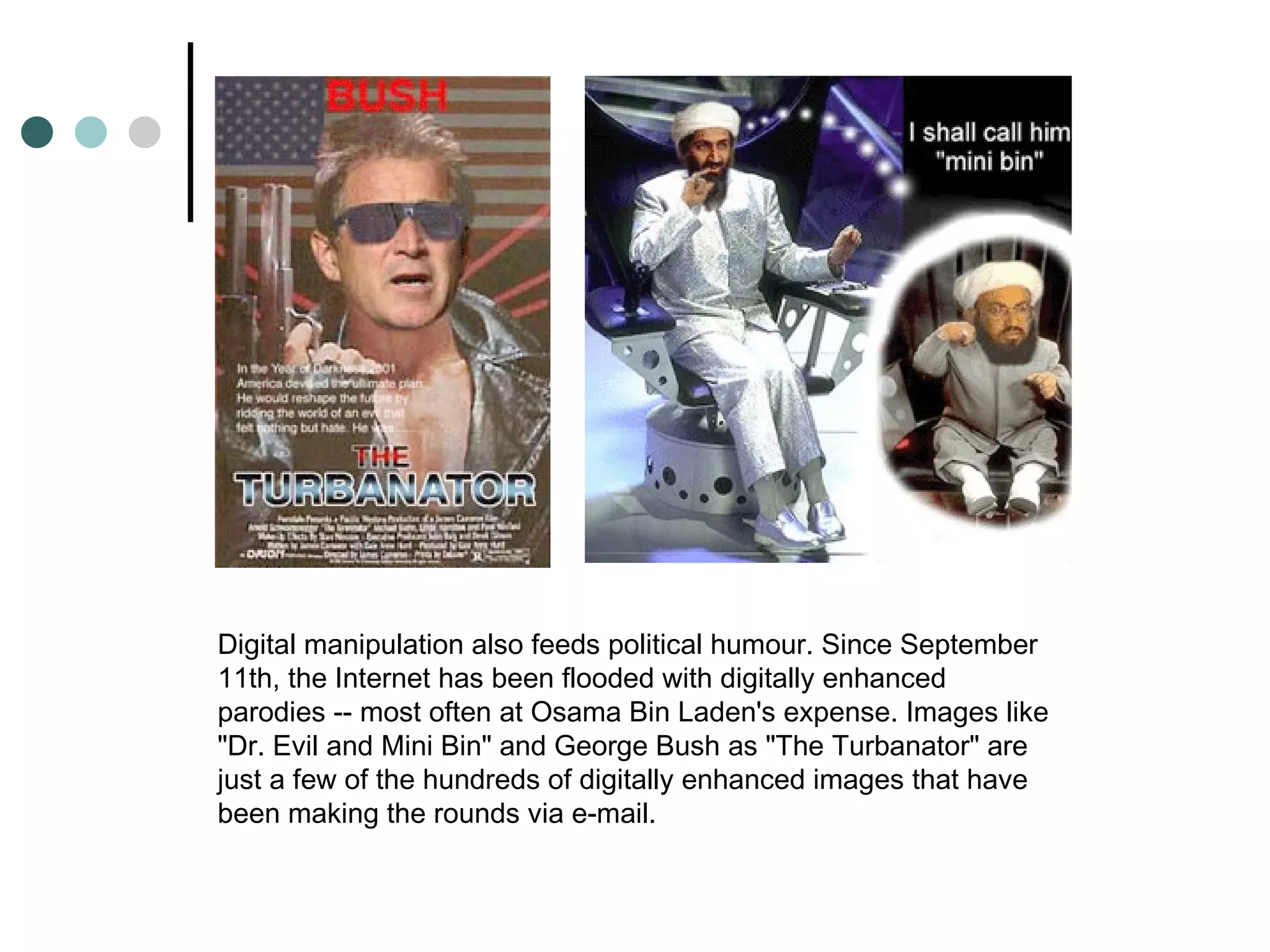
Digital manipulation also feeds political humour. Since September 11th, the Internet has been flooded with digitally enhanced parodies -- most often at Osama Bin Laden's expense. Images like "Dr. Evil and Mini Bin" and George Bush as "The Turbanator" are just a few of the hundreds of digitally enhanced images that have been making the rounds via e-mail.
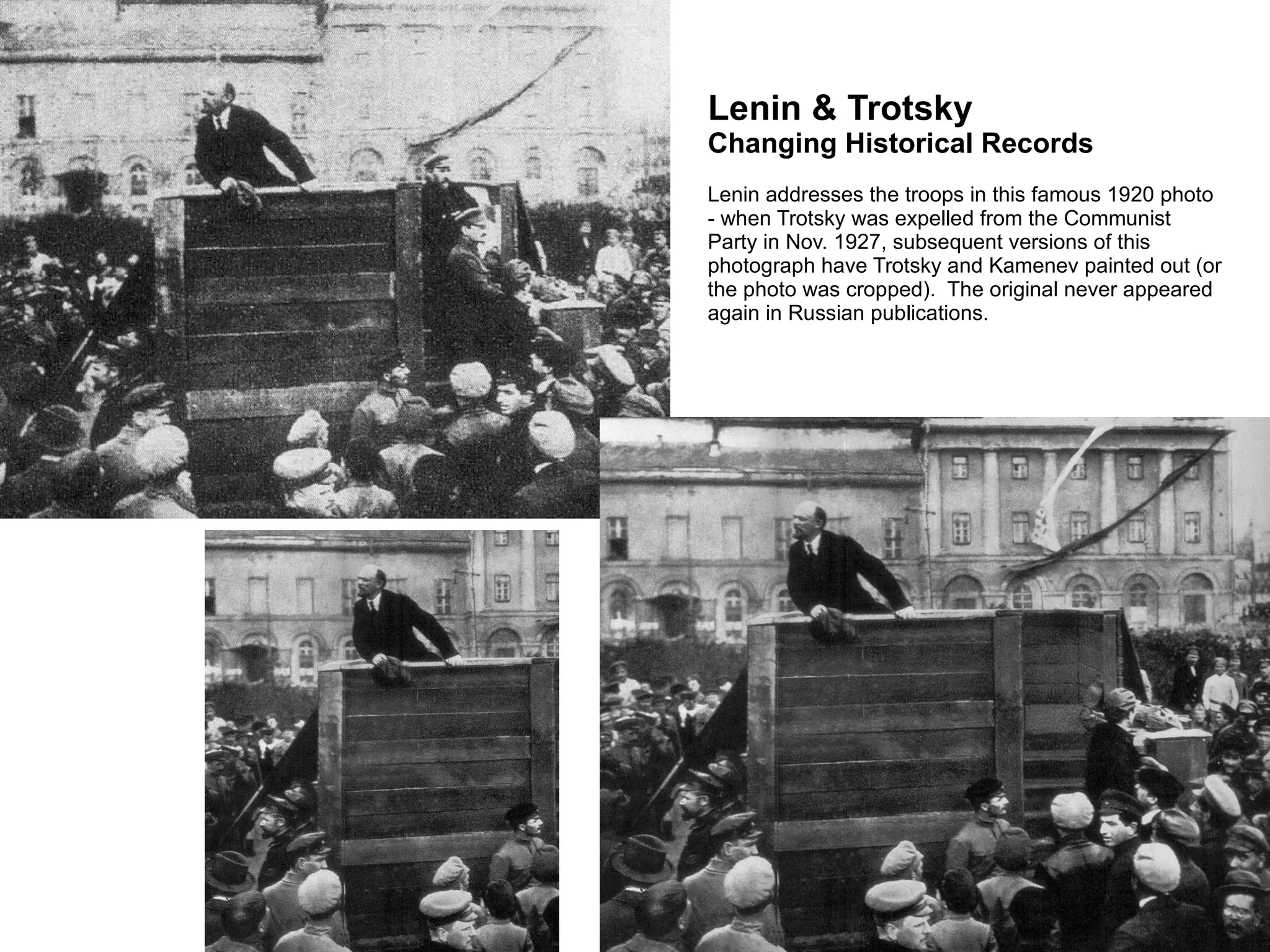
Lenin & Trotsky  Changing Historical Records Lenin addresses the troops in this famous 1920 photo - when Trotsky was expelled from the Communist Party in Nov. 1927, subsequent versions of this photograph have Trotsky and Kamenev painted out (or the photo was cropped).  The original never appeared again in Russian publications.


The visual image

  • 1.
    The Visual Image- Analyzing the Photographic Image - Use of Design - What is truth?
  • 2.
    Design Elements Line(direction created) Shape & Form (outline - 2D & volume -3D) Space (positive and negative) Texture (surface quality) Colour (symbolic, choice of…) Viewpoint (not an actual element of art)
  • 3.
    Line Shape& Form Space Texture Colour Viewpoint
  • 4.
    Line Shape& Form Space Texture Colour Viewpoint
  • 5.
    Line Shape& Form Space Texture Colour Viewpoint
  • 6.
    Design Principles Balance(symmetry, asymmetry, all over) Contrast (visual and thematic differences) Unity (individual parts make up whole) Emphasis (focal point or focus) Movement (directs viewers through work) Pattern (through repetition)
  • 7.
    Balance Contrast Unity Emphasis Movement Pattern
  • 8.
    Balance Contrast Unity Emphasis Movement Pattern
  • 9.
    Balance Contrast Unity Emphasis Movement Pattern
  • 10.
  • 11.
  • 12.
  • 13.
  • 14.
    Analyzing Photographs Findan effective (grabs your attention in some way) ad on the internet (or in a magazine) which has a photograph as its main focus. Answer the following questions: Which design elements and principles are most important to the photographs success and why? What is the purpose of the photograph? Who is the target audience for the ad? How are the men/women/objects portrayed? How might this influence the audience? What values or messages are emphasized?
  • 15.
    Photographic Truth http://homepage.mac.com/gapodaca/digital/bikini/bikini2.htmlhttp://www.snopes.com/photos/politics/kerry2.asp http://www.autodesk.com/eng/etc/fakeorfoto/quiz.html http://www.autodesk.com/eng/etc/fakeorfoto/v1/index.html
  • 16.
    Digital manipulation canadd credibility to urban legends and hoaxes. In the days following the horrific attack of the World Trade Center, a photo of a tourist being photographed just seconds before the tragedy was widely circulated. Supposedly, the camera containing the shot was found in the rubble of the twin towers. It didn't take long to discover that this image was from the "Tourist Guy" Web site -- a digitally manipulated "Where's Waldo" photo gallery of the hapless tourist plunked into a wide variety of historical and humorous scenarios. Photographic Truth in the Digital Era
  • 17.
    During the trialof O.J. Simpson, Time magazine received widespread criticism for manipulating a cover photograph of O.J. Simpson's police mug shot -- intentionally altered to make Simpson look darker and more menacing. Not only were there concerns regarding Simpson's right to a fair trial, but these images also fed public debate about racial stereotyping.
  • 18.
    The September 1994issue of Mirabella featured a beautiful cover model with a caption that read "Who is the Face of America?" It turned out that the "face of America" appearing on the cover was not one model, but a composite picture that was created by combining six pictures of six different women.
  • 19.
    Digital manipulation alsofeeds political humour. Since September 11th, the Internet has been flooded with digitally enhanced parodies -- most often at Osama Bin Laden's expense. Images like "Dr. Evil and Mini Bin" and George Bush as "The Turbanator" are just a few of the hundreds of digitally enhanced images that have been making the rounds via e-mail.
  • 20.
    Lenin & Trotsky Changing Historical Records Lenin addresses the troops in this famous 1920 photo - when Trotsky was expelled from the Communist Party in Nov. 1927, subsequent versions of this photograph have Trotsky and Kamenev painted out (or the photo was cropped). The original never appeared again in Russian publications.
  • 21.
  • 22.

Editor's Notes

  • #4 Richard Avedon: Café de Flore, Paris, 1948
  • #5 Steve McClurry – National Geographic
  • #6 Richard Avedon: Dress by Paco Rabanne, New York, 1966.
  • #8 Richard Avedon: Dovima with Elephants. Dress by Dior. Cirque d’Hiver, Paris, 1955
  • #9 Richard Avedon: Mouthpiece and Headphones by Tom Binns, New York, 1998.
  • #10 Richard Avedon: “In Memory of the Late Mr. and Mrs. Comfort,” a fable. Dress by Geoffrey Beene, Suit and Sweater by Jean Paul Gaultier, New York, 1995.
  • #11 Diane Arbus, Boy with toy hand grenade in Central Park