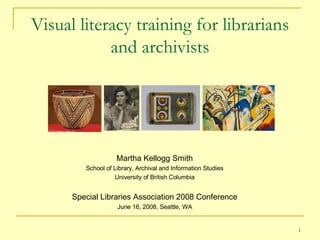
Visual literacy training for librarians and archivists Martha Kellogg Smith School of Library, Archival and Information Studies University of British Columbia Special Libraries Association 2008 Conference June 16, 2008, Seattle, WA
Overview of today Overview of  Visual Literacy for Information Professionals  course (UBC, UW) “ Teaching the teachers” – for visual resources, library, and archival professionals as practitioners and teachers of visual literacy Visual literacy among new “literacies” falling under the broad umbrella of information literacy, e.g., media literacy and digital literacy
Core competencies lists  Iyer, H. (2007).  Core competencies for visual resources management.  IMLS-Funded Research Project  Visual Resources Management: Determining Professional Competencies and Guidelines for Professional Education  (2005-2007) Ball, H., et al. (2008).  Core Competencies and Core Curricula for Art Library and Visual Resources Professionals .  ARLIS Occasional Paper No. 15.
Rationale for the course Aimed at training those who will (1) document and create metadata for and/or (2) interpret visual resources and provide access and instruction to users of these resources  Alongside courses on multimedia project development and management, image retrieval, museum informatics, library media curricula In the context of cultural heritage institutions
For info professionals who work with visual materials “ Visual literacy” for information professionals extends to understanding how images are and can be analyzed and described in words.  This includes: Pictorial and media analysis and translation, including becoming aware of and verbalize the unconscious associations that images have Understanding:  the original media of an image ( and  reproductions of it) original users and contexts of an image’s creation an image’s original  and  potential interpretations potential end uses and contexts of current use of an image Visual information-seeking behaviors Recognizing bias and inherent or explicit POV issues and limitations in image description tools such as controlled vocabularies
Other academic disciplines and applied fields that study “visual information” for its own sake perceptual and cognitive psychology physiology of vision communications and media studies  philosophy and aesthetics art history  history and historiography visual sociology and anthropology graphics, visualization, and design technical communications  educational technology and media computer vision studies optics and physics
Course content and shape Intro to course and “information” orientation among other “domains” Images and cognition (brain-level issues) Images and culture (society- or communication-level issues) Contexts of image use and users (functions of images) Images as documents:  image media, especially digital  Images as documents:  image attributes and description (image-level issues) Visual resources: images in collections (collections-level issues)
Images and cognition (brain-level issues) Visual perception Concepts, conceptual categories, and prototypes Memory – mental storage and processing “ Analog” code (storage of ideas as images) “ Propositional” code (storage of ideas as words)
Images and culture (society- or communication-level issues) The meanings of images – cultural interpretation and use of images Cultural codes – conventions of visual communication and rhetoric
In-class exercise:  everybody draw a “barn”
 
Contexts of image use and users (functions of images):  Research/examination/diagnostics   Historical and cultural: Social scientific, e.g., visual anthropology  and sociology How imaging (creator POV, selection, elimination, and medium) affects or constructs that “evidence”
Contexts of image use and users (functions of images):  Research / examination / diagnostics Scientific, medical, and engineering (including both research and applied) Images used for: description  evidence diagnosis prediction
Contexts of image use and users (functions of images):  Teaching/illustration/demonstration Publishing—photo selection and editing Images used to illustrate ideas, events, places, people, things
Contexts of image use and users (functions of images):  Teaching/illustration/demonstration Images deliberately created to illustrate ideas and how they work with associated text information
Contexts of image use and users (functions of images):  Persuasion/message making “ Stock images” Pictures used to persuade viewers in commercial or political or social uses (both deliberately created and selected from existing collections)
Images as documents:  image media, especially digital  Compare original objects and images and a variety of reproduction media, especially digital, and their strengths and shortcomings in conveying visual information in different use contexts
Images as documents:  image attributes and description (image-level issues) Analyze, describe, classify, and index images based on a variety of visual, physical, contextual, and interpretive attributes
Images as documents:  image attributes and description (collection-level issues) Evaluate the usefulness of metadata standards and tools for visual image description, including schemas, descriptive and subject vocabularies, indexing policies, and display options for organization and access
TITLE:   [Head of Statue of Liberty on display in park in Paris] CALL NUMBER:   Illus. in NB553.B3 A3 Case Z [P&P]  REPRODUCTION NUMBER:   LC-USZ62-18086 (b&w film copy neg.) MEDIUM:   1 photographic print. CREATED/PUBLISHED:   [1883] NOTES:   Illus. in: Album des travaux de construction de la statue colossale de la Liberté, destinée au port de New-York / Frédéric Auguste Bartholdi.  Reference copy U.S. GEOG FILE - New York--New York City--Statue of Liberty.  SUBJECTS: Statue of Liberty (New York, N.Y.)--1880-1890. Parks--France--Paris--1880-1890. FORMAT: Photographic prints 1880-1890. REPOSITORY:   Library of Congress Prints and Photographs Division Washington, D.C. 20540 USA  DIGITAL ID:   (b&w film copy neg.) cph  3a53268   VIDEO FRAME ID:   LCPP003A-53268 (from b&w film copy neg.)
Visual resources: images in collections  (collections-level issues) How different types of collections (both analog and digital) are organized and accessed Standards in cataloguing and indexing MARC format In-house and proprietary metadata systems VRA Core 4.0, Cataloging Cultural Objects (CCO), Getty Categories for the Description of Works of Art (CDWA) Indexing and subject cataloguing vocabularies Thesaurus of Graphic Materials (TGM) Getty Art and Architecture Thesaurus (AAT) ICONCLASS
Images as documents:  content-based image retrieval Understand the potentials of automatic visual content recognition (computer recognition and processing) to aid image retrieval
Image tagging Evaluate the incorporation of emerging social classification (tagging) and annotation technologies into image description for retrieval
Visual literacy for information professionals means understanding (1): Histories and affordances of different kinds of visual media and how they affect how we interpret works and how other viewers (contemporary or in earlier times) might have viewed the works [a technology literacy] Original functions of artworks, photographs, and other visual media and the intentions of their creators and the effects on their original audiences That varieties of interpretations are possible for pictures, depending on personal and cultural preferences and conventions (both contemporary and historical)
Visual literacy for information professionals means understanding (2): That there are different levels of description and analysis to be attempted:  pre-iconographic, iconographic, and iconological subject matter (though translated into what viewers will understand as generic, named, and interpretive themes) How to find pictures and how to frame queries, i.e., how to “decode” mental images and terminological choices, and how to translate these into system languages, e.g., search terms Specialized art or media terminology – formal, historical, multicultural,  foreign language – including instruction on where to find these terminologies
Visual literacy for information professionals means understanding (3): Distinctions among original objects (or “works”) and their reproduction images (or “surrogates”) The inevitable diminution of experience in reproduction images, as well as the possibility of limited and possibly manipulated views of the originals, with special attention to digital reproductions [a technology literacy]
Visual literacy for information professionals means understanding (4): Information that pertains to and is useful at the collection level and relationships among original works (and surrogates), e.g., part-whole relationships and sets Legal, ethical, social, and economic considerations of visual information particularly in the digital environment (e.g., access, copyright, and image manipulation)
Special thanks to my students in LIBR 514 (UBC) and LIS 539 (UW)
 
 
Pictures and References PICTURES Mrs. Si-a-gut,  Coiled Cedar Root Basket , Cowlitz/Nisqually, 1899, Burke Museum of Natural History and Culture, University of Washington, Seattle, WA, acc. no. 3.2000/1. Dorothea Lange,  Human Erosion in California (Migrant Mother), Nipomo, Californina , 1936, J Paul Getty Museum, Los Angeles, CA. Enamel Plaque , Germany, Rhine Valley, Cologne, ca. 1170, The Cleveland Museum of Art, acc. no. 1953.274. Vasily Kandinsky,  Composition IV , 1911,  Kunstsammlung Nordrhein-Westfallen, Dusseldorf , Germany. Robert Feke,  Charles Apthorp , 1748, The Cleveland Museum of Art, acc. no. 1919.1006. Henry Farrer,  Winter Scene in Moonlight , 1869, The Metropolitan Museum of Art, NY, acc. no. 1999.19. REFERENCES Frost, C. O., Taylor, B., Noakes, A., Markel, S., Torres, D., and Drabenstott, K. M. (2000).  Browse and search patterns in a digital image database.  Information Retrieval , 1,  287-313. Gilchrest, A. (2003).  Factors affecting controlled vocabulary usage in art museum information systems.  Art Documentation ,  22(1) , 13-20. Gordon, C. (1996).  Patterns of user queries in an ICONCLASS database.  Visual Resources ,  12(2) , 177-186. Hourihane, C. (1996).  The Van Eyck Project, information exchange, and European art libraries.  VRA Bulletin ,  23(2) , 57-60. The Metropolitan Museum of Art (2005).  Image cataloguing test.  December 7, 2004.  Available at:   http://www.steve.museum/reference/MMAImageCatalogingTest12-7-04.pdf Panofsky, E. (1955).  Iconography and iconology: An introduction to the study of Renaissance art.  In Erwin Panofsky,  Meaning in the Visual Arts  (pp. 26-54).  New York, NY: Doubleday Anchor. Seren, T., Donohue, D., and Underwood, L. A. (2001).  Integrated art documentation: The Guggenheim perspective.  Art Documentation ,  20(1) , 31-35. Smith, M. K. (2006).  Art information use and needs of non-specialists: Evidence in art museum visitor studies.  PhD dissertation.  University of Washington.  White, L. (2002).  Interpretation and representation: The who, why, what, and how of subject access in museums.  Art Documentation ,  21(1) , 21-22.
29.  Images as documents:  image attributes and description (collection-level issues) Arena Chapel (Capella degli Scrovegni) Padua, Italy ca. 1303-ca. 1306
30.  Images as documents:  image attributes and description (collection-level issues) Giotto,  Last Supper  and  Lamentation of Christ  (ca. 1303-1305)  full panels and details; Fresco; Arena Chapel, Padua, Italy

Martha Kellogg Smith

  • 1.
    Visual literacy trainingfor librarians and archivists Martha Kellogg Smith School of Library, Archival and Information Studies University of British Columbia Special Libraries Association 2008 Conference June 16, 2008, Seattle, WA
  • 2.
    Overview of todayOverview of Visual Literacy for Information Professionals course (UBC, UW) “ Teaching the teachers” – for visual resources, library, and archival professionals as practitioners and teachers of visual literacy Visual literacy among new “literacies” falling under the broad umbrella of information literacy, e.g., media literacy and digital literacy
  • 3.
    Core competencies lists Iyer, H. (2007). Core competencies for visual resources management. IMLS-Funded Research Project Visual Resources Management: Determining Professional Competencies and Guidelines for Professional Education (2005-2007) Ball, H., et al. (2008). Core Competencies and Core Curricula for Art Library and Visual Resources Professionals . ARLIS Occasional Paper No. 15.
  • 4.
    Rationale for thecourse Aimed at training those who will (1) document and create metadata for and/or (2) interpret visual resources and provide access and instruction to users of these resources Alongside courses on multimedia project development and management, image retrieval, museum informatics, library media curricula In the context of cultural heritage institutions
  • 5.
    For info professionalswho work with visual materials “ Visual literacy” for information professionals extends to understanding how images are and can be analyzed and described in words. This includes: Pictorial and media analysis and translation, including becoming aware of and verbalize the unconscious associations that images have Understanding: the original media of an image ( and reproductions of it) original users and contexts of an image’s creation an image’s original and potential interpretations potential end uses and contexts of current use of an image Visual information-seeking behaviors Recognizing bias and inherent or explicit POV issues and limitations in image description tools such as controlled vocabularies
  • 6.
    Other academic disciplinesand applied fields that study “visual information” for its own sake perceptual and cognitive psychology physiology of vision communications and media studies philosophy and aesthetics art history history and historiography visual sociology and anthropology graphics, visualization, and design technical communications educational technology and media computer vision studies optics and physics
  • 7.
    Course content andshape Intro to course and “information” orientation among other “domains” Images and cognition (brain-level issues) Images and culture (society- or communication-level issues) Contexts of image use and users (functions of images) Images as documents: image media, especially digital Images as documents: image attributes and description (image-level issues) Visual resources: images in collections (collections-level issues)
  • 8.
    Images and cognition(brain-level issues) Visual perception Concepts, conceptual categories, and prototypes Memory – mental storage and processing “ Analog” code (storage of ideas as images) “ Propositional” code (storage of ideas as words)
  • 9.
    Images and culture(society- or communication-level issues) The meanings of images – cultural interpretation and use of images Cultural codes – conventions of visual communication and rhetoric
  • 10.
    In-class exercise: everybody draw a “barn”
  • 11.
  • 12.
    Contexts of imageuse and users (functions of images): Research/examination/diagnostics Historical and cultural: Social scientific, e.g., visual anthropology and sociology How imaging (creator POV, selection, elimination, and medium) affects or constructs that “evidence”
  • 13.
    Contexts of imageuse and users (functions of images): Research / examination / diagnostics Scientific, medical, and engineering (including both research and applied) Images used for: description evidence diagnosis prediction
  • 14.
    Contexts of imageuse and users (functions of images): Teaching/illustration/demonstration Publishing—photo selection and editing Images used to illustrate ideas, events, places, people, things
  • 15.
    Contexts of imageuse and users (functions of images): Teaching/illustration/demonstration Images deliberately created to illustrate ideas and how they work with associated text information
  • 16.
    Contexts of imageuse and users (functions of images): Persuasion/message making “ Stock images” Pictures used to persuade viewers in commercial or political or social uses (both deliberately created and selected from existing collections)
  • 17.
    Images as documents: image media, especially digital Compare original objects and images and a variety of reproduction media, especially digital, and their strengths and shortcomings in conveying visual information in different use contexts
  • 18.
    Images as documents: image attributes and description (image-level issues) Analyze, describe, classify, and index images based on a variety of visual, physical, contextual, and interpretive attributes
  • 20.
    Images as documents: image attributes and description (collection-level issues) Evaluate the usefulness of metadata standards and tools for visual image description, including schemas, descriptive and subject vocabularies, indexing policies, and display options for organization and access
  • 21.
    TITLE:   [Head ofStatue of Liberty on display in park in Paris] CALL NUMBER:   Illus. in NB553.B3 A3 Case Z [P&P] REPRODUCTION NUMBER:   LC-USZ62-18086 (b&w film copy neg.) MEDIUM:   1 photographic print. CREATED/PUBLISHED:   [1883] NOTES: Illus. in: Album des travaux de construction de la statue colossale de la Liberté, destinée au port de New-York / Frédéric Auguste Bartholdi. Reference copy U.S. GEOG FILE - New York--New York City--Statue of Liberty. SUBJECTS: Statue of Liberty (New York, N.Y.)--1880-1890. Parks--France--Paris--1880-1890. FORMAT: Photographic prints 1880-1890. REPOSITORY:   Library of Congress Prints and Photographs Division Washington, D.C. 20540 USA DIGITAL ID:   (b&w film copy neg.) cph 3a53268 VIDEO FRAME ID:   LCPP003A-53268 (from b&w film copy neg.)
  • 22.
    Visual resources: imagesin collections (collections-level issues) How different types of collections (both analog and digital) are organized and accessed Standards in cataloguing and indexing MARC format In-house and proprietary metadata systems VRA Core 4.0, Cataloging Cultural Objects (CCO), Getty Categories for the Description of Works of Art (CDWA) Indexing and subject cataloguing vocabularies Thesaurus of Graphic Materials (TGM) Getty Art and Architecture Thesaurus (AAT) ICONCLASS
  • 23.
    Images as documents: content-based image retrieval Understand the potentials of automatic visual content recognition (computer recognition and processing) to aid image retrieval
  • 24.
    Image tagging Evaluatethe incorporation of emerging social classification (tagging) and annotation technologies into image description for retrieval
  • 25.
    Visual literacy forinformation professionals means understanding (1): Histories and affordances of different kinds of visual media and how they affect how we interpret works and how other viewers (contemporary or in earlier times) might have viewed the works [a technology literacy] Original functions of artworks, photographs, and other visual media and the intentions of their creators and the effects on their original audiences That varieties of interpretations are possible for pictures, depending on personal and cultural preferences and conventions (both contemporary and historical)
  • 26.
    Visual literacy forinformation professionals means understanding (2): That there are different levels of description and analysis to be attempted: pre-iconographic, iconographic, and iconological subject matter (though translated into what viewers will understand as generic, named, and interpretive themes) How to find pictures and how to frame queries, i.e., how to “decode” mental images and terminological choices, and how to translate these into system languages, e.g., search terms Specialized art or media terminology – formal, historical, multicultural, foreign language – including instruction on where to find these terminologies
  • 27.
    Visual literacy forinformation professionals means understanding (3): Distinctions among original objects (or “works”) and their reproduction images (or “surrogates”) The inevitable diminution of experience in reproduction images, as well as the possibility of limited and possibly manipulated views of the originals, with special attention to digital reproductions [a technology literacy]
  • 28.
    Visual literacy forinformation professionals means understanding (4): Information that pertains to and is useful at the collection level and relationships among original works (and surrogates), e.g., part-whole relationships and sets Legal, ethical, social, and economic considerations of visual information particularly in the digital environment (e.g., access, copyright, and image manipulation)
  • 29.
    Special thanks tomy students in LIBR 514 (UBC) and LIS 539 (UW)
  • 30.
  • 31.
  • 32.
    Pictures and ReferencesPICTURES Mrs. Si-a-gut, Coiled Cedar Root Basket , Cowlitz/Nisqually, 1899, Burke Museum of Natural History and Culture, University of Washington, Seattle, WA, acc. no. 3.2000/1. Dorothea Lange, Human Erosion in California (Migrant Mother), Nipomo, Californina , 1936, J Paul Getty Museum, Los Angeles, CA. Enamel Plaque , Germany, Rhine Valley, Cologne, ca. 1170, The Cleveland Museum of Art, acc. no. 1953.274. Vasily Kandinsky, Composition IV , 1911, Kunstsammlung Nordrhein-Westfallen, Dusseldorf , Germany. Robert Feke, Charles Apthorp , 1748, The Cleveland Museum of Art, acc. no. 1919.1006. Henry Farrer, Winter Scene in Moonlight , 1869, The Metropolitan Museum of Art, NY, acc. no. 1999.19. REFERENCES Frost, C. O., Taylor, B., Noakes, A., Markel, S., Torres, D., and Drabenstott, K. M. (2000). Browse and search patterns in a digital image database. Information Retrieval , 1, 287-313. Gilchrest, A. (2003). Factors affecting controlled vocabulary usage in art museum information systems. Art Documentation , 22(1) , 13-20. Gordon, C. (1996). Patterns of user queries in an ICONCLASS database. Visual Resources , 12(2) , 177-186. Hourihane, C. (1996). The Van Eyck Project, information exchange, and European art libraries. VRA Bulletin , 23(2) , 57-60. The Metropolitan Museum of Art (2005). Image cataloguing test. December 7, 2004. Available at: http://www.steve.museum/reference/MMAImageCatalogingTest12-7-04.pdf Panofsky, E. (1955). Iconography and iconology: An introduction to the study of Renaissance art. In Erwin Panofsky, Meaning in the Visual Arts (pp. 26-54). New York, NY: Doubleday Anchor. Seren, T., Donohue, D., and Underwood, L. A. (2001). Integrated art documentation: The Guggenheim perspective. Art Documentation , 20(1) , 31-35. Smith, M. K. (2006). Art information use and needs of non-specialists: Evidence in art museum visitor studies. PhD dissertation. University of Washington. White, L. (2002). Interpretation and representation: The who, why, what, and how of subject access in museums. Art Documentation , 21(1) , 21-22.
  • 33.
    29. Imagesas documents: image attributes and description (collection-level issues) Arena Chapel (Capella degli Scrovegni) Padua, Italy ca. 1303-ca. 1306
  • 34.
    30. Imagesas documents: image attributes and description (collection-level issues) Giotto, Last Supper and Lamentation of Christ (ca. 1303-1305) full panels and details; Fresco; Arena Chapel, Padua, Italy