The Birth of Venus
by Sandro Botticelli
   Hyeri Park, A!y Chung
Myth

This painting relates to the myth that explains Venus’s
birth.

According to the myth, the Venus, the Roman goddess of
beauty and love, emerged "om the sea upon a she! as a
fu!y grown woman. She was born when Zeus castrated
Titan Uranus and ki!ed him.
How is the myth retold through the
            painting..


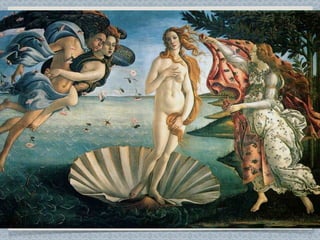
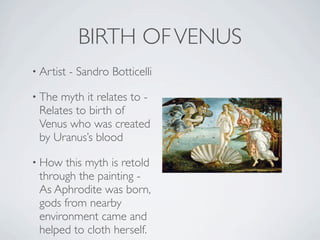
The painting portrays the a#ermath of Venus’s creation. Zephyr and
Aura, the gods of wind, is pushing Venus toward a shore, and a
Nymph is reaching out to cover her naked body with a robe. Venus is
depicted as a modest and graceful figure, as she is carefu!y leaning
on one hip and covering her body. The colors used in the painting,
especia!y the green hues of the sea, delivers a sense of warmth and
love, harmonizing with the image and characteristics of Venus.
Works Cited

http://mmmnoodles.wordpress.com/2010/06/11/sandro-
bottice!is-the-birth-of-venus/

http://www.artble.com/artists/sandro_bottice!i/
paintings/birth_of_venus
Greek Mythology:
Echo and Narcissus
      Kate Jeong
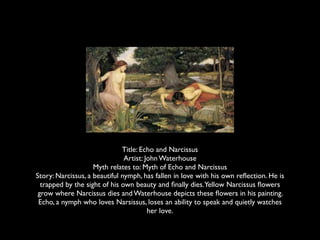
Title: Echo and Narcissus
                               Artist: John Waterhouse
                    Myth relates to: Myth of Echo and Narcissus
Story: Narcissus, a beautiful nymph, has fallen in love with his own reflection. He is
  trapped by the sight of his own beauty and finally dies.Yellow Narcissus flowers
 grow where Narcissus dies and Waterhouse depicts these flowers in his painting.
 Echo, a nymph who loves Narsissus, loses an ability to speak and quietly watches
                                        her love.
Works Cited

http://www.liverpoolmuseums.org.uk/walker/collections/20c/waterhouse.aspx
BIRTH OF VENUS
   Seung Youn Park
BIRTH OF VENUS
• Artist   - Sandro Botticelli

• The myth it relates to -
 Relates to birth of
 Venus who was created
 by Uranus’s blood

• How  this myth is retold
 through the painting -
 As Aphrodite was born,
 gods from nearby
 environment came and
 helped to cloth herself.
WORKS CITED

• http://www.artble.com/
 artists/sandro_botticelli/
 paintings/birth_of_venus

• http://www.paleothea.com/
 Myths/BirthAphrodite.html

• http://www.mythweb.com/
 encyc/entries/aphrodite.html

Arthunt

  • 1.
    The Birth ofVenus by Sandro Botticelli Hyeri Park, A!y Chung
  • 3.
    Myth This painting relatesto the myth that explains Venus’s birth. According to the myth, the Venus, the Roman goddess of beauty and love, emerged "om the sea upon a she! as a fu!y grown woman. She was born when Zeus castrated Titan Uranus and ki!ed him.
  • 4.
    How is themyth retold through the painting.. The painting portrays the a#ermath of Venus’s creation. Zephyr and Aura, the gods of wind, is pushing Venus toward a shore, and a Nymph is reaching out to cover her naked body with a robe. Venus is depicted as a modest and graceful figure, as she is carefu!y leaning on one hip and covering her body. The colors used in the painting, especia!y the green hues of the sea, delivers a sense of warmth and love, harmonizing with the image and characteristics of Venus.
  • 5.
  • 6.
    Greek Mythology: Echo andNarcissus Kate Jeong
  • 7.
    Title: Echo andNarcissus Artist: John Waterhouse Myth relates to: Myth of Echo and Narcissus Story: Narcissus, a beautiful nymph, has fallen in love with his own reflection. He is trapped by the sight of his own beauty and finally dies.Yellow Narcissus flowers grow where Narcissus dies and Waterhouse depicts these flowers in his painting. Echo, a nymph who loves Narsissus, loses an ability to speak and quietly watches her love.
  • 8.
  • 9.
    BIRTH OF VENUS Seung Youn Park
  • 10.
    BIRTH OF VENUS •Artist - Sandro Botticelli • The myth it relates to - Relates to birth of Venus who was created by Uranus’s blood • How this myth is retold through the painting - As Aphrodite was born, gods from nearby environment came and helped to cloth herself.
  • 11.
    WORKS CITED • http://www.artble.com/ artists/sandro_botticelli/ paintings/birth_of_venus • http://www.paleothea.com/ Myths/BirthAphrodite.html • http://www.mythweb.com/ encyc/entries/aphrodite.html

Editor's Notes