VALUE ADDITION IN GARMENT INDUSTRY


                      BY:
                      NISHOK TSR
                      DIPLOMA IN APPAREL TECHNOLOGY
                      PSG POLYTECHNIC COLLEGE
INTRODUCTION
 Value addition is converting of raw materials into finished product.

 Value addition increases the aesthetic look of the garment but does not
     have any effect on the quality of the product.

 The key aspect of value addition is high price, uniqueness, attractiveness
     and focusing a business more closely on its targeted market segments.

    MAIN REASONS FOR VALUE ADDITION

    Increases the value of the garment both by appearance and by price.

    Attracts the customer to buy that particular garment. 

    And to increase the market demand
TYPES OF VALUE ADDITIONS
 FINISHNG                   `
 PRINTING
        1.All over prints
         2.Chest prints
 Special processes
         1.Tie and dye
           2.Batiks
           3.Quilting
 Closures
          1.buttons
      2.Zippers
         3.Velcro
         4.Hooks and loops
 Embroidery

             Hand embroidery
       Machine embroidery
FINISHING
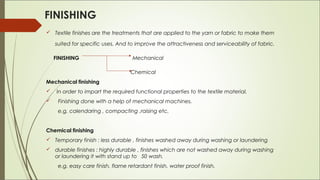
 Textile finishes are the treatments that are applied to the yarn or fabric to make them

    suited for specific uses. And to improve the attractiveness and serviceability of fabric.

    FINISHING                       Mechanical

                                   Chemical
Mechanical finishing
    In order to impart the required functional properties to the textile material.
    Finishing done with a help of mechanical machines.
     e.g. calendaring , compacting ,raising etc.


Chemical finishing
 Temporary finish : less durable , finishes washed away during washing or laundering
 durable finishes : highly durable , finishes which are not washed away during washing
  or laundering it with stand up to 50 wash.
     e.g. easy care finish, flame retardant finish, water proof finish.
PRINTING
Printing is a process for reproducing text and images, logos or motif based on our
    requirement printing is done , using different types of dyes.
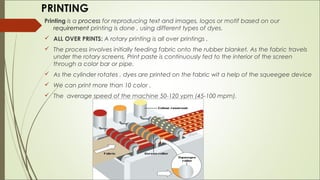
 ALL OVER PRINTS: A rotary printing is all over printings .
 The process involves initially feeding fabric onto the rubber blanket. As the fabric travels
  under the rotary screens, Print paste is continuously fed to the interior of the screen
  through a color bar or pipe.
 As the cylinder rotates , dyes are printed on the fabric wit a help of the squeegee device
 We can print more than 10 color .
 The average speed of the machine 50-120 ypm (45-100 mpm).
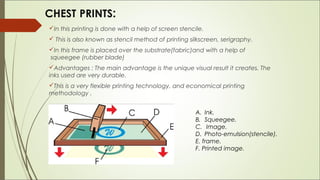
CHEST PRINTS:
In this printing is done with a help of screen stencile.
 This is also known as stencil method of printing silkscreen, serigraphy.
In this frame is placed over the substrate(fabric)and with a help of
 squeegee (rubber blade)
Advantages : The main advantage is the unique visual result it creates. The
inks used are very durable.
This is a very flexible printing technology, and economical printing
methodology .


                                                      A. Ink.
                                                      B. Squeegee.
                                                      C. Image.
                                                      D. Photo-emulsion(stencile).
                                                      E. frame.
                                                      F. Printed image.
CLOSURES
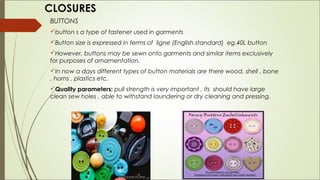
BUTTONS
button s a type of fastener used in garments
Button size is expressed in terms of ligne (English standard) eg.40L button
However, buttons may be sewn onto garments and similar items exclusively
for purposes of ornamentation.
In now a days different types of button materials are there wood, shell , bone
, horns , plastics etc.
Quality parameters: pull strength is very important , its should have large
clean sew holes , able to withstand laundering or dry cleaning and pressing.
ZIPPERS
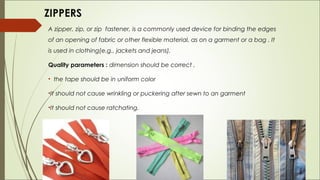
A zipper, zip, or zip fastener, is a commonly used device for binding the edges
of an opening of fabric or other flexible material, as on a garment or a bag . It
is used in clothing(e.g., jackets and jeans).

Quality parameters : dimension should be correct ,

• the tape should be in uniform color

•It should not cause wrinkling or puckering after sewn to an garment

•It should not cause ratchating.
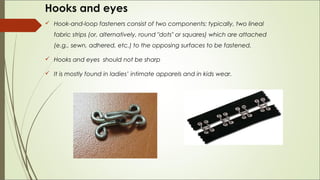
Hooks and eyes
 Hook-and-loop fasteners consist of two components: typically, two lineal
   fabric strips (or, alternatively, round "dots" or squares) which are attached
   (e.g., sewn, adhered, etc.) to the opposing surfaces to be fastened.

 Hooks and eyes should not be sharp

 It is mostly found in ladies’ intimate apparels and in kids wear.
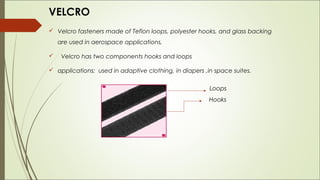
VELCRO
 Velcro fasteners made of Teflon loops, polyester hooks, and glass backing
    are used in aerospace applications,

    Velcro has two components hooks and loops

 applications: used in adaptive clothing, in diapers ,in space suites.


                                                        Loops
                                                        Hooks
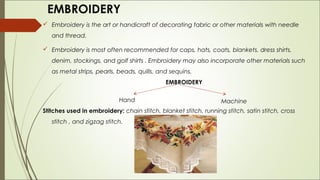
EMBROIDERY
 Embroidery is the art or handicraft of decorating fabric or other materials with needle
   and thread.

 Embroidery is most often recommended for caps, hats, coats, blankets, dress shirts,
   denim, stockings, and golf shirts . Embroidery may also incorporate other materials such
   as metal strips, pearls, beads, quills, and sequins.
                                             EMBROIDERY

                            Hand                                  Machine
Stitches used in embroidery: chain stitch, blanket stitch, running stitch, satin stitch, cross
   stitch , and zigzag stitch.
INDIAN TRADITIONAL EMBROIDERY
 Indian embroidery takes its inspiration from nature and the products of
    various regions reflect the colors of the flora and fauna of that area.

 Religious motifs such as gopurams, the tulsi plant, the temple doorway etc.,
    are all equally popular.

 Material used : embroidery materials such as wool, cotton, silk, beads and
    gold or silver thread are used .
   Kashmiri work
   Pulkari
   Kasuti
   Kantha
   Zardozi
   Chikankari
These are the some of Indian traditional embroidery.
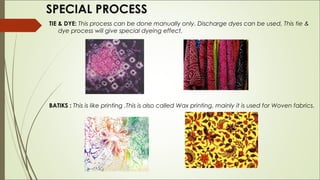
SPECIAL PROCESS
TIE & DYE: This process can be done manually only. Discharge dyes can be used, This tie &
    dye process will give special dyeing effect.


BATIKS : This is like printing .This is also called Wax printing, mainly it is used for Woven fabrics. 
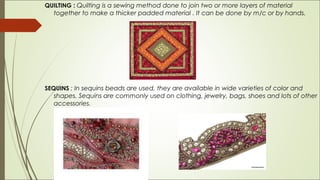
QUILTING : Quilting is a sewing method done to join two or more layers of material
  together to make a thicker padded material . It can be done by m/c or by hands.


SEQUINS : In sequins beads are used, they are available in wide varieties of color and
  shapes. Sequins are commonly used on clothing, jewelry, bags, shoes and lots of other
  accessories.
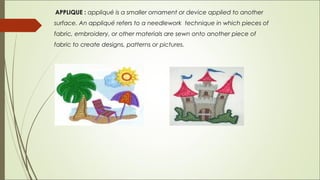
APPLIQUE : appliqué is a smaller ornament or device applied to another
surface. An appliqué refers to a needlework technique in which pieces of
fabric, embroidery, or other materials are sewn onto another piece of
fabric to create designs, patterns or pictures.
CONCLUSION


Thus by doing value addition on garments ,the price , aesthetic properties
                  and the look of the garment is improved .


             THANK YOU

The value addition in garments

  • 1.
    VALUE ADDITION INGARMENT INDUSTRY BY: NISHOK TSR DIPLOMA IN APPAREL TECHNOLOGY PSG POLYTECHNIC COLLEGE
  • 2.
    INTRODUCTION  Value additionis converting of raw materials into finished product.  Value addition increases the aesthetic look of the garment but does not have any effect on the quality of the product.  The key aspect of value addition is high price, uniqueness, attractiveness and focusing a business more closely on its targeted market segments. MAIN REASONS FOR VALUE ADDITION  Increases the value of the garment both by appearance and by price.  Attracts the customer to buy that particular garment.   And to increase the market demand
  • 3.
    TYPES OF VALUEADDITIONS  FINISHNG `  PRINTING 1.All over prints 2.Chest prints  Special processes 1.Tie and dye 2.Batiks 3.Quilting  Closures 1.buttons 2.Zippers 3.Velcro 4.Hooks and loops  Embroidery Hand embroidery Machine embroidery
  • 4.
    FINISHING  Textile finishesare the treatments that are applied to the yarn or fabric to make them suited for specific uses. And to improve the attractiveness and serviceability of fabric. FINISHING Mechanical Chemical Mechanical finishing  In order to impart the required functional properties to the textile material.  Finishing done with a help of mechanical machines. e.g. calendaring , compacting ,raising etc. Chemical finishing  Temporary finish : less durable , finishes washed away during washing or laundering  durable finishes : highly durable , finishes which are not washed away during washing or laundering it with stand up to 50 wash. e.g. easy care finish, flame retardant finish, water proof finish.
  • 5.
    PRINTING Printing is a processfor reproducing text and images, logos or motif based on our requirement printing is done , using different types of dyes.  ALL OVER PRINTS: A rotary printing is all over printings .  The process involves initially feeding fabric onto the rubber blanket. As the fabric travels under the rotary screens, Print paste is continuously fed to the interior of the screen through a color bar or pipe.  As the cylinder rotates , dyes are printed on the fabric wit a help of the squeegee device  We can print more than 10 color .  The average speed of the machine 50-120 ypm (45-100 mpm).
  • 6.
    CHEST PRINTS: In thisprinting is done with a help of screen stencile.  This is also known as stencil method of printing silkscreen, serigraphy. In this frame is placed over the substrate(fabric)and with a help of  squeegee (rubber blade) Advantages : The main advantage is the unique visual result it creates. The inks used are very durable. This is a very flexible printing technology, and economical printing methodology . A. Ink. B. Squeegee. C. Image. D. Photo-emulsion(stencile). E. frame. F. Printed image.
  • 7.
    CLOSURES BUTTONS button s atype of fastener used in garments Button size is expressed in terms of ligne (English standard) eg.40L button However, buttons may be sewn onto garments and similar items exclusively for purposes of ornamentation. In now a days different types of button materials are there wood, shell , bone , horns , plastics etc. Quality parameters: pull strength is very important , its should have large clean sew holes , able to withstand laundering or dry cleaning and pressing.
  • 8.
    ZIPPERS A zipper, zip,or zip fastener, is a commonly used device for binding the edges of an opening of fabric or other flexible material, as on a garment or a bag . It is used in clothing(e.g., jackets and jeans). Quality parameters : dimension should be correct , • the tape should be in uniform color •It should not cause wrinkling or puckering after sewn to an garment •It should not cause ratchating.
  • 9.
    Hooks and eyes Hook-and-loop fasteners consist of two components: typically, two lineal fabric strips (or, alternatively, round "dots" or squares) which are attached (e.g., sewn, adhered, etc.) to the opposing surfaces to be fastened.  Hooks and eyes should not be sharp  It is mostly found in ladies’ intimate apparels and in kids wear.
  • 10.
    VELCRO  Velcro fastenersmade of Teflon loops, polyester hooks, and glass backing are used in aerospace applications,  Velcro has two components hooks and loops  applications: used in adaptive clothing, in diapers ,in space suites. Loops Hooks
  • 11.
    EMBROIDERY  Embroidery isthe art or handicraft of decorating fabric or other materials with needle and thread.  Embroidery is most often recommended for caps, hats, coats, blankets, dress shirts, denim, stockings, and golf shirts . Embroidery may also incorporate other materials such as metal strips, pearls, beads, quills, and sequins. EMBROIDERY Hand Machine Stitches used in embroidery: chain stitch, blanket stitch, running stitch, satin stitch, cross stitch , and zigzag stitch.
  • 12.
    INDIAN TRADITIONAL EMBROIDERY Indian embroidery takes its inspiration from nature and the products of various regions reflect the colors of the flora and fauna of that area.  Religious motifs such as gopurams, the tulsi plant, the temple doorway etc., are all equally popular.  Material used : embroidery materials such as wool, cotton, silk, beads and gold or silver thread are used .  Kashmiri work  Pulkari  Kasuti  Kantha  Zardozi  Chikankari These are the some of Indian traditional embroidery.
  • 13.
    SPECIAL PROCESS TIE &DYE: This process can be done manually only. Discharge dyes can be used, This tie & dye process will give special dyeing effect. BATIKS : This is like printing .This is also called Wax printing, mainly it is used for Woven fabrics. 
  • 14.
    QUILTING : Quiltingis a sewing method done to join two or more layers of material together to make a thicker padded material . It can be done by m/c or by hands. SEQUINS : In sequins beads are used, they are available in wide varieties of color and shapes. Sequins are commonly used on clothing, jewelry, bags, shoes and lots of other accessories.
  • 15.
    APPLIQUE : appliquéis a smaller ornament or device applied to another surface. An appliqué refers to a needlework technique in which pieces of fabric, embroidery, or other materials are sewn onto another piece of fabric to create designs, patterns or pictures.
  • 16.
    CONCLUSION Thus by doingvalue addition on garments ,the price , aesthetic properties and the look of the garment is improved . THANK YOU