



The use of Facebook (FB) and Social
Network Analysis (SNA) to Predict
Students “At Risk” in Further
Education (FE)
Elaine Garcia
@ela1negarc1a
lainey@elainegarcia.uk
About me
• Elaine Garcia
• Head of Blended Learning & Digital Development (currently)
• Plymouth College of Art
• Associate Lecturer in information systems / PhD student
• University of Plymouth
• Research interests: Web 2.0, teaching & learning, knowledge
management, social learning, CoP, blogs
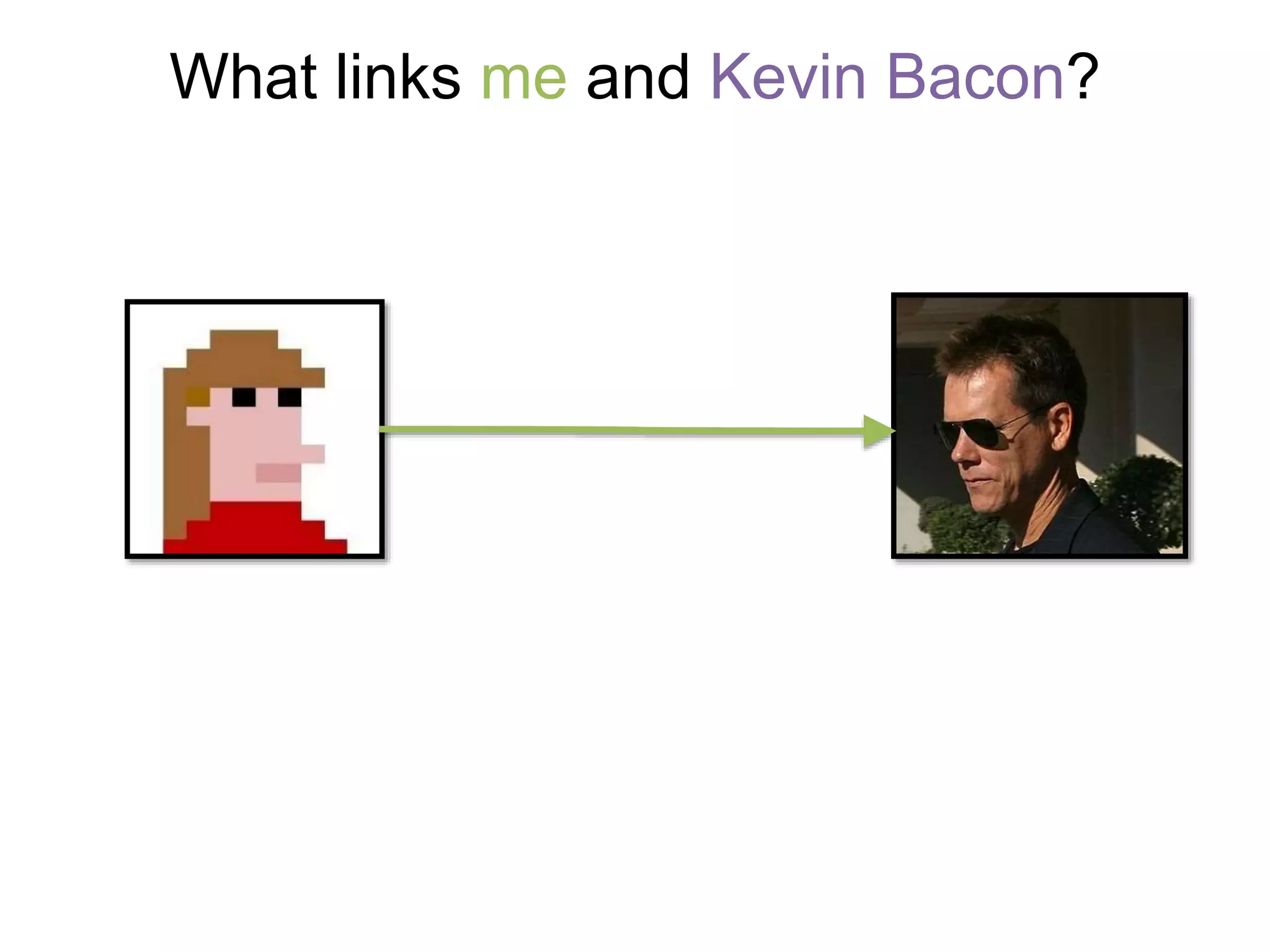
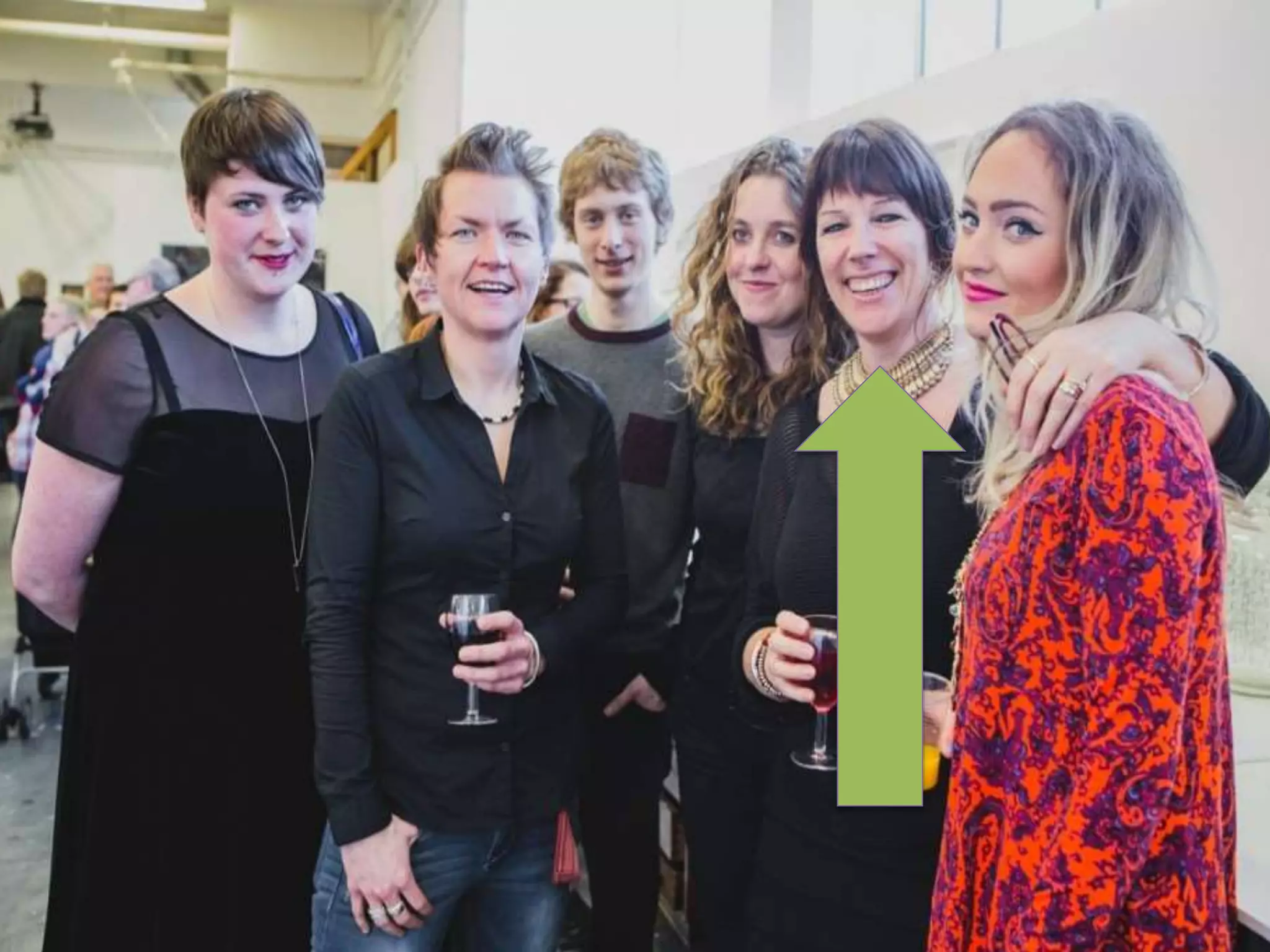
What links me and Kevin Bacon?
BACKGROUND
Background
Background
Web 2.0 is becoming
increasingly popular amongst
students
Young people are forming
‘…. complex, invisible and
organic social networks.’
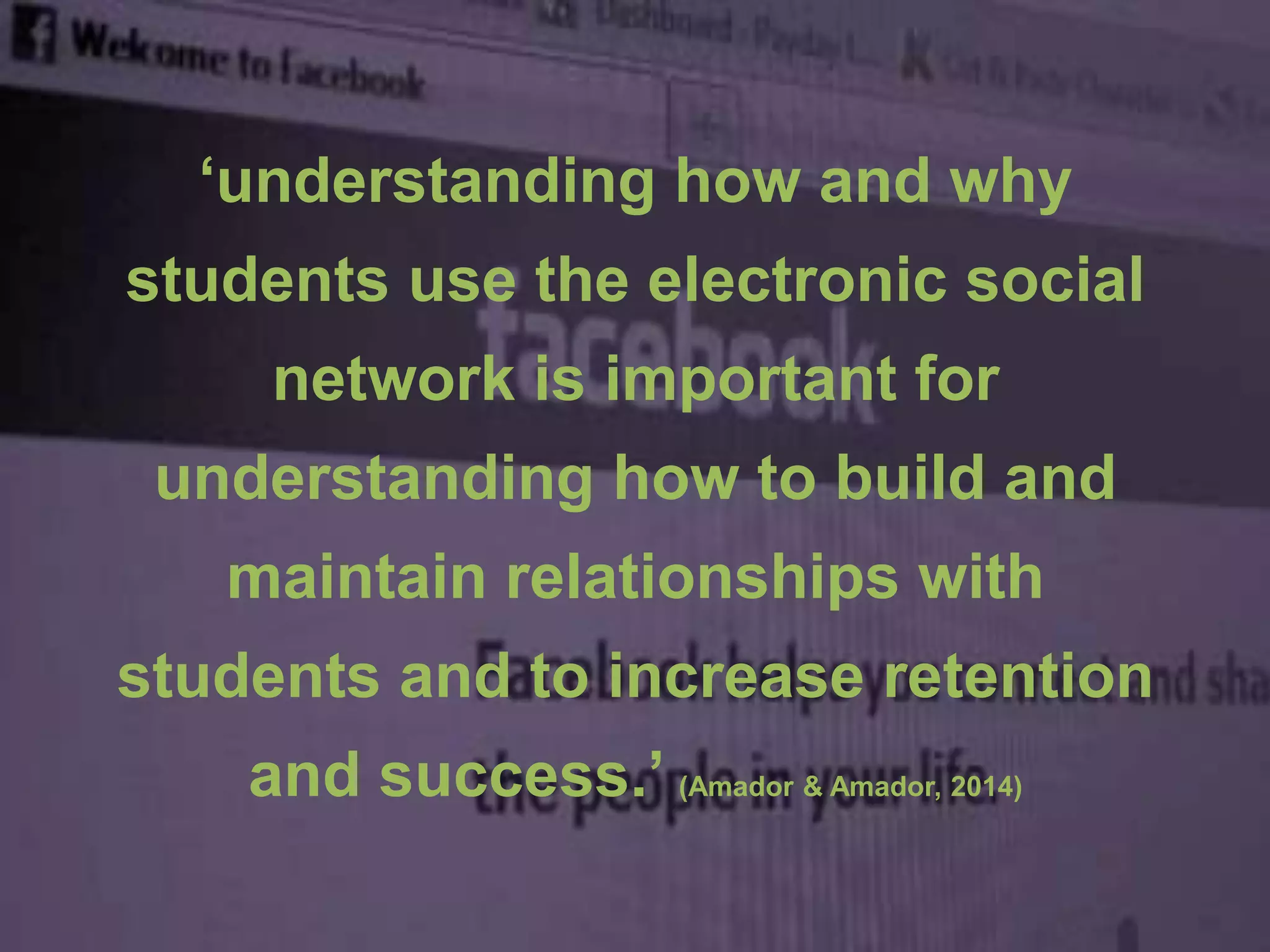
‘understanding how and why
students use the electronic social
network is important for
understanding how to build and
maintain relationships with
students and to increase retention
and success.’ (Amador & Amador, 2014)
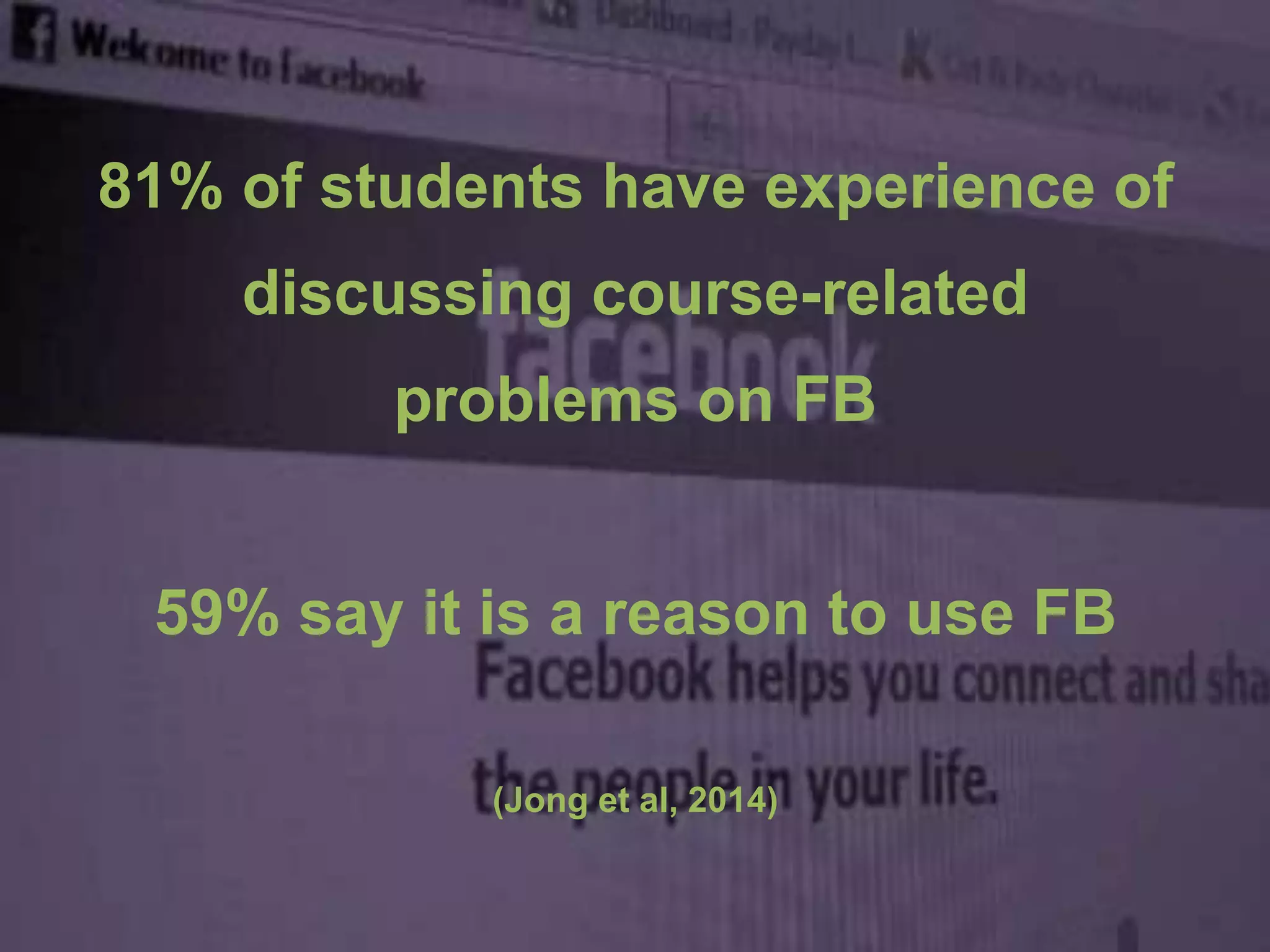
81% of students have experience of
discussing course-related
problems on FB
59% say it is a reason to use FB
(Jong et al, 2014)
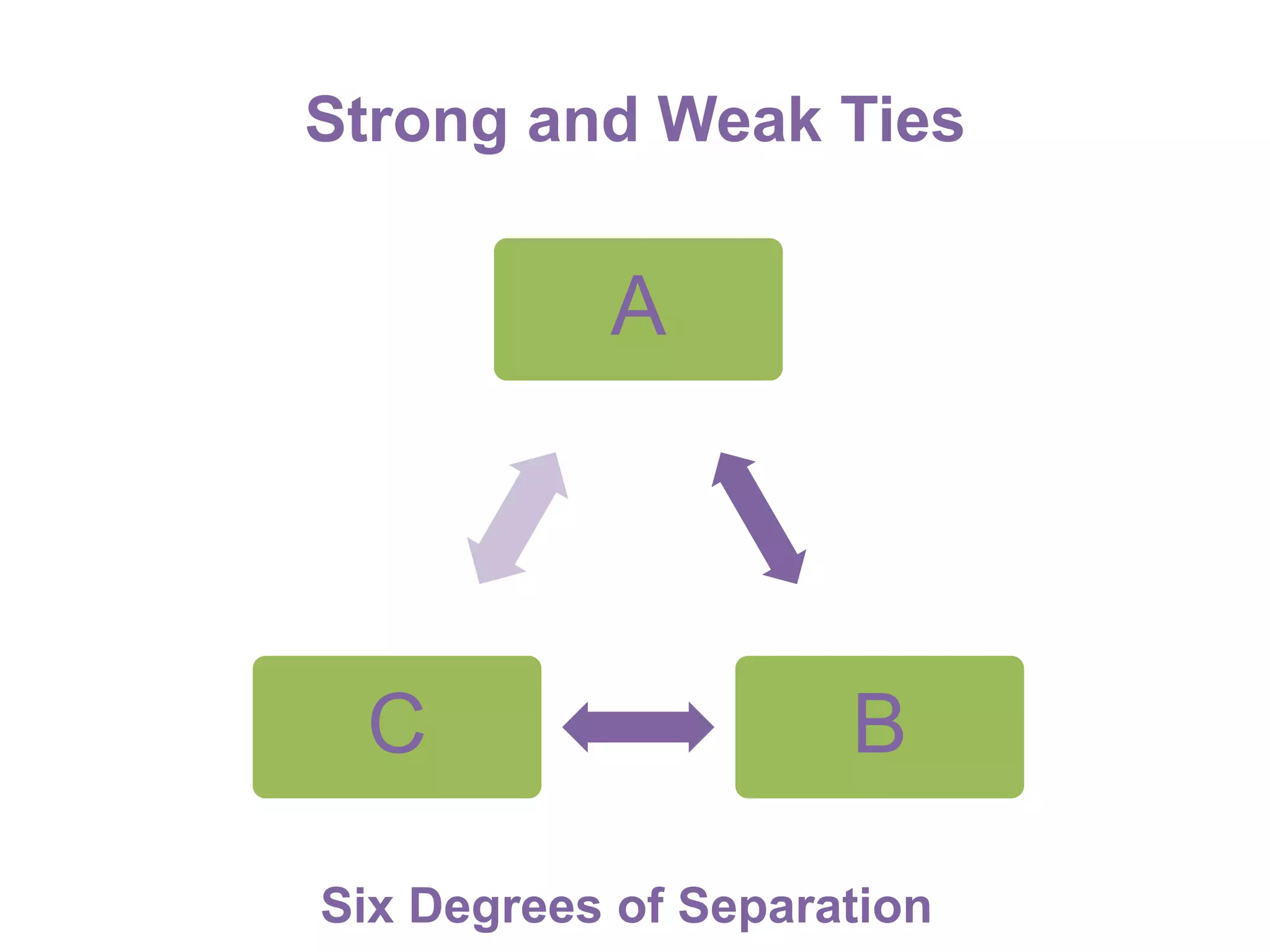
Strong and Weak Ties
A
BC
Six Degrees of Separation
Objectives
• To determine if open data from social networks (Facebook)
maintained by students online provide indicators of those
students who may be less likely to succeed or complete a
course of study.
• To investigate the manner in which analysis of Facebook and
SNA may provide information which will assist in the
development of teaching strategies and approaches to
classroom management which will result in improved
teaching and learning and greater success on course.
THE COURSE & STUDENTS
METHODOLOGY
Social Network Analysis (SNA)
• SNA is ‘the mapping and measuring of relationships and flows
between people, groups, organisations, computers, URLs, and
other connected information/knowledge entities’ (Orgnet, 2013)
• Allows researchers to visually see the network and make “sense” of
the data
• For this project only degree of centrality was considered
– Each individual is a node
– Nodes are connected and some will be the “hubs” of the network
• Used Open source SNA software - Gephi
Survey
• Used Survey Monkey
• Informed by past research
• 90 students were asked to participate
• 23 completed the survey – 25% return
RESULTS
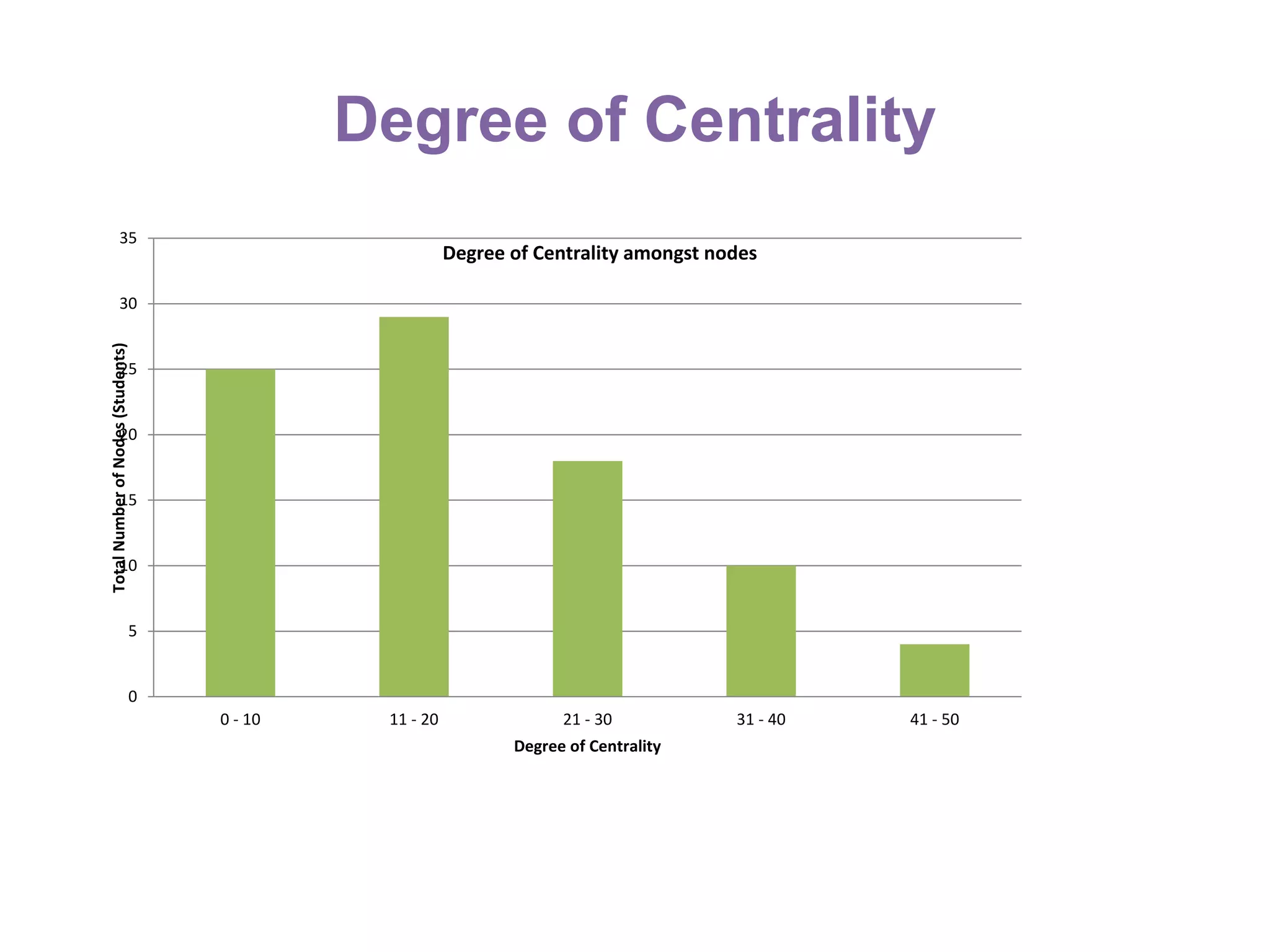
Degree of Centrality
0
5
10
15
20
25
30
35
0 - 10 11 - 20 21 - 30 31 - 40 41 - 50
TotalNumberofNodes(Students)
Degree of Centrality
Degree of Centrality amongst nodes
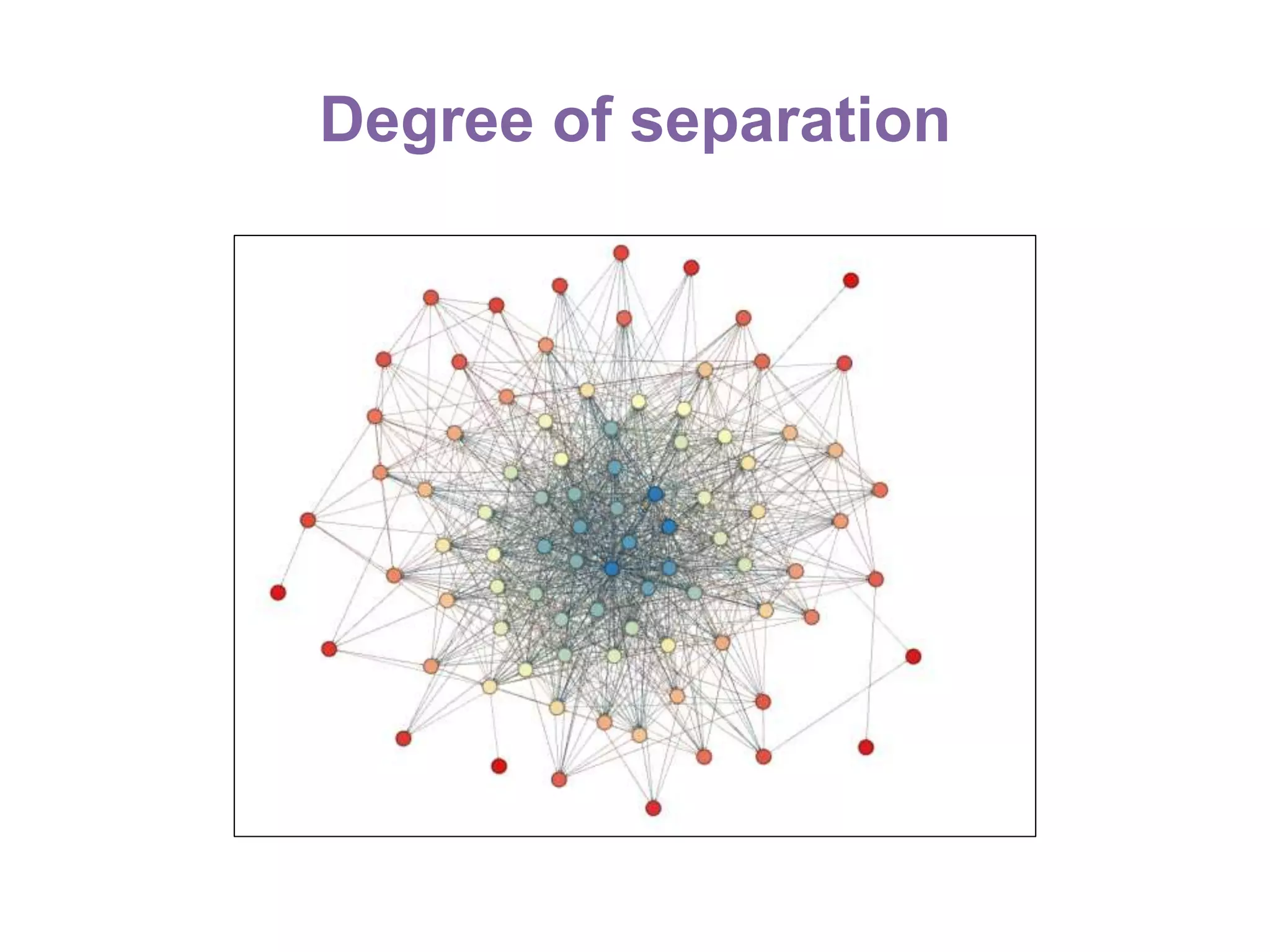
Degree of separation
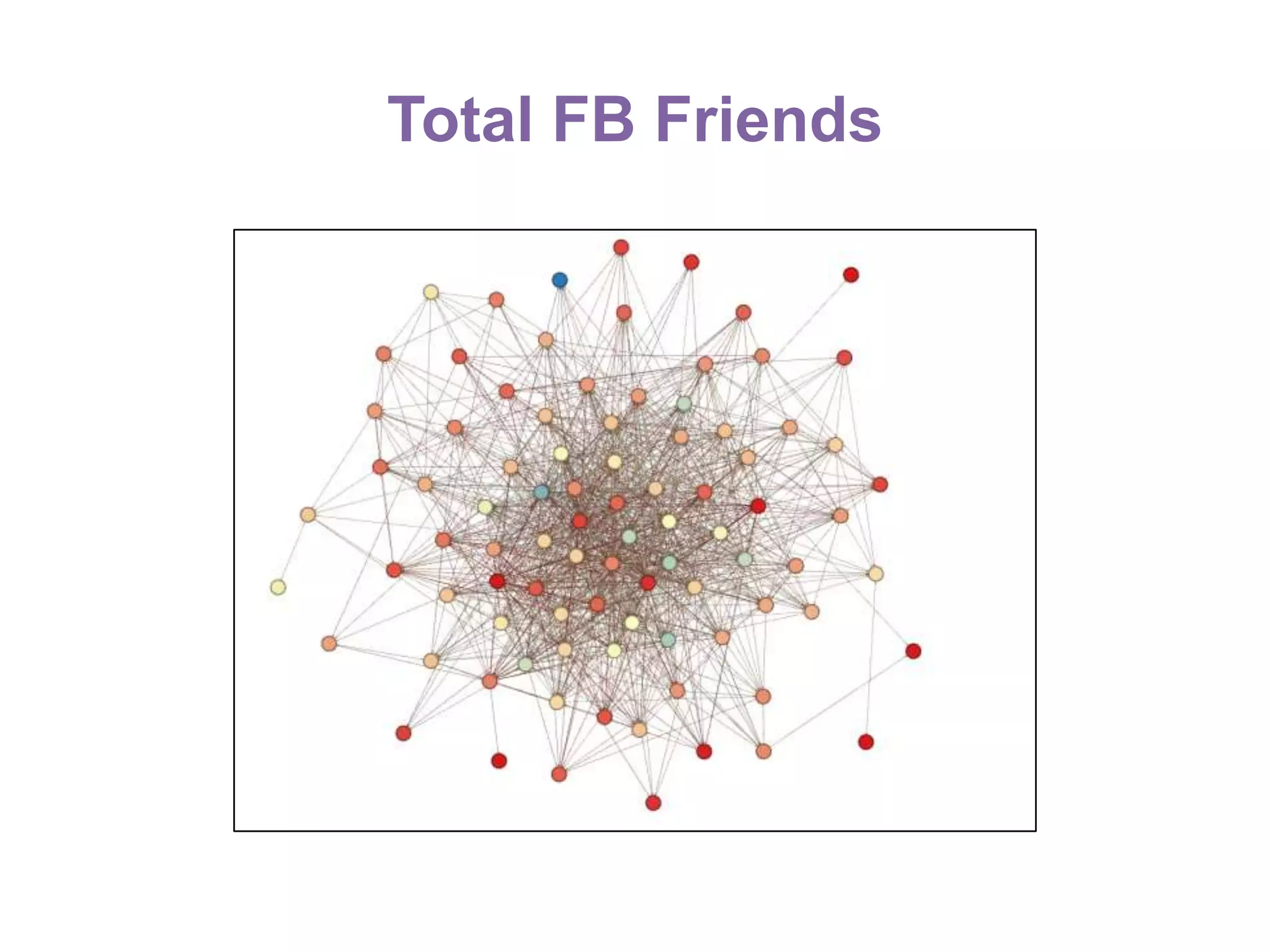
Total FB Friends
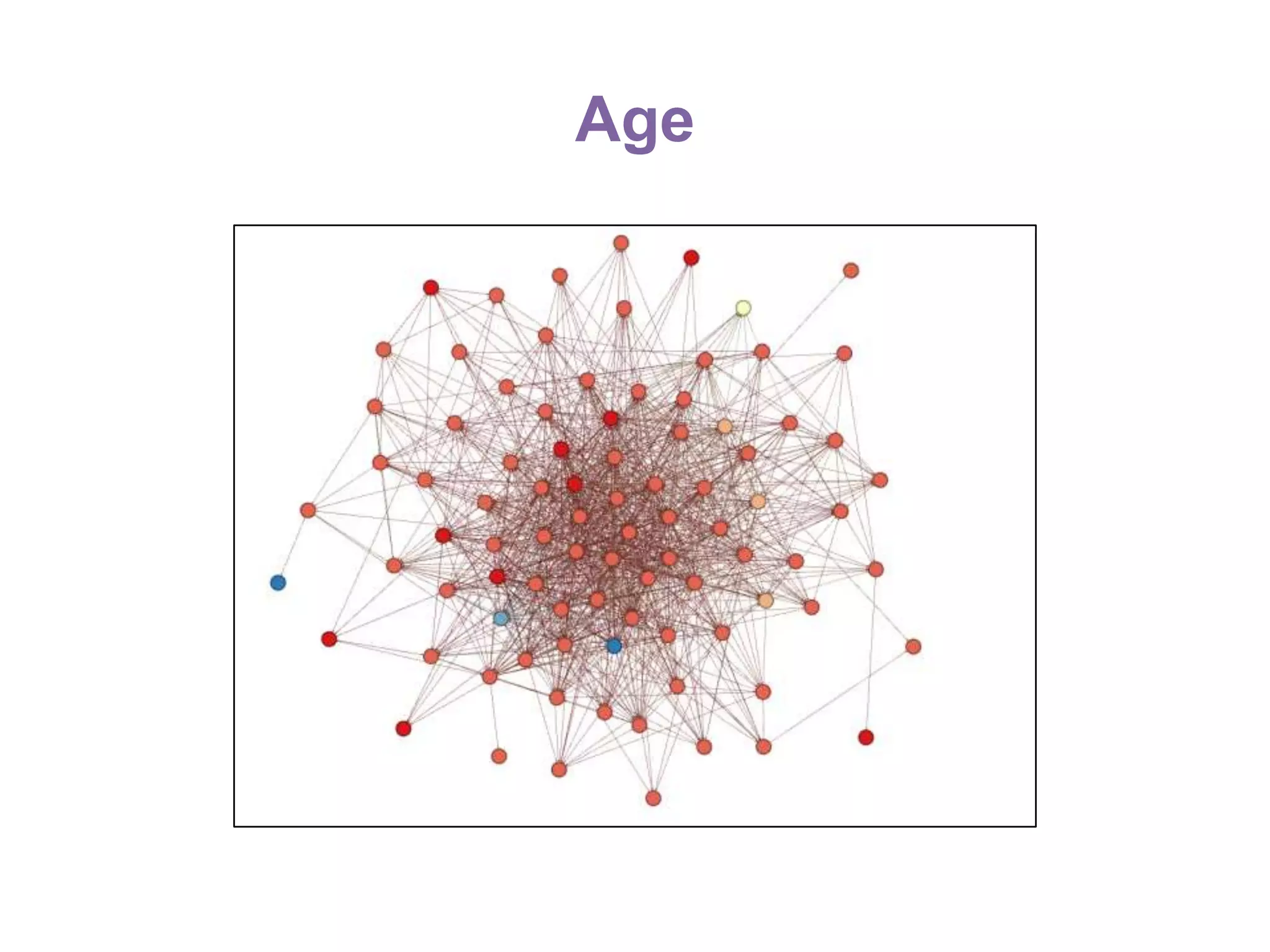
Age
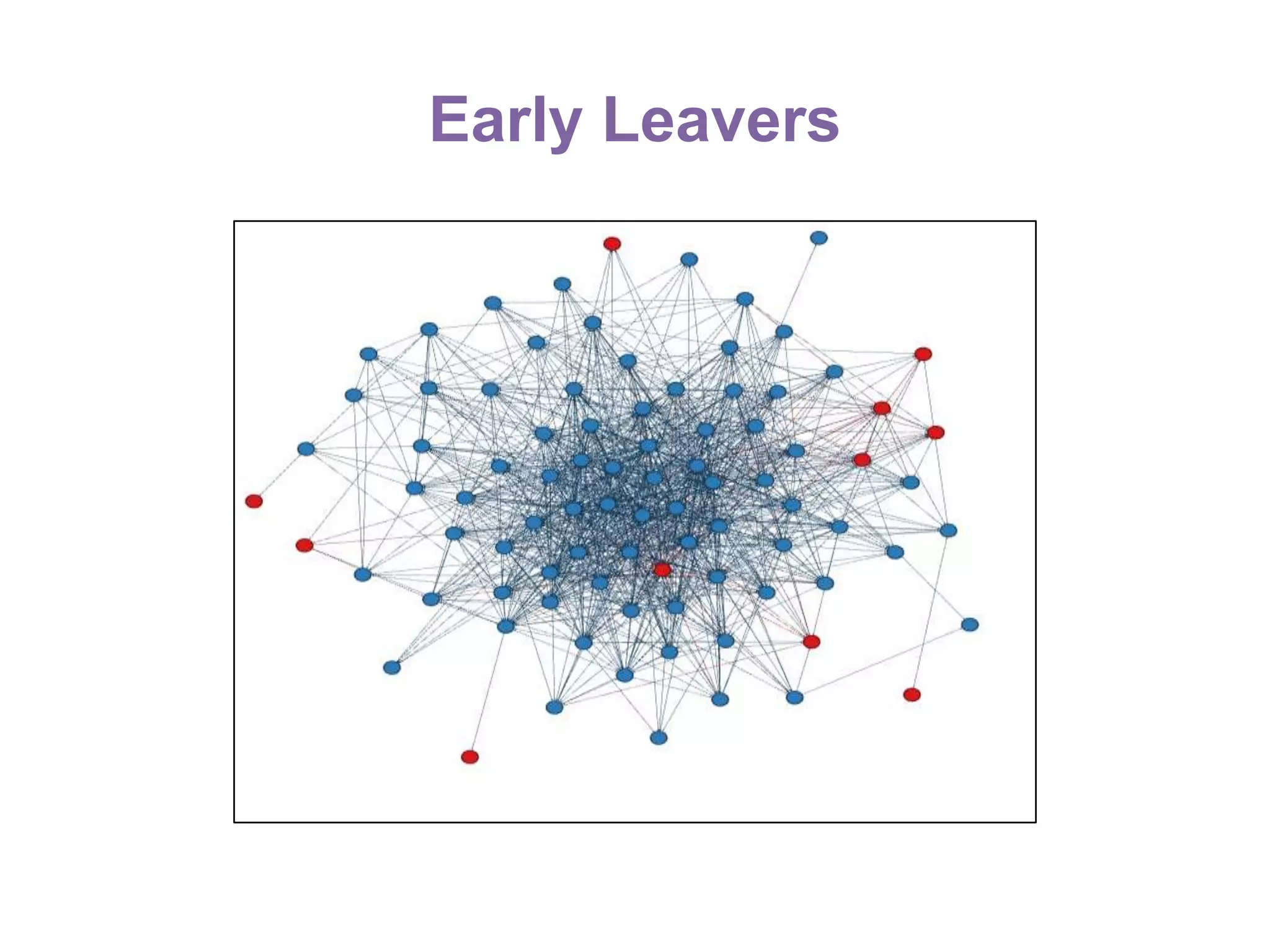
Early Leavers
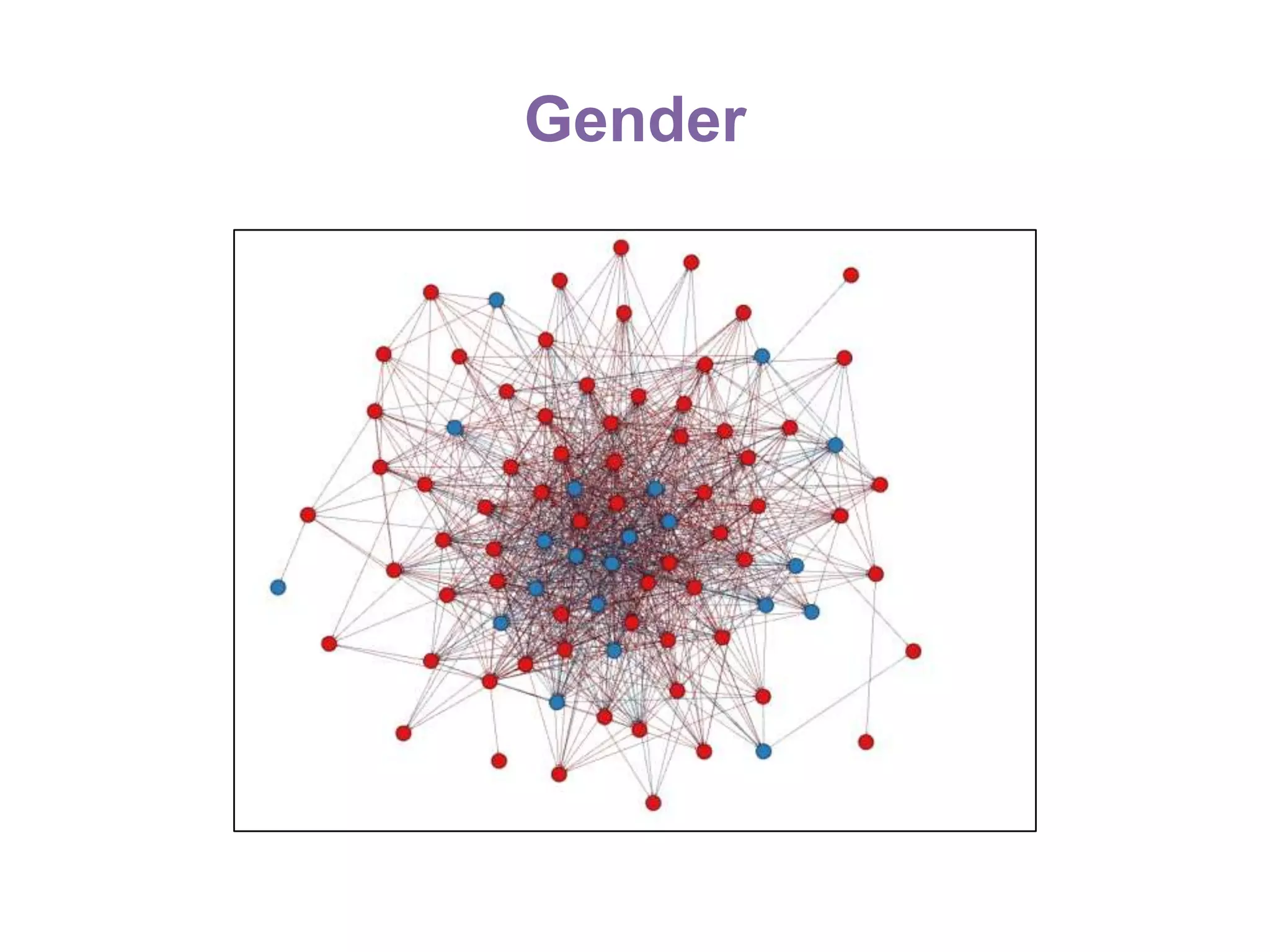
Gender
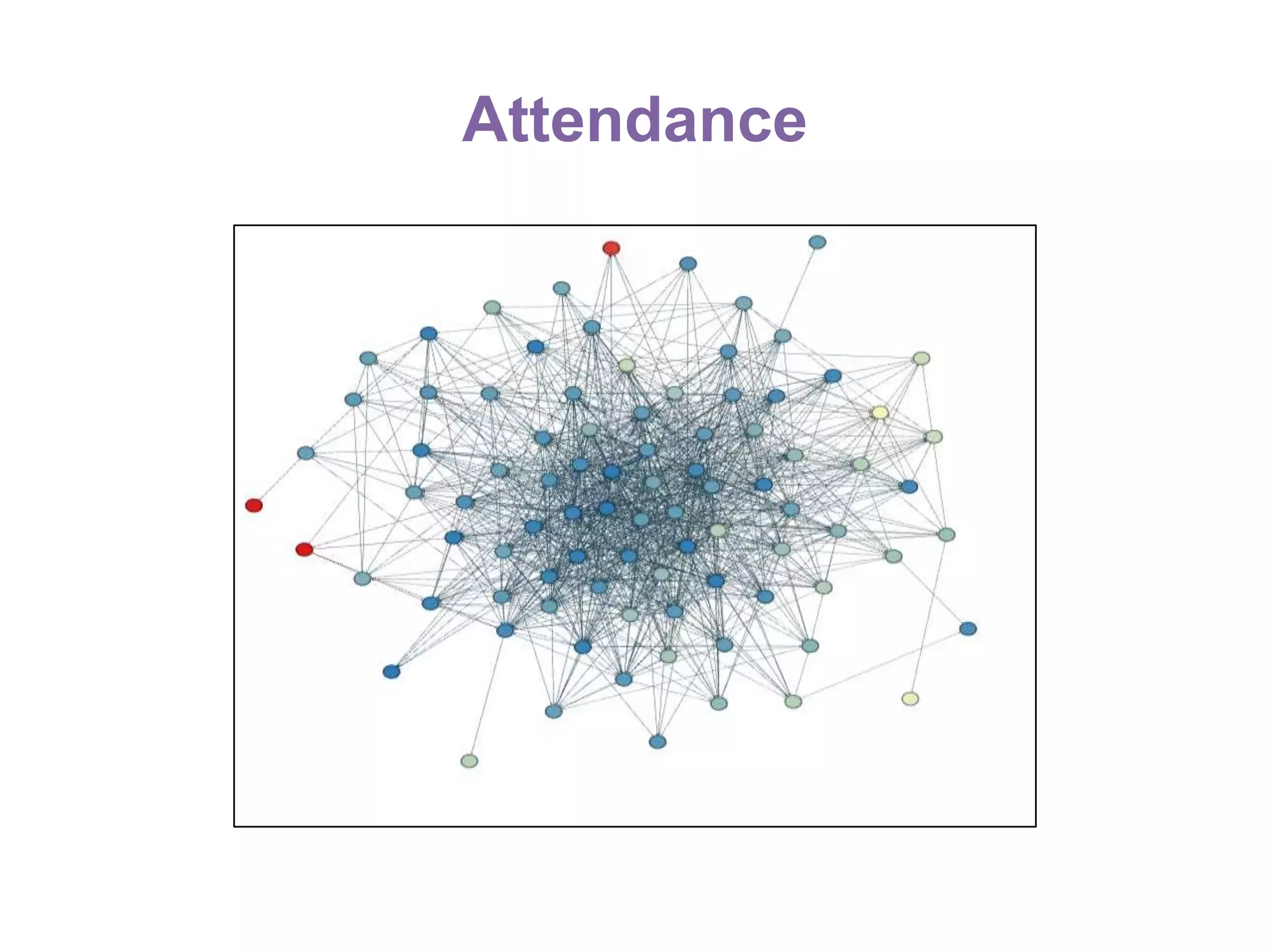
Attendance
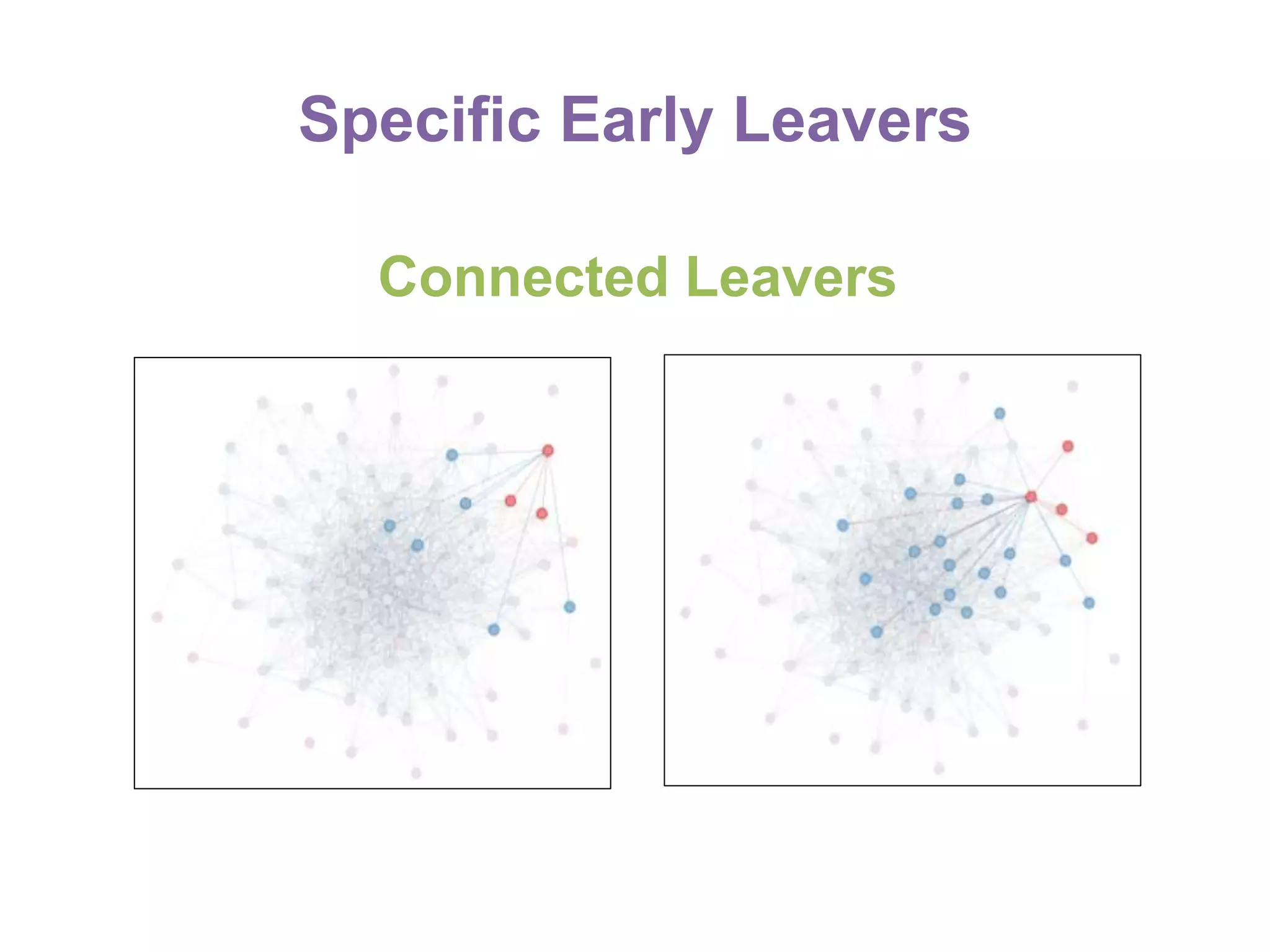
Specific Early Leavers
Connected Leavers
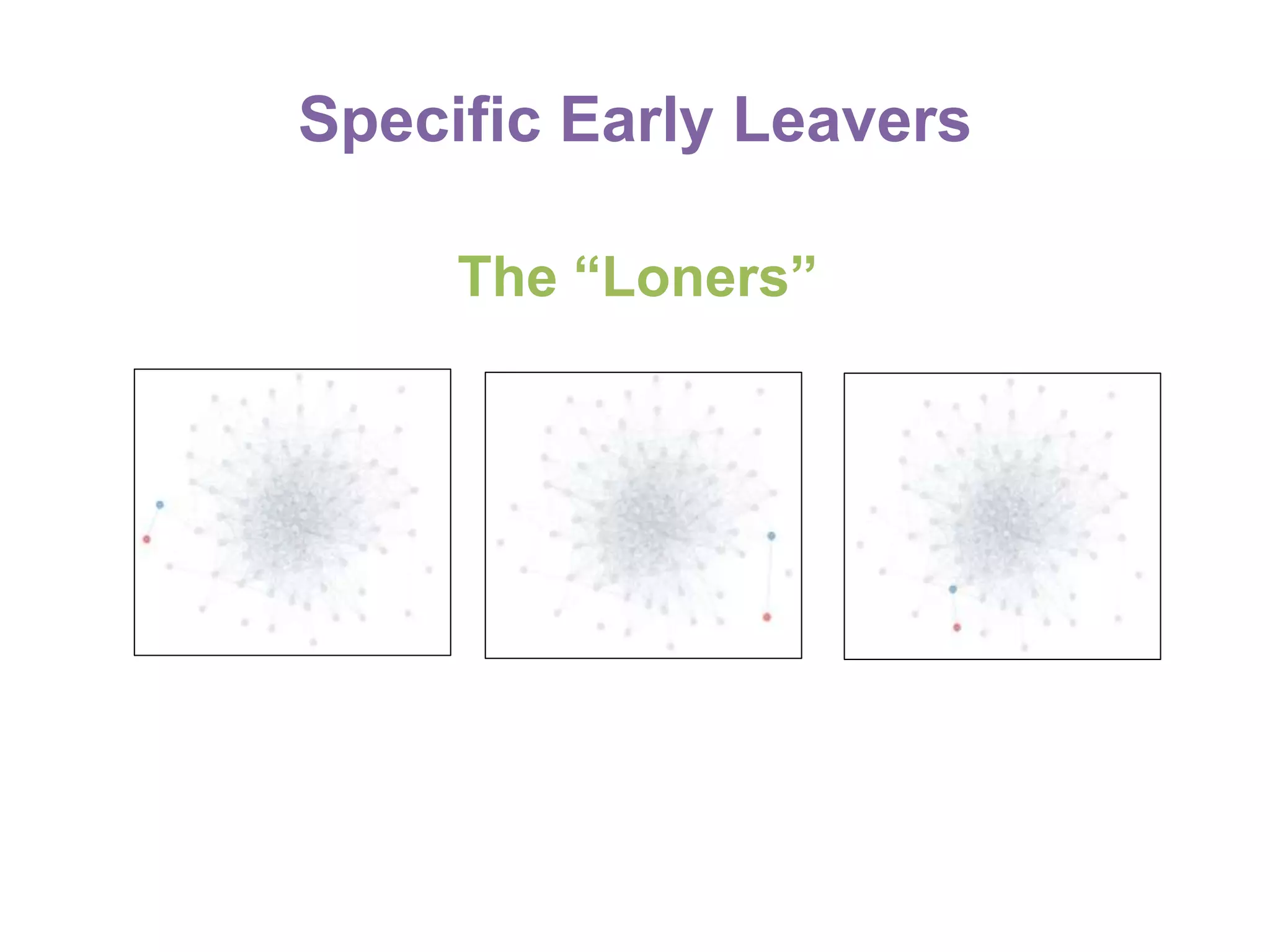
Specific Early Leavers
The “Loners”
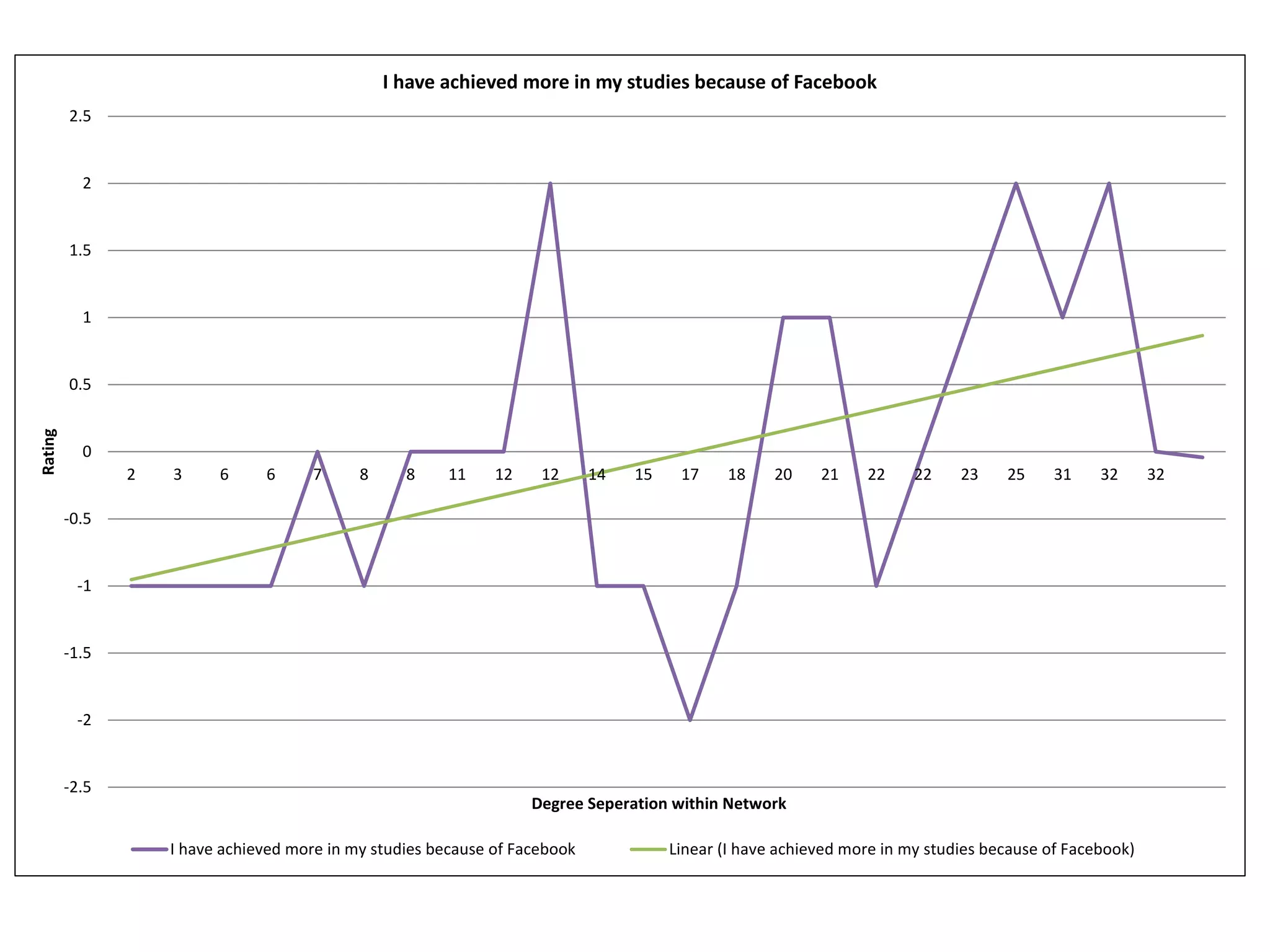
-2.5
-2
-1.5
-1
-0.5
0
0.5
1
1.5
2
2.5
2 3 6 6 7 8 8 11 12 12 14 15 17 18 20 21 22 22 23 25 31 32 32
Rating
Degree Seperation within Network
I have achieved more in my studies because of Facebook
I have achieved more in my studies because of Facebook Linear (I have achieved more in my studies because of Facebook)
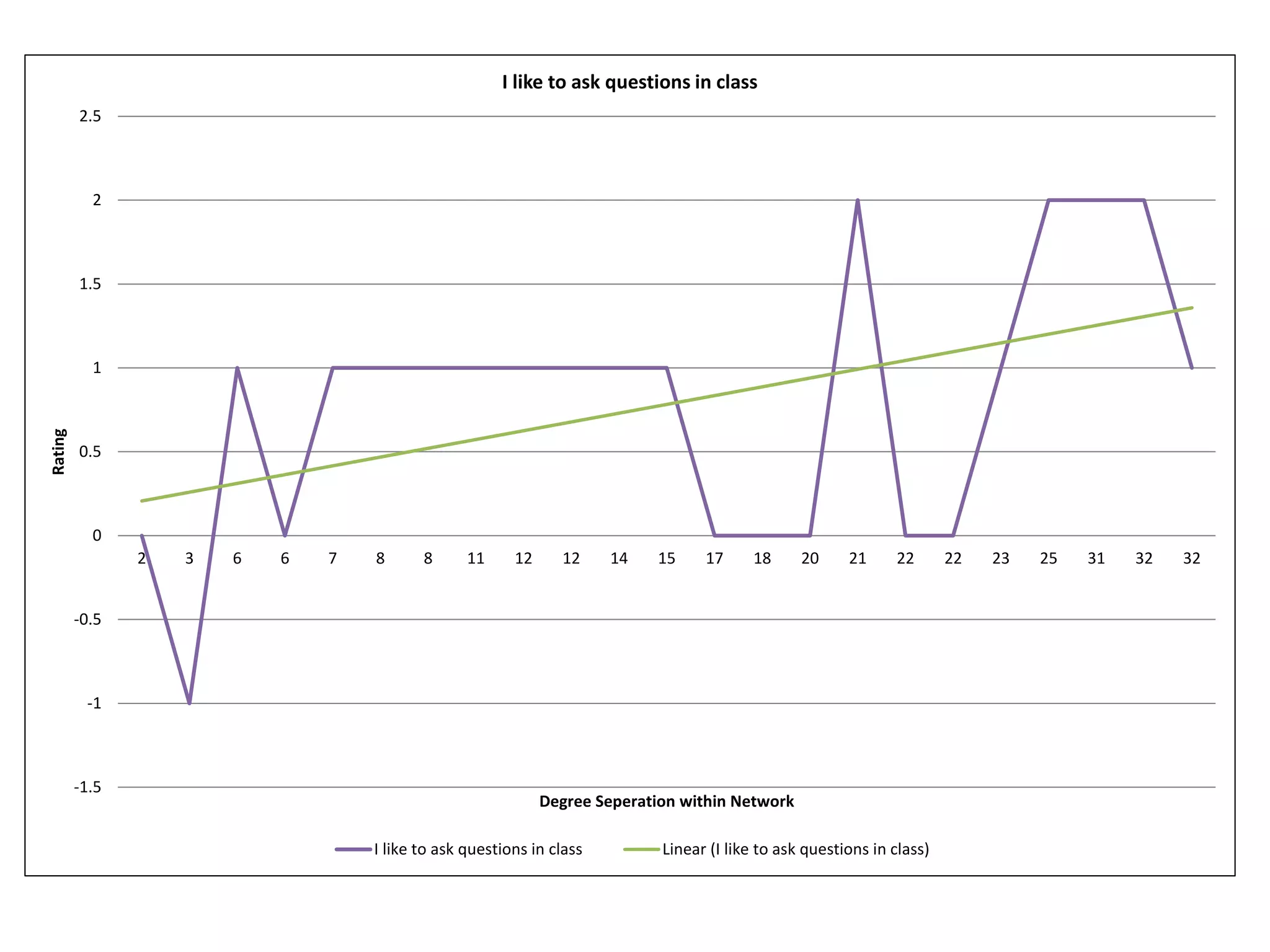
-1.5
-1
-0.5
0
0.5
1
1.5
2
2.5
2 3 6 6 7 8 8 11 12 12 14 15 17 18 20 21 22 22 23 25 31 32 32
Rating
Degree Seperation within Network
I like to ask questions in class
I like to ask questions in class Linear (I like to ask questions in class)
-2.5
-2
-1.5
-1
-0.5
0
0.5
1
1.5
2
2.5
2 3 6 6 7 8 8 11 12 12 14 15 17 18 20 21 22 22 23 25 31 32 32
Rating
Degree Seperation within Network
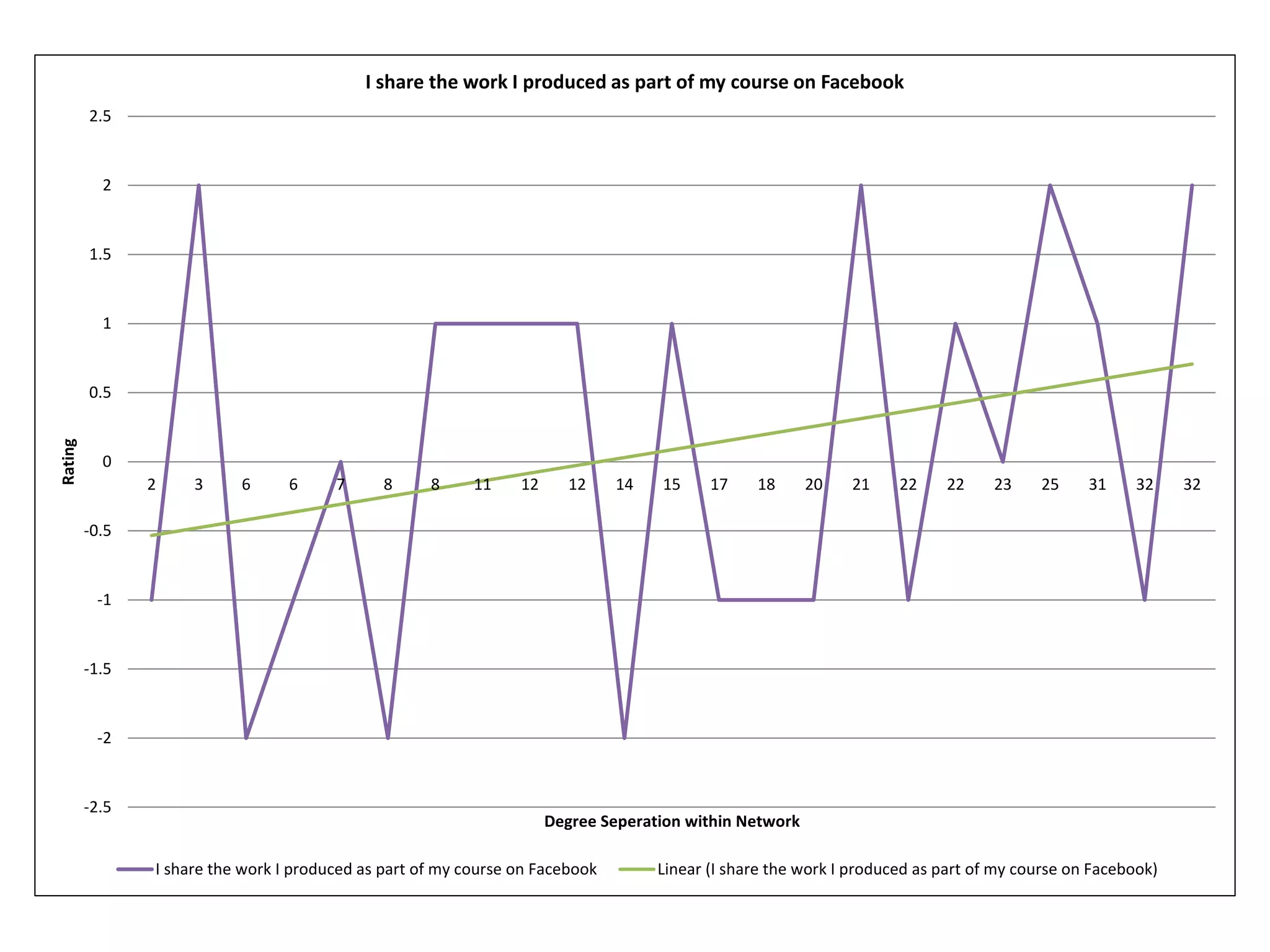
I share the work I produced as part of my course on Facebook
I share the work I produced as part of my course on Facebook Linear (I share the work I produced as part of my course on Facebook)
-2.5
-2
-1.5
-1
-0.5
0
0.5
1
1.5
2
2.5
2 3 6 6 7 8 8 11 12 12 14 15 17 18 20 21 22 22 23 25 31 32 32
Rating
Degree Seperation within Network
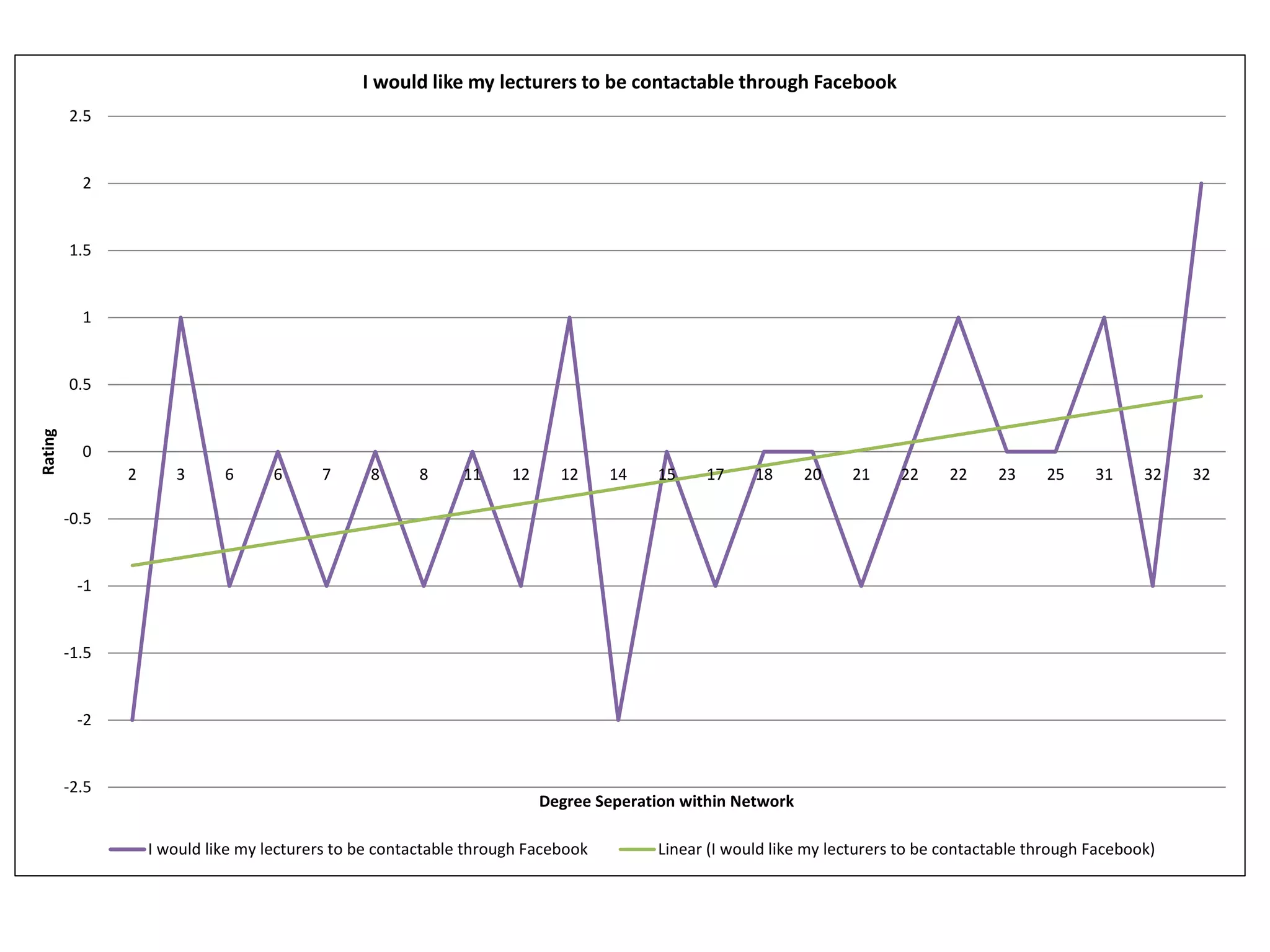
I would like my lecturers to be contactable through Facebook
I would like my lecturers to be contactable through Facebook Linear (I would like my lecturers to be contactable through Facebook)
DISCUSSION
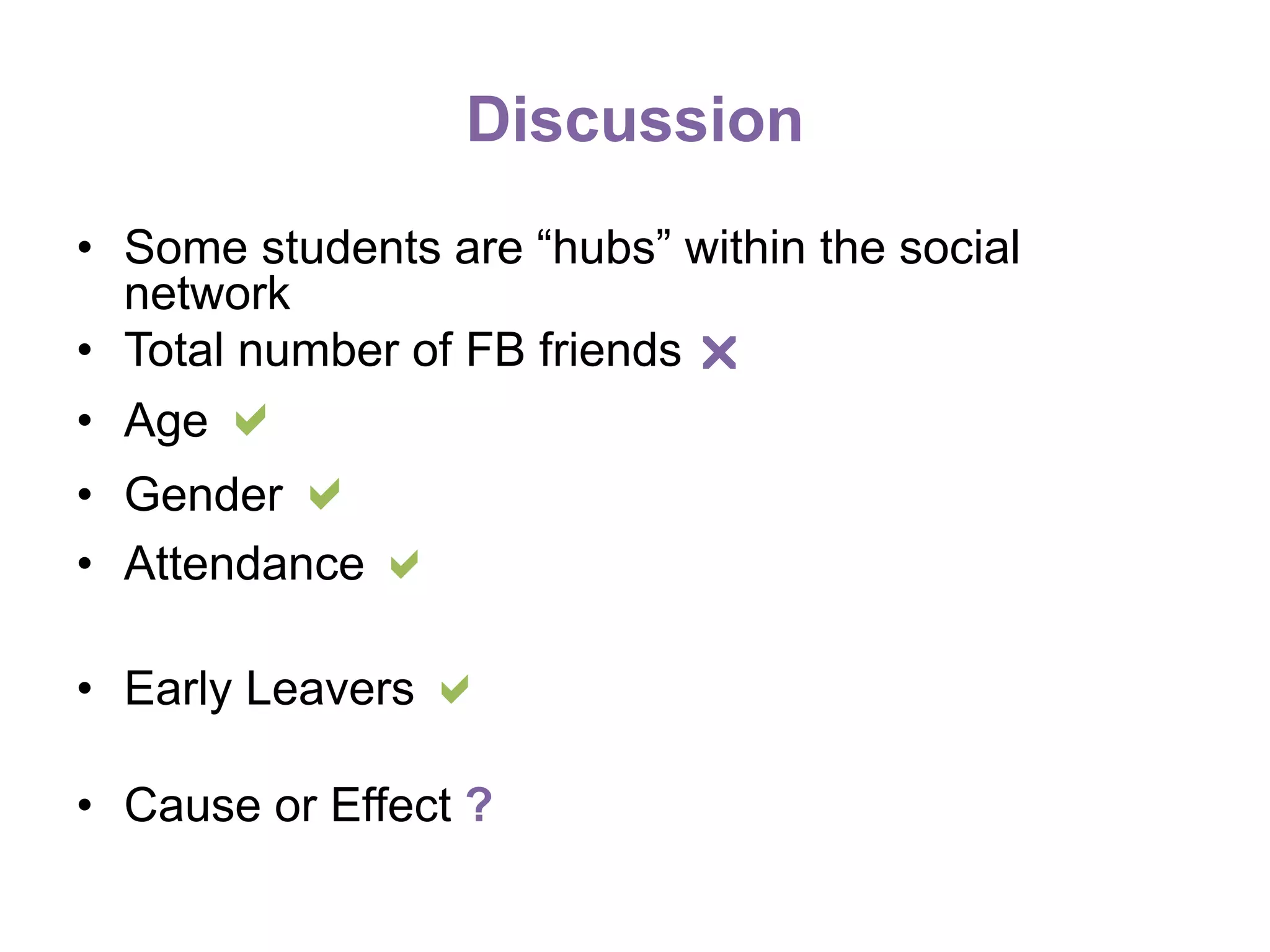
Discussion
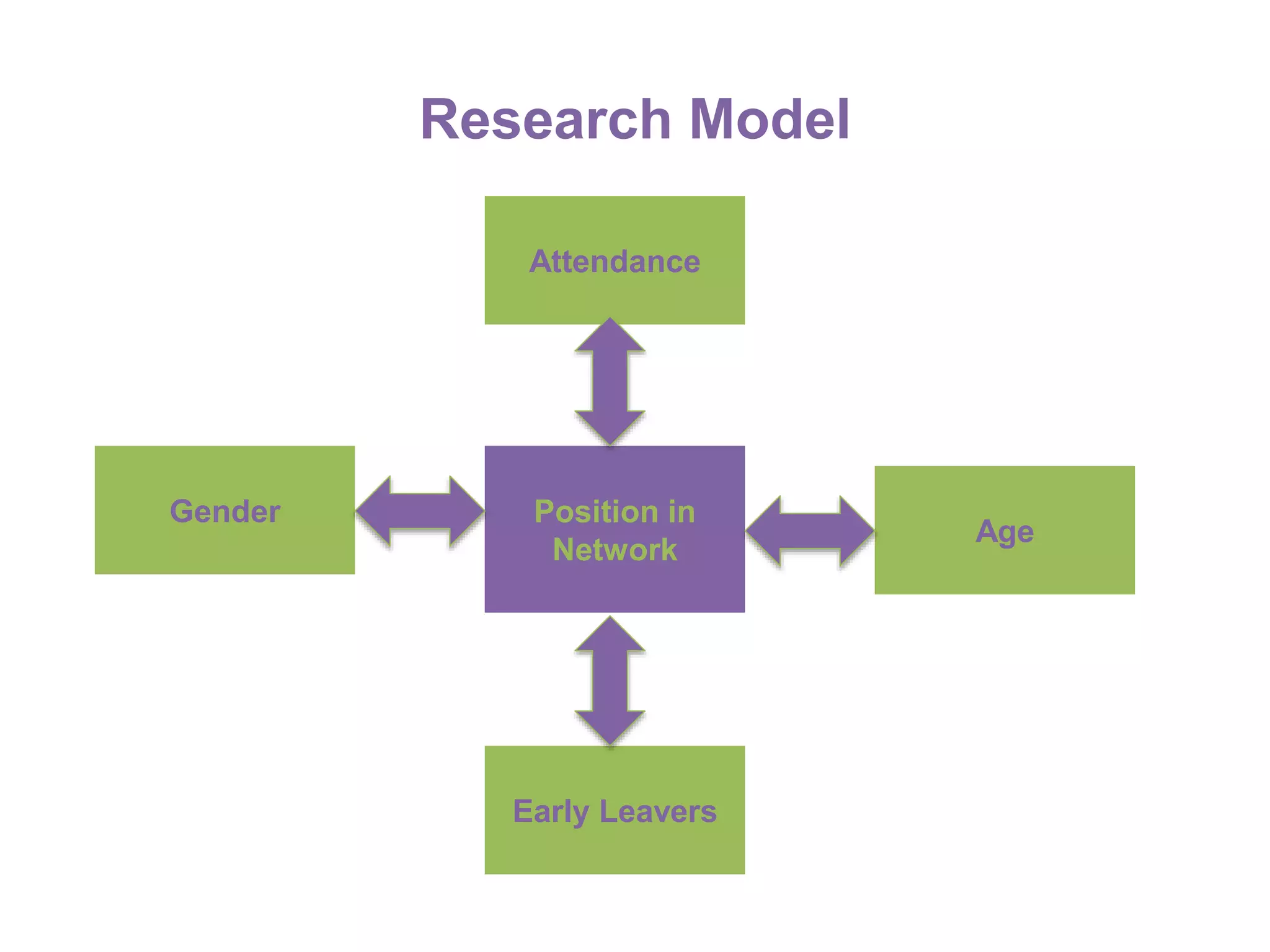
• Some students are “hubs” within the social
network
• Total number of FB friends r
• Age a
• Gender a
• Attendance a
• Early Leavers a
• Cause or Effect ?
Research Model
Attendance
Gender
Age
Early Leavers
Position in
Network
CONCLUSION
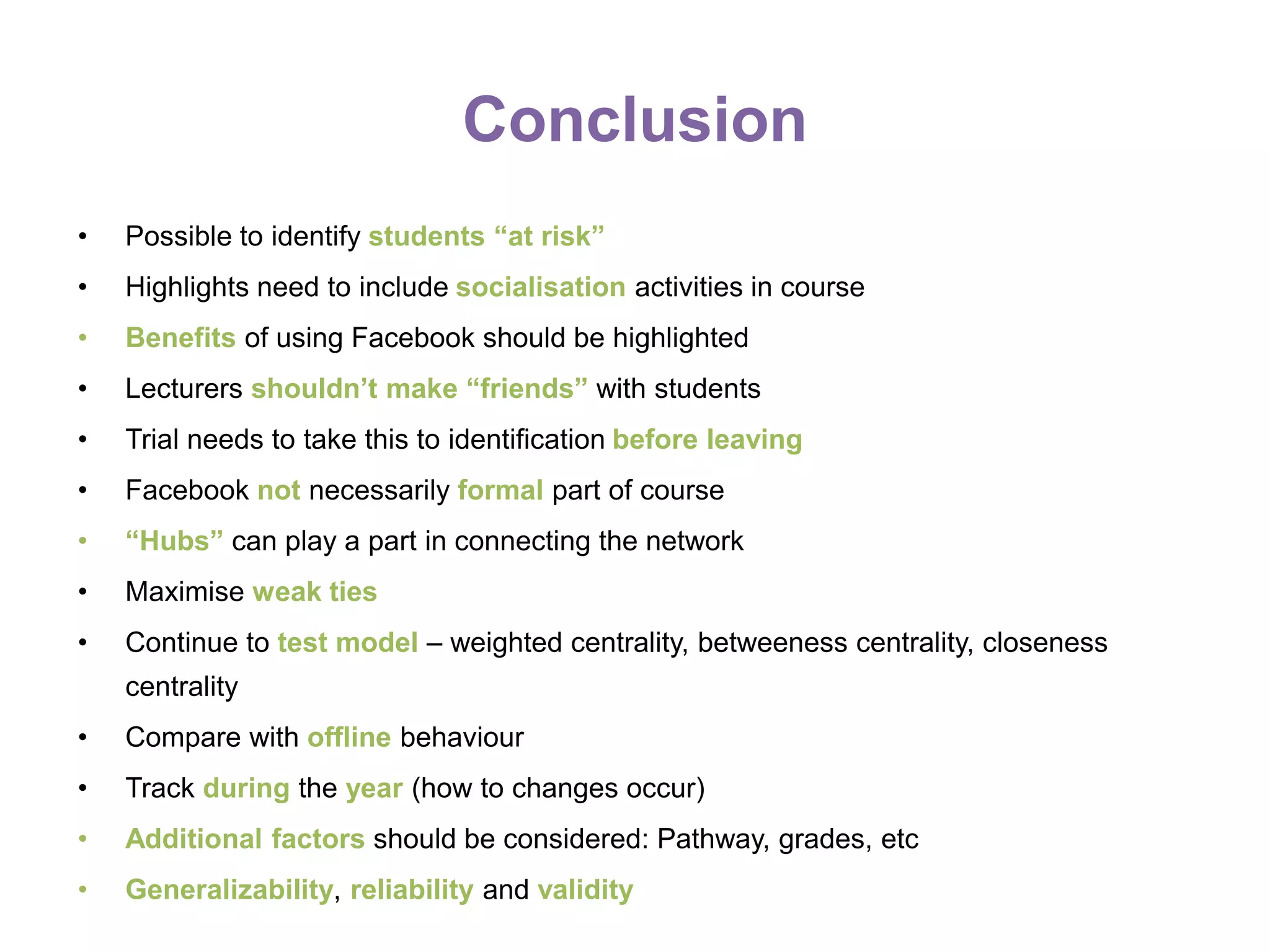
Conclusion
• Possible to identify students “at risk”
• Highlights need to include socialisation activities in course
• Benefits of using Facebook should be highlighted
• Lecturers shouldn’t make “friends” with students
• Trial needs to take this to identification before leaving
• Facebook not necessarily formal part of course
• “Hubs” can play a part in connecting the network
• Maximise weak ties
• Continue to test model – weighted centrality, betweeness centrality, closeness
centrality
• Compare with offline behaviour
• Track during the year (how to changes occur)
• Additional factors should be considered: Pathway, grades, etc
• Generalizability, reliability and validity
LETS TALK ABOUT KEVIN…
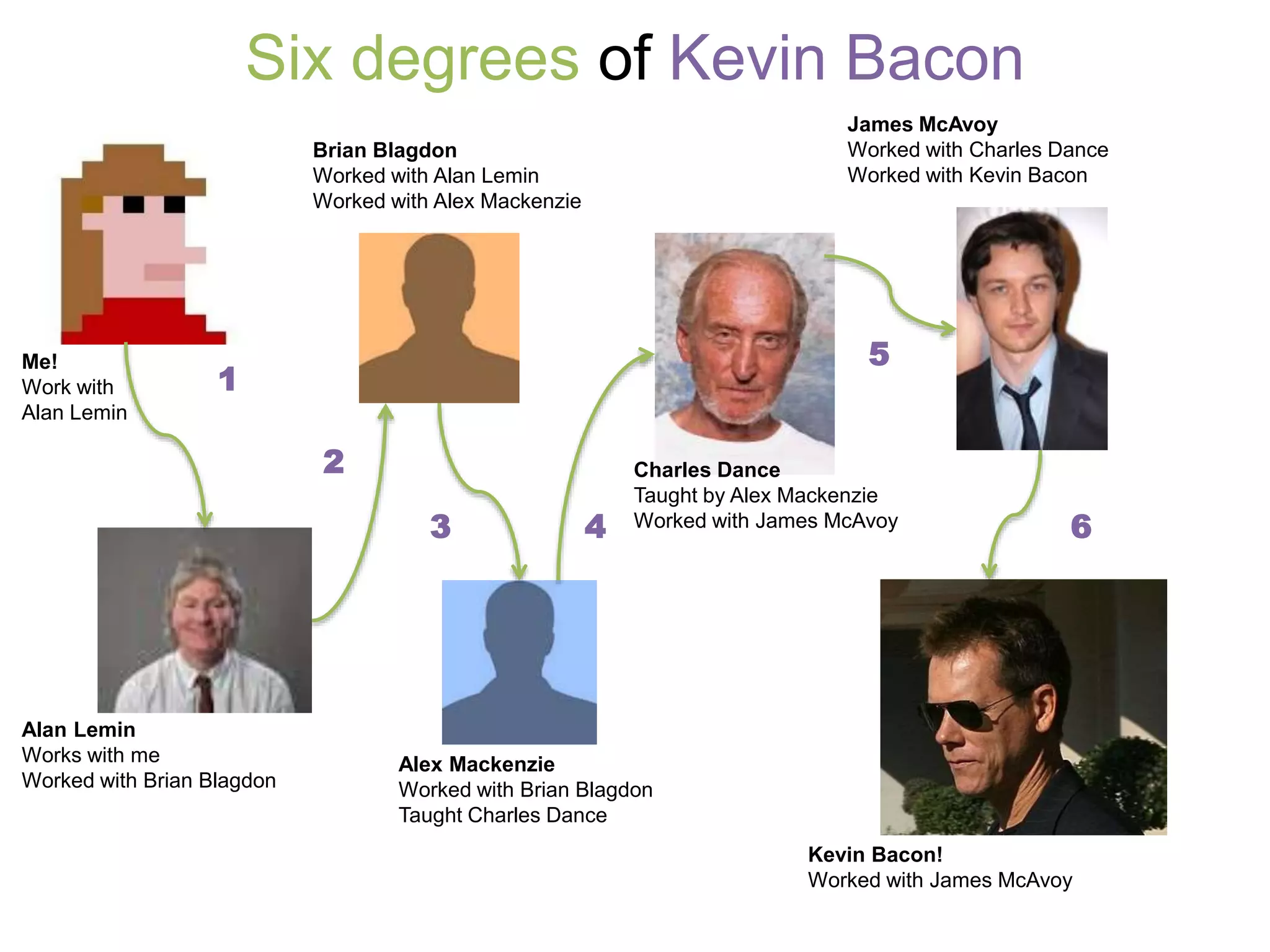
Six degrees of Kevin Bacon
Me!
Work with
Alan Lemin
Alan Lemin
Works with me
Worked with Brian Blagdon
Brian Blagdon
Worked with Alan Lemin
Worked with Alex Mackenzie
Alex Mackenzie
Worked with Brian Blagdon
Taught Charles Dance
Charles Dance
Taught by Alex Mackenzie
Worked with James McAvoy
James McAvoy
Worked with Charles Dance
Worked with Kevin Bacon
Kevin Bacon!
Worked with James McAvoy
1
2
3 4
5
6
Contact Details
Elaine Garcia
lainey@elainegarcia.uk
@ela1negarc1a
References / Picture Attribution
• Amador, P. & Amador, J. (2014) Academic advising via Facebook: Examining student help
seeking. Internet and Higher Education, No. 21, pp. 9-16.
• Jong, B., Lai, C., Hsia, Y., Lin, T. & Liao, Y. (2014) An exploration of the potential educational
value of Facebook, Computers in Human Behaviour, No. 32, pp201-211
• Orgnet (2013) Social Network Analysis: A brief introduction, Accessed 1st May 2014. Available at:
http://www.orgnet.com/sna.html
• Students in field: Kyle Spradley https://flic.kr/p/nE5xbX
• Facebook: MoneyBlogNewz https://flic.kr/p/92CvQF
• Gephi Logo http://en.wikipedia.org/wiki/File:Gephi-logo.png
• Kevin Bacon http://commons.wikimedia.org/wiki/File:KevinBacon07TIFF.jpg#file
• Charles Dance http://commons.wikimedia.org/wiki/File:Charles_Dance_%28July_2012%29.jpg
• James McAvoy http://commons.wikimedia.org/wiki/File:James_McAvoy.jpg

The Use of Facebook and Social Network Analysis (ETF 2014)

  • 1.
    The use ofFacebook (FB) and Social Network Analysis (SNA) to Predict Students “At Risk” in Further Education (FE) Elaine Garcia @ela1negarc1a lainey@elainegarcia.uk
  • 2.
    About me • ElaineGarcia • Head of Blended Learning & Digital Development (currently) • Plymouth College of Art • Associate Lecturer in information systems / PhD student • University of Plymouth • Research interests: Web 2.0, teaching & learning, knowledge management, social learning, CoP, blogs
  • 3.
    What links meand Kevin Bacon?
  • 4.
  • 5.
  • 6.
    Background Web 2.0 isbecoming increasingly popular amongst students
  • 8.
    Young people areforming ‘…. complex, invisible and organic social networks.’
  • 9.
    ‘understanding how andwhy students use the electronic social network is important for understanding how to build and maintain relationships with students and to increase retention and success.’ (Amador & Amador, 2014)
  • 10.
    81% of studentshave experience of discussing course-related problems on FB 59% say it is a reason to use FB (Jong et al, 2014)
  • 11.
    Strong and WeakTies A BC Six Degrees of Separation
  • 12.
    Objectives • To determineif open data from social networks (Facebook) maintained by students online provide indicators of those students who may be less likely to succeed or complete a course of study. • To investigate the manner in which analysis of Facebook and SNA may provide information which will assist in the development of teaching strategies and approaches to classroom management which will result in improved teaching and learning and greater success on course.
  • 13.
    THE COURSE &STUDENTS
  • 22.
  • 23.
    Social Network Analysis(SNA) • SNA is ‘the mapping and measuring of relationships and flows between people, groups, organisations, computers, URLs, and other connected information/knowledge entities’ (Orgnet, 2013) • Allows researchers to visually see the network and make “sense” of the data • For this project only degree of centrality was considered – Each individual is a node – Nodes are connected and some will be the “hubs” of the network • Used Open source SNA software - Gephi
  • 24.
    Survey • Used SurveyMonkey • Informed by past research • 90 students were asked to participate • 23 completed the survey – 25% return
  • 25.
  • 26.
    Degree of Centrality 0 5 10 15 20 25 30 35 0- 10 11 - 20 21 - 30 31 - 40 41 - 50 TotalNumberofNodes(Students) Degree of Centrality Degree of Centrality amongst nodes
  • 27.
  • 28.
  • 29.
  • 30.
  • 31.
  • 32.
  • 33.
  • 34.
  • 35.
    -2.5 -2 -1.5 -1 -0.5 0 0.5 1 1.5 2 2.5 2 3 66 7 8 8 11 12 12 14 15 17 18 20 21 22 22 23 25 31 32 32 Rating Degree Seperation within Network I have achieved more in my studies because of Facebook I have achieved more in my studies because of Facebook Linear (I have achieved more in my studies because of Facebook)
  • 36.
    -1.5 -1 -0.5 0 0.5 1 1.5 2 2.5 2 3 66 7 8 8 11 12 12 14 15 17 18 20 21 22 22 23 25 31 32 32 Rating Degree Seperation within Network I like to ask questions in class I like to ask questions in class Linear (I like to ask questions in class)
  • 37.
    -2.5 -2 -1.5 -1 -0.5 0 0.5 1 1.5 2 2.5 2 3 66 7 8 8 11 12 12 14 15 17 18 20 21 22 22 23 25 31 32 32 Rating Degree Seperation within Network I share the work I produced as part of my course on Facebook I share the work I produced as part of my course on Facebook Linear (I share the work I produced as part of my course on Facebook)
  • 38.
    -2.5 -2 -1.5 -1 -0.5 0 0.5 1 1.5 2 2.5 2 3 66 7 8 8 11 12 12 14 15 17 18 20 21 22 22 23 25 31 32 32 Rating Degree Seperation within Network I would like my lecturers to be contactable through Facebook I would like my lecturers to be contactable through Facebook Linear (I would like my lecturers to be contactable through Facebook)
  • 39.
  • 40.
    Discussion • Some studentsare “hubs” within the social network • Total number of FB friends r • Age a • Gender a • Attendance a • Early Leavers a • Cause or Effect ?
  • 41.
  • 42.
  • 43.
    Conclusion • Possible toidentify students “at risk” • Highlights need to include socialisation activities in course • Benefits of using Facebook should be highlighted • Lecturers shouldn’t make “friends” with students • Trial needs to take this to identification before leaving • Facebook not necessarily formal part of course • “Hubs” can play a part in connecting the network • Maximise weak ties • Continue to test model – weighted centrality, betweeness centrality, closeness centrality • Compare with offline behaviour • Track during the year (how to changes occur) • Additional factors should be considered: Pathway, grades, etc • Generalizability, reliability and validity
  • 44.
  • 45.
    Six degrees ofKevin Bacon Me! Work with Alan Lemin Alan Lemin Works with me Worked with Brian Blagdon Brian Blagdon Worked with Alan Lemin Worked with Alex Mackenzie Alex Mackenzie Worked with Brian Blagdon Taught Charles Dance Charles Dance Taught by Alex Mackenzie Worked with James McAvoy James McAvoy Worked with Charles Dance Worked with Kevin Bacon Kevin Bacon! Worked with James McAvoy 1 2 3 4 5 6
  • 46.
  • 47.
    References / PictureAttribution • Amador, P. & Amador, J. (2014) Academic advising via Facebook: Examining student help seeking. Internet and Higher Education, No. 21, pp. 9-16. • Jong, B., Lai, C., Hsia, Y., Lin, T. & Liao, Y. (2014) An exploration of the potential educational value of Facebook, Computers in Human Behaviour, No. 32, pp201-211 • Orgnet (2013) Social Network Analysis: A brief introduction, Accessed 1st May 2014. Available at: http://www.orgnet.com/sna.html • Students in field: Kyle Spradley https://flic.kr/p/nE5xbX • Facebook: MoneyBlogNewz https://flic.kr/p/92CvQF • Gephi Logo http://en.wikipedia.org/wiki/File:Gephi-logo.png • Kevin Bacon http://commons.wikimedia.org/wiki/File:KevinBacon07TIFF.jpg#file • Charles Dance http://commons.wikimedia.org/wiki/File:Charles_Dance_%28July_2012%29.jpg • James McAvoy http://commons.wikimedia.org/wiki/File:James_McAvoy.jpg