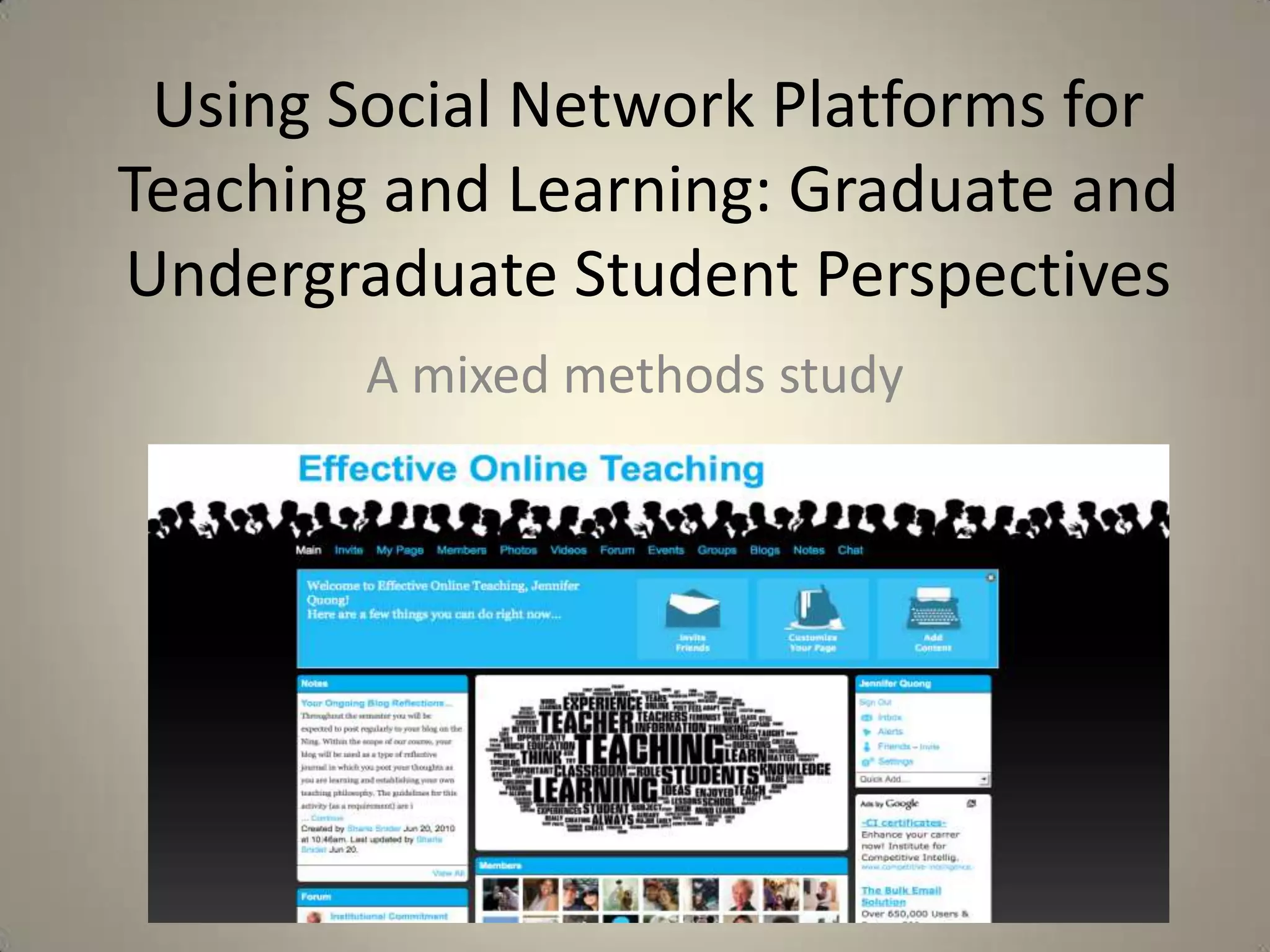
Using Social Network Platforms for Teaching and Learning: Graduate and Undergraduate Student PerspectivesA mixed methods study
Pre-readingIn order to facilitate the discussion, please read the following 2 articles.Ophys, J. D., & Abbitt, J. T. (2009). Exploring the potential perceptions of social networking systems in university courses. Journal of Online Learning and Teaching, 5(4), 639-648. Gorsky, P., & Caspi, A.,(2005). A critical analysis of transactional distance theory. Quarterly Review of Distance Education, 6(1), 1-11.
Literature ReviewParadigm shiftsPassive to active learningFace to face to onlineSeparation of personal and academicLearningsocial comfort social presence teacher presence respectinfluence
Current StudyIn graduate and undergraduate coursesHybrid and onlineParticipants176 students 107 undergraduates and 69 graduate students 98 hybrid and 78 online students during the 2008-2009 semesters. InstrumentationOnline survey consisted of 3 parts: demographic data, feedback about the Ning and experiences and a critical reflection sectionContinuing to add data
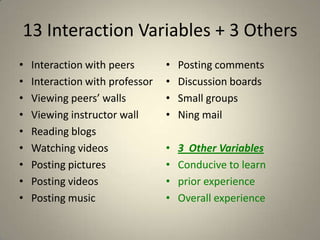
13 Interaction Variables + 3 OthersInteraction with peersInteraction with professorViewing peers’ wallsViewing instructor wallReading blogsWatching videosPosting picturesPosting videosPosting musicPosting commentsDiscussion boardsSmall groupsNing mail3  Other VariablesConducive to learnprior experienceOverall experience
Quantitative ResultsDiscriminant analysisdiscussion board, professor wall and interaction with the professor Regressions conducive to the learning- discussion boards, posting comments and interaction with the professor. CorrelationsFactor analysis with oblique rotationsA general interactive factor emerged with additional 2 factorsActive and passive one-way ANOVAsMANOVAsAll 13 variables loaded onto one interaction variable.
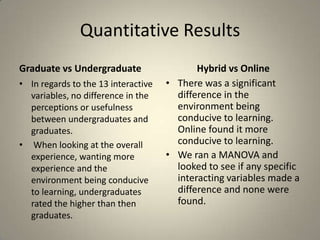
Quantitative ResultsGraduate vs UndergraduateIn regards to the 13 interactive variables, no difference in the perceptions or usefulness between undergraduates and graduates. When looking at the overall experience, wanting more experience and the environment being conducive to learning, undergraduates rated the higher than then graduates.Hybrid vs OnlineThere was a significant difference in the environment being conducive to learning. Online found it more conducive to learning. We ran a MANOVA and looked to see if any specific interacting variables made a difference and none were found.
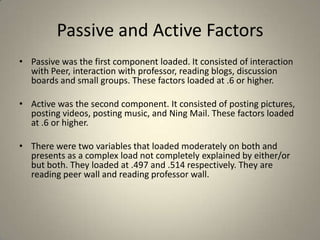
Passive and Active FactorsPassive was the first component loaded. It consisted of interaction with Peer, interaction with professor, reading blogs, discussion boards and small groups. These factors loaded at .6 or higher.Active was the second component. It consisted of posting pictures, posting videos, posting music, and Ning Mail. These factors loaded at .6 or higher.There were two variables that loaded moderately on both and presents as a complex load not completely explained by either/or but both. They loaded at .497 and .514 respectively. They are reading peer wall and reading professor wall.
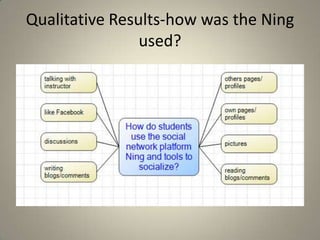
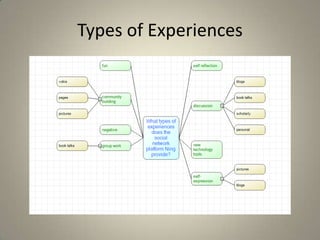
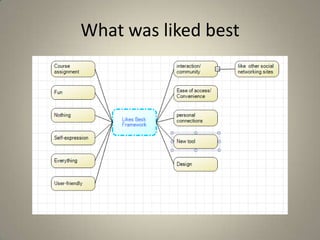
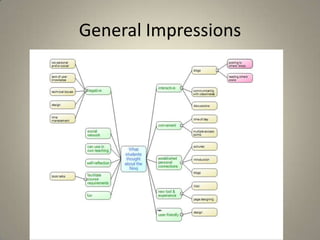
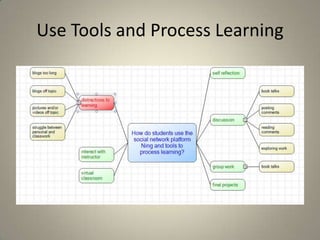
Qualitative Results-how was the Ning used?
Types of Experiences
What was liked best
General Impressions
Use Tools and Process Learning
FindingsIf you liked one tool, you liked it all and was a positive learning experience, if you didn't it wasn't.The Passive and Active FactorsPassive may be the first component to load due to the nature of learning, first observing and then doing. The two factors common to both may be organized differently in use.
DiscussionOverall impressions?In light of your experiences on the Ning

Discussant project

  • 1.
    Using Social NetworkPlatforms for Teaching and Learning: Graduate and Undergraduate Student PerspectivesA mixed methods study
  • 2.
    Pre-readingIn order tofacilitate the discussion, please read the following 2 articles.Ophys, J. D., & Abbitt, J. T. (2009). Exploring the potential perceptions of social networking systems in university courses. Journal of Online Learning and Teaching, 5(4), 639-648. Gorsky, P., & Caspi, A.,(2005). A critical analysis of transactional distance theory. Quarterly Review of Distance Education, 6(1), 1-11.
  • 3.
    Literature ReviewParadigm shiftsPassiveto active learningFace to face to onlineSeparation of personal and academicLearningsocial comfort social presence teacher presence respectinfluence
  • 4.
    Current StudyIn graduateand undergraduate coursesHybrid and onlineParticipants176 students 107 undergraduates and 69 graduate students 98 hybrid and 78 online students during the 2008-2009 semesters. InstrumentationOnline survey consisted of 3 parts: demographic data, feedback about the Ning and experiences and a critical reflection sectionContinuing to add data
  • 5.
    13 Interaction Variables+ 3 OthersInteraction with peersInteraction with professorViewing peers’ wallsViewing instructor wallReading blogsWatching videosPosting picturesPosting videosPosting musicPosting commentsDiscussion boardsSmall groupsNing mail3 Other VariablesConducive to learnprior experienceOverall experience
  • 6.
    Quantitative ResultsDiscriminant analysisdiscussionboard, professor wall and interaction with the professor Regressions conducive to the learning- discussion boards, posting comments and interaction with the professor. CorrelationsFactor analysis with oblique rotationsA general interactive factor emerged with additional 2 factorsActive and passive one-way ANOVAsMANOVAsAll 13 variables loaded onto one interaction variable.
  • 7.
    Quantitative ResultsGraduate vsUndergraduateIn regards to the 13 interactive variables, no difference in the perceptions or usefulness between undergraduates and graduates. When looking at the overall experience, wanting more experience and the environment being conducive to learning, undergraduates rated the higher than then graduates.Hybrid vs OnlineThere was a significant difference in the environment being conducive to learning. Online found it more conducive to learning. We ran a MANOVA and looked to see if any specific interacting variables made a difference and none were found.
  • 8.
    Passive and ActiveFactorsPassive was the first component loaded. It consisted of interaction with Peer, interaction with professor, reading blogs, discussion boards and small groups. These factors loaded at .6 or higher.Active was the second component. It consisted of posting pictures, posting videos, posting music, and Ning Mail. These factors loaded at .6 or higher.There were two variables that loaded moderately on both and presents as a complex load not completely explained by either/or but both. They loaded at .497 and .514 respectively. They are reading peer wall and reading professor wall.
  • 9.
  • 10.
  • 11.
  • 12.
  • 13.
    Use Tools andProcess Learning
  • 14.
    FindingsIf you likedone tool, you liked it all and was a positive learning experience, if you didn't it wasn't.The Passive and Active FactorsPassive may be the first component to load due to the nature of learning, first observing and then doing. The two factors common to both may be organized differently in use.
  • 15.
    DiscussionOverall impressions?In lightof your experiences on the Ning