• Great Britain, USA, USSR – Allies
– Protect oil of the Middle East from Nazis
– “oil is the lifeblood of the armies of WWII”
• 1940 – 63% of world’s oil from the USA only 5% from
ME
• Why would the USA want to preserve their oil and use
the oil in the Middle East in the future?
– Increased importance of Saudi Arabia
• 20% of the world’s oils reserves are in SA
World War II – 1939-1945
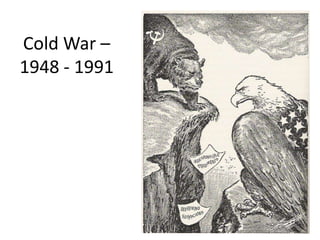
Cold War –
1948 - 1991
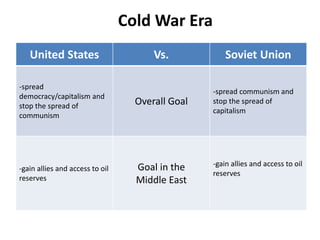
Cold War Era
Cold War 1948 – 1991
United States Vs. Soviet Union
-spread
democracy/capitalism and
stop the spread of
communism
Overall Goal
-spread communism and
stop the spread of
capitalism
-gain allies and access to oil
reserves
Goal in the
Middle East
-gain allies and access to oil
reserves
Cold War Era
• Countries that recently gained independence
were feared to side with Soviet Union
– Iran
• Elected Prime Minister (Mossadegh) in 1951
• Nationalized oil
• Legitimate fear or ‘excuse’ to get involved?
1953 Iranian Coup
• Britain & US CIA involvement
– Embargo on trade caused economic troubles
– “Operation Ajax”
• False reports were planted in newspapers
• Violence occurred in the streets of Iran
• Shah overthrew Mossadegh
– Received aid & military arms from US & Britain
Shah’s Rule of Iran
• Contradictory?
– Liked many aspects of “modernism”
• Supported women’s rights
• Claimed to redistribute land from wealthy to farmers
• Receptive to Western policy ideas
– Very authoritarian
• Islamic clergy’s power slowly taken away
• Created a one-party system
• Corruption
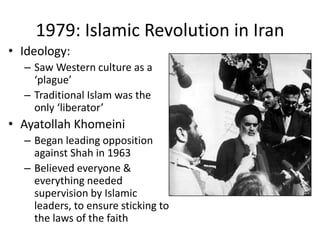
1979: Islamic Revolution in Iran
• Ideology:
– Saw Western culture as a
‘plague’
– Traditional Islam was the
only ‘liberator’
• Ayatollah Khomeini
– Began leading opposition
against Shah in 1963
– Believed everyone &
everything needed
supervision by Islamic
leaders, to ensure sticking to
the laws of the faith
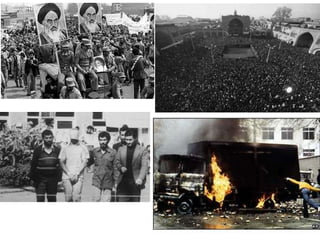
First Televised Revolution
• http://www.youtube.com/watch?v=oDeaOOm
fxZ8
Islamic Revolution: Groups Involved
• Political Groups
– Marxist
• Focused on social-class issues
• Islamic Groups
– Followers of Khomeini
• Focused on cultural issues
Results of Revolution
• Ties between Iran & West completely severed
– Shah’s Westernization reversed
• Women were ordered to wear head coverings and full
body cloaks
• gangs of religious zealots roamed the streets enforcing
new laws
– Ayatollah rule not what was expected
Results of Revolution
• Some revolutionaries now seen as enemies
– Even people who supported the revolution but not
Kohmeini were imprisoned, beaten & killed
• Shah & wife left Iran in January, 1979
• October 1979: Shah comes to US for cancer treatment
– Hostage situation, lead by student group
– Failed rescue attempt killed 8 Americans
– Shah died in July 1980, hostages not released until January
1981
– http://www.youtube.com/watch?v=A8bC1DEYbI4
– http://www.youtube.com/watch?v=b9COJXrrHHQ
– http://www.youtube.com/watch?v=Ld2KOv_zWWw
Hostage Situation
• What would you have done?!
– If you were the President of the U.S. during the
hostage crisis, what would you do?
• What are the options?
Iran-Iraq War
• 1980: Iran-Iraq war begins
– Iraq attacks Iran
– WHY?
Iraq
• Attacked Iran to prevent being attacked
– Weak after revolution
– Shia leader of Iran made Hussein nervous
• Lead by Saddam Hussein
– Militaristic dictator
– 65% of population: Shia
– 32% of population: Sunni
• Including Saddam Hussein
• Openly oppressed Shia
Iran-Iraq War
• Who did the US support?
– Why?
• War lasted 8 years (Sept. 1980- July 1988)
– Over 1 million casualties, cost $500 million for each
country, neither side claimed victory
Impact of War on Iran
• What did the Persepolis video tell us about
the war’s impact on Iranian society?
– Air strikes
– Strict laws
– Food shortages
Impact of War on Iraq
• Increased ‘personality cult’ of Hussein
• Civilian rations
• Terror campaign
– Fear people into supporting, fighting well
– 300 Iraqi army officers killed for ‘poor
performance’ in battle
– Use of force against Kurds in northern Iraq
• Chemical weapon use, 1988
• US response?
Iraq
• 1990: Hussein accused Kuwait of taking oil that
belonged to Iraq
– Iraqi army invades Kuwait
• US & International forces fight back
– Operation Desert Storm, January 1991
– Defeated Iraqi forces, cease-fire declared in February
Results of Persian Gulf War
• Iraqi government remained
– UN imposed economic sanctions, limiting sale of
oil, created no-fly zones
– UN conducted regular inspections to prevent
production of nuclear, chemical, and biological
weapons
U.S. Relations in Middle East
• Kuwait, Saudi Arabia, & others felt US
presence was necessary for protection
– 15,000 US troops stayed
• Reminder to Arab world of weaknesses
• Angered a lot of people in Middle East
U.S. Relations in Middle East
• March 2003: Iraq Invasion
– Operation Iraqi Freedom
• Bush administration believed Hussein had WMD and
would use it against U.S.
• Did everyone in U.S. support invasion?
– Hussein’s government toppled in weeks
• WMDs?
Who lead the attacks on 9/11?
• Al-Qaeda
• Osama Bin Laden
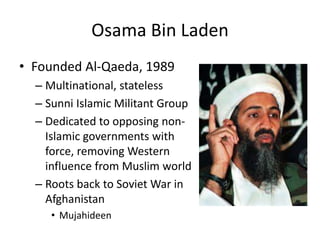
Osama Bin Laden
• Founded Al-Qaeda, 1989
– Multinational, stateless
– Sunni Islamic Militant Group
– Dedicated to opposing non-
Islamic governments with
force, removing Western
influence from Muslim world
– Roots back to Soviet War in
Afghanistan
• Mujahideen
Why Afghanistan?
• Taliban
– Islamic fundamentalist political group
– Ruled Afghanistan from 1996-2001
• Only recognized as legitimate political leader in Saudi
Arabia, Pakistan, and the United Arab Emirates
– After Bin Laden moved to Afghanistan in 1996,
groups became allies
• Al-Qaeda began training Taliban army forces
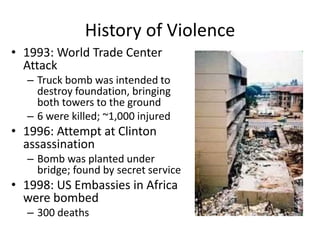
History of Violence
• 1993: World Trade Center
Attack
– Truck bomb was intended to
destroy foundation, bringing
both towers to the ground
– 6 were killed; ~1,000 injured
• 1996: Attempt at Clinton
assassination
– Bomb was planted under
bridge; found by secret service
• 1998: US Embassies in Africa
were bombed
– 300 deaths
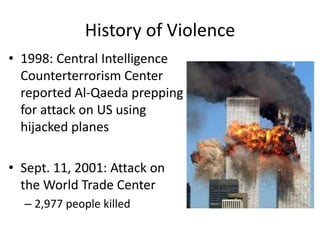
History of Violence
• 1998: Central Intelligence
Counterterrorism Center
reported Al-Qaeda prepping
for attack on US using
hijacked planes
• Sept. 11, 2001: Attack on
the World Trade Center
– 2,977 people killed
After 9/11
• October 2001: Invade Afghanistan
– Operation Enduring Freedom

Iran (1).pptx

  • 3.
    • Great Britain,USA, USSR – Allies – Protect oil of the Middle East from Nazis – “oil is the lifeblood of the armies of WWII” • 1940 – 63% of world’s oil from the USA only 5% from ME • Why would the USA want to preserve their oil and use the oil in the Middle East in the future? – Increased importance of Saudi Arabia • 20% of the world’s oils reserves are in SA World War II – 1939-1945
  • 4.
  • 5.
    Cold War Era ColdWar 1948 – 1991 United States Vs. Soviet Union -spread democracy/capitalism and stop the spread of communism Overall Goal -spread communism and stop the spread of capitalism -gain allies and access to oil reserves Goal in the Middle East -gain allies and access to oil reserves
  • 6.
    Cold War Era •Countries that recently gained independence were feared to side with Soviet Union – Iran • Elected Prime Minister (Mossadegh) in 1951 • Nationalized oil • Legitimate fear or ‘excuse’ to get involved?
  • 7.
    1953 Iranian Coup •Britain & US CIA involvement – Embargo on trade caused economic troubles – “Operation Ajax” • False reports were planted in newspapers • Violence occurred in the streets of Iran • Shah overthrew Mossadegh – Received aid & military arms from US & Britain
  • 8.
    Shah’s Rule ofIran • Contradictory? – Liked many aspects of “modernism” • Supported women’s rights • Claimed to redistribute land from wealthy to farmers • Receptive to Western policy ideas – Very authoritarian • Islamic clergy’s power slowly taken away • Created a one-party system • Corruption
  • 9.
    1979: Islamic Revolutionin Iran • Ideology: – Saw Western culture as a ‘plague’ – Traditional Islam was the only ‘liberator’ • Ayatollah Khomeini – Began leading opposition against Shah in 1963 – Believed everyone & everything needed supervision by Islamic leaders, to ensure sticking to the laws of the faith
  • 11.
    First Televised Revolution •http://www.youtube.com/watch?v=oDeaOOm fxZ8
  • 12.
    Islamic Revolution: GroupsInvolved • Political Groups – Marxist • Focused on social-class issues • Islamic Groups – Followers of Khomeini • Focused on cultural issues
  • 13.
    Results of Revolution •Ties between Iran & West completely severed – Shah’s Westernization reversed • Women were ordered to wear head coverings and full body cloaks • gangs of religious zealots roamed the streets enforcing new laws – Ayatollah rule not what was expected
  • 14.
    Results of Revolution •Some revolutionaries now seen as enemies – Even people who supported the revolution but not Kohmeini were imprisoned, beaten & killed • Shah & wife left Iran in January, 1979 • October 1979: Shah comes to US for cancer treatment – Hostage situation, lead by student group – Failed rescue attempt killed 8 Americans – Shah died in July 1980, hostages not released until January 1981 – http://www.youtube.com/watch?v=A8bC1DEYbI4 – http://www.youtube.com/watch?v=b9COJXrrHHQ – http://www.youtube.com/watch?v=Ld2KOv_zWWw
  • 15.
    Hostage Situation • Whatwould you have done?! – If you were the President of the U.S. during the hostage crisis, what would you do? • What are the options?
  • 16.
    Iran-Iraq War • 1980:Iran-Iraq war begins – Iraq attacks Iran – WHY?
  • 17.
    Iraq • Attacked Iranto prevent being attacked – Weak after revolution – Shia leader of Iran made Hussein nervous • Lead by Saddam Hussein – Militaristic dictator – 65% of population: Shia – 32% of population: Sunni • Including Saddam Hussein • Openly oppressed Shia
  • 18.
    Iran-Iraq War • Whodid the US support? – Why? • War lasted 8 years (Sept. 1980- July 1988) – Over 1 million casualties, cost $500 million for each country, neither side claimed victory
  • 19.
    Impact of Waron Iran • What did the Persepolis video tell us about the war’s impact on Iranian society? – Air strikes – Strict laws – Food shortages
  • 20.
    Impact of Waron Iraq • Increased ‘personality cult’ of Hussein • Civilian rations • Terror campaign – Fear people into supporting, fighting well – 300 Iraqi army officers killed for ‘poor performance’ in battle – Use of force against Kurds in northern Iraq • Chemical weapon use, 1988 • US response?
  • 21.
    Iraq • 1990: Husseinaccused Kuwait of taking oil that belonged to Iraq – Iraqi army invades Kuwait • US & International forces fight back – Operation Desert Storm, January 1991 – Defeated Iraqi forces, cease-fire declared in February
  • 22.
    Results of PersianGulf War • Iraqi government remained – UN imposed economic sanctions, limiting sale of oil, created no-fly zones – UN conducted regular inspections to prevent production of nuclear, chemical, and biological weapons
  • 23.
    U.S. Relations inMiddle East • Kuwait, Saudi Arabia, & others felt US presence was necessary for protection – 15,000 US troops stayed • Reminder to Arab world of weaknesses • Angered a lot of people in Middle East
  • 24.
    U.S. Relations inMiddle East • March 2003: Iraq Invasion – Operation Iraqi Freedom • Bush administration believed Hussein had WMD and would use it against U.S. • Did everyone in U.S. support invasion? – Hussein’s government toppled in weeks • WMDs?
  • 25.
    Who lead theattacks on 9/11? • Al-Qaeda • Osama Bin Laden
  • 26.
    Osama Bin Laden •Founded Al-Qaeda, 1989 – Multinational, stateless – Sunni Islamic Militant Group – Dedicated to opposing non- Islamic governments with force, removing Western influence from Muslim world – Roots back to Soviet War in Afghanistan • Mujahideen
  • 27.
    Why Afghanistan? • Taliban –Islamic fundamentalist political group – Ruled Afghanistan from 1996-2001 • Only recognized as legitimate political leader in Saudi Arabia, Pakistan, and the United Arab Emirates – After Bin Laden moved to Afghanistan in 1996, groups became allies • Al-Qaeda began training Taliban army forces
  • 28.
    History of Violence •1993: World Trade Center Attack – Truck bomb was intended to destroy foundation, bringing both towers to the ground – 6 were killed; ~1,000 injured • 1996: Attempt at Clinton assassination – Bomb was planted under bridge; found by secret service • 1998: US Embassies in Africa were bombed – 300 deaths
  • 29.
    History of Violence •1998: Central Intelligence Counterterrorism Center reported Al-Qaeda prepping for attack on US using hijacked planes • Sept. 11, 2001: Attack on the World Trade Center – 2,977 people killed
  • 30.
    After 9/11 • October2001: Invade Afghanistan – Operation Enduring Freedom