ROLE OF GREAT POWERS IN CENTRAL ASIA
Dr. Ibrahim Koncak
International Ataturk Alatoo University, Kyrgyzstan
OUTLINE
• Geopolitical Environment
• Major Powers’ engagement in Central Asia;
• Russia
• China
• United States
• India
• Policy Recommendations
Geopolitical Environment
• International and Regional establishment process with peculiarities
• There are two waves or levels of foundational processes going on
with probabilistic effects reaching far beyond the region.
• Firstly, internationally major powers; such as Russia, China, India are having
ebb and flow approach in their policies toward the region.
• Central Asia is NOT in the Center of foreign policy objectives of major powers.
• Too precious to leave aside, too early to hop in situation
• Not rivalry but rhetorical competition
• Nevertheless geopolitical structuring process is under way with small but sure
steps.
Geopolitical Environment
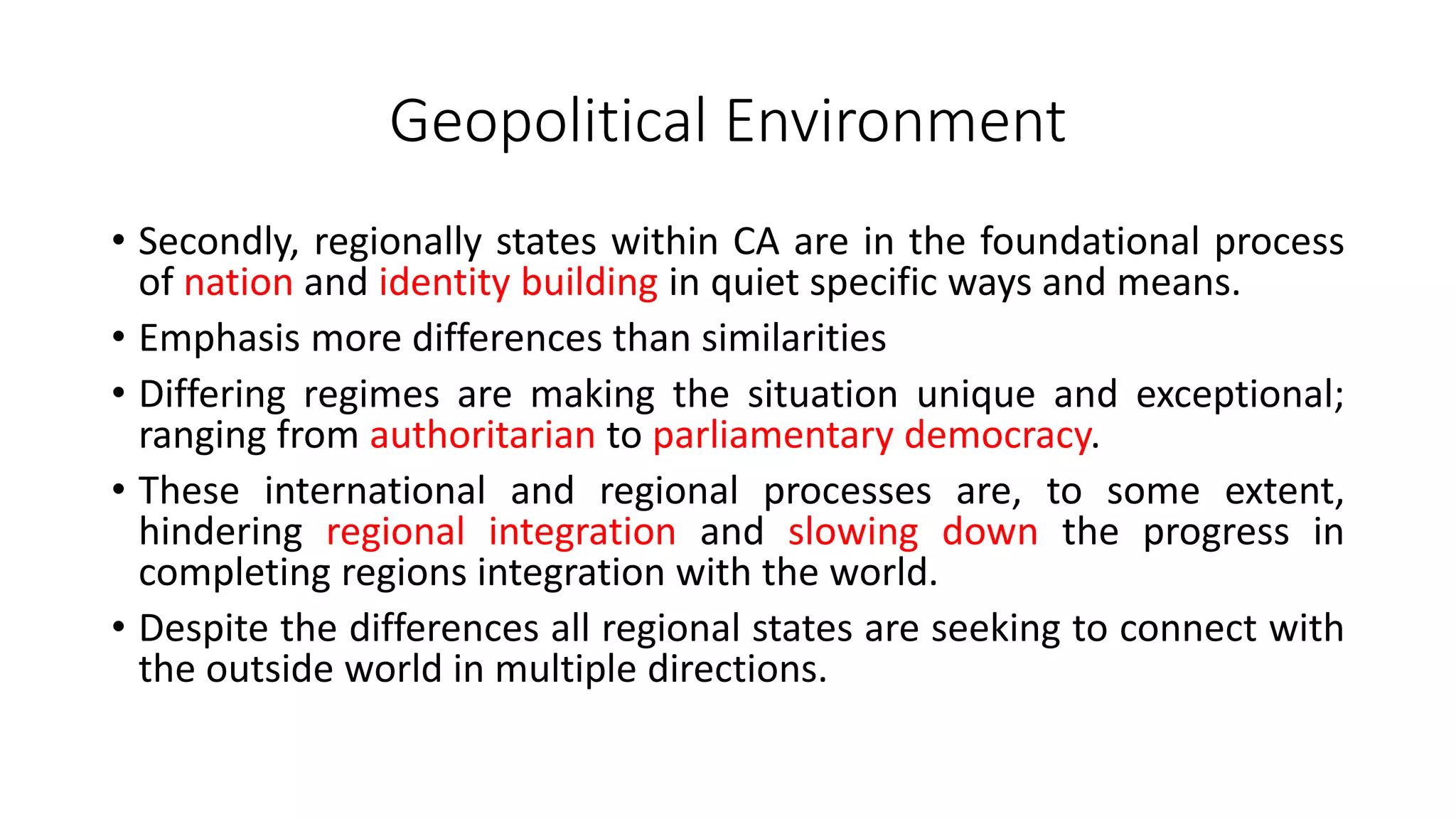
• Secondly, regionally states within CA are in the foundational process
of nation and identity building in quiet specific ways and means.
• Emphasis more differences than similarities
• Differing regimes are making the situation unique and exceptional;
ranging from authoritarian to parliamentary democracy.
• These international and regional processes are, to some extent,
hindering regional integration and slowing down the progress in
completing regions integration with the world.
• Despite the differences all regional states are seeking to connect with
the outside world in multiple directions.
Great Power Engagement in CA
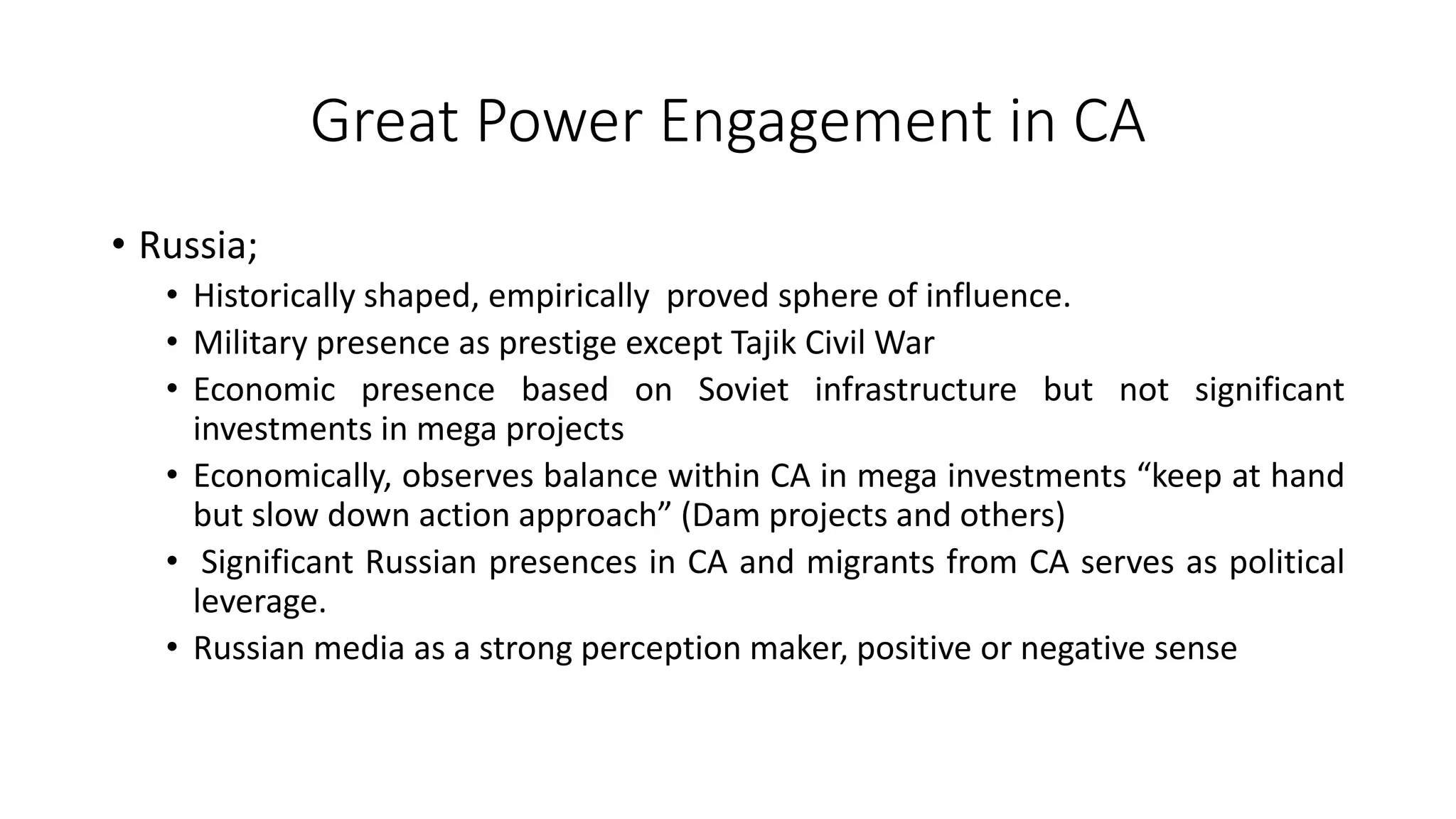
• Russia;
• Historically shaped, empirically proved sphere of influence.
• Military presence as prestige except Tajik Civil War
• Economic presence based on Soviet infrastructure but not significant
investments in mega projects
• Economically, observes balance within CA in mega investments “keep at hand
but slow down action approach” (Dam projects and others)
• Significant Russian presences in CA and migrants from CA serves as political
leverage.
• Russian media as a strong perception maker, positive or negative sense
Great Power Engagement in CA
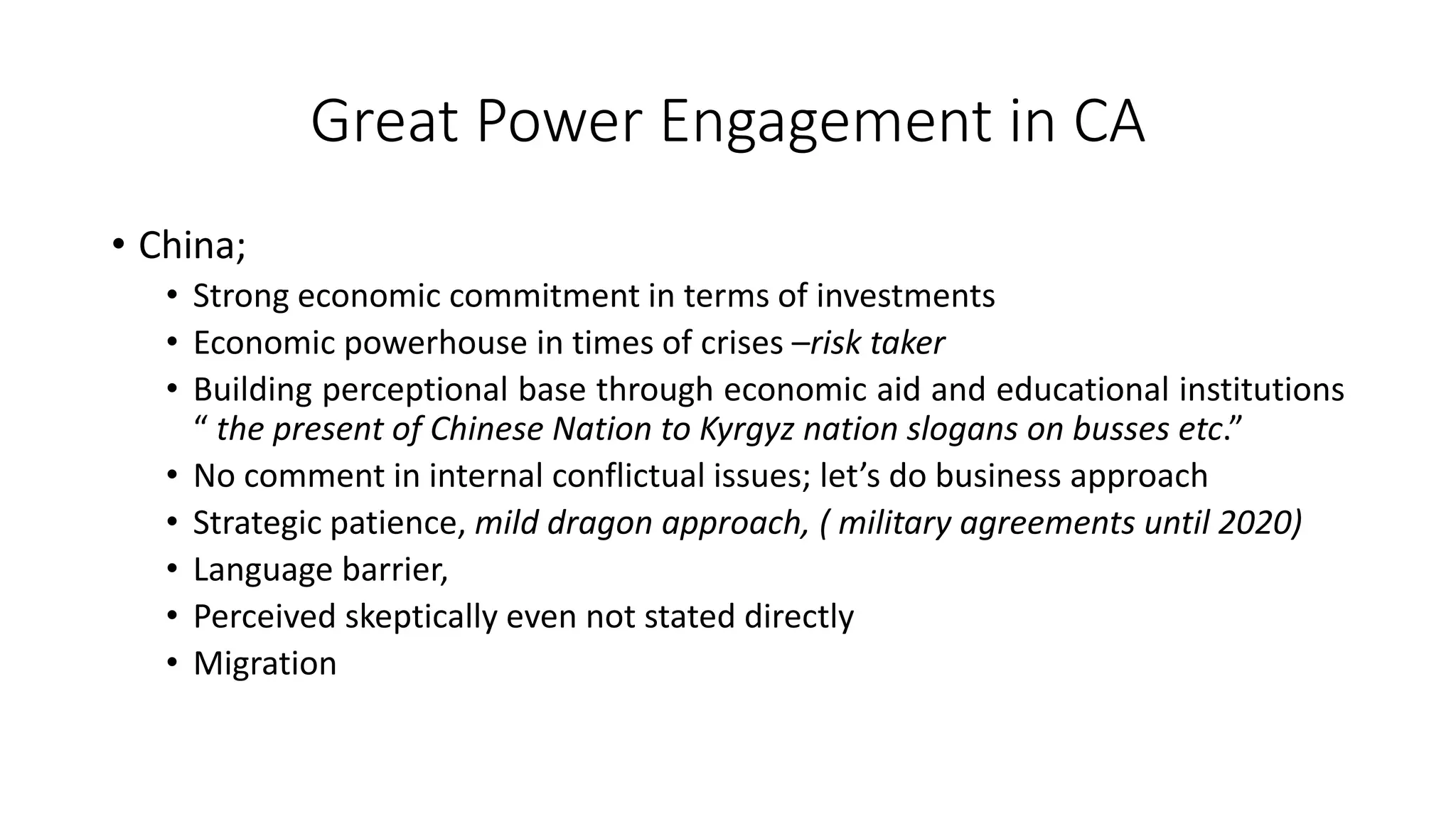
• China;
• Strong economic commitment in terms of investments
• Economic powerhouse in times of crises –risk taker
• Building perceptional base through economic aid and educational institutions
“ the present of Chinese Nation to Kyrgyz nation slogans on busses etc.”
• No comment in internal conflictual issues; let’s do business approach
• Strategic patience, mild dragon approach, ( military agreements until 2020)
• Language barrier,
• Perceived skeptically even not stated directly
• Migration
Great Power Engagement in CA
• United States;
• Afghanistan focused approach, less economic commitment
• Engage Central Asia through allies or friendly nations
• No security guarantee - not strong security commitment; too land locked to
reach, too risky to invest, too important to neglect limbo
• Far behind on perception building comparing Russia
• Lack of regional integration without Russia and China hinders US ambitions.
• There seems attempts in US circles to awaken the US interests towards the
region, but CA lacks attraction or has less attraction comparing with other
regions.
• US may support at least politically friendly nations engagement vis a vis China and
Russia
Great Power Engagement in CA
• India;
• Not sufficient engagement comparing the capacity
• Strong positive perception in cultural terms in CA
• Lack of transportation lines, mountain ranges, international pressure on
Iran, disputed relations with Pakistan hinders Indian engagement in Central
Asia
• Strategic to the point trade agreements; uranium purchasing and other
mineral buying agreements.
• TAPI project
• Connect Central Asia policy and recent high profile visit and implications
(243.000 total entry, 3530 news entry, 10400 video entry)
Great Power Engagement in CA
• Perception building through capacity building and trainings,
successful so far.
• India can be cooperative power in the region between outside as well
as internal states.
• Connect Central Asia policy may be a leverage in terms of economy
with her neighbors.
• India may build model partnership with Kyrgyzstan and other states in
CA and enhance it toward the wider region. ( Political experience to
become global)
Policy Recommendations
• Emphasizing more cooperation with other major powers than
competition.
• Encouraging more people to people diplomacy
• Implementing produce for Central Asia initiatives.
• More student and expert exchange may be useful to enhance
relations.
• Provide scholarships to students from India to Central Asia, from
Central Asia to India to study International Relations, Economics,
Sociology and other areas.
Thank you for your attention.

Role of great powers in central asia

  • 1.
    ROLE OF GREATPOWERS IN CENTRAL ASIA Dr. Ibrahim Koncak International Ataturk Alatoo University, Kyrgyzstan
  • 2.
    OUTLINE • Geopolitical Environment •Major Powers’ engagement in Central Asia; • Russia • China • United States • India • Policy Recommendations
  • 3.
    Geopolitical Environment • Internationaland Regional establishment process with peculiarities • There are two waves or levels of foundational processes going on with probabilistic effects reaching far beyond the region. • Firstly, internationally major powers; such as Russia, China, India are having ebb and flow approach in their policies toward the region. • Central Asia is NOT in the Center of foreign policy objectives of major powers. • Too precious to leave aside, too early to hop in situation • Not rivalry but rhetorical competition • Nevertheless geopolitical structuring process is under way with small but sure steps.
  • 4.
    Geopolitical Environment • Secondly,regionally states within CA are in the foundational process of nation and identity building in quiet specific ways and means. • Emphasis more differences than similarities • Differing regimes are making the situation unique and exceptional; ranging from authoritarian to parliamentary democracy. • These international and regional processes are, to some extent, hindering regional integration and slowing down the progress in completing regions integration with the world. • Despite the differences all regional states are seeking to connect with the outside world in multiple directions.
  • 5.
    Great Power Engagementin CA • Russia; • Historically shaped, empirically proved sphere of influence. • Military presence as prestige except Tajik Civil War • Economic presence based on Soviet infrastructure but not significant investments in mega projects • Economically, observes balance within CA in mega investments “keep at hand but slow down action approach” (Dam projects and others) • Significant Russian presences in CA and migrants from CA serves as political leverage. • Russian media as a strong perception maker, positive or negative sense
  • 6.
    Great Power Engagementin CA • China; • Strong economic commitment in terms of investments • Economic powerhouse in times of crises –risk taker • Building perceptional base through economic aid and educational institutions “ the present of Chinese Nation to Kyrgyz nation slogans on busses etc.” • No comment in internal conflictual issues; let’s do business approach • Strategic patience, mild dragon approach, ( military agreements until 2020) • Language barrier, • Perceived skeptically even not stated directly • Migration
  • 7.
    Great Power Engagementin CA • United States; • Afghanistan focused approach, less economic commitment • Engage Central Asia through allies or friendly nations • No security guarantee - not strong security commitment; too land locked to reach, too risky to invest, too important to neglect limbo • Far behind on perception building comparing Russia • Lack of regional integration without Russia and China hinders US ambitions. • There seems attempts in US circles to awaken the US interests towards the region, but CA lacks attraction or has less attraction comparing with other regions. • US may support at least politically friendly nations engagement vis a vis China and Russia
  • 8.
    Great Power Engagementin CA • India; • Not sufficient engagement comparing the capacity • Strong positive perception in cultural terms in CA • Lack of transportation lines, mountain ranges, international pressure on Iran, disputed relations with Pakistan hinders Indian engagement in Central Asia • Strategic to the point trade agreements; uranium purchasing and other mineral buying agreements. • TAPI project • Connect Central Asia policy and recent high profile visit and implications (243.000 total entry, 3530 news entry, 10400 video entry)
  • 9.
    Great Power Engagementin CA • Perception building through capacity building and trainings, successful so far. • India can be cooperative power in the region between outside as well as internal states. • Connect Central Asia policy may be a leverage in terms of economy with her neighbors. • India may build model partnership with Kyrgyzstan and other states in CA and enhance it toward the wider region. ( Political experience to become global)
  • 10.
    Policy Recommendations • Emphasizingmore cooperation with other major powers than competition. • Encouraging more people to people diplomacy • Implementing produce for Central Asia initiatives. • More student and expert exchange may be useful to enhance relations. • Provide scholarships to students from India to Central Asia, from Central Asia to India to study International Relations, Economics, Sociology and other areas.
  • 11.
    Thank you foryour attention.