The TTM-trials-why, how and what
NIKLAS NIELSEN, MD, PHD, A/PROF ZERMATT FEB 7TH 2019
Improving survival rates….
Swedish Cardiac Arrest Registry
Survivors after 1 month
www.HLR.nu
In 2010….
• Hypothermia established
• Guidelines were firm
• Everyone happy….
TTM-trial – 2010-2013
• 950 randomised to 33°or 36°C
• Out-of-hospital cardiac arrest
• Cardiac cause
• Europe and Australia
HACA-trial compared to TTM-trial
HACA-trial 2002
TTM-trial 2013
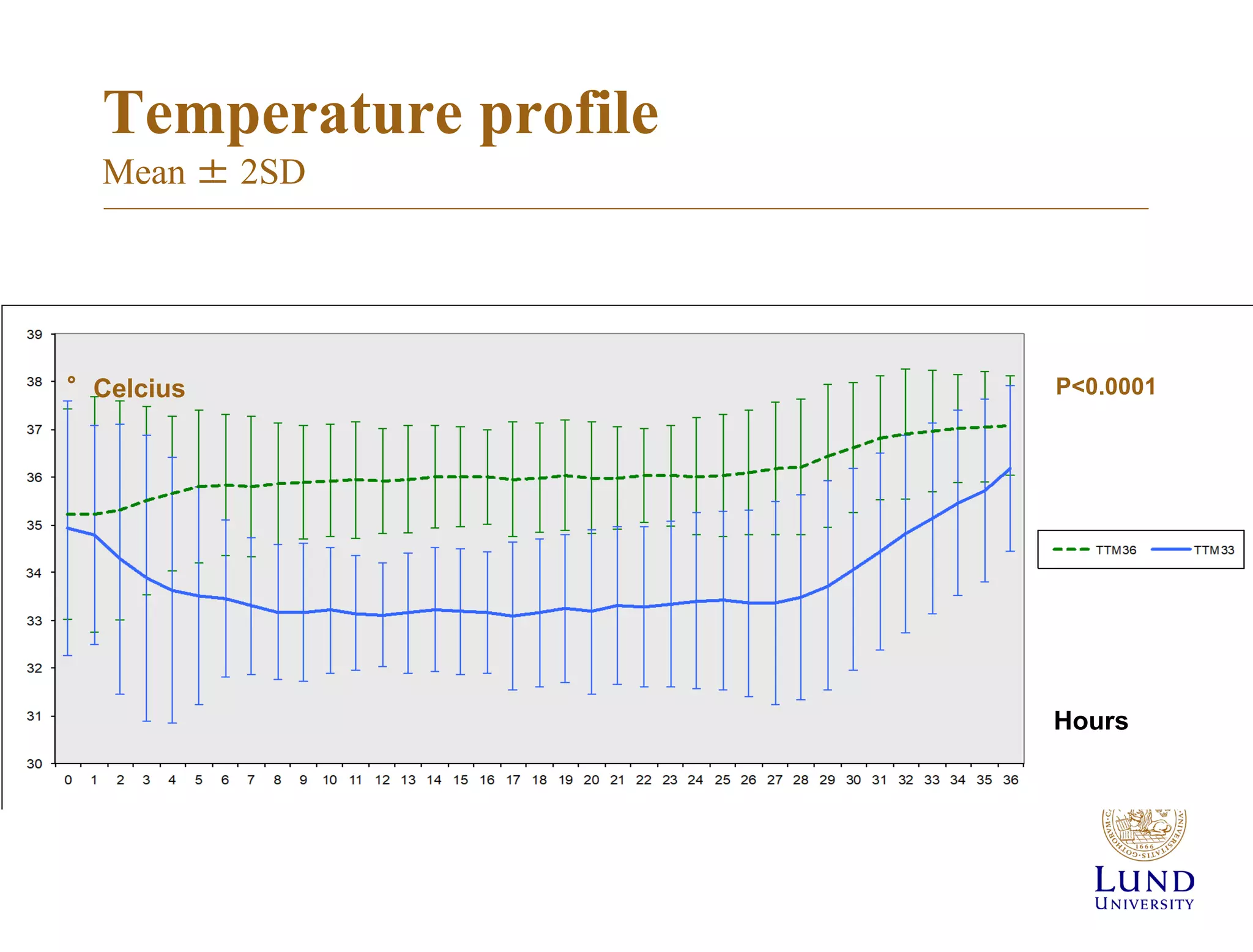
Temperature profile
Mean ± 2SD
P<0.0001
Hours
°Celcius
P=0.51
No difference in survival
HR=1.06 95% CI 0.89 to 1.28; P=0.51
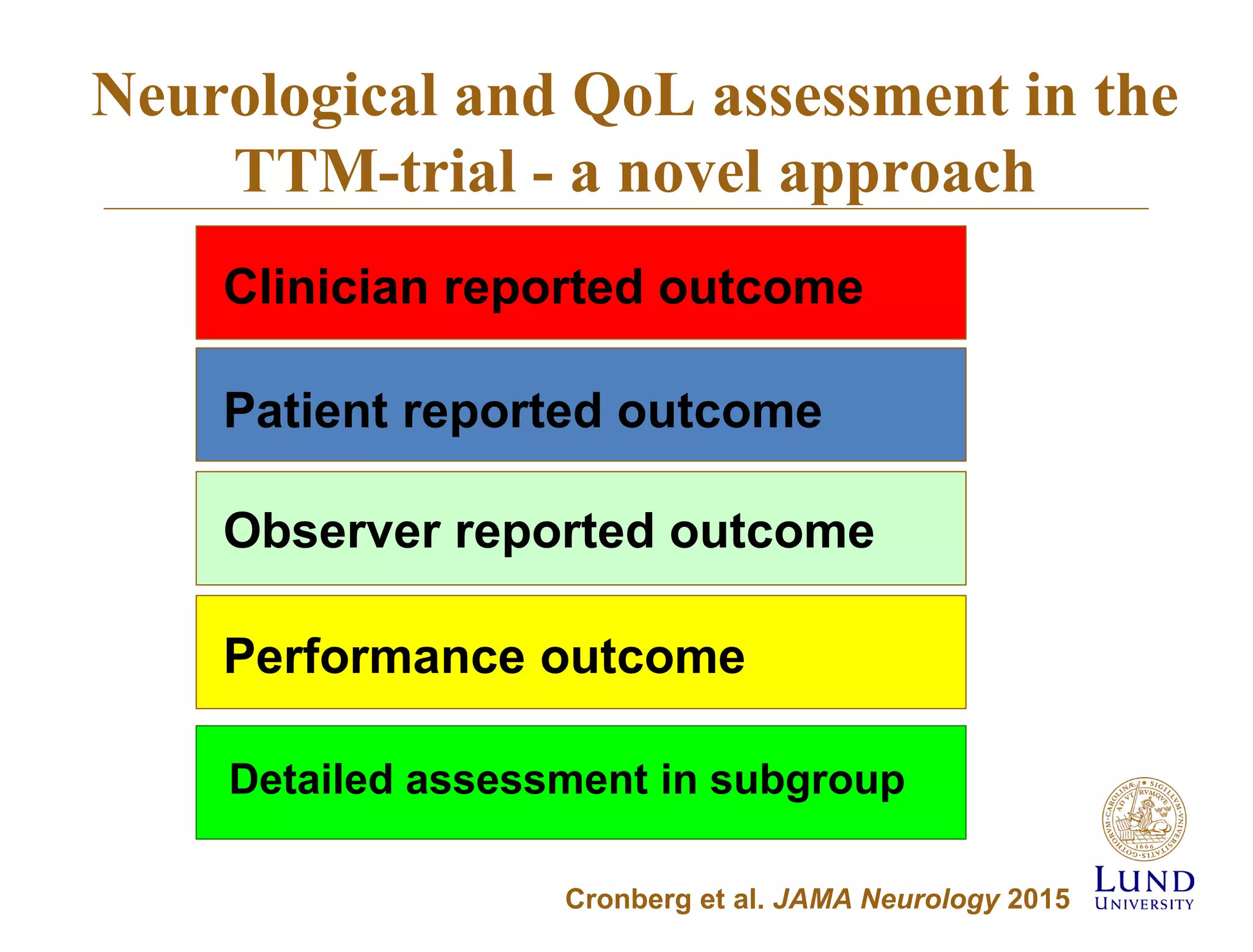
Neurological and QoL assessment in the
TTM-trial - a novel approach
Performance outcome
Clinician reported outcome
Patient reported outcome
Observer reported outcome
Cronberg et al. JAMA Neurology 2015
Detailed assessment in subgroup
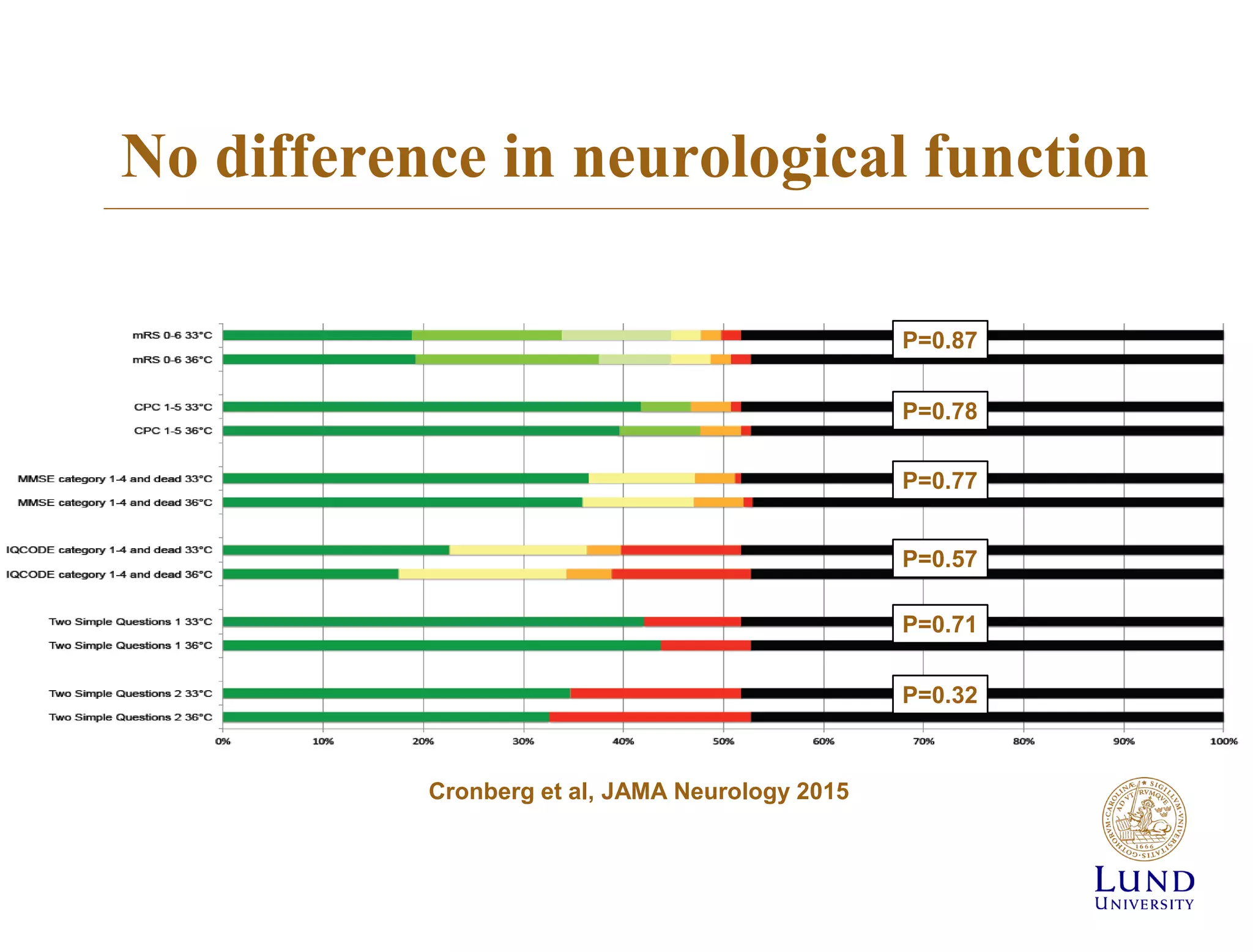
No difference in neurological function
Cronberg et al, JAMA Neurology 2015
P=0.77
P=0.57
P=0.71
P=0.32
P=0.78
P=0.87
….or quality of life!
P=0.45
P=0.79
Cronberg et al, JAMA Neurology 2015
Trial conclusion:
A target temperature of 33°C did not
confer any benefit compared to 36°C
No difference detected in any of
the sub or post hoc studies of
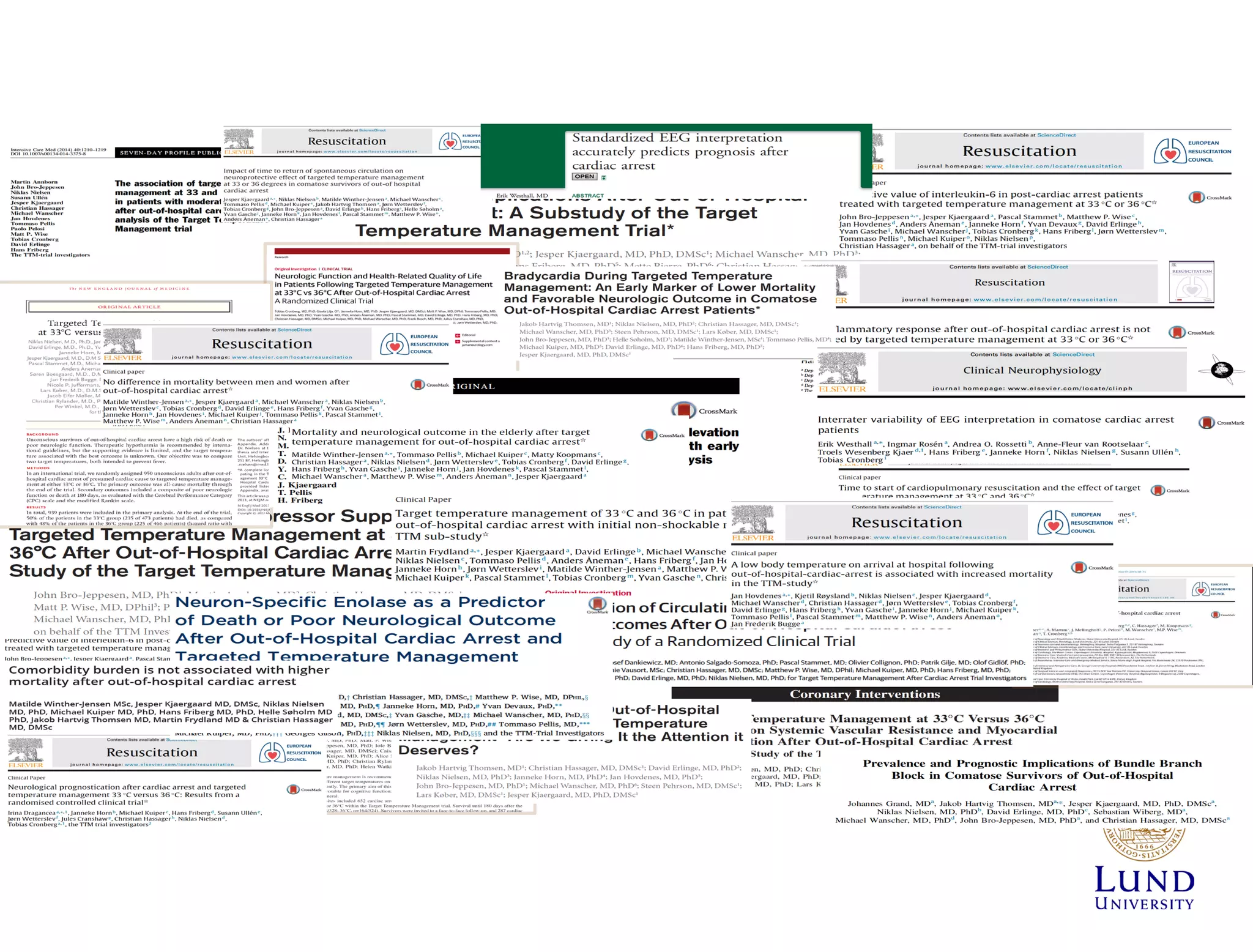
TTM!
48
49
43
23
21
35
29
36
14
19
16
12
13
6
7
10
8
7
7
49
46
0 20 40 60 80 100
STEMI-controls*
Cardiac arrest 36°C*
Cardiac arrest 33°C*
Cardiac arrest 36°C ALL
Cardiac arrest 33° ALL
Normal
Mild
Moderate
Severe
Dead
%
Figure 2. Categorical outcome for the Rivermead Behavioural Memory Test (RBMT)
Memory
Lilja et al. Circulation. 2015
87
80
77
39
38
13
20
23
15
13
46
49
0 20 40 60 80 100
STEMI-
controls*
Cardiac arrest
36°C*
Cardiac arrest
33°C*
Cardiac arrest
36°C ALL
Cardiac arrest
33° ALL
Normal
Impaired
Dead
%
Figure 3. Categorical outcome for the Frontal Assessment Battery (FAB)
Executive function
Lilja et al. Circulation. 2015
66
43
48
21
24
11
9
17
5
8
22
48
34
25
22
49
46
0 20 40 60 80 100
STEMI-controls*
Cardiac arrest 36°C*
Cardiac arrest 33°C*
Cardiac arrest 36°C ALL
Cardiac arrest 33°C ALL
Normal
Bordeline
Impaired
Dead
%
Figure 4. Categorical outcome for the Symbol Digit Modalities test (SDMT)
Attention/Processing speed
Lilja et al. Circulation. 2015
Was the trial representative?
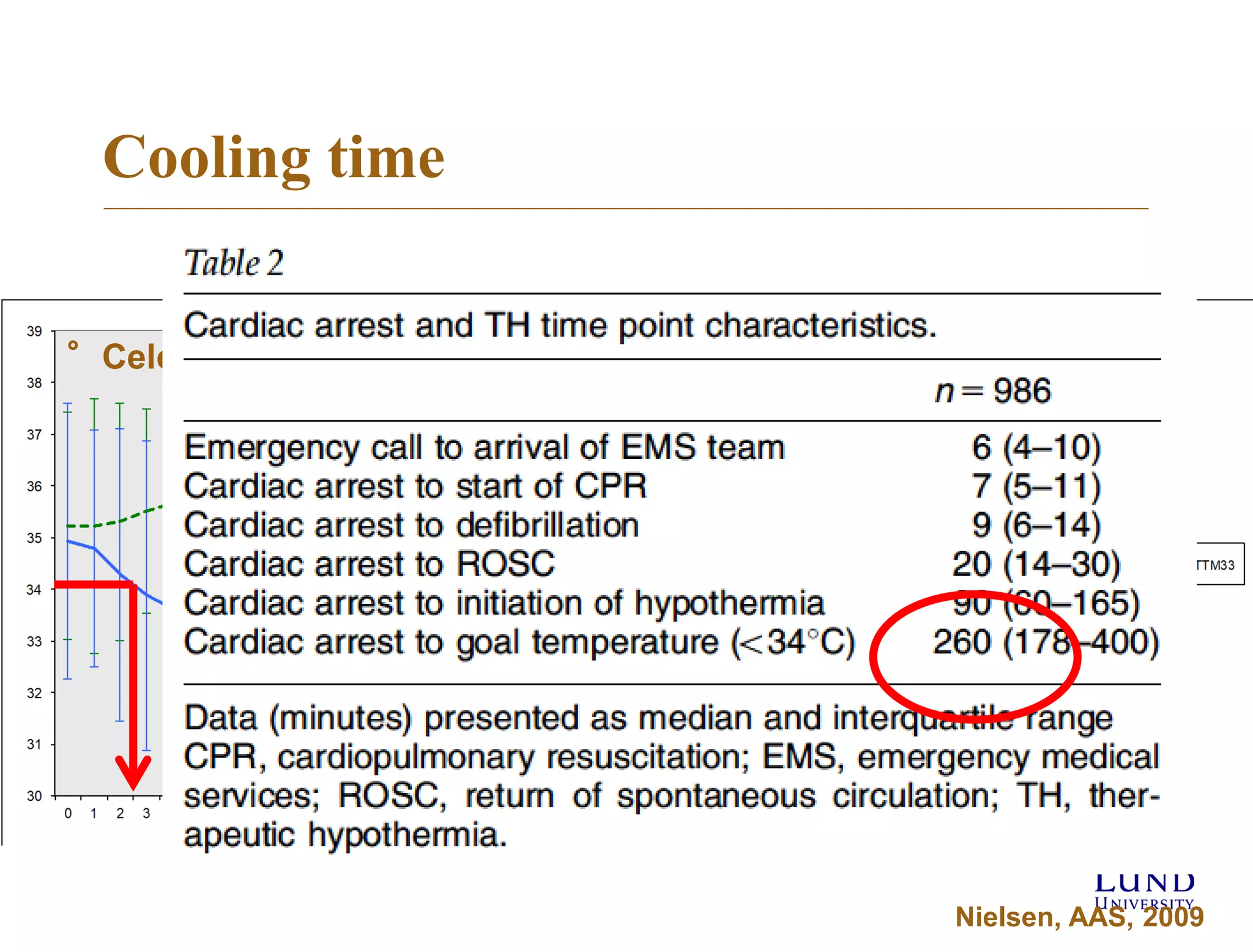
Cooling time
P<0.0001
Hours
°Celcius
Cooling time
P<0.0001
Hours
°Celcius
+130
150 min
Time To Target <34°C ≈ 280 min (4.5 hours)
Cooling time
P<0.0001
Hours
°Celcius
Nielsen, AAS, 2009
P<0.0001
Hours
°Celcius
Cooling time
Kirkegaard, JAMA, 2017
P<0.0001
Hours
°Celcius
Cooling time
Tömte, CCM, 2011
Temperature control
+/-2 SD
IQR
Temperature control
Median ± IQR
Severity of illness
• 25 minutes to ROSC
• Lactate 6.7 mmol/L
• All patients unconscious (median GCS 3)
• Overall mortality 50%
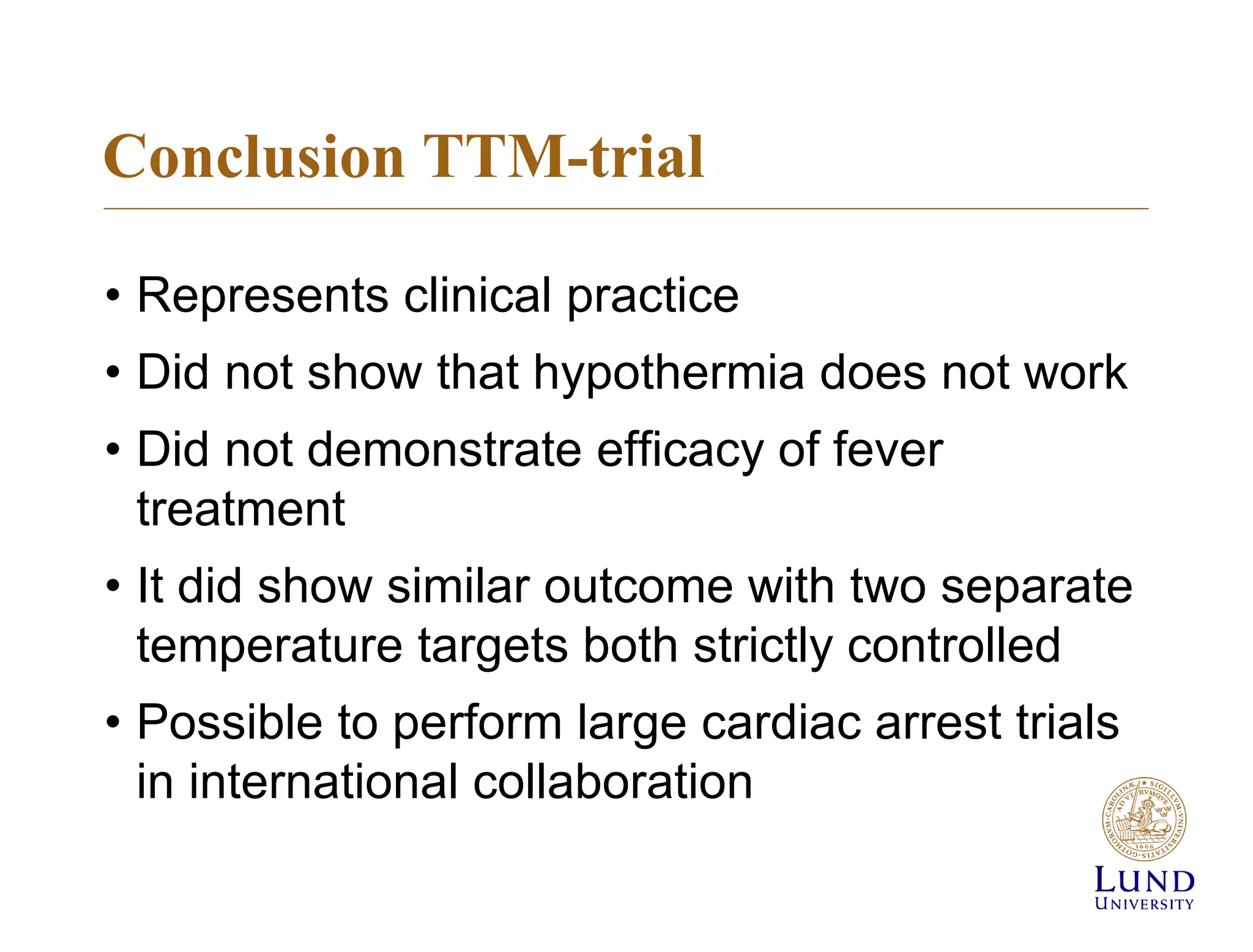
Conclusion TTM-trial
• Represents clinical practice
• Did not show that hypothermia does not work
• Did not demonstrate efficacy of fever
treatment
• It did show similar outcome with two separate
temperature targets both strictly controlled
• Possible to perform large cardiac arrest trials
in international collaboration
Nolan J et al. Resuscitation 2015
Nolan J et al. Intensive Care Med 2015
2015 ERC/ESICM guidelines
Nolan J et al. Resuscitation 2015
Nolan J et al. Intensive Care Med 2015
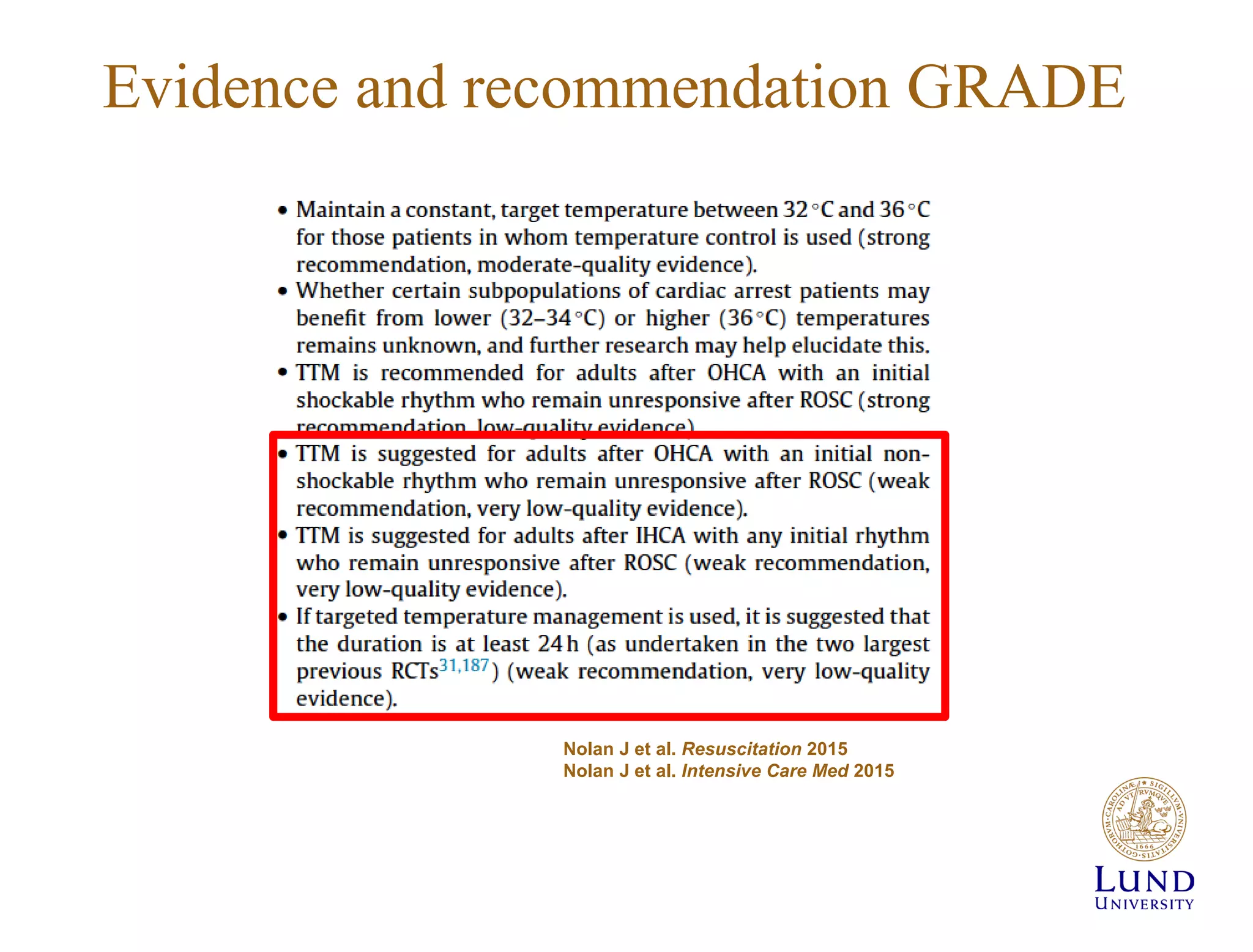
Evidence and recommendation GRADE
Nolan J et al. Resuscitation 2015
Nolan J et al. Intensive Care Med 2015
Evidence and recommendation GRADE
Nolan J et al. Resuscitation 2015
Nolan J et al. Intensive Care Med 2015
Evidence and recommendation GRADE
Nothing
36°C
35°
34°33°C or lower
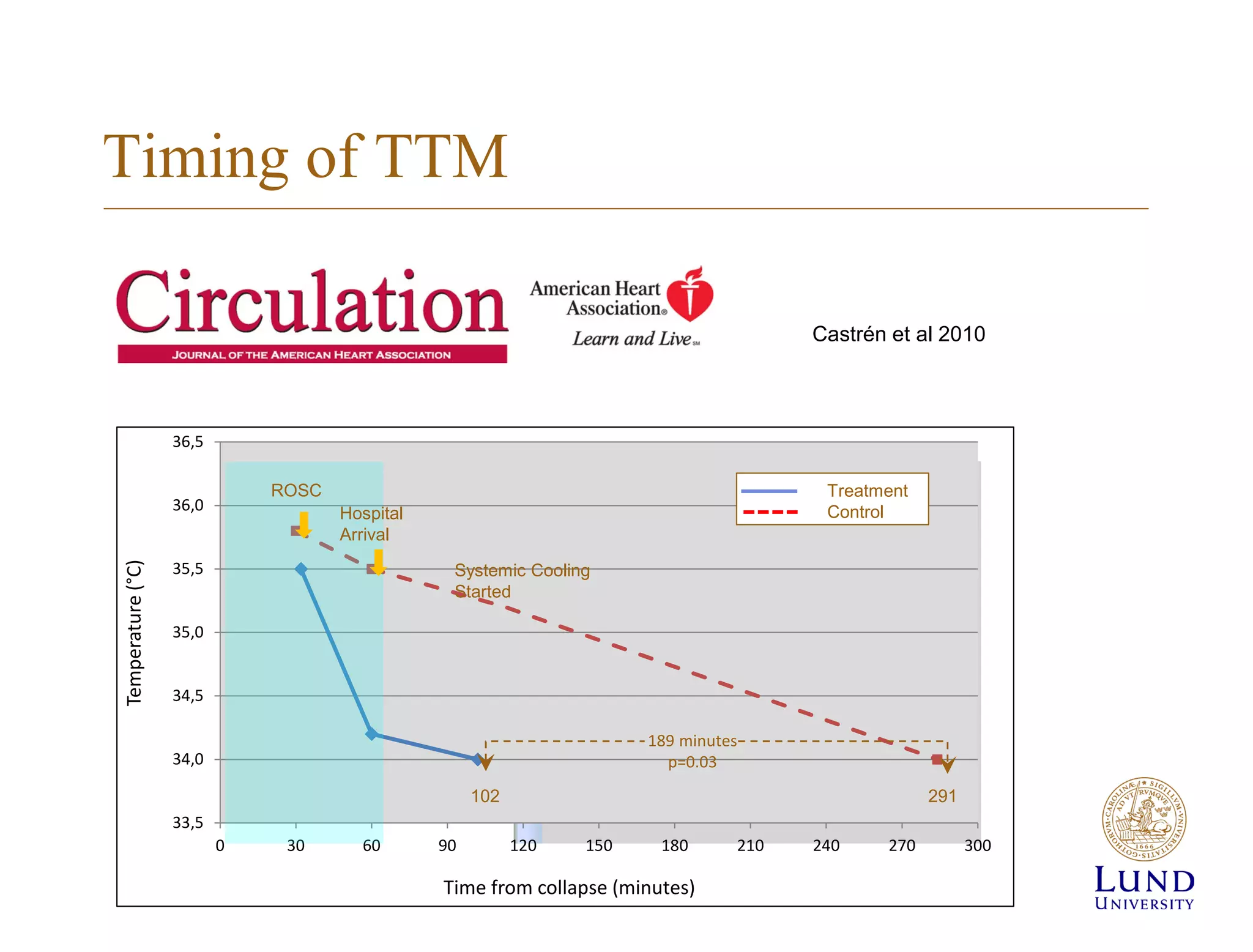
Timing of TTM
• PRINCE trial
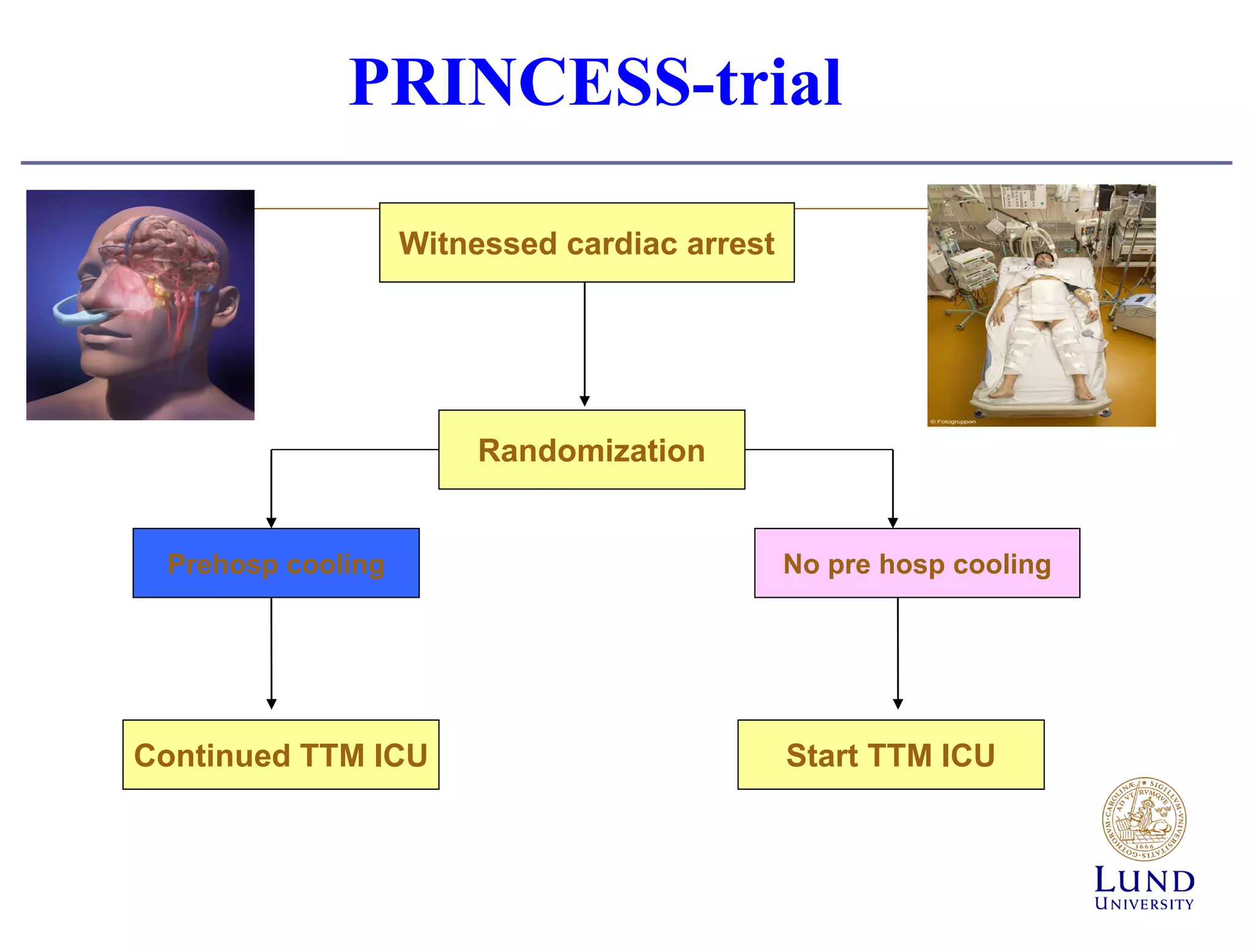
• PRINCESS trial
• Kim-trial
• Bernard-trials
Timing of TTM
33,5
34,0
34,5
35,0
35,5
36,0
36,5
0 30 60 90 120 150 180 210 240 270 300
Temperature(°C)
Time from collapse (minutes)
ROSC
Hospital
Arrival
Systemic Cooling
Started
291102
189 minutes
p=0.03
Treatment
Control
Castrén et al 2010
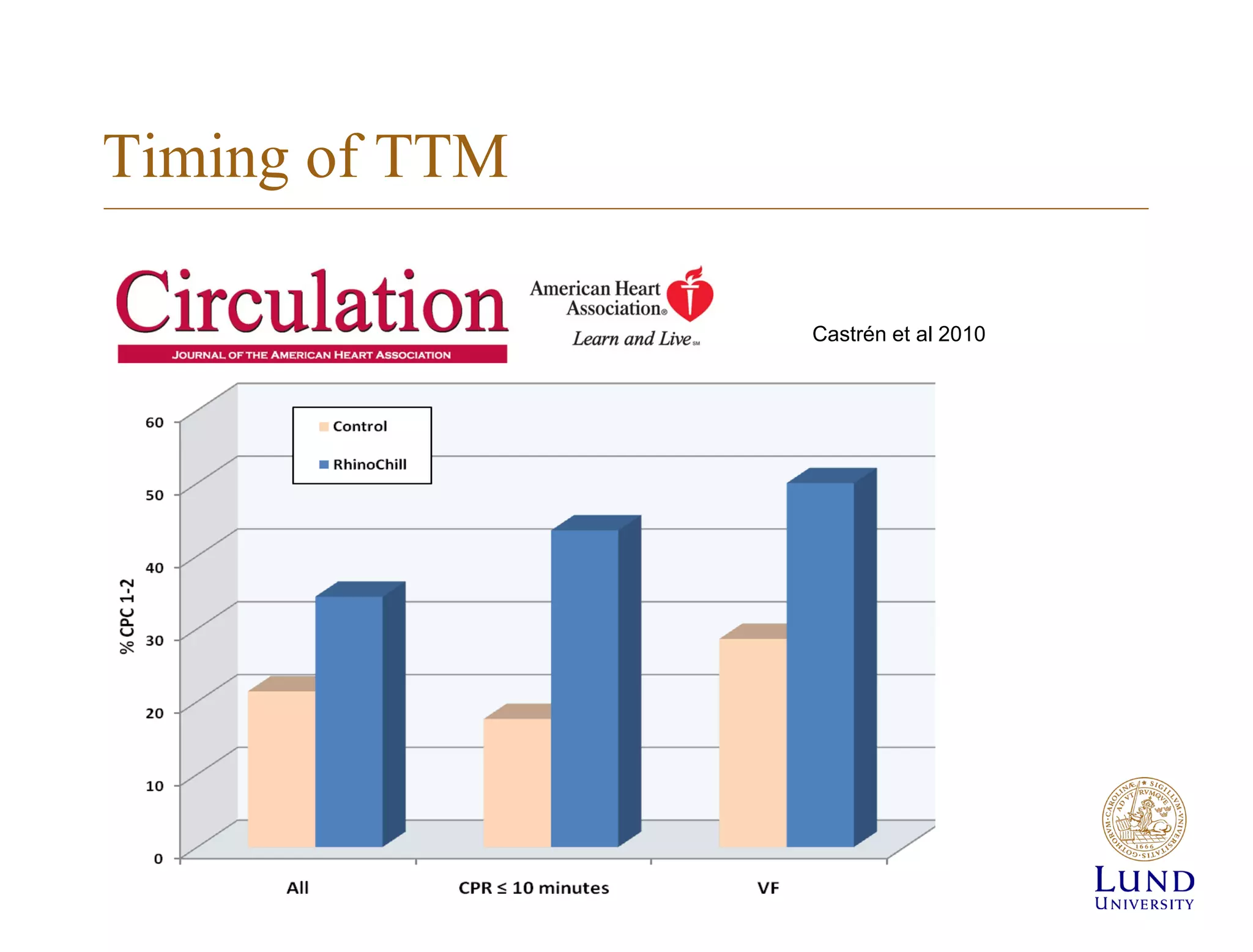
Timing of TTM
Castrén et al 2010
Witnessed cardiac arrest
Randomization
No pre hosp coolingPrehosp cooling
Continued TTM ICU Start TTM ICU
PRINCESS-trial
Duration of TTM
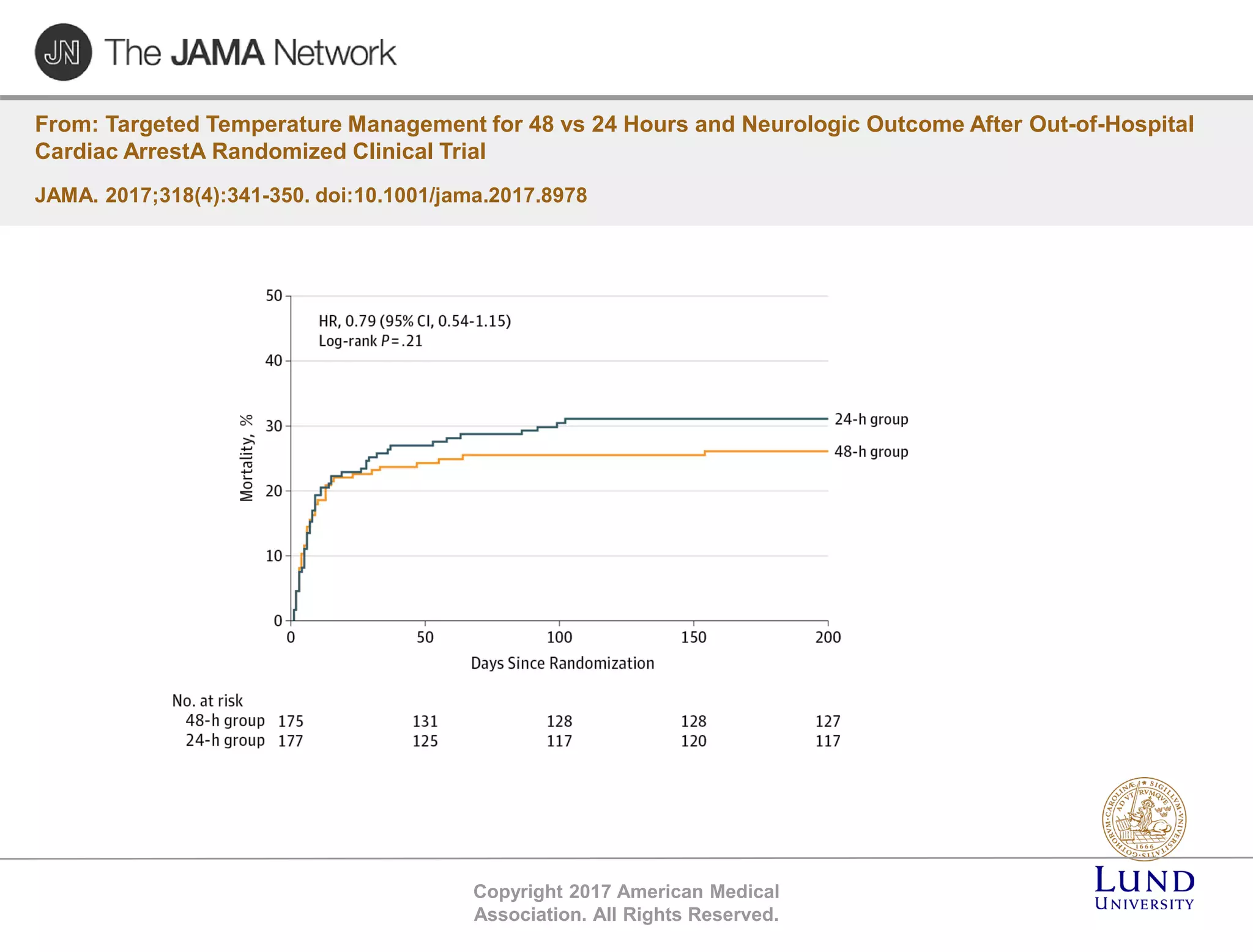
• TTH48 trial comparing 24 versus 48 hours of cooling
From: Targeted Temperature Management for 48 vs 24 Hours and Neurologic Outcome After Out-of-Hospital
Cardiac ArrestA Randomized Clinical Trial
JAMA. 2017;318(4):341-350. doi:10.1001/jama.2017.8978
Copyright 2017 American Medical
Association. All Rights Reserved.
Copyright 2017 American Medical
Association. All Rights Reserved.
From: Targeted Temperature Management for 48 vs 24 Hours and Neurologic Outcome After Out-of-Hospital
Cardiac ArrestA Randomized Clinical Trial
JAMA. 2017;318(4):341-350. doi:10.1001/jama.2017.8978
Hypothermia or early treatment of fever
Targeted hypothermia versus targeted
normothermia after out-of-hospital cardiac
arrest
-the TTM2-trial
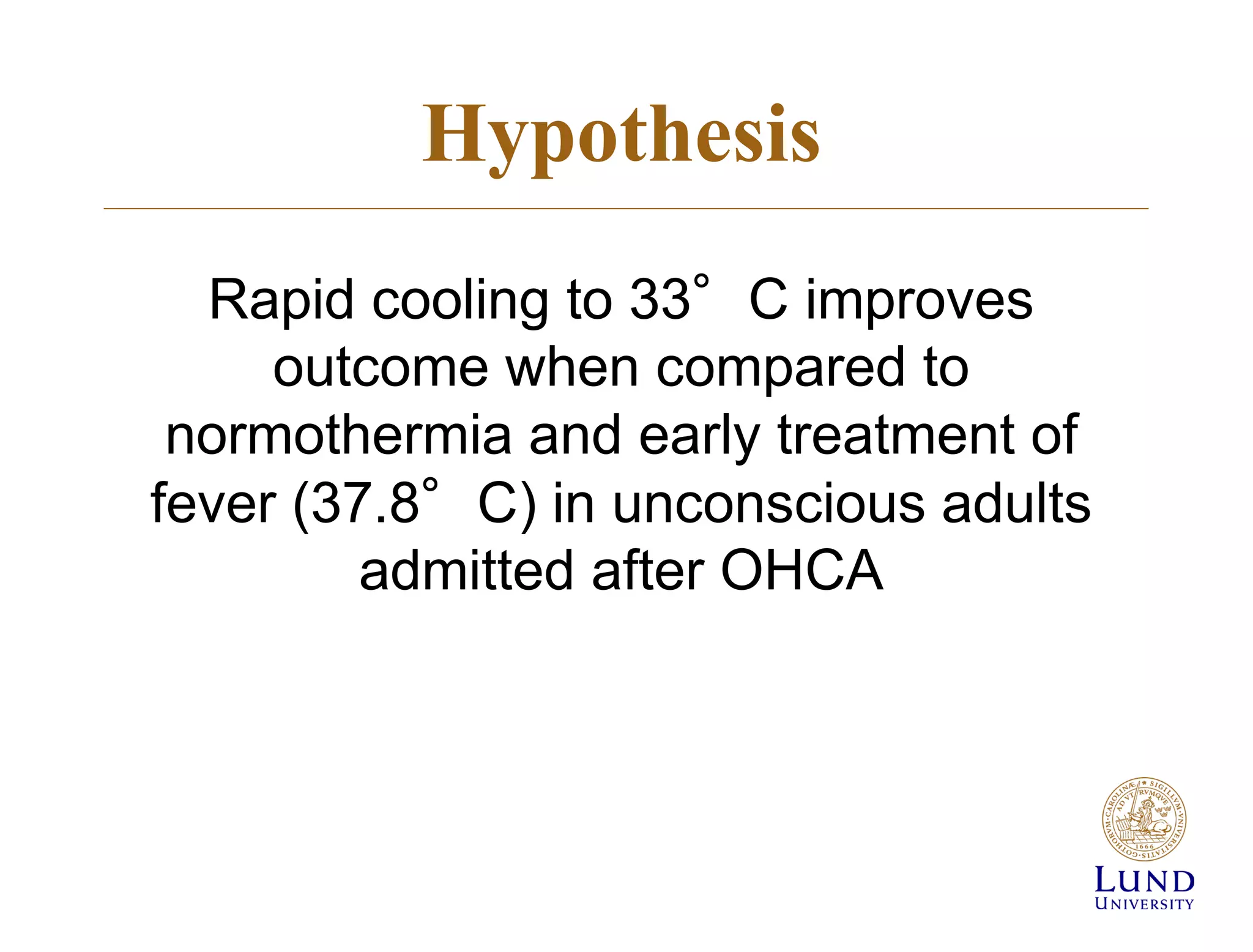
Hypothesis
Rapid cooling to 33°C improves
outcome when compared to
normothermia and early treatment of
fever (37.8°C) in unconscious adults
admitted after OHCA
Mackowiak 1992 – 148 individuals
Mackowiak 1992
”The upper limit of normal
body temperature is 37.7°C”
Obermeyer 2017 – 35000 individuals
Obermeyer 2017
”The upper limit of normal
body temperature is 37.7°C”
OHCA
33°C <37.8°C
Full organ support minimum 96 h
Neurological prognostication
Continued care discretion of caregivers
40hours
Inclusion criteria
1. Adult
2. Comatose out of hospital cardiac arrest, presumed
cardiac cause
3. Sustained ROSC
4. Eligible for intensive care admission without
restriction or limitations
5. Within 3 hours from ROSC
Exclusion criteria
1. Unwitnessed cardiac arrest with initial rhythm
asystole
2. Temperature at admission <30°C
3. On ECMO prior to ROSC
4. Obvious or suspected pregnancy
5. Intracranial bleeding
6. On home oxygen
Trial flow
• 1. Targeted temperature management to
33°C
• 2. Observe and keep temperature below
fever 37.8°C
Intervention period
HACA-trial 2002
Intervention period
HACA-trial 2002
TTM2-trial 2017
Intervention period
HACA-trial 2002
TTM2-trial 2017
Intervention period
HACA-trial 2002
TTM2-trial 2017
Intervention period
HACA-trial 2002
TTM2-trial 2017
Young et al ICM 2012
Patients with infections Patients without infections
Primary outcome
Landmark 180-day
all cause mortality
Secdondary outcomes
Performance outcome
Clinician reported outcome
Patient reported outcome
Observer reported outcome
Detailed assessment in subgroup
Power and sample size
• Previous trials had power to detect or
reject ≥20%RRR
• RRR 14% (ARR 7.5%)
• 90% power
• 1900 patients
Differences from TTM1?
• Shorter window of inclusion
• More emphasis on reaching low fast
• Increased separation
• Longer follow up
• Larger sample size
Status
Status
Baseline characteristics
33°C 36°C
No. 473 466
Age
Male sex
64+/-12
83 %
64+/-13
79 %
Arrest in place of
residence
Arrest in public place
Bystander witnessed
Bystander CPR
Shockable rhythm
52 %
42 %
89 %
73 %
79 %
55 %
40 %
90 %
73 %
81 %
Arrest to ROSC (min) 25 [18-40] 25 [16-40]
Circulatory shock on
adm.
Lactate mmol/L
15 %
6.7±4.5
14 %
6.7±4.5
ST-elevation infarction 40 % 42 %
GCS 3 [3-4] 3 [3-4]
Time to CPR- no flow
Basic life support = Bystander CPR
Time to BLS in HACA-trial?
HACA 2002
Zeiner 2001
Hypothermia more effective when
longer no flow
- observational study
Testori Resuscitation, 2011
Hypothermia more effective when
longer no flow
- observational study
Testori Resuscitation, 2011
No flow time in TTM-trial
Dankiewicz 2015, Resuscitation
No flow time in TTM-trial
Dankiewicz 2015, Resuscitation
Temperature and mortality
Saxena et al ICM 2015
We actually have little knowledge on
this….
• Almost all human data are observational
• Associations rather than causality
• Fever may be a epiphenomenon?
• Does fever cause damage or is it a symptom of illness?
The theoretical benefit and cost of fever
Young, Nielsen, Saxena ICM 20
The theoretical benefit and cost of fever
Young, Nielsen, Saxena ICM 20
Wild type temperature trajectory CA-ROSC to 48 h
Zeiner, Archives of Int Med 2001
HACA-trial, NEJM 2002
Subgroups…….
AGE
GENDER
RHYTHM
SHOCK
DOWNTIME

The TTM trials - why, how and what?