Trauma Induced Coagulopathy
Dr. Abdul Gafoor. M.T
MD (Anesthesiology)
ICU - ALKHOR HOSPITAL
Impact of TIC
 Incidence:25-35 % of Trauma cases.
 Mortality:3-4 fold higher in TI
 24 hour mortality - 8 times higher
(Brohi K et al Current Opin Crit Care 13:680-685:2007)
 Higher transfusion requirements.
 Longer intensive care unit and hospital stays.
 More days requiring mechanical ventilation.
 Greater incidence of multiorgan dysfunction.
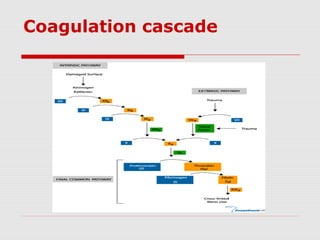
Coagulation cascade
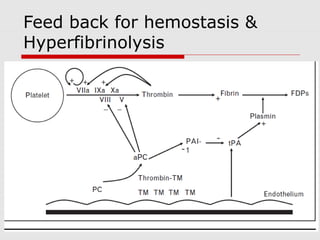
Feed back for hemostasis &
Hyperfibrinolysis
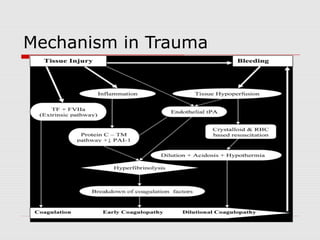
Mechanism in Trauma
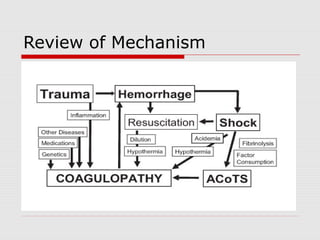
Review of Mechanism
Acute Coagulopathy of Trauma
Shock (ACoTS)
 Syn:ETIC(Early Trauma Induced Coagulopathy)
 Starts in the prehospital period.
 Shock&Hypoperfusion is the cause.
 Dilution,Hypothermia,Loss of coagulation
factors not significant at this stage.
 Thrombomodulin-ProteinC pathway is activated
in hypoperfusion.
 Hypercoagulable state and risk of thrombosis
due to Protein C depletion.
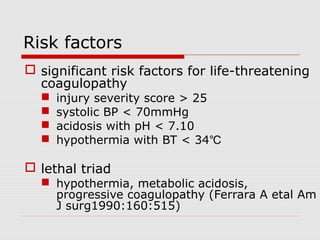
Risk factors
 significant risk factors for life-threatening
coagulopathy
 injury severity score > 25
 systolic BP < 70mmHg
 acidosis with pH < 7.10
 hypothermia with BT < 34℃
 lethal triad
 hypothermia, metabolic acidosis,
progressive coagulopathy (Ferrara A etal Am
J surg1990:160:515)
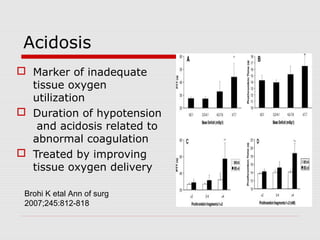
Acidosis
 Marker of inadequate
tissue oxygen
utilization
 Duration of hypotension
and acidosis related to
abnormal coagulation
 Treated by improving
tissue oxygen delivery
Brohi K etal Ann of surg
2007;245:812-818
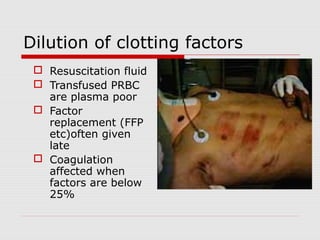
Dilution of clotting factors
 Resuscitation fluid
 Transfused PRBC
are plasma poor
 Factor
replacement (FFP
etc)often given
late
 Coagulation
affected when
factors are below
25%
Hypothermia
 Strong relationship between temperature
and survival.Less than 32°C-100%
mortality
 Mild Hypothermia-platelet function reduced
 Severe Hypothermia-Function of clotting
factors reduced
 PT,PTT performed routinely at 37°C do not
reflect the real state and misleading
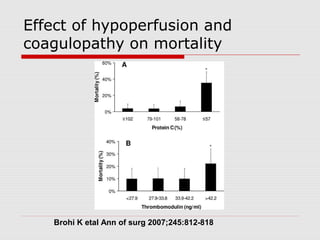
Effect of hypoperfusion and
coagulopathy on mortality
Brohi K etal Ann of surg 2007;245:812-818
Changes in fibrinogen synthesis and breakdown in pigs
after haemorrhage, hypothermia, and acidosis.
Fries D , Martini W Z Br. J. Anaesth. 2010;105:116-121
© The Author [2010]. Published by Oxford University Press on behalf of the British Journal of
Anaesthesia. All rights reserved. For Permissions, please email:
journals.permissions@oxfordjournal.org
Role of Fibrinogen
Loss and consumption of
clotting factors
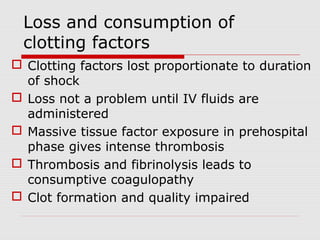
 Clotting factors lost proportionate to duration
of shock
 Loss not a problem until IV fluids are
administered
 Massive tissue factor exposure in prehospital
phase gives intense thrombosis
 Thrombosis and fibrinolysis leads to
consumptive coagulopathy
 Clot formation and quality impaired
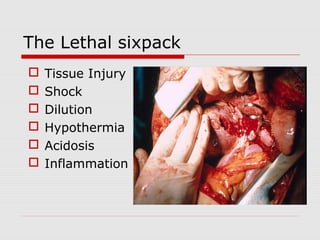
The Lethal sixpack
 Tissue Injury
 Shock
 Dilution
 Hypothermia
 Acidosis
 Inflammation
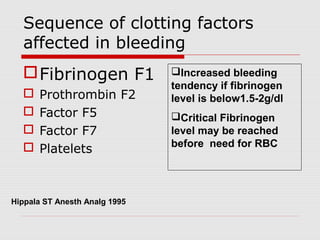
Sequence of clotting factors
affected in bleeding
Fibrinogen F1
 Prothrombin F2
 Factor F5
 Factor F7
 Platelets
Hippala ST Anesth Analg 1995
Increased bleeding
tendency if fibrinogen
level is below1.5-2g/dl
Critical Fibrinogen
level may be reached
before need for RBC
Updated European guidelines
 Target Hb of 7-9 g/dl. (Grade 1C).
 Ionised calcium levels be monitored during
massive transfusion. (Grade 1C) .If low CaCl2
 FFP in a dose of 10-15ml/Kg(Grade 1B)
 Platelets to maintain a platelet count above 50 ×
10 9
/l. (Grade 1C). Above 100 × 10 9
/l in multiple
trauma or TBI (Grade 2C) .Initially4-8 platelet
concentrates or one aphaeresis pack. (Grade 2C).
Crit Care 2010;14:R52
Updated European guidelines
 Single haematocrit measurements not a good marker
for bleeding. (Grade 1B).
 Serum lactate and base deficit are sensitive tests to
estimate and monitor the extent of bleeding and
shock. (Grade 1B).
 PT,aPTT,INR,Fibrinogen and platelets estimation
recommended((Grade 1C)
 Thromboelastometry recommended(Grade 2C)
 Maintain Normothermia
Crit Care 2010;14:R52
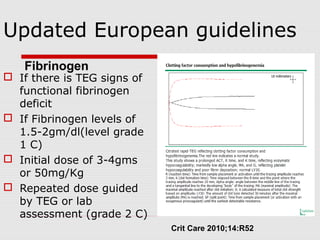
Updated European guidelines
 If there is TEG signs of
functional fibrinogen
deficit
 If Fibrinogen levels of
1.5-2gm/dl(level grade
1 C)
 Initial dose of 3-4gms
or 50mg/Kg
 Repeated dose guided
by TEG or lab
assessment (grade 2 C)
Crit Care 2010;14:R52
Fibrinogen
Updated European guidelines
 Antifibrinolytic agents be considered in the
bleeding trauma patient (Grade 2C). In
established hyperfibrinolysis(Grade 1B)
 Tranexamic acid 10-15 mg/kg followed by an
infusion of 1-5 mg/kg per hour or
 ε-aminocaproic acid 100-150 mg/kg followed by
15 mg/kg/h(guided by thromboelastometry)
 Aprotinine not recommended
 Caution in renal failure
Crit Care 2010;14:R52
Antifibrinolytics
Updated European guidelines
 Novoseven(rFVIIa) if major bleeding in blunt trauma
persists despite standard attempts to control
bleeding and best-practice use of blood components.
(Grade 2C).
 PCC for the emergency reversal of vitamin K-
dependent oral anticoagulants. (Grade 1B).
 Desmopressin (DDAVP) considered ONLY in
refractory microvascular bleeding if the patient has
been treated with platelet-inhibiting drugs such as
aspirin. (Grade 2C).
 Antithrombin concentrates not recommended.
(Grade 1C).
Crit Care 2010;14:R52
Fibrinogen
 Fibrinogen as low as 2gm found to reduce post
operative blood loss upto 32%(Karlsson
etal.Thromb.Hemost 2009)
 ROTEM guided fibrinogen administration reduced
transfusion rate and postoperative blood loss
 Fibrinogen improved dilutional coagulopathy
induced by HES by increasing clot firmness
 Fibrinogen&PCC avoided PRBC transfusion in
29%patients when compared to FFP(3%)
 Fibrinogen &PCC avoided platelet transfusion in
91%patients compared to FFP(56%).
Scochi etal crit care 2011;15R83
Prothrombin concentrate PCC
 Initially used for immediate reversal of warfarin
 PCC available in different concentration of
ingredients in different commercial products. only
factor 9 is standardised.
 PCC contain prothrombin&factors 7,9,10
 Prothrombin is the major thrombogenic agent in
PCC.
 Combination of PCC and Fibrinogen was found to
be most effective in liver injury.
Tranexamic acid
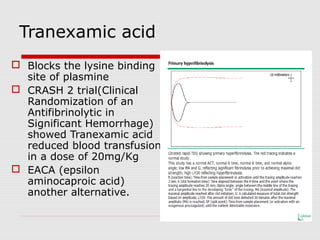
 Blocks the lysine binding
site of plasmine
 CRASH 2 trial(Clinical
Randomization of an
Antifibrinolytic in
Significant Hemorrhage)
showed Tranexamic acid
reduced blood transfusion
in a dose of 20mg/Kg
 EACA (epsilon
aminocaproic acid)
another alternative.
Fresh Frozen Plasma
 FFP:RBC close to 1:1 ratio beneficial in
massive transfusion.In nonmassive;1:2
optimum.
 No RCTs,only retrospective data.
 7 studies favoring high ratios(1:1) regarding
mortality reduction;2 studies against.
 Time for FFP thawing, a confounding factor.
 Severity of injury another confounding
factor(received more PRBC)
 Each unit of FFP independently associated with
2.1%higher risk of MOF and 2.5%higher risk of
ARDS.
Recombinant Factor 7 rFVIIa
(Novoseven)
 Not a first line treatment
 In blunt trauma ,when standard therapy fails.
 In diffuse small vessel coagulopathic bleeding
 Hct>24,Platelets>50000,fibrinogen 1.5-2gm/L
and
 Acidosis,hypothrmia&hypocalcemia corrected
 First dose200mcg/Kg after 8 units PRBC
 Second and Third dose100mcg/Kg ,1 and 8
hours later.
Summary
 TIC starts early in trauma (ACoTS)in the pre-
hospital period and caused by shock,
hypoperfusion & Inflammation
 Aggravated by hypothermia,Acidosis,Dilution&loss
of coagulation factors.
 PT,PTT,INR,Hct unreliable in assessment.
 Thromboelastometry highly recommended
 Fibrinogen /cryoprecipitate highly recommended.
 Prothrombin concentrates(PCC) to be considered.
 Antifibrinolytics to be considered.
 Novoseven for specific indications.

Trauma induced coagulopathy

  • 1.
    Trauma Induced Coagulopathy Dr.Abdul Gafoor. M.T MD (Anesthesiology) ICU - ALKHOR HOSPITAL
  • 2.
    Impact of TIC Incidence:25-35 % of Trauma cases.  Mortality:3-4 fold higher in TI  24 hour mortality - 8 times higher (Brohi K et al Current Opin Crit Care 13:680-685:2007)  Higher transfusion requirements.  Longer intensive care unit and hospital stays.  More days requiring mechanical ventilation.  Greater incidence of multiorgan dysfunction.
  • 3.
  • 4.
    Feed back forhemostasis & Hyperfibrinolysis
  • 5.
  • 6.
  • 7.
    Acute Coagulopathy ofTrauma Shock (ACoTS)  Syn:ETIC(Early Trauma Induced Coagulopathy)  Starts in the prehospital period.  Shock&Hypoperfusion is the cause.  Dilution,Hypothermia,Loss of coagulation factors not significant at this stage.  Thrombomodulin-ProteinC pathway is activated in hypoperfusion.  Hypercoagulable state and risk of thrombosis due to Protein C depletion.
  • 8.
    Risk factors  significantrisk factors for life-threatening coagulopathy  injury severity score > 25  systolic BP < 70mmHg  acidosis with pH < 7.10  hypothermia with BT < 34℃  lethal triad  hypothermia, metabolic acidosis, progressive coagulopathy (Ferrara A etal Am J surg1990:160:515)
  • 9.
    Acidosis  Marker ofinadequate tissue oxygen utilization  Duration of hypotension and acidosis related to abnormal coagulation  Treated by improving tissue oxygen delivery Brohi K etal Ann of surg 2007;245:812-818
  • 10.
    Dilution of clottingfactors  Resuscitation fluid  Transfused PRBC are plasma poor  Factor replacement (FFP etc)often given late  Coagulation affected when factors are below 25%
  • 11.
    Hypothermia  Strong relationshipbetween temperature and survival.Less than 32°C-100% mortality  Mild Hypothermia-platelet function reduced  Severe Hypothermia-Function of clotting factors reduced  PT,PTT performed routinely at 37°C do not reflect the real state and misleading
  • 12.
    Effect of hypoperfusionand coagulopathy on mortality Brohi K etal Ann of surg 2007;245:812-818
  • 13.
    Changes in fibrinogensynthesis and breakdown in pigs after haemorrhage, hypothermia, and acidosis. Fries D , Martini W Z Br. J. Anaesth. 2010;105:116-121 © The Author [2010]. Published by Oxford University Press on behalf of the British Journal of Anaesthesia. All rights reserved. For Permissions, please email: journals.permissions@oxfordjournal.org Role of Fibrinogen
  • 14.
    Loss and consumptionof clotting factors  Clotting factors lost proportionate to duration of shock  Loss not a problem until IV fluids are administered  Massive tissue factor exposure in prehospital phase gives intense thrombosis  Thrombosis and fibrinolysis leads to consumptive coagulopathy  Clot formation and quality impaired
  • 15.
    The Lethal sixpack Tissue Injury  Shock  Dilution  Hypothermia  Acidosis  Inflammation
  • 16.
    Sequence of clottingfactors affected in bleeding Fibrinogen F1  Prothrombin F2  Factor F5  Factor F7  Platelets Hippala ST Anesth Analg 1995 Increased bleeding tendency if fibrinogen level is below1.5-2g/dl Critical Fibrinogen level may be reached before need for RBC
  • 17.
    Updated European guidelines Target Hb of 7-9 g/dl. (Grade 1C).  Ionised calcium levels be monitored during massive transfusion. (Grade 1C) .If low CaCl2  FFP in a dose of 10-15ml/Kg(Grade 1B)  Platelets to maintain a platelet count above 50 × 10 9 /l. (Grade 1C). Above 100 × 10 9 /l in multiple trauma or TBI (Grade 2C) .Initially4-8 platelet concentrates or one aphaeresis pack. (Grade 2C). Crit Care 2010;14:R52
  • 18.
    Updated European guidelines Single haematocrit measurements not a good marker for bleeding. (Grade 1B).  Serum lactate and base deficit are sensitive tests to estimate and monitor the extent of bleeding and shock. (Grade 1B).  PT,aPTT,INR,Fibrinogen and platelets estimation recommended((Grade 1C)  Thromboelastometry recommended(Grade 2C)  Maintain Normothermia Crit Care 2010;14:R52
  • 19.
    Updated European guidelines If there is TEG signs of functional fibrinogen deficit  If Fibrinogen levels of 1.5-2gm/dl(level grade 1 C)  Initial dose of 3-4gms or 50mg/Kg  Repeated dose guided by TEG or lab assessment (grade 2 C) Crit Care 2010;14:R52 Fibrinogen
  • 20.
    Updated European guidelines Antifibrinolytic agents be considered in the bleeding trauma patient (Grade 2C). In established hyperfibrinolysis(Grade 1B)  Tranexamic acid 10-15 mg/kg followed by an infusion of 1-5 mg/kg per hour or  ε-aminocaproic acid 100-150 mg/kg followed by 15 mg/kg/h(guided by thromboelastometry)  Aprotinine not recommended  Caution in renal failure Crit Care 2010;14:R52 Antifibrinolytics
  • 21.
    Updated European guidelines Novoseven(rFVIIa) if major bleeding in blunt trauma persists despite standard attempts to control bleeding and best-practice use of blood components. (Grade 2C).  PCC for the emergency reversal of vitamin K- dependent oral anticoagulants. (Grade 1B).  Desmopressin (DDAVP) considered ONLY in refractory microvascular bleeding if the patient has been treated with platelet-inhibiting drugs such as aspirin. (Grade 2C).  Antithrombin concentrates not recommended. (Grade 1C). Crit Care 2010;14:R52
  • 22.
    Fibrinogen  Fibrinogen aslow as 2gm found to reduce post operative blood loss upto 32%(Karlsson etal.Thromb.Hemost 2009)  ROTEM guided fibrinogen administration reduced transfusion rate and postoperative blood loss  Fibrinogen improved dilutional coagulopathy induced by HES by increasing clot firmness  Fibrinogen&PCC avoided PRBC transfusion in 29%patients when compared to FFP(3%)  Fibrinogen &PCC avoided platelet transfusion in 91%patients compared to FFP(56%). Scochi etal crit care 2011;15R83
  • 23.
    Prothrombin concentrate PCC Initially used for immediate reversal of warfarin  PCC available in different concentration of ingredients in different commercial products. only factor 9 is standardised.  PCC contain prothrombin&factors 7,9,10  Prothrombin is the major thrombogenic agent in PCC.  Combination of PCC and Fibrinogen was found to be most effective in liver injury.
  • 24.
    Tranexamic acid  Blocksthe lysine binding site of plasmine  CRASH 2 trial(Clinical Randomization of an Antifibrinolytic in Significant Hemorrhage) showed Tranexamic acid reduced blood transfusion in a dose of 20mg/Kg  EACA (epsilon aminocaproic acid) another alternative.
  • 25.
    Fresh Frozen Plasma FFP:RBC close to 1:1 ratio beneficial in massive transfusion.In nonmassive;1:2 optimum.  No RCTs,only retrospective data.  7 studies favoring high ratios(1:1) regarding mortality reduction;2 studies against.  Time for FFP thawing, a confounding factor.  Severity of injury another confounding factor(received more PRBC)  Each unit of FFP independently associated with 2.1%higher risk of MOF and 2.5%higher risk of ARDS.
  • 26.
    Recombinant Factor 7rFVIIa (Novoseven)  Not a first line treatment  In blunt trauma ,when standard therapy fails.  In diffuse small vessel coagulopathic bleeding  Hct>24,Platelets>50000,fibrinogen 1.5-2gm/L and  Acidosis,hypothrmia&hypocalcemia corrected  First dose200mcg/Kg after 8 units PRBC  Second and Third dose100mcg/Kg ,1 and 8 hours later.
  • 27.
    Summary  TIC startsearly in trauma (ACoTS)in the pre- hospital period and caused by shock, hypoperfusion & Inflammation  Aggravated by hypothermia,Acidosis,Dilution&loss of coagulation factors.  PT,PTT,INR,Hct unreliable in assessment.  Thromboelastometry highly recommended  Fibrinogen /cryoprecipitate highly recommended.  Prothrombin concentrates(PCC) to be considered.  Antifibrinolytics to be considered.  Novoseven for specific indications.

Editor's Notes

  • #11 210 patients cohort
  • #15 Changes in fibrinogen synthesis and breakdown in pigs after haemorrhage, hypothermia, and acidosis. Data from Martini and colleagues17 and Martini and Holcomb.18 *P&lt;0.05 compared with control values.
  • #19 1C Strong recommendation, low-quality or very low-quality evidenceBenefits clearly outweigh risk and burdens, or vice versaObservational studies or case seriesStrong recommendation but may change when higher quality evidence becomes available . 2C Weak recommendation, Low-quality or very low-quality evidenceUncertainty in the estimates of benefits, risks, and burden; benefits, risk and burden may be closely balancedObservational studies or case seriesVery weak recommendation; other alternatives may be equally reasonable
  • #21 Prolonged ACT,R time,K time,(reduced enzymatic hypocoagulability) low alpha angle,MA and G(platelet hypocoagulability and poor fibrin deposition
  • #24 %(Karlsson etal.Thromb.Hemost 2009)
  • #25 when compared to fibrinogen and rF2,rF3 in a porcine model(JTH2011) to control blood loss after liver injury.
  • #26 When compared with FFP,CF concentrates significantly reduced transfusion requirement in early(first6hrs)and late (after 24hrs)in trauma victims(Nienhaber etal Injury 2011
  • #28 blunt trauma who survived for more than 48 hours, assigned to receive rFVIIa 200 μg/kg, after they had received eight units of RBCs, and a second and third dose of 100 μg/mg one and three hours later; had a reduction in RBC transfusion requirements and the need for massive transfusions (&gt;20 units of RBCs), compared with placebo. Israeli guidelines based on findings from a case series of 36 patients who received rFVIIa on a compassionate-use basis in Israel [ 313 ] propose an initial dose of 120 μg/kg (between 100 and 140 μg/kg) and (if required) a second and third dose.